How Did Pieper's Hybrid System Work in 1900?
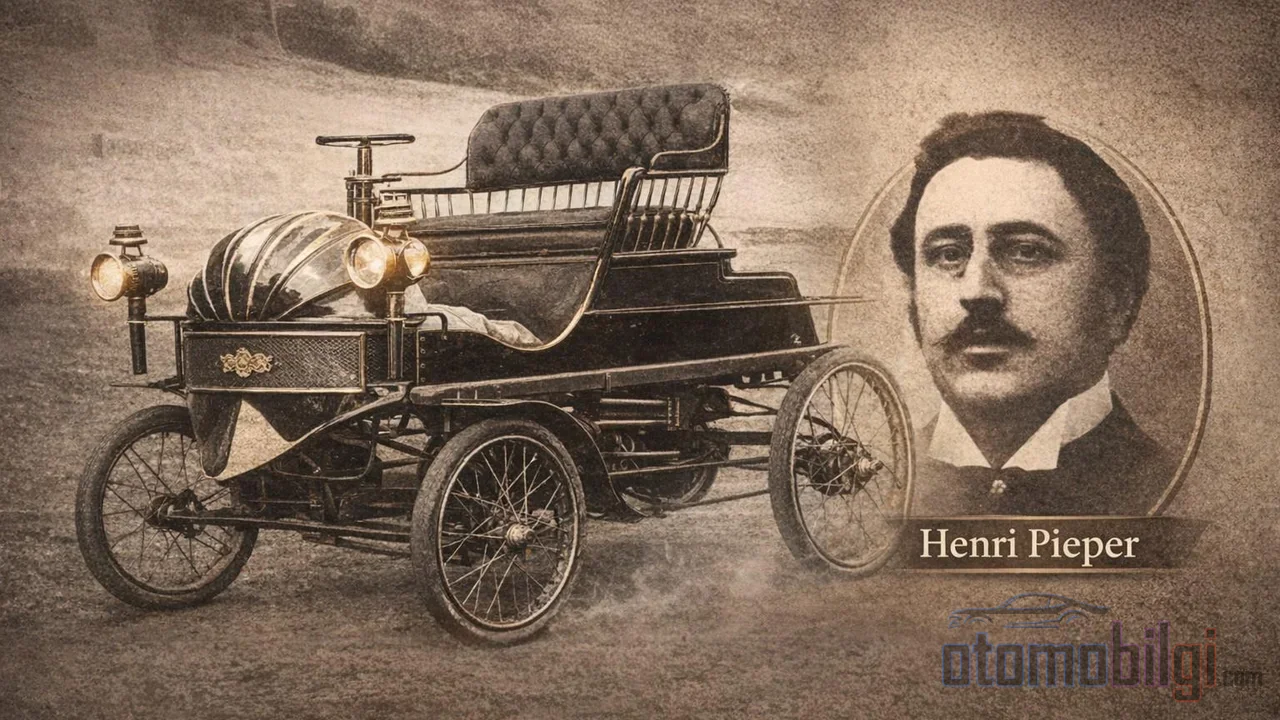
In 1900, two electric drive experiments were exhibited in the same fair halls in Paris, and one of the most intriguing parallels in automotive history took place. One was the Lohner-Porsche of 24-year-old Ferdinand Porsche; everyone still knows its name today. The other was the vehicle of the Pieper brothers from Liège, which combined a gasoline engine and an electric motor on the same chassis; today almost no one speaks of it. Yet when the patent records are examined, this arrangement - in which an internal combustion engine connected directly to the wheels operated with electric assistance - is remarkably close to the logic of modern hybrid powertrains.
So how did Pieper's 1900 system actually work, how did it differ from Porsche's famous solution, and why was it buried on history's dusty shelves? On this page, we step through the technology of the Pieper hybrid using archival records and patent documents.
Who Were the Pieper Brothers and What Did They Present at the 1900 Paris Fair?
Henri and Nicolas Pieper were brothers who manufactured in the city of Liège, Belgium. They developed small gasoline automobiles in 1898 and an electric automobile in 1899, and from that same year they carried all three drive types - gasoline, electric, and a combination of the two - in their sales lists. In the market of that era, this variety was in itself an act of engineering courage.
The hybrid vehicle was exhibited at the Paris Salon during the 1899-1900 period. One of the two hybrids exhibited at the 1899 salon belonged to a Belgian firm with a parallel internal combustion and electric drive arrangement; the chronology and architecture point to this vehicle being the work of the Pieper brothers. Pieper vehicles were also equipped with a well-functioning hybrid using a De Dion-Bouton engine, and achieved a considerable number of sales across a range extending from custom automobiles to panel vans.
Highlights
- The Pieper brothers' hybrid vehicle was exhibited at the Paris Salon during the 1899-1900 period.
- The system operated with a parallel hybrid architecture: engine torque and electric power went to the wheels together.
- The chassis contained a small air-cooled gasoline engine, an electric motor, and lead-acid batteries.
- Henri Pieper filed a US patent application for the hybrid powertrain in 1905.
- The hybrid tradition of the Pieper company continued in the Auto-Mixte brand founded by Henry Pescatore.
How the System Worked: Parallel Hybrid Architecture
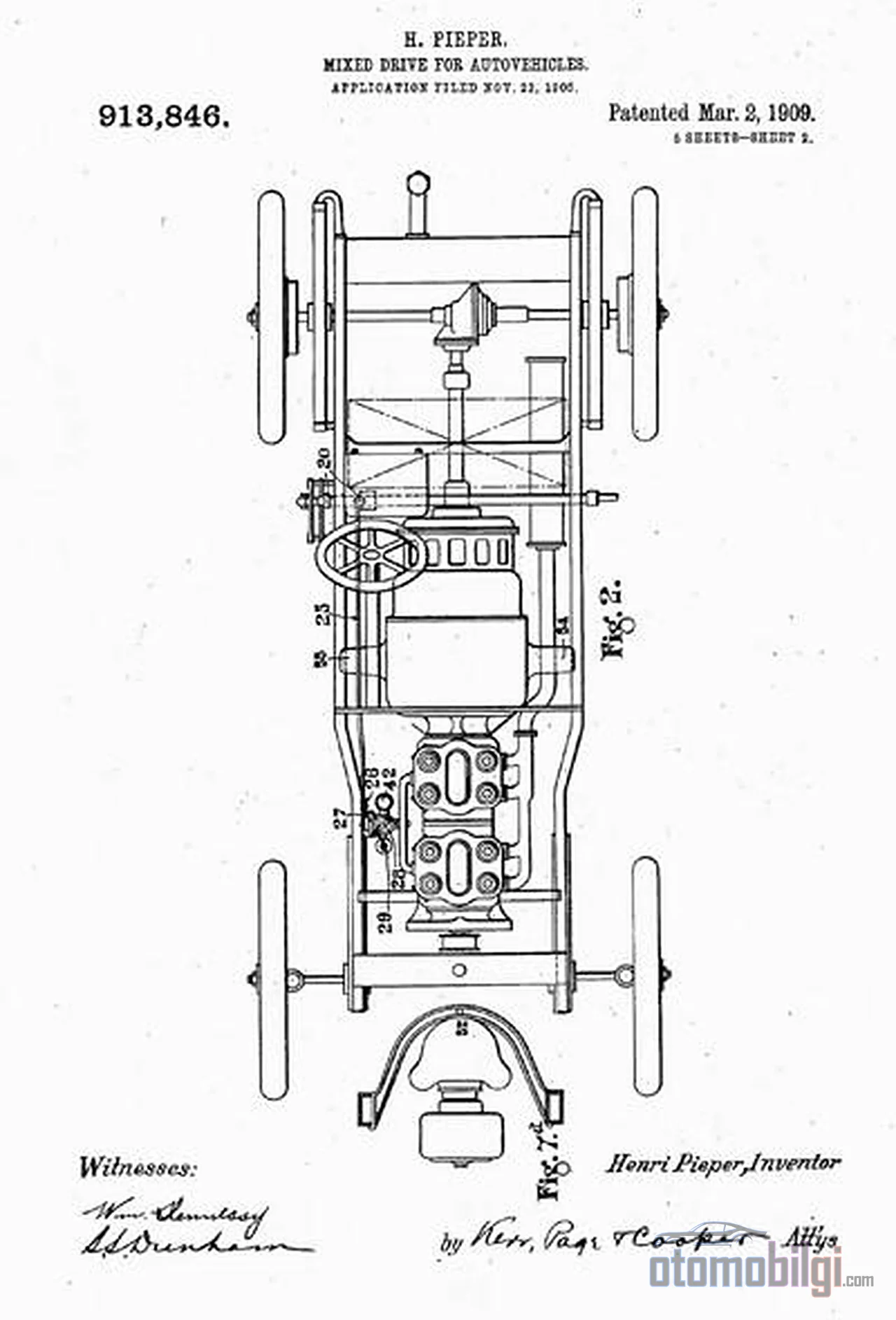
The technically critical point is this: Although Pieper's arrangement is occasionally described in different ways in popular accounts, the patent text is an explicit definition of a parallel hybrid. That is, the output of the gasoline engine was mechanically connected to the wheels; the electric motor, as a separate power source, contributed to the same drive line. Engine torque and electric power combined to move the vehicle.
The chassis components consisted of three main parts: a small, air-cooled gasoline engine; an electric motor and lead-acid batteries. Some accounts state that the electric motor feeds the battery pack and that the battery in turn provides traction support to the gasoline engine - this is consistent with an arrangement in which the generator charges the battery and the electric motor shares the load. The core idea was simple but pioneering: while the gasoline engine ran continuously, electric propulsion kicked in at moments when torque demand increased.
What Was in the 1905 Patent?
Henri Pieper filed a US patent application in 1905 for a hybrid engine-electric motor powertrain. In this application, the engine and generator were combined into a single unit, presented to the driver with a single-lever control system. It was a significant simplification for the engineering of the era: instead of separate controls for managing two power sources, it relied on the logic of a single lever. Another striking point is the motivation: Pieper's aim was not to improve fuel economy or reduce exhaust emissions. The fact that these concepts were not even on the agenda in the 1900s shows that the design's real goal was practicality and traction reliability.
Comparison with the Lohner-Porsche: Series or Parallel?
The best reference for understanding Pieper's arrangement is the Lohner-Porsche, the most famous hybrid of those same years. The Lohner-Porsche electric vehicle, introduced on April 14, 1900 in the Electricity Palace of the Paris Exposition, reached speeds of 32 km/h with hub motors delivering 2.5 PS at each wheel, and had a range of approximately 50 km with its lead battery. Battery problems and the almost complete absence of charging infrastructure pushed Porsche one step further: the Semper Vivus, in which internal combustion engines generated electricity only.
The Semper Vivus drove two generators with two water-cooled 3.5 PS single-cylinder De Dion-Bouton engines; each engine operated independently, producing 20 amperes at 90 volts. Electricity flowed first to the hub motors, with the surplus going to the batteries; by reversing the generators, they could also be used as starter motors. The vehicle weighed approximately 1.7 tons and could reach 35 km/h. The critical technical distinction here is this: The combustion engines had no mechanical connection to the wheels whatsoever. For this reason, the Semper Vivus is a series hybrid - the combustion engine was merely an electricity generation unit turning the generator.
| Feature | Pieper (1899-1900) | Lohner-Porsche Semper Vivus (1900) |
|---|---|---|
| Architecture | Parallel hybrid | Series hybrid |
| Role of the gasoline engine | Direct torque to the wheels | Only driving the generator |
| Electric propulsion | Support during traction | Wheel hub motors, main propulsion |
| Battery | Lead-acid | Lead-acid (small, serving as a buffer) |
| Free control | Single-lever control (1905 patent) | Generators reversible as starter motors |
So the two hybrids of the 1900 Paris Exposition actually represented two different philosophies. Porsche was showcasing the birth of the series architecture centered on electrical power flow; Pieper was patenting the parallel concept, keeping the gasoline engine in the driveline and supporting it with electricity. Both logics live on in today's cars: the series hybrid layout forms the basis of most contemporary railway locomotives, while the power-split logic that provides multiple paths of power to the wheels is the modern descendant of the parallel hybrid. The idea in Pieper's patent - the combination of mechanical torque with electric assistance - is one of the earliest examples conceptually closest to the operating principle of today's series-parallel hybrids.
Auto-Mixte: Continuing the Pieper Tradition
The Pieper company was later sold to Henry Pescatore. Pescatore built the Auto-Mixte brand on this technical heritage and produced a wide range of industrial vehicles, from fire-protected vehicles to hybrid-powered buses. This system, derived from the Pieper patent, shows that the hybrid idea was no longer just a fairground experiment; it had turned into a commercial product family. A detail open to confusion also arises here: The Auto-Mixte name is easily confused with the Lohner-Porsche Mixte, Porsche's series-production hybrid model, whereas the two are products of different companies and different architectures.
On the Lohner-Porsche side, however, the story quickly died out. The Mixte, ready for series production in 1901, used a 5.5-liter, 25 hp four-cylinder Austrian Daimler engine as a generator; the buyer of the first five vehicles was Emil Jellinek. Yet between 1900 and 1905, only 11 hybrids could be sold. Prices ranged between 14,400 and 34,028 Kronen - almost twice those of conventional vehicles - and the maintenance costs of the complex system kept sales far below expectations.
Why Was Pieper Forgotten?
The reasons for Pieper's disappearance from history are not technical, but historical. First, there was no strong brand lineage to tell the story: The Lohner-Porsche name lived on for a century, nourished by Ferdinand Porsche's later career; indeed, Boeing and NASA benefited from this design while developing the Apollo Lunar Vehicle. Pieper, on the other hand, lost its brand identity with the sale of the company, and Auto-Mixte was not long-lived either.
Second, market conditions had turned against hybrids. Henry Ford's dominance of the industry and the cost advantage of the mass-produced gasoline automobile kept hybrid efforts off the agenda for decades. In 1897 in Philadelphia, Justus Entz's car, which supported the internal combustion engine with an electric motor, and in 1905 the American engineer H. Piper's development of the concept in 1905, and even the hybrids that could silently proceed on battery at low speeds in 1916, the picture is clear: The idea surfaced repeatedly, but the economic ground was never consolidated.
Short Answer: How Did Pieper's System Work in 1900?
In summary: Pieper's 1900 vehicle was a parallel hybrid in which a small gasoline engine mechanically connected to the wheels was supported by an electric motor and lead-acid batteries; engine torque and electric power combined to move the vehicle. The generator setup charged the battery, and the electric motor kicked in during traction. The goal was not fuel savings, but making the drive reliable and practical. This logic differed from Porsche's series hybrid, which completely separated the internal combustion engine from the drivetrain, but was every bit as close to today's power-split thinking.
The continuation of that lineage only came at the end of the century: Toyota introduced the Prius in Japan in December 1997 as the world's first mass-produced hybrid car, and brought it to the global market in 2000. The Prius was not the first hybrid; it was simply the most durable and continuously evolving one. Its family tree stretches back to those two early-1900s attempts - one with electrical, the other with mechanical power flow. Pieper's name has not yet fully taken the place it deserves in that family tree; but the patent records are still there.
Sources
- We Hail Hybrids' Hundredth Birthday... – Green Car Reports
- Lohner-Porsche Mixte Hybrid (Pieper figure) – ResearchGate
- The first hybrid car comes from Spain – Prestige Electric Car
- Ahead of his time: Electric wheel-hub motor from 1900 – Porsche Newsroom
- Prof. Ferdinand Porsche created the first functional hybrid car – Porsche Park
- Lohner–Porsche – Wikipedia
- How the Prius Traces Its Lineage to a 1900 Car – The New York Times
- The History of the Electric Car – energy.gov