The Forgotten Racing Story of La Toujours Contente
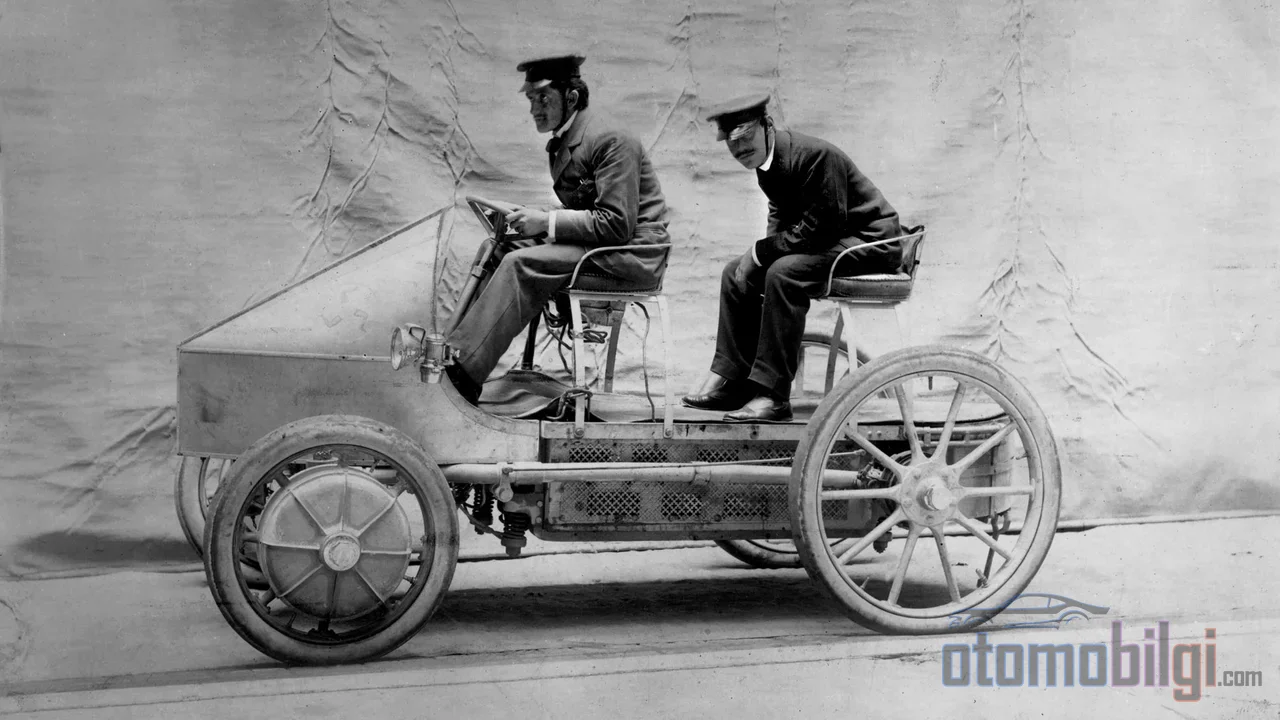
In England of November 1900, the coachbuilder E.W. Hart arrived with three vehicles at the starting line of an electric vehicle endurance trial held in Chislehurst. One of them was, even by the standards of the day, an unusual engineering experiment: with a separate electric motor placed in each of the four wheels, weighing over four tons and equipped with an 80-volt bank of lead-acid batteries, it bore the signature of Ferdinand Porsche: La Toujours Contente. And at the wheel sat the design itself. The race would end after barely the 34th mile due to tire failures; but this elimination was also the record of the first-ever competitive test of the hybrid automobile in history.
This page focuses on a shadowed member of the Lohner-Porsche family, usually narrated through its Moon vehicle connection and the general pioneering story - on the technical identity of this car, built to E.W. Hart's special order, and on its short but instructive adventure at Chislehurst.
E.W. Hart's Order: Hybrid and Four-Wheel Drive in a Single Instruction
Hart was a well-known coachbuilder in England, and his request was clear when he placed the order: the vehicle had to run on both gasoline and electricity, carry four passengers, and be four-wheel drive. In other words, a customer from the year 1900 was requesting, in a single order, a combination of hybrid and four-wheel drive that is still considered premium-segment technology even in today's marketing language. The young Ferdinand Porsche, working in Jacob Lohner's workshops in Vienna, met this request with the hub motor concept.
Porsche had previously gained electrical engineering experience at Béla Egger & Co (later Brown Boveri, today's ABB), joined the Lohner factory at 23, and had developed his own wheel hub motor based on Wellington Adams' concept. Four of these motors were used in Hart's vehicle, one in the hub of each wheel.
Highlights
- The La Toujours Contente was a special Lohner-Porsche with four hub motors, a hybrid-4WD, built to E.W. It was a special Lohner-Porsche with four hub motors and hybrid-4WD, built to Hart's order.
- Battery: A 44-cell, 80-volt lead-acid pack, weighing approximately 1.8 tons.
- Total output of 56 horsepower; vehicle weight over four tons.
- Its price was 15,000 Austrian crowns; extraordinarily expensive by the standards of the day.
- It was eliminated at the 34th mile of the Chislehurst endurance trial due to tire failures.
The Vehicle's Technical Identity: La Toujours Contente in Numbers
From an engineering standpoint, what is striking about this vehicle is that the power transmission chain has almost completely disappeared. In the hub motor, the rotor was connected directly to the wheel; there was no gearbox, belt, chain, or clutch. The system operated at approximately 85% efficiency, a notable advantage over the contemporary gasoline drivetrains struggling with belt and clutch losses. Per hub motor, a continuous 2.5-3.5 hp could be produced, with a short-term peak power of 7 hp (5.2 kW).
| Specification | Value |
|---|---|
| Battery | 44-cell, 80 V lead-acid, ~270 Ah |
| Battery weight | Approximately 1.8 tons |
| Electric motors | 4 hub motors, ~580 kg total |
| Total output | 56 hp, four-speed gearbox |
| Vehicle weight | Over four tons (with Continental pneumatics) |
| Price | 15,000 Austrian crowns |
The battery pack was treated as an engineering challenge in its own right: lead-acid cells were fragile, and to protect the pack from road shocks on its 1.8-ton mass, it was placed in a special enclosure with sprung suspension. The four electric motors had a combined weight of 1,280 pounds, or roughly 580 kilograms. In total, the vehicle equipped with Continental pneumatic tires weighed four tons. This mass already foreshadows the Chislehurst fate we are about to tell.
On the hybrid side, the design logic was progressive: instead of using the battery as the sole power source, an internal combustion engine fed a generator, and the generator powered the hub motors. This was exactly the architecture we today call a series hybrid. The Lohner-Porsche is regarded with this structure as the first hybrid electric vehicle and the first commercial hub-motor automobile. Porsche personally delivered the vehicle to Hart in Luton; in some records, the vehicle is also referred to as the first four-wheel-drive automobile of its kind.
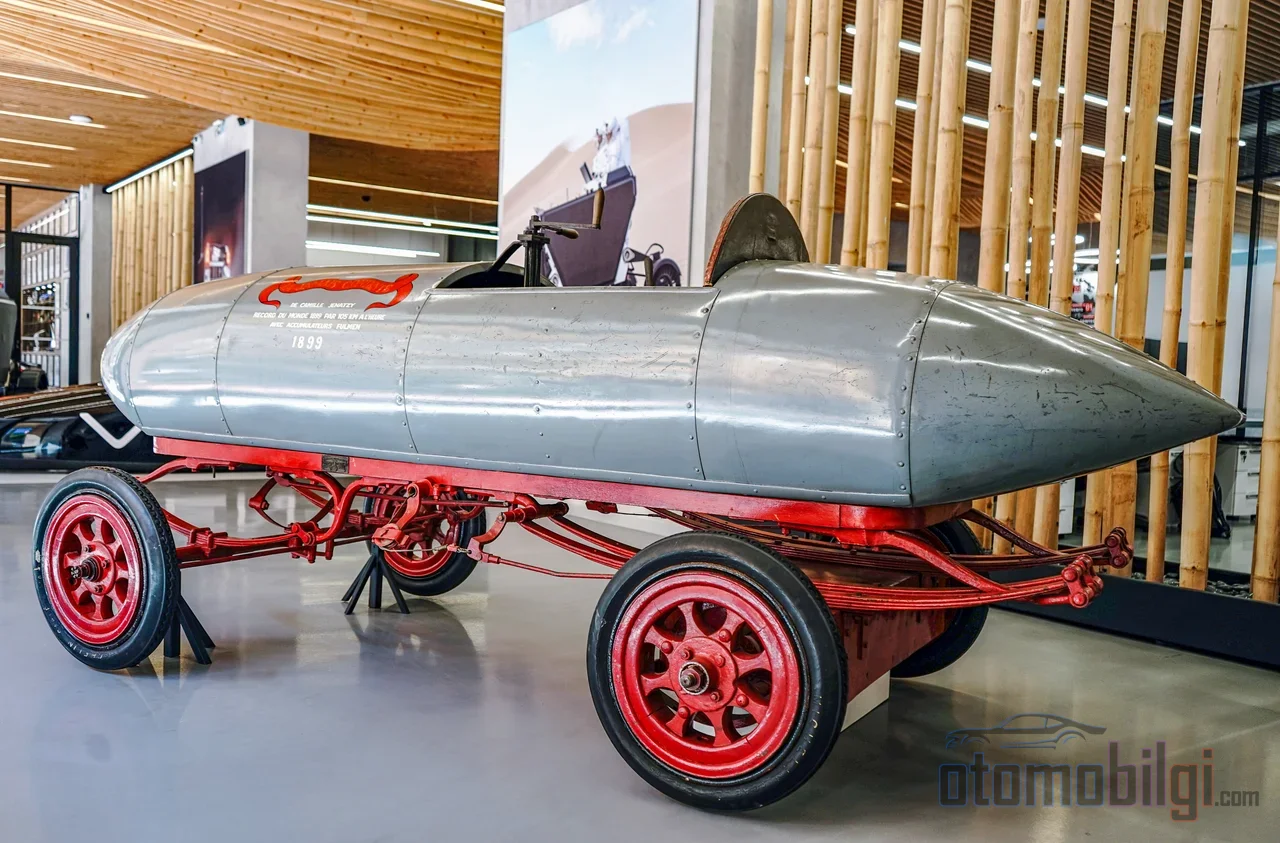
The vehicle's name, meanwhile, was the product of a joke rather than engineering: it was a pun referring to speed-record holder Camille Jenatzy's electric vehicle La Jamais Contente, meaning "the never satisfied." The name, meaning "always satisfied," interestingly carried the owner's sense of humor down to the present day. The price tag also went down in history: 15,000 Austrian crowns. One measure of just how steep this figure was: after liking the vehicle, Hart bought a second, simpler example for 7,950 crowns.
On Stage at the Paris Exhibition: December 1900
The vehicle was exhibited in Paris in December 1900. The Lohner-Porsche electric vehicle had attracted great interest at the 1900 Paris World's Fair earlier that year, after which the four-wheel-drive version was developed. Porsche's official narrative also begins here: Ferdinand Porsche presented the first hybrid automobile as a prototype in 1900; this coincides with exactly 110 years before the company's modern hybrid models. In the Mixtes, known as series hybrid racing vehicles, a gasoline engine fed four electric motors, one on each wheel.
The Chislehurst Endurance Trial: The Hybrid's First Racing Test
In November 1900, the Automobile Club of Great Britain and Ireland (today's Royal Automobile Club) organized an electric vehicle endurance trial at Chislehurst; the event ran from 6 to 9 November. Of the eleven entrants, the four-wheel-drive Lohner-Porsche was technically the most ambitious vehicle. Hart had arrived at the starting line with three vehicles, and the Lohner-Porsche was one of them.
Conditions and Results
The course was not merciful. There was mud on the ground measuring several centimeters thick; rain leaked through the roofs of the shelters, and in the shelters without doors, vehicles and officials were exposed to the full force of wind and rain every night. Some electric vehicles managed only 7 miles on the bumpy and muddy course.
The vehicle named Powerful, built by Louis-Krieger, won the trial: thanks to its lighter body and larger-diameter wheels, it completed 59 miles at an average speed of about 10 mph on the first lap. La Toujours Contente, despite Ferdinand Porsche being at the wheel, dropped out of the race with tire failures at mile 34. After the grueling conditions, Porsche coming down with a heavy cold was also among the factors that prevented the vehicles from continuing. The main engineering lesson we will mention, however, lies hidden in the reason for the elimination.
Why Did the Tires Give Up?
The answer lies in mass balance. The vehicle's battery alone weighed 1.8 tons, its motors about 580 kilograms, with a total weight of over four tons. The pneumatic tire technology of 1900 was not ready to carry this load, especially on a muddy and bumpy course. The winning Powerful's solution was in the opposite direction: lightness and large-diameter wheels. As one of the first racing tests of hybrid and electric technology, Chislehurst clearly exposed the problems of tire durability and vehicle weight. This was one of the first lessons of hybrid history: efficient power delivery is not enough to win when it comes with the mass penalty.
An honest historical note needs to be made here: the records do not clearly distinguish whether the vehicle was a hybrid version or a four-motor electric racing car running on battery power. Although Hart's order clearly specified the hybrid configuration, some accounts describe the Chislehurst vehicle as fully electric, with the hybrid conversion as a later stage. This ambiguity is a natural consequence of the classes not yet being clearly defined in early-period prototypes.
After Chislehurst: The Story Did Not End with Elimination
For Porsche, Chislehurst was not a turning point but a starting point. In 1901 he won the Exelberg Rally with a similar vehicle; in 1902 he won the same rally again with the hybrid Lohner-Porsche Mixte. Austrian speed records reached 37 mph, that is, about 60 km/h. In 1905 Porsche received the Potting Prize as Austria's most distinguished automotive engineer, and in 1906 he moved to Austro-Daimler as chief designer.
On the commercial side, more than 300 Lohner-Porsches were sold by 1906: rear-wheel-drive double-decker buses for Berlin, front-wheel-drive fire trucks for the Vienna-Frankfurt-London route, and imperial vehicles. The technology being too expensive for the public was the main reason Lohner steered this architecture toward commercial vehicles instead of passenger cars. The more distant consequences are striking: Boeing and NASA examined the Lohner-Porsche design while developing the design of the Apollo program's Lunar Roving Vehicle; the series hybrid concept today forms the basis of many modern railway locomotives.
What Is La Toujours Contente's Place in Hybrid History?
The short and clear answer is this: La Toujours Contente was the first racing and endurance experience of the hybrid car; despite its four-ton weight and its elimination due to tire failures at 34 miles, with its 80-volt lead-acid battery, four hub motors, and gasoline-electric architecture, it put the core concepts of modern hybrids and all-wheel-drive electric powertrains on the field in 1900.
To broaden the perspective, this vehicle was a starting point, but not the only step. The Woods Interurban hybrid was introduced in 1905 and is known as the second hybrid produced. Then came a long silence; the cost issue shelved the hybrid idea for decades. The modern wave only arrived with the Toyota Prius, in 1997; Honda became the first manufacturer to present a hybrid internationally, and the two-seat liftback coupé Honda Insight hit the roads at the end of 1999. On the battery side, the evolution from lead-acid to NiMH, and from there to lithium-ion, improved energy density step by step; GM launched the Chevrolet Volt in 2010 as the first commercial plug-in hybrid, and production plug-in hybrids became widespread in 2012.
The fact that the first link of this chain was a four-ton vehicle with a flat tire in the mud of Chislehurst is one of the beautiful ironies of engineering history. La Toujours Contente lost the race; but the architecture it was built on became the starting point of a line extending, a century later, from locomotives to the lunar surface, and from there to today's hybrid and electric passenger vehicles. The name "always content" was never true for the vehicle's tires; but for the future of its idea, it was an apt prophecy.