How Do Crash Test Dummies Mimic the Human Body?
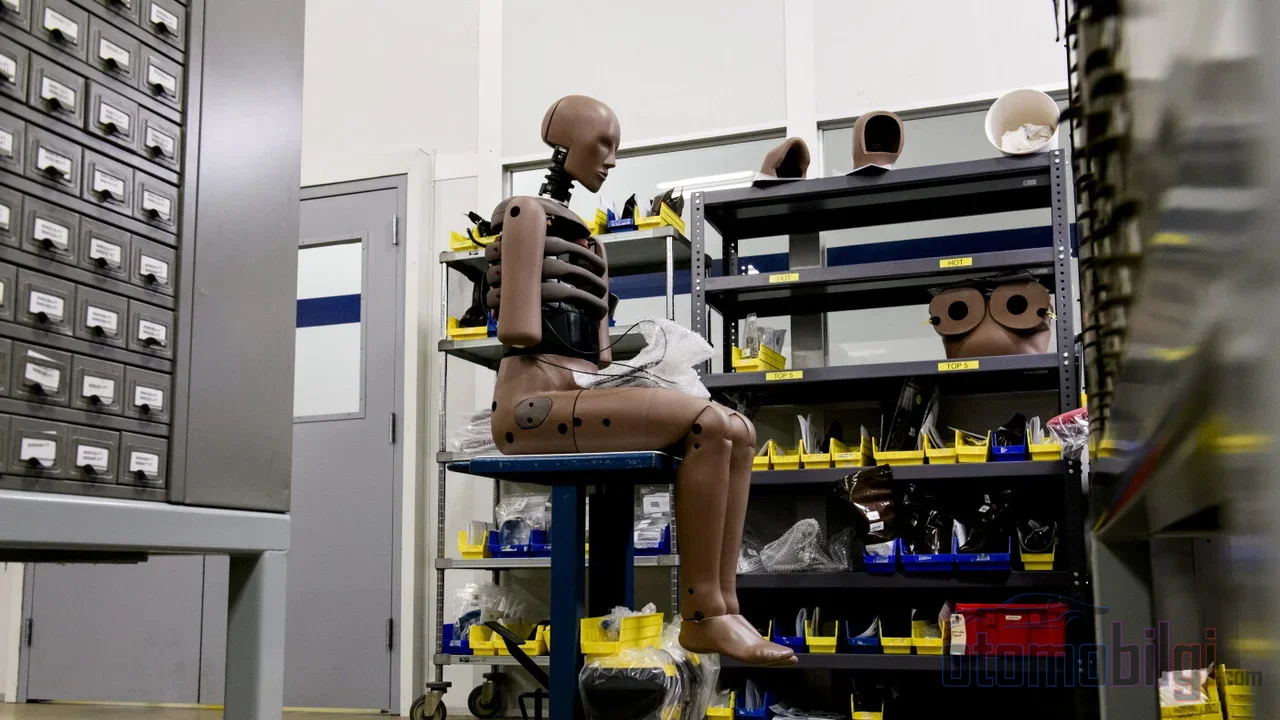
What comes to mind when you see a five-star safety rating? Most people think of airbags and seatbelts first. But what really earns that rating is a plastic man whose ribcage hasn't been driven into after the crash: the crash test dummy. What's more, not every dummy is the same - some come with a spine of 24 vertebrae, others with more than 150 data channels. So how do these bodies of metal and rubber manage to mimic a real human's behavior in a collision? Let's dig deep into those invisible heroes behind the stars.
From Cadavers to Sierra Sam: Why Do Dummies Exist?
Today, crash test dummies seem like they've always been around, but the history starts from a much more gruesome place. In the pre-dummy era, car companies conducted their tests with cadavers, animals, and even live volunteers; and the first serious biomechanical data collection efforts were launched by a university team. Of course, these methods could be neither ethical nor repeatable - you can't slam a victim into a wall at the same speed a second time.
The solution arrived in 1949: Sierra Sam, produced for aircraft ejection seat tests. An interesting detail is that Sam represented a large man - he was sized after the largest 95th percentile of the male population. Then in 1971, General Motors developed Hybrid I by combining the best features of Sierra Stan, followed by Hybrid II in 1972. And in 1973, the real star was born, built upon the ATD 502 dummy produced under a contract with a public safety agency: Hybrid III.
What Does Biofidelity Mean? How Similar Is a Dummy to a Human?
Let's simplify that fancy word the engineers use: biofidelity expresses how closely a part of the dummy approaches the response of real human tissue in a collision. For example, a skull compresses in a certain way upon impact, and a neck bends at a certain speed. A good dummy brings these responses into the laboratory - but it isn't perfect. In fact, even in the official product specifications of the most common frontal dummy, it's said that biofidelity remains marginal; meaning this is a technology that is continuously being improved.
When you look inside the Hybrid III, the real engineering show emerges. Its head is designed based on biomechanical data. Its neck is a layered structure that mimics the human front-to-back bending response. Its chest is a spring-loaded torso capable of measuring the amount of compression. Even its knees and ankles are padded with dampers that reduce mechanical noise. Its joints have constant torque - meaning when you lift its arm, it moves with a certain resistance, just like a real joint. Thanks to its slanted lumbar spine and two spinal cables, its sitting posture is just like ours: slightly slouched, in a real driver's position.
The Dummy Family Album: Why Isn't Everyone the Same Body Type?
Here's the part most people never think about: two different dummies are tested in the same vehicle, because body size changes the injury scenario. A smaller person sits exactly 21.5 cm closer to the steering wheel than a medium-sized man - same airbag, same belt, but a completely different geometry. That's why crash test dummies are produced based on a percentile logic: The 5th percentile female represents the smallest segment, the 95th percentile male the largest.
| Dummy | Role | Dimensions |
|---|---|---|
| Hybrid III 50% male | Frontal impact, the most common model in the world | 175 cm, approximately 77 kg |
| Hybrid III 95% male | Largest body segment, frontal | 188 cm, 100 kg |
| Hybrid III 5% female | Small body segment, frontal | 152 cm, 50 kg |
| THOR-50M | Advanced frontal, human-like spine and pelvis | 150+ data channels |
| WorldSID / SID-IIs | Side impact, medium-sized male / 5% female | About 50 sensors in the 5% female model |
| BioRID II | Rear impact and whiplash | 24-segment spine |
| 3, 6 and 10-year-old child models | Child protection | Classes of 15 kg and above |
Highlights
- The first dummy, Sierra Sam, was built in 1949 for aircraft seat testing.
- The most common model is the Hybrid III 50% male: 175 cm, 77 kg, 78 data channels.
- The THOR-50M dummy can carry more than 150 measurement channels.
- BioRID's spine consists of 24 vertebrae and curves in an S shape.
- The 5% female dummy sits 21.5 cm closer to the steering wheel than the 95% male.
How Does Sensor Data Turn Into an Injury Score?
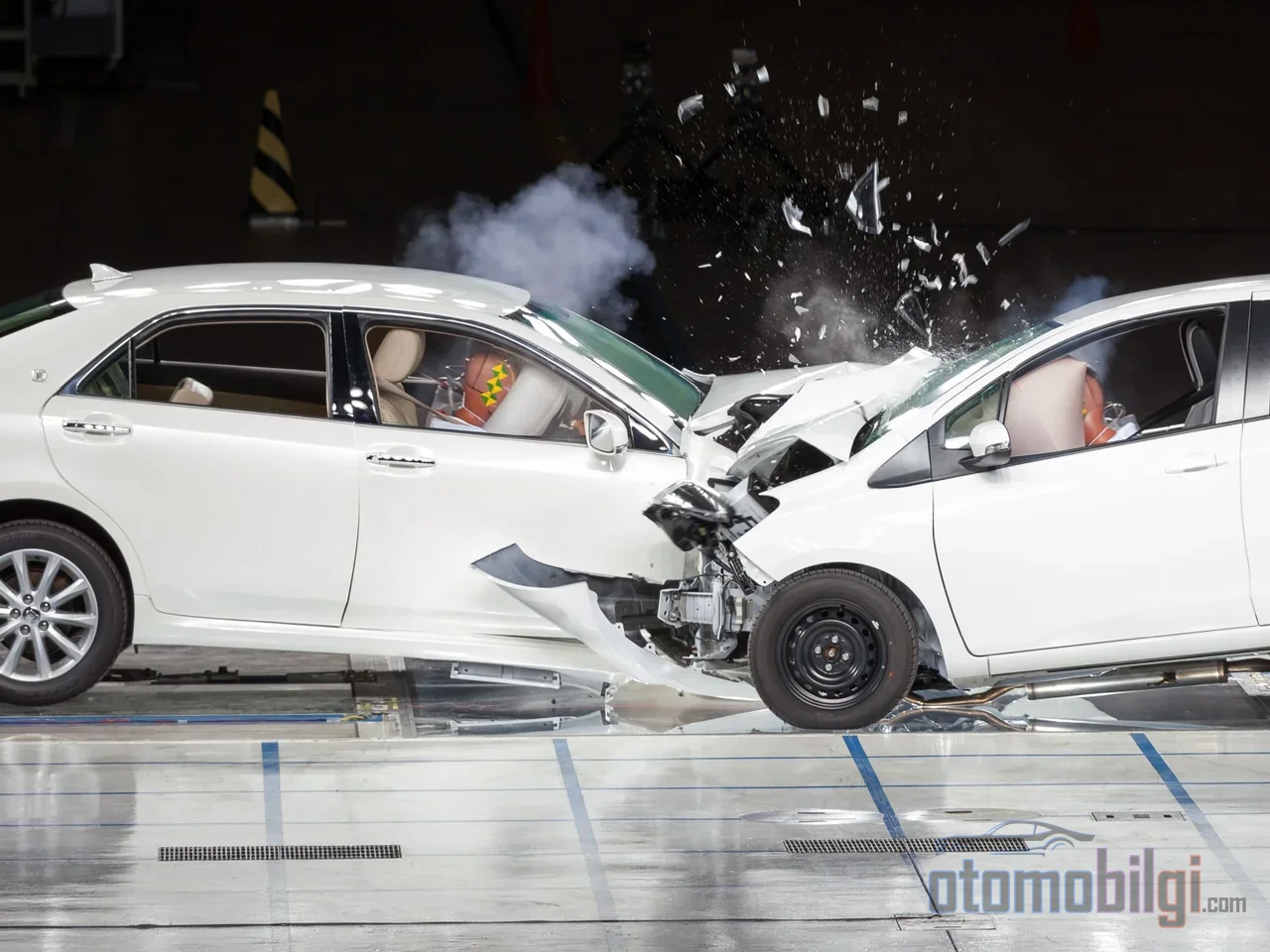
A crash test lasts milliseconds, but in those milliseconds the dummy pumps out data from everywhere. It has three-axis accelerometers on its head, chest and pelvis; force-moment load cells line the neck, spine, femur and tibia. How much the chest compresses (deflection), how much the tibia displaces, how much the head rotates - all recorded channel by channel. In a Hybrid III 50% male, the number of these channels reaches 78; in the next-generation THOR, the figure exceeds 150. Just imagine: a single plastic man produces 150 different numbers in one crash.
From numbers to scores: HIC and friends
Raw data alone delivers no verdict; there are criteria that interpret it. The most famous is HIC (Head Injury Criterion): the change of head acceleration over time reduces the risk of head injury to a single number. For the chest, deflection and deflection velocity are the basis - how much the airbag or belt deforms the chest is read from this. But the interesting thing is that the same chest deflection measurement is interpreted differently depending on the loading type: the dangerous deflection threshold for airbag loading is not the same as the threshold for belt loading. So the sensor says one thing, and the engineer decides based on context.
Euro NCAP's stars are tied to exactly this point: the organization uses this sensor data from advanced dummies to score how well adult and child protection works. So when a car gets 5 stars, it actually means that the hundreds of measurements inside those plastic bodies stayed below certain limits.
A Different Beast in Rear Impacts: BioRID and Whiplash
Think about the seat you are sitting in right now and imagine someone rear-ending you. Your head snaps backward first, then forward - that annoying neck injury called whiplash is born exactly here. The problem is this: Hybrid III's spine is too stiff for this motion. BioRID, developed specifically for rear impacts, is built on the opposite philosophy: it has a segmented spine made up of 24 vertebrae and curves into an S shape during a crash, just like the human spine. Its design was validated against volunteer and cadaver test results; very high repeatability was achieved in sled tests.
Side impacts have their own dummies too: WorldSID is a mid-size male side-impact dummy developed through an international project involving industry representatives from the US, Europe, and Japan. The small female prototype is equipped with around 50 sensors; the load sensor on the pubis in the hip area allows direct monitoring of one of the most critical anatomical regions in a side impact. In other words, every crash direction has its own dummy - a single plastic man cannot do it all.
The Big Criticism: Are Women and Children Really Represented?
This is the most controversial part of the matter, and to be honest, it has still not been fully resolved. The current female dummy represents the 5th percentile - meaning not the average woman, but the smallest 5 percent of the population. Moreover, this dummy is also based on the male body type; there is no independent dummy that truly represents average female anthropometry. Research shows that female passengers carry a higher injury risk than males in frontal crashes, and this difference is attempted to be explained by the fact that seat systems are largely optimized for the 50th percentile male. The picture is similar in rear impacts: whiplash protection systems are largely adapted to the mid-size male. The good news is that developments have accelerated in recent years, such as THOR-05F, developed specifically for female representation, and the 5th percentile... the 50th percentile female prototype subjected to comparative testing in 2026, similar to BioRID.
The situation is even more difficult with child dummies, because of course crash testing cannot be performed on children. For this reason, child models rely largely on estimates and approximations - the lack of data stands as the most fragile link in dummy design.
From Plastic to Pixels: Virtual Dummies and the Future
Dummies no longer live only in the workshop, but also in the computer. Computational human body models are becoming increasingly common in the industry as virtual tools that complement real dummies. The most famous of these is THUMS: a human model that mimics tissues and organs but is based on the 50th percentile male body. It has an interesting origin - its development began when the neck results of the 3-year-old child Hybrid III failed to match real-world data. There is even a military branch of the dummy world: WIAMan, developed to evaluate skeletal injuries in under-vehicle explosions, was delivered as a prototype in 2018.
On the other hand, the regulatory infrastructure is also shifting toward advanced dummies: In the US, THOR-50M was incorporated into legislation by reference in 2023, with NHTSA becoming the first institution to adopt THOR into Euro NCAP protocols. Virtual testing is also officially on the table - a safety agency has already announced that virtual rear-impact crash tests conducted by attaching the new-generation BioRID spine dummy to the seat will open new avenues in preventing neck injuries.
In short: The Price of a Star: Millisecond-Level Data
What we call a crash test dummy is, simply put, engineering's effort to imitate the human body piece by piece: a biomechanics-based head and neck, joints with fixed torque, separate spine designs for different crash directions, and data on acceleration, force, and deflection flowing through hundreds of channels in every collision. Euro NCAP's stars are the reward for this data staying below certain injury criteria. But the dummy itself also tells a story: A family that starts with a 95th percentile male still cannot fully represent women and children, while outside frontal-collision scenarios the Hybrid III gives way to THOR, WorldSID, and BioRID. The next time you watch a safety test video, it's enough to think of the data flowing from every joint of that silent plastic body - the fifth star comes out of exactly there.
Sources
- 770938: Hybrid III-A Biomechanically-Based Crash Test Dummy
- Hybrid III 50th Male
- Crash test dummy
- Development and Validation of Dummies and Human Models
- A Biomechanically-Based Crash Test Dummy
- NHTSA's Crash Test Dummies
- Euro NCAP - Meet our family of dummies
- Inclusive Crash Test Dummies (Stanford Gendered Innovations)
- BioRID: A Crash Test Dummy for Rear Impact
- Anthropomorphic Test Devices; THOR 50th Percentile Adult Male Test Dummy