How the Nitromethane Ban Changed Drag Racing History
February 3, 1957, Lions Drag Strip in Long Beach. Emory Cook runs 10.02 seconds and 166.97 mph in the elimination round with his nitromethane-fed 354 cubic inch Chrysler Hemi - over 6 mph above the world speed record of the time. Track management finds this speed so unbelievable that they ask Cook to run again. On his first rerun, he breaks the track record with 9.28 seconds. Ten days later, the tracks in California announce history's most controversial decision: nitromethane is banned. But wait - is the story as it's really told? The version most people know is almost the exact opposite of what actually happened. And this single decision would set off a chain reaction leading all the way to the birth of a class called Funny Car.
If you're ready, let me walk you step by step through how the nitromethane ban turned drag history upside down - and why the ban was actually imposed in the first place. Spoiler: it's not just about safety - there's money in it too.
Where Did the NHRA Come From: From Chaos to Order
First, let's set the scene. The NHRA was founded in California on March 13, 1951, under the leadership of Wally Parks, together with Ak Miller and Marvin Lee. The charter was signed at the legendary Tam O'Shanter restaurant - yes, a giant motorsport organization was born at a restaurant table. Parks was a co-founder and the first editor of Hot Rod magazine, and he founded the NHRA with a single purpose: to bring a safe, rule-based track order out of the chaos created by unsanctioned speed racing on the streets.
Starting in 1953, the NHRA began officially sanctioning drag races; between 1954 and 1956, Parks tasked his four-person Safety Safari team with traveling the country to spread a culture of safe racing. So the organization was safety-focused by nature. By 1957, however, this safety reflex was about to explode in a place no one expected.
Why Was the 1957 Nitromethane Ban Actually Imposed?
The popular narrative goes like this: the NHRA and Wally Parks banned nitromethane out of safety concerns. The real story is a bit more complicated - and in my opinion, far more interesting.
The Real Trigger of the Ban: Our Wallet or Our Lives?
Just seven days after Cook's record run at Lions, the operator of the Santa Ana track, C.J. Hart, announced that from February 10, 1957 onward, only gasoline would be allowed at his track. His reasoning wasn't safety, but concern over costs: racers' growing expenses were threatening the future of the tracks. Cook's runs were the cover; this was the real issue behind them. On February 15, seven tracks in the Los Angeles area - San Fernando, Pomona, San Gabriel, Lions, Saugus, Kingdon, and later Colton - joined the same decision; moreover, multi-engine vehicles and all supercharger systems were also banned. When the seven tracks of the Cascade Timing Association in Washington state joined as well, the general ban took effect on March 1, 1957.
The timing was also telling: the decision came just one week after statements against drag racing from the International Association of Chiefs of Police and the National Safety Council; on top of that, nitro's sole supplier that year was planning a price increase. So it wasn't just about safety on the table.
Parks' Hands Were Tied
Here's the critical detail: Wally Parks was at Daytona when the ban was established. When he returned, the choice offered to him by the West Coast tracks was clear as day: accept the rules or leave. Parks had no choice but to accept. The NHRA's official announcement came on March 20, 1957; the 1957 NHRA Nationals in Oklahoma City were run with gasoline classes only. Afterward, at the start of the 1958 season, the NHRA officially declared the gasoline rule at all tracks it sanctioned - the first track to enforce it was Santa Maria on January 5, 1958. Years later, Parks would recall this ban as one of the two regrets of his half-century-long tenure.
Highlights
- February 3, 1957: Emory Cook made headlines at Lions Drag Strip with 10.02 sec / 166.97 mph; ten days later the nitro ban began.
- 1958: The NHRA banned nitro in all classes, while the AHRA and other organizations continued to allow nitro.
- 1963: The lifting of the ban kicked off a golden age that would extend to 1972.
- 1965-1966: The Funny Car class, with nitro power and removable fiberglass bodies, was born and formalized.
- 2015: The NHRA limited the fuel mixture to a maximum of 90% nitromethane.
Did the Ban Cover All Tracks? No - and That Changed Everything
Here's the most overlooked part of the story. In 1957, the NHRA sanctioned less than a quarter of the country's tracks. The AHRA, ATAA, ITA, DRI and other organizations continued to allow nitro. So the ban split the American drag scene in two: on one side, gasoline-powered NHRA tracks; on the other, nitro-loving independent organizations. By early 1959, tensions had risen so much that the California Drag Strip Operators Association would declare the nitro ban the single most divisive element of drag racing.
Did gasoline bring safety? Unfortunately, no. In September 1958, two drivers lost their lives within a week at the gasoline-powered San Gabriel track; in November 1958, Lions resorted to 990-foot, i.e. 3/16-mile, runs in order to reduce speeds. Even though the fuel type changed, the risk had not.
The Ban's Unexpected Legacy: Bakersfield
Every ban creates a vacuum; and that vacuum was filled by the Smokers, Inc. club. The club organized the United States Fuel & Gas Championships at Famoso (Bakersfield) on February 28 - March 1, 1959, drawing the stars to the track with guaranteed cash payouts. On Sunday alone, 31,000 spectators were reported; on the final day, 21 runs above 170 mph were made during eliminations that lasted 10 hours. The racing world regards this event as the one good thing to come out of the ban - and the series ran for a full 70 years.
Were Records Broken During the Ban? You Bet They Were!
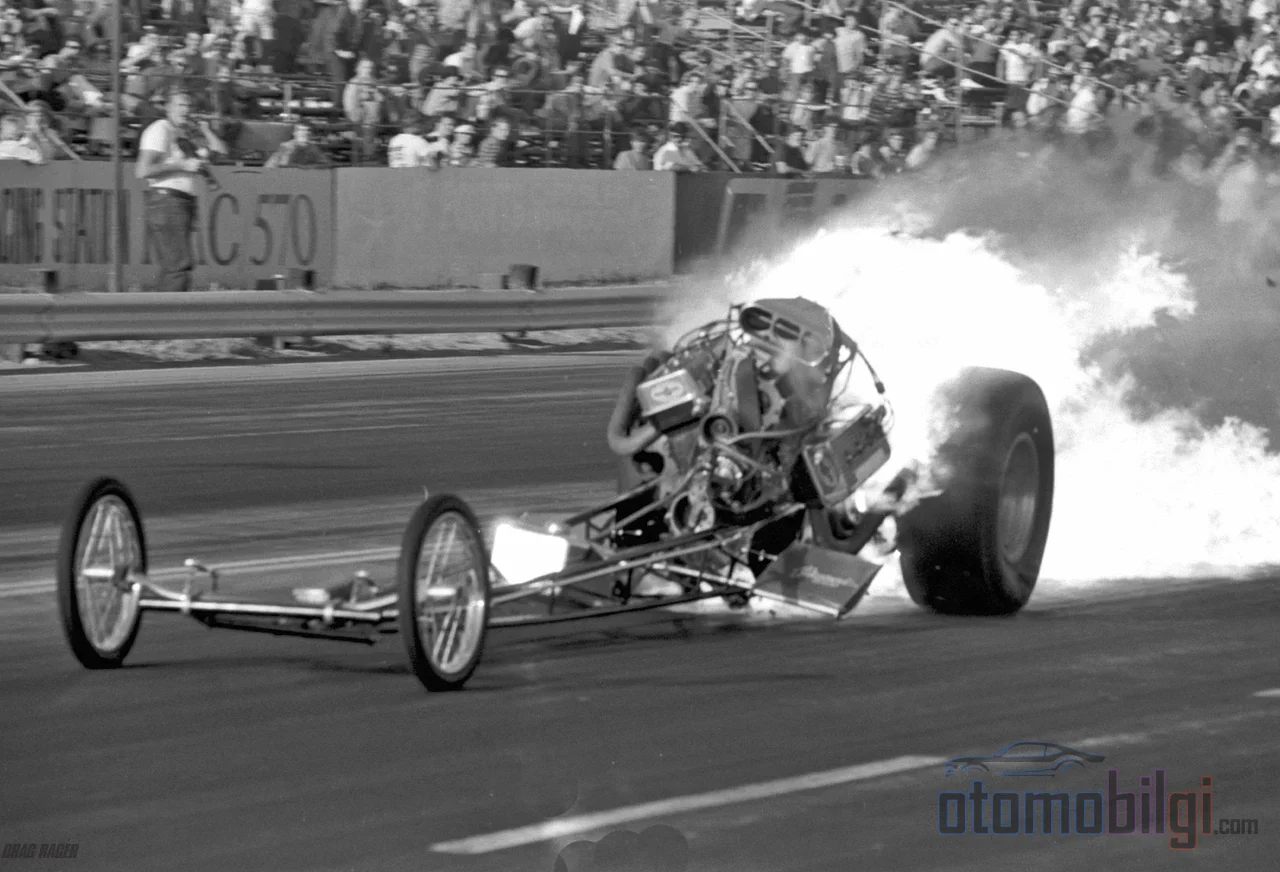
If you think the ban stopped nitro, you're wrong - outside the sanctioned tracks, nitro was alive and well. Cook broke the world ET record at Famoso with 8.89 seconds on April 7, 1957, and saw 168.89 mph at Colton on May 5. Red Greth reached 169.11 mph at Tucson on October 20, 1957. The real bombshell, though, was young Don Garlits: On November 10, 1957, in Brooksville, he became the first name to break the 170-mile threshold with 8.79 seconds and 176.40 mph. What's even more striking: On December 14, 1958, Garlits reached 180.00 mph without supercharging or injection, using eight Stromberg carburetors on a 392 Chrysler Hemi. In the same period, gasoline records were hovering around 9.70 seconds and 149 mph as of late 1957 - the difference was obvious.
At the 1957 Cordova World Series, Garlits beating Cook & Bedwell in the semifinals (9.92/150 against 10.12/160) is considered the race that made his career. So the ban era was, ironically, the birthplace of legendary names.
How Did Funny Car Come to Be? The Chain Effect of the Ban
Now we've come to the point I promised you from the start. In 1958, all classes at NHRA-sanctioned tracks were forced onto gasoline; AHRA and similar organizations continued to allow nitro. This division laid the groundwork for the development of new nitro-based body classes: when nitro engines combined with fiberglass body technology, the Funny Car emerged.
Funny Cars are known for their tilt-up fiberglass bodies that can be lifted forward. Their name dates back to the 1960s, and the original Funny Car dates to 1964; in 1965 these cars began to multiply - at the AHRA Winternationals at the end of January there were seven Funny Cars in the field, all of them Hemis-powered Mopars. The NHRA officially introduced the class in 1966; by that time supercharged Hemis on nitro had long since passed the 200 mph threshold. In today's Funny Car, the mix is typically 85-90% nitromethane, 10-15% methanol, and the air/fuel ratio can go up to 1:1.
Wally Parks lifted the ban in early 1963 - the Hot Rod crowd ties nitro's permanent return to the 1964 Winternationals, so there is a small date difference. Whichever date you take, the result is the same: nitro's return started the golden age of drag racing that would last until 1972. The 1962-1971 period of tracks like Lions is remembered as the true golden age experienced outside NHRA influence. Santa Ana, however, was a stubborn exception: C.J. Hart kept the track on gasoline until it closed in 1959.
How Did Safety Decisions Redraw the Classes?
The nitro ban was the first example, but not the last. Throughout drag racing history, safety-focused rules reshaped technology and the balance of competition again and again. If you ask me, this is in the sport's DNA.
- 1976: Don Prudhomme dominated the Funny Car season - he won seven of eight events, achieved a 30-1 win-loss record, and extended his streak to the second of four consecutive championships. The class's technological maturity had reached this level.
- 1982: Supercharger restriction systems became mandatory in Top Fuel dragsters; the rule was later extended to Funny Car as well. The power of the blown engine was now chained.
- 2008: Following Scott Kalitta's fatal crash in Englishtown, the Top Fuel and Funny Car race distance was reduced to 1,000 feet (304.8 m); this has been the FIA standard since 2012. IHRA Australia also dropped the classic quarter mile in September 2017.
- 2015: NHRA limited the fuel composition to a maximum of 90% nitromethane; the remainder is largely methanol.
- 2025: Vehicles without five-point safety harnesses began to be disqualified in the Top Sportsman and Top Dragster categories.
Do you see it? From the 1957 nitro ban to the 2008 distance reduction, all of them were products of the same logic: when risk rises, the rule kicks in, and when the rule kicks in, engineers search for a new balance. This dance is the very engine that constantly renews drag racing.
What Makes Nitromethane So Special?
Let's take a short technical break, because this was what was banned and what was burning. Nitromethane's energy density is actually low: 11.2 megajoules per kilogram - it lags behind while gasoline is at 44 and methanol at 22.7 megajoules. So why is it so powerful? Because the stoichiometric air ratio is 14.7:1 for gasoline, while for nitro it's 1.7:1. You can burn 7.6 times more nitro with the same amount of air; the engine can produce up to 2.4 times more power compared to gasoline. Let me give an analogy from everyday life: gasoline is a compressed energy pill, while nitromethane is a sponge that carries its own oxygen - you burn more volumetrically and the engine feasts on being fed.
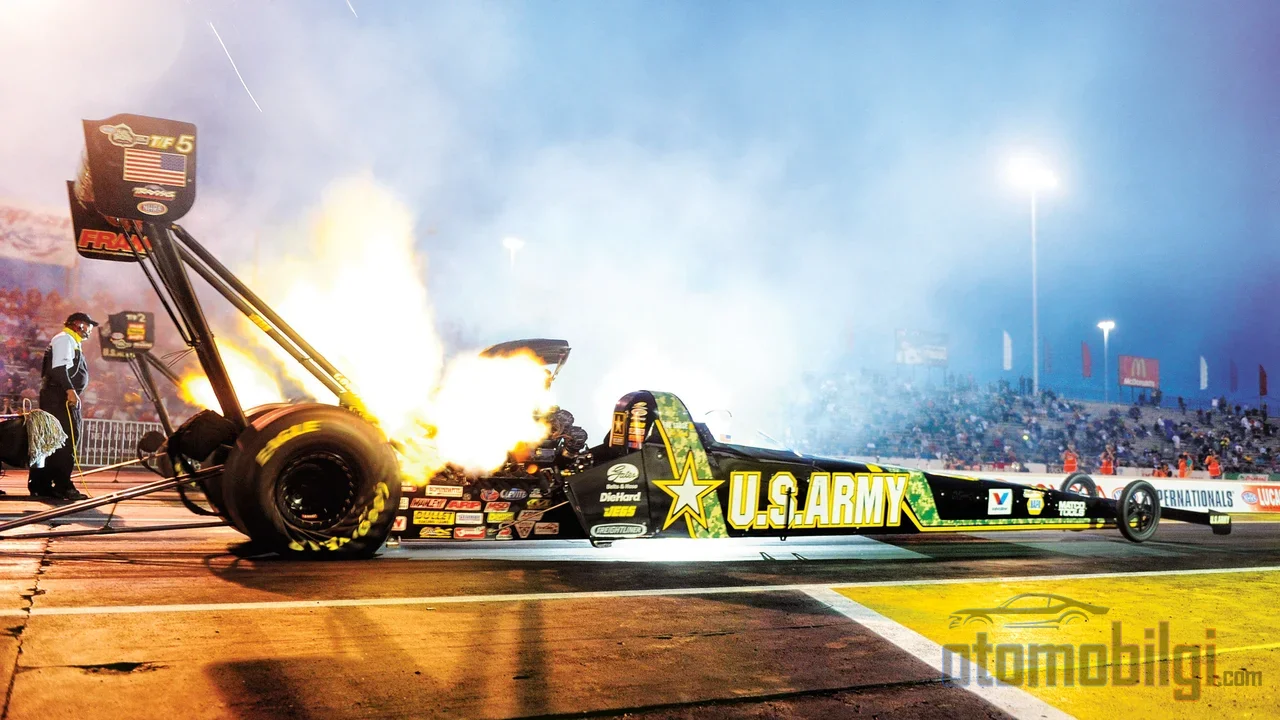
There is also the spectacle side: the high heat of vaporization cools the engine, and the slow flame speed (half a meter per second) burns the unburned nitro exiting the rich mixture with a yellow flame in the exhaust; when oxygen runs out, hydrogen is released and the flame turns white. A single run - including warm-up, burnout and qualifying - consumes 12 to 22.75 gallons (45-86 liters) of fuel, and the sound level at full throttle reaches approximately 150 decibels. Banning nitro would never have been an easy task, would it?
In summary: One Ban, History Made
Let's clarify both sides of the coin. Contrary to what is commonly believed, the nitromethane ban was not a pure safety decision spearheaded by Wally Parks; it was a movement started by Californian track operators out of cost concerns, with Parks later reluctantly joining. In 1958 it spread across the entire class, but outside sanctioned tracks - particularly in the AHRA camp - nitro continued to live on. It was precisely this split that laid the groundwork for the birth of the nitro-fueled, lift-body Funny Car class between 1964 and 66. With the ban lifted in 1963, drag racing entered a golden age that extended to 1972, and that controversial 1957 decision, though aimed at the wrong target, inadvertently created the ashes of one of the sport's most beloved classes. Today, Funny Cars run on nitro mixtures below 90% on tracks shortened from the quarter mile - the shadow of 1957 is still upon them, but now as a legacy.
Sources
- The Real History Of The Infamous NHRA Nitro Ban
- Top Fuel
- Hot rod history with Jack Beckman, a recap of drag racing
- Early Funny Car History 101
- When did we start doing that?
- NHRA vs AHRA: The Sanctioning Story Behind the Strip
- Give Me Nitro or Nothing
- The 50th Anniversary Of Nitro Returning To Drag Racing
- Funny Car