How Does a Top Fuel Dragster Stay From Flying Away?
Share This Page
Think about this for a moment: an engine burning four liters of nitromethane per second carries you past 480 kilometers per hour in a span of time short enough that you wouldn't age even three times by blinking. So why doesn't this thing lift off the ground? I'm asking seriously. Airplane wings generate lift, while the wings on dragsters cut through the air at nearly the same speed. Why doesn't this skinny weapon with no passenger seat climb into the sky over a quarter mile instead of sticking to the ground?
That is exactly the question we'll answer on this page: why doesn't a Top Fuel dragster fly? The short answer lies in the wings, the long answer in physics. Let's get started.
What Is Downforce? The Reversed Twin of an Airplane Wing
Let's first establish the basic concept. Downforce is the aerodynamic force that presses the car down toward the road. It's even called negative lift, because it does exactly the opposite of what an airplane wing does. An airplane wing creates a pressure difference between the airflow over its upper and lower surfaces to lift upward; a dragster's wing reverses the same principle to press downward.
Why do we want this? Because as downforce increases, the tires are pressed more firmly into the road, grip improves, and high-speed stability gets better. Think of it this way: it's like the difference between riding a bicycle in windy weather versus riding it while carrying two crates on top. With weight on board, the wheels hold the ground and bouncing becomes harder. A dragster's wings do exactly this in order to transfer nitro power to the road.
And here's the most cinematic part of the whole affair: this force is not constant. Aerodynamic forces increase roughly with the square of speed. So if you double your speed, your downforce and drag increase roughly fourfold. By the halfway point of the run, the air acting on the car becomes aggressively more intense than what it was at the start. This growth in the air is both a problem and a solution - you'll see why in a moment.
7,000 Pounds of Air: How Much Do the Wings Actually Press Down?
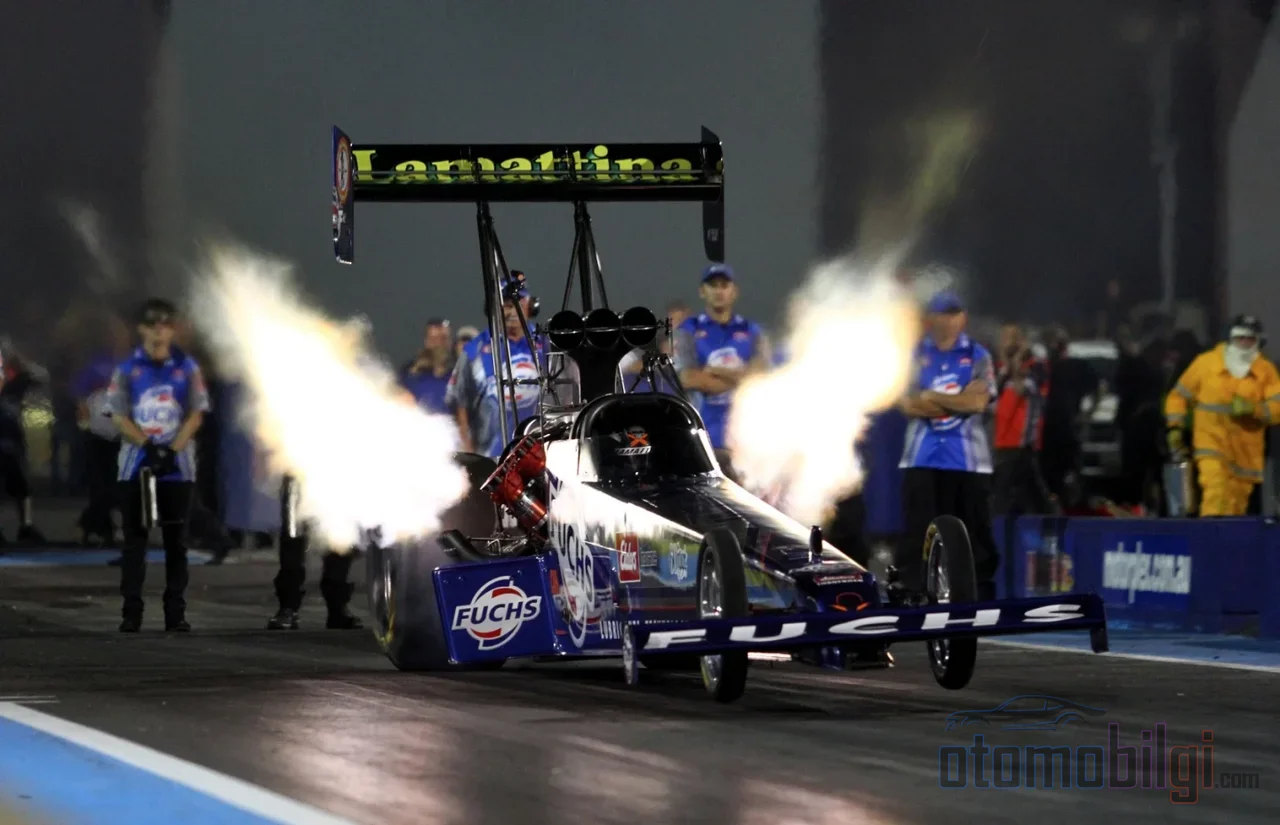
Now let's look at the numbers, because these figures are truly insane. Top Fuel dragsters have two main aerodynamic surfaces, both designed for heavy duty:
- Front wing: produces approximately 700 pounds (317 kg) of downforce.
- Rear wing: can produce over 5,000 pounds (more than 2,270 kg) of downforce.
So together, the two wings glue this thing to the ground with a force that exceeds the car's own weight many times over. Imagine an invisible elephant sitting on top of it. While the rear wing generates such massive force, the front wing serves as the stabilizer that keeps the nose from lifting. The two work together; if one fails, the balance is thrown off.
So how does the wing generate this force? The rear wing is designed in the shape of an inverted airplane wing. A pressure difference forms between the airflows above and below it, and this difference pushes the wing downward. Simple but effective - humanity is using the same physics it has relied on for 100 years to stay in the air, but this time to stay out of it.
Everything Comes at a Price: The Downforce and Drag Trade-off
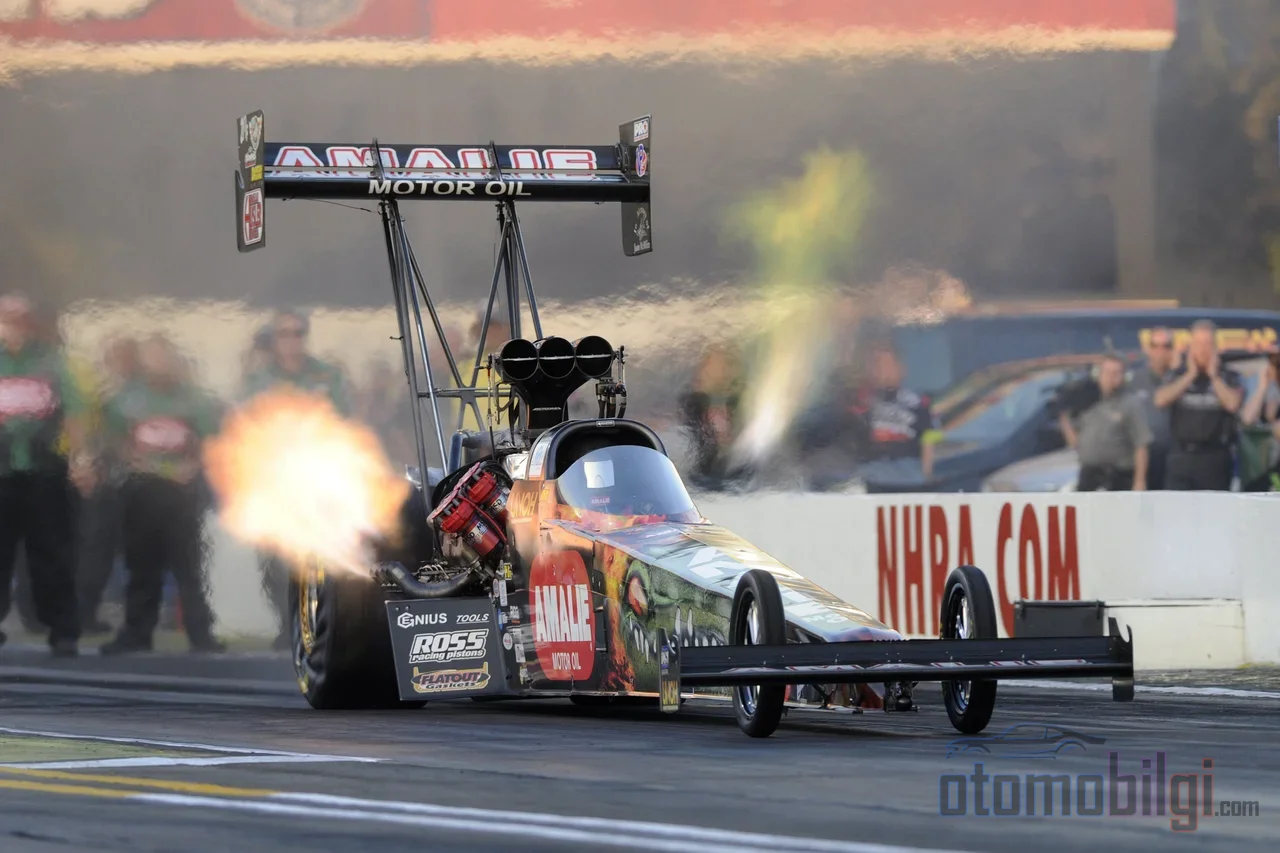
This is where the real tension of the story begins. The air doesn't give you a free lunch. Almost every component that produces downforce - wing, splitter, diffuser - also produces air resistance, or drag, at the same time. When you try to increase one, you usually end up increasing the other. This is the most fundamental trade-off in aerodynamics.
Think of steepening the wing's angle. You gain more downforce, great. But behind the wing, the airflow separates more strongly, and more drag is born. This resistance, which grows with the square of speed, forces part of the engine's power to be spent pushing air instead of the car forward. A good dragster setup is the art of finding the golden mean between these two forces: stick enough, but don't slow down more than necessary.
Efficiency is measured for this very reason by the lift-to-drag ratio, that is, the ratio of downforce to drag. Drag isn't just one type either:
- Pressure drag: the resistance created by air compressed in front of the vehicle; this is usually the largest contribution.
- Induced drag: the price of the turbulence that wings leave behind while generating downforce.
- Skin friction drag: a smaller but inevitable share arising from air rubbing along the body surface.
That's why a dragster's body is so slender and long: designed so that the air is cut at the front while leaving as little turbulence as possible behind it. Now it's time to come to that question you've been wondering about: with the rear wing pressing down so hard, why doesn't the car flip over?
The Highlights
- The Top Fuel front wing produces approximately 700 pounds (317 kg) of downforce.
- The rear wing alone can generate a force of over 5,000 pounds (2,270+ kg).
- When speed doubles, downforce and drag increase roughly fourfold.
- Every component that produces downforce also produces air resistance.
- These cars can complete their 0-160 km/h acceleration in under 0.8 seconds.
Why Doesn't the Huge Winged Car Flip Over While Accelerating?
Here is the heart of this page. A logical question: if the rear wing applies a downward force of thousands of pounds to the car, doesn't this force also press the rear of the car to the ground and lift its nose up? In theory, yes - but the keyword in that "in theory" is balance.
A car doesn't flip over; it doesn't flip as long as the total load distribution on the wheels formed by downforces and weight doesn't shift forward enough to cause a rollover. In Top Fuel dragsters, this balance is maintained by three elements. First, the front wing: however much the rear wing presses down, the front wing responds with its force pressing the nose toward the ground. Second, the long body: the greater the distance between the wing and the front wheels, the weaker the massive force at the rear becomes at rotating the car forward. Third, the wheelie bar: that small-wheeled rod extending behind the rear axle serves as the last line of defense against the possibility of the nose rising too high.
Also, don't forget this: this force is not built in a second. Since speed is still low at launch, the downforce is also minuscule. The wings' real power comes fully into play when the car has already reached high speed and the giant tires that keep the throttle on the ground have warmed up. In other words, the air grows gradually along with the force acting on the car - the car travels at every moment in a balance accustomed to this force.
In short, a dragster doesn't fly, because the force of the rear wing pulling the car backward and downward is neutralized in balance by the front wing, the long body geometry, and the weight distribution pressing to the ground. Air resistance, meanwhile, acts as a friend at this point: that massive resistance pushing from behind acts like a hidden ally in neutralizing the force that would lift the car's rear.
0.8 per second: Why Is So Much of This Force Needed?
Without downforce these cars wouldn't make sense at all, because nowhere on Earth is there another grip capable of carrying this acceleration. Top Fuel dragsters are the fastest-accelerating race vehicles in the world. The 0-100 mph acceleration, that is, going from 0 to 160 km/h, can drop to as low as 0.8 seconds. A production sports car reaching this acceleration would take three times longer. A dragster finishes the 1,000-foot distance in about 3.6 seconds - faster than the takeoff acceleration of a fighter jet taking off, they say, and they're not exaggerating.
What transfers this acceleration to the ground, of course, is not just the wings; slick tires, a massive clutch, and enormous torque are the other half of the job. But without the wings, the power produced by the engine would spin the tires uselessly without gaining traction, and the car would either go into a spin or lift its nose. Downforce is the translator between engine power and the asphalt. Since the engine produces thousands of horsepower while turning only about 540 rpm from light to light, connecting that power to the road without losing it means everything.
What Happens When the Race Ends? Brakes and the Parachute
Aerodynamics' job doesn't end with accelerating. A speed of 480 km/h can be slowed down to a point with the wing: the moment the driver lifts off the throttle, air resistance begins to act like a giant air brake with its force that grows with the square of speed. But if the speed is still high at the end of the quarter mile, the parachute braking system comes into play. The parachutes used on dragsters and Funny Cars are systems designed to open at speeds of roughly 190-250 mph and slow the car down in a controlled manner.
The parachute's relationship with the body is no trivial matter either: the pressure balance behind the body directly affects the car's stability when the parachute opens. If the structural continuity behind the body is compromised, the aerodynamic balance is disrupted from that point on. That's why the chassis, wing, parachute, and body design are developed not separately but as a single whole. Aerodynamics takes the stage both at the race's launch and its finish - once the light comes on, once the parachute opens, and the air has the final say at both ends.
Conclusion: Sticking to the Ground Is Harder Than Flying
That's why the Top Fuel dragster doesn't fly: its wings are designed not to lift it into the air, but to slam it into the ground. The inverted wing profiles generate 700 pounds of downforce at the front and over 5,000 pounds at the rear, and this force carries the power of the massive engine to the single point of contact between the tires and the asphalt. Air resistance is a tax already paid; but that same resistance, shaking hands with the parachute at the end of the run, also stops the car. This three-second duel is, in fact, one of humanity's most elegant negotiations with the air. Next time you watch a dragster video, pay attention to the wings - no one but you will know which surface does which job anymore.
Sources
- NHRA 101: Top Fuel dragster wings
- NHRA Tech Talk Tuesday – Wing and Rear End
- Downforce vs Drag Explained: How Aerodynamics Affect Car Performance
- Top Fuel – Wikipedia
- What is Top Fuel Drag Racing – NitroVikings
- Some interesting facts about Top Fuel – RF Motorsport
- Parachute Tech Chart – GoodVibes Racing