Quarter Mile on Two Wheels: The World of Drag Motorcyclists
Share This Page
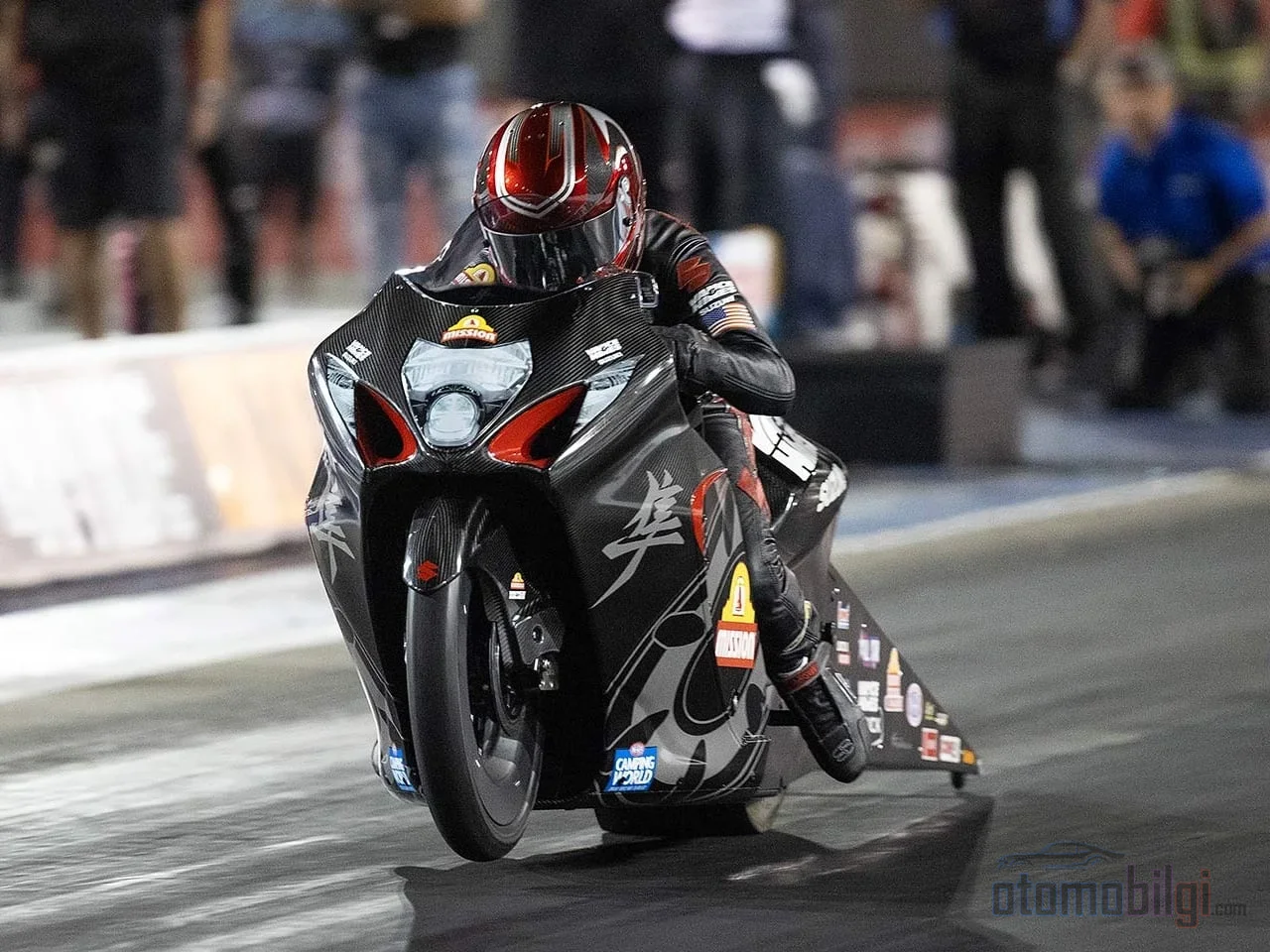
Motorcycle drag racing is a speed discipline that sets straight-line records over the quarter mile on two wheels, and the Pro Stock Motorcycle class in the NHRA has represented the pinnacle of this sport as a fully recognized professional championship category since 1987. Factory-looking but labyrinth-like modified Suzukis and V-Twins, with their riders tucked in, can run below 6.70 seconds and exceed 205 mph. On this page you will find the engines, records, balance of this class, and its story extending from amateur ladders to Türkiye.
Highlights
- Pro Stock Motorcycle ET record: 6.627 seconds (Gaige Herrera, 2023)
- Top speed record: 205.04 mph - Matt Smith, 2021
- Approximately 2.5 G of acceleration at launch; 0 to 100 mph in just over 2 seconds
- The class gained professional status in 1987; the first champion was Dave Schultz
- Participation in TMF drag events in Türkiye is free
What Is Pro Stock Motorcycle and Why Is It So Special?
Pro Stock Motorcycle, one of the NHRA's four professional classes, is the only two-wheeled category in the series. In 1987, motorcycles were allowed to count toward the national championship alongside Top Fuel, Funny Car, and Pro Stock cars; that year's first champion was Dave Schultz. While national records initially hovered around 7.99 seconds, today the class's best runs are in the 6.6-second region. Gaining a full second over thirty-some years shows just how great an engineering leap this has been on two wheels.
My favorite thing about the class is that it is pure and natural. No turbos, no superchargers, no nitrous, no exotic fuels. Everything runs on naturally aspirated engines, and 118-octane racing gasoline is used as the fuel. In other words, these guys bring a motorcycle under 7 seconds purely through engine skill. This is the two-wheeled version of the philosophy known in the car world as the factory hot rod.
Suzuki Inline-Four or V-Twin? A Comparison of the Two Engine Philosophies
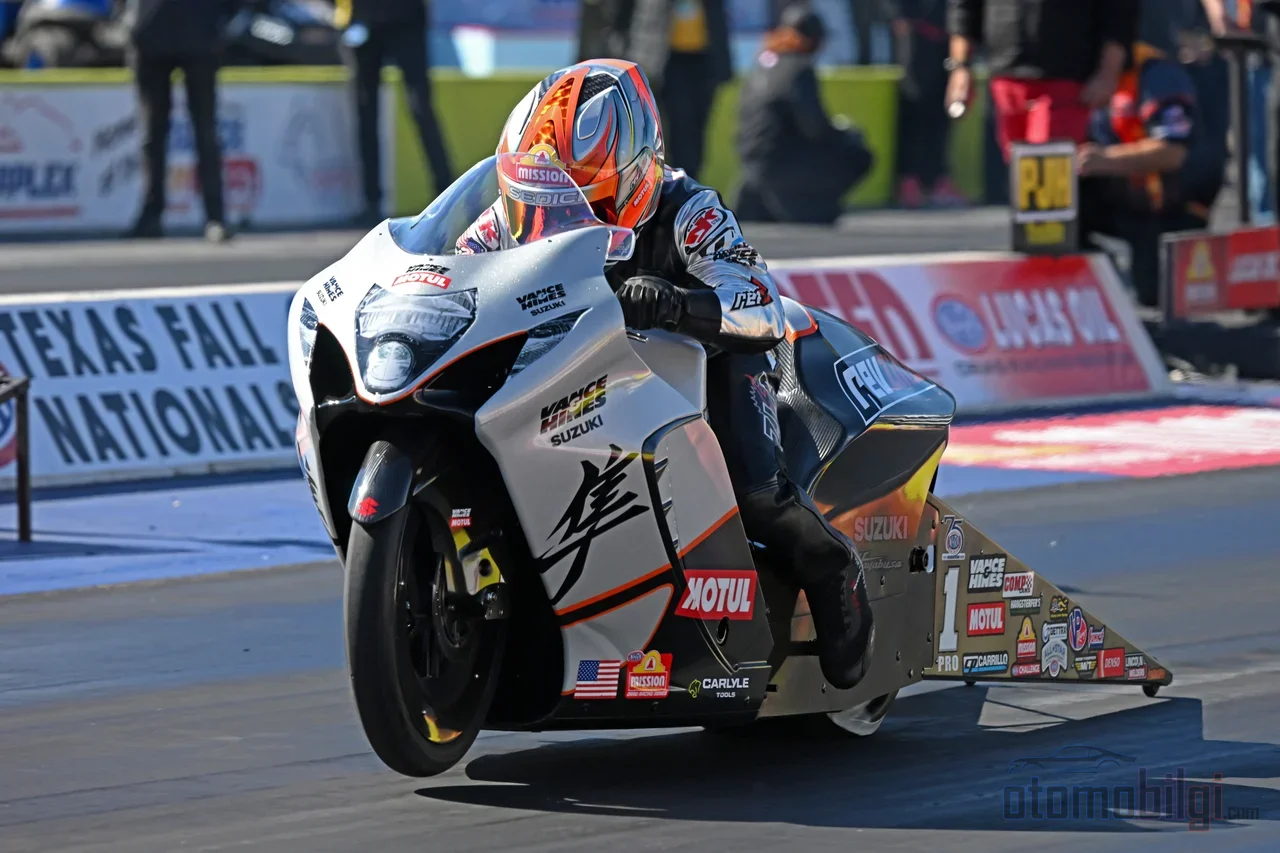
At the heart of the class are two different engine approaches, and the battle between them is the sport's biggest technical story. On one side are high-revving inline-four engines based on the Suzuki GS 1150; on the other are large-displacement 45-degree pushrod V-Twins of Harley-Davidson/Buell origin. Both do the same job but in completely opposite ways: one wins with revs, the other with torque. If it were you, which one would you choose?
| Feature | Suzuki Inline-Four | V-Twin |
|---|---|---|
| Displacement | ~1,850 cc | ~2,621 cc (160 cubic inches) |
| Design | 2 valves per cylinder, 16:1 compression | 45° pushrod, 14.5:1 compression |
| Rev range | 14,000 rpm redline | 10,400 rpm redline |
| Power | ~370 hp @ 13,600 rpm | ~400 hp @ 9,800 rpm |
| Dry engine weight | ~185 pounds | ~220 pounds |
| Class entry | Since the 1980s | 2002-03 |
Both engines have two spark plugs per cylinder and a single injector; about 20 ounces (approximately 600 ml) of fuel are consumed per run. On the V-Twin side, valve spring pressure can reach up to 1,400 pounds - meaning they work with springs so stiff you couldn't hold one in your hand when compressed. Think of it this way: Suzuki sings high and fast like a soprano, while the V-Twin strikes deep and heavy like a bass guitar. In the end, both are singing the same song.
A Balance Played in Pounds: The Weight Handicap and the Parity Battle
So how does a 370-horsepower Suzuki race fairly against a 400-horsepower V-Twin? The NHRA's answer is simple but effective: minimum weight. The stronger engine gets more weight added. That's why the minimum weight including the driver ranges from 575 to 625 pounds depending on engine configuration; for example, Buell-based machines get 5 pounds added to reach 625, while Suzukis can shed 5 pounds down to 605. For Kawasaki, it's 600 pounds. The rulebook gets weighed almost every year, much like a boxer losing weight.
This parity management occasionally becomes the subject of heated debates. The weight change in the middle of the 2024 season made big waves, and the NHRA analyzed the entire season to show that the average difference between the Suzuki and the V-Twin was only 0.015 seconds. Two thousandths of one percent - a difference impossible to distinguish by eye on the track. So the weighing system is doing its job, or at least that's what the numbers say.
Why Do Riders Lie Down? Physics and Challenge
On Pro Stock motorcycles, the rider doesn't sit upright; they practically lie face-down over the bike. There are two reasons for this: to reduce the frontal surface area and cut aerodynamic drag, and to keep body weight at a low center during launch acceleration of roughly 2.5 G. At launch, the front wheel tries to rise; that's why a tipping-prevention bar called a wheelie bar is fitted at the rear. While in car drag racing a safety harness and parachute braking system protect you, here your balance and reaction are everything.
There's also the calibration side: before launch, a burnout is performed to heat and clean the rear tire, ensuring grip on the asphalt. Some racers also do a dry-hop, a short test launch, after the burnout. The quarter mile is 402 meters, but half the job is actually done before you even cross the starting line.
Records and Legendary Names: A Journey from 7 Seconds to 6.6
The class record book is frighteningly impressive. The ET (elapsed time) record is Gaige Herrera's 6.627-second pass at the Texas Motorplex in 2023. The speed record belongs to Matt Smith: 205.04 mph in Sonoma in 2021. Herrera's 2023-25 streak is in a league of its own - with 11 consecutive national wins and 46 consecutive elimination round wins, he broke the all-time NHRA record; over three seasons he tallied 28 wins and 31 poles. Andrew Hines, meanwhile, had run the first sub-6-second pass in class history at the 2005 Gatornationals.
Looking at the championship table, three names lead the way: Dave Schultz, Andrew Hines and Matt Smith, each sharing the record with 6 championships. On the women's front, Angelle Sampey became the class's first female champion with three consecutive titles between 2000-02, and with 46 national wins she was long remembered as the winningest woman in NHRA history. The 2025 champion was Richard Gadson - and since the Pomona final was cancelled due to rain, this title, which came with a 21-point margin, is still being debated; Gadson aims to prove himself on the track in 2026. The cost of a season is also serious: a PSM program costs around 700,000 dollars per year. Expensive, but compared to the million-dollar budgets of a Top Fuel dragster, it can still be considered an entry point.
NHRA's Fastest Two-Wheeled Class: Top Fuel Motorcycles
Pro Stock Motorcycle is fast, but the absolute peak is not its. Top Fuel motorcycles that burn nitromethane and produce over 1,500 horsepower cover the quarter mile in around 6 seconds, reach 230 mph, and their minimum weight is only 500 pounds. The fastest motorcycle pass in drag history belongs to Larry "Spiderman" McBride, recorded in a demonstration run at the 2022 Virginia NHRA Nationals: 268.38 mph. Chris Matheson, meanwhile, has set a 5.50-second world record pass with his 2,000-horsepower machine. I recommend holding your head with both hands while reading these - I did while writing.
But there is an interesting development: NHRA has removed the Top Fuel motorcycle class from its program for the 2026 season. The good side of the bad news is this - IHRA is keeping the class alive, and in the 2026 Triple Crown series Top Fuel motorcycles exceeding 1,600 horsepower will race. So the nitro two-wheeled monsters are not dying, they are simply moving to another stage. Pro Stock Motorcycle keeps its place in NHRA, and 2026's main stories are the intra-team championship battle between Gadson-Herrera, Matt Smith's 7th title goal, and the ongoing weight parity debate.
Motorcycle Drag in Türkiye: How to Climb from Kepez to the Amateur Ladder?
So what is the situation here? In Türkiye, motorcycle drag races are run within the Turkish Motodrag Championship organized by the Turkish Motorcycle Federation. In the 2026 calendar, the Kepez Drag Strip in Antalya was in the lead role: the second round was held here in June, the third round took place on September 19-20, and the fourth round, the season finale, is on October 24-25 - that is, this weekend! - held at Kepez. Moreover, according to the federation, participation in the races is free, and preparing the motorcycle falls to the rider. So you can set up your own bike and post times on the strip; you prepare the vehicle, the mechanics are on you.
Amateur Classes and the Handicap System
On the NHRA side, there are amateur classes such as Comp, Super Stock, and Stock. They work with a handicapped start system: the slower vehicle leaves the start line with an advantage, and in an E.T. handicap race, if you run under the time you predicted, you break out and lose. The goal is not to be the fastest, but to be the most consistent predictor. AMA drag races, however, feature purpose-built drag bikes: full race machines equipped with a rigid chassis, wide slick rear tire, and a wheelie bar. So there are two ways into the world of motodrag: a factory-based racing path and a pure race bike path - both are two-wheelers, but their souls are different.
Why Do the Two Wheels of the Quarter Mile Deserve to Be Told?
Amid an abundance of four-wheeled drag content, the motorcycle side has always stayed in the background; yet Pro Stock Motorcycle is the living story of a class dropping from 8 seconds to 6.6 seconds in 30 years. A naturally aspirated engine philosophy, parity managed by the pound, riders lying down at 2.5 G launches, and a championship in Türkiye that's free to enter... There is room in this crucible for every level. We think of this page as a permanent corner for two-wheeled drag on our site; if we see you at trackside at the next Kepez event, it means we wrote this piece here. Which do you find more impressive: an inline-four screaming at 14,000 rpm or a deep-growling V-Twin?
Sources
- Pro Stock Motorcycle: The Complete Guide to NHRA's Two-Wheel Thunder - Competition Plus
- Inside a Pro Stock Motorcycle engine - NHRA
- Drag Racing Classes - NHRA
- McBride makes fastest motorcycle run ever: 268 mph - NHRA
- NHRA Changes Minimum Weights for Pro Stock Motorcycles - Nitromater
- Top Fuel Motorcycles Back in Action at First IHRA Triple Crown Event of 2026 - Drag Illustrated
- Track Time: NHRA Pro Stock Psych - Motorcyclist
- The Starting Line: What is the best technique for a burn-out - Dragbike
- E.T. Handicap Racing - NHRA Rulebook / Sonoma Raceway
- Drag Racing - American Motorcyclist Association
- Vance & Hines Gen III Hayabusa Pro Stock Motorcycle - Cycle World
- Drag Racing - Türkiye Motorcycle Federation
- I Want to Race - Türkiye Motorcycle Federation
- Türkiye Motodrag Championship in Kepez - Kepez Municipality
- The Grand Final of the Türkiye Drag Championship in Antalya - Uşak Haber Gazetesi
- Motorcycle drag racing - Wikipedia