Sammy Miller, the Vanishing Point Rocket Car and the 3.58-Second Record
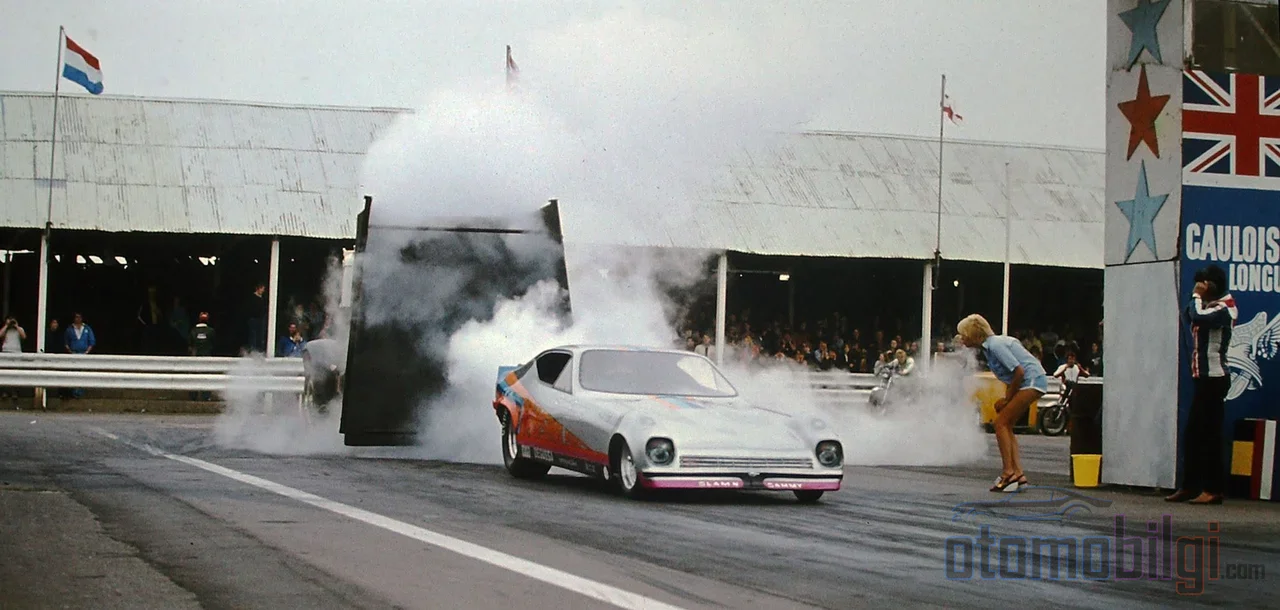
Imagine a straight track a quarter mile long and you want to cover that distance without blinking. Okay, blinking might be a bit of an exaggeration, but not for Sammy Miller: In 1984, at the Santa Pod Raceway track in England, with his rocket-powered Funny Car named Vanishing Point, he completed the quarter mile in 3.58 seconds, and his speed at the finish was measured at 386.26 mph, which is about 621 km/h. Exactly 42 years have passed since that day, and this time still remains the fastest ET, or elapsed time, ever recorded at any drag strip in the world. Yes, you read that right: A record set with 1984 technology still stands in 2026. But how?
Here's the interesting part: Today's piston-powered Top Fuel legends are incredibly fast, technically groundbreaking machines. But Sammy Miller's car didn't even have a piston engine. It was a hydrogen peroxide-powered rocket engine that gave him that speed. So the question this page asks is clear: What were rocket dragsters, how were they so fast, and why are they no longer on the strips today? Let's get started, because this story is both a technical lesson and one of the strangest chapters in drag racing history.
Highlights
- In 1984, Sammy Miller completed the quarter mile with Vanishing Point in 3.58 seconds
- The finish speed was recorded as 386.26 mph (about 621 km/h)
- The record still stands as the absolute ET record at any drag strip in the world
- Vanishing Point was powered by a rocket engine burning hydrogen peroxide
- The rocket class withdrew from the strips due to fuel costs and safety rules
What Is a Rocket Dragster and How Does It Differ from Top Fuel?
First, let's take a look at the physics of the matter - don't worry, it's much more fun than what's taught in class. A piston engine, whether it's Top Fuel's giant 500 cubic inch Hemi or your own car's engine, cannot push the vehicle forward on its own. It has to transmit its power to the road through the gearbox, driveshaft, differential and tires. Jet and rocket engines, on the other hand, work on a completely different principle: They convert the pressure increase inside them directly into thrust, meaning they don't need tires to push the vehicle - they push it with the gas they spray out the back.
The difference between jet and rocket is hidden right here. A jet engine takes the oxygen needed for combustion from the air. A rocket carries its own oxygen - or rather, the oxidizer it chemically contains - along with it. That's why jet cars and rocket cars are separate categories in the drag racing world and should never be confused with each other. A rocket carries both its own fuel and its own oxygen on its back; this gives it tremendous power density, but at the same time it opens the door to those famous cost and safety problems.
If we look at the Top Fuel side, here's the picture: A 500 cubic inch Hemi engine produces roughly 7,000-8,000 horsepower and transfers 12,000 to 13,000 pounds of forward drive through the tires at launch. In a single run, a Top Fuel engine turns over only about 540 revolutions from light to light; the total number of revolutions the engine must survive, including burnout, is around 900. These engines contain approximately 1.5 gallons of nitromethane for most of the quarter mile. Aren't the numbers crazy enough? They are, but rockets are in a different league.
There is one more critical detail in racing terms: A Top Fuel dragster, especially in the first part of the distance, is more impressive in acceleration than a rocket. The grip of the tires and the gear shifts provide magnificent control at launch. A rocket, however, becomes uncontrollable at top speed; once the speed climbs, it seems impossible to stop. In the short distance of a drag strip, the clash of these two characters was one of the most exciting technical debates of the 1970s.
What Kind of a Legend Were Sammy Miller and Vanishing Point?
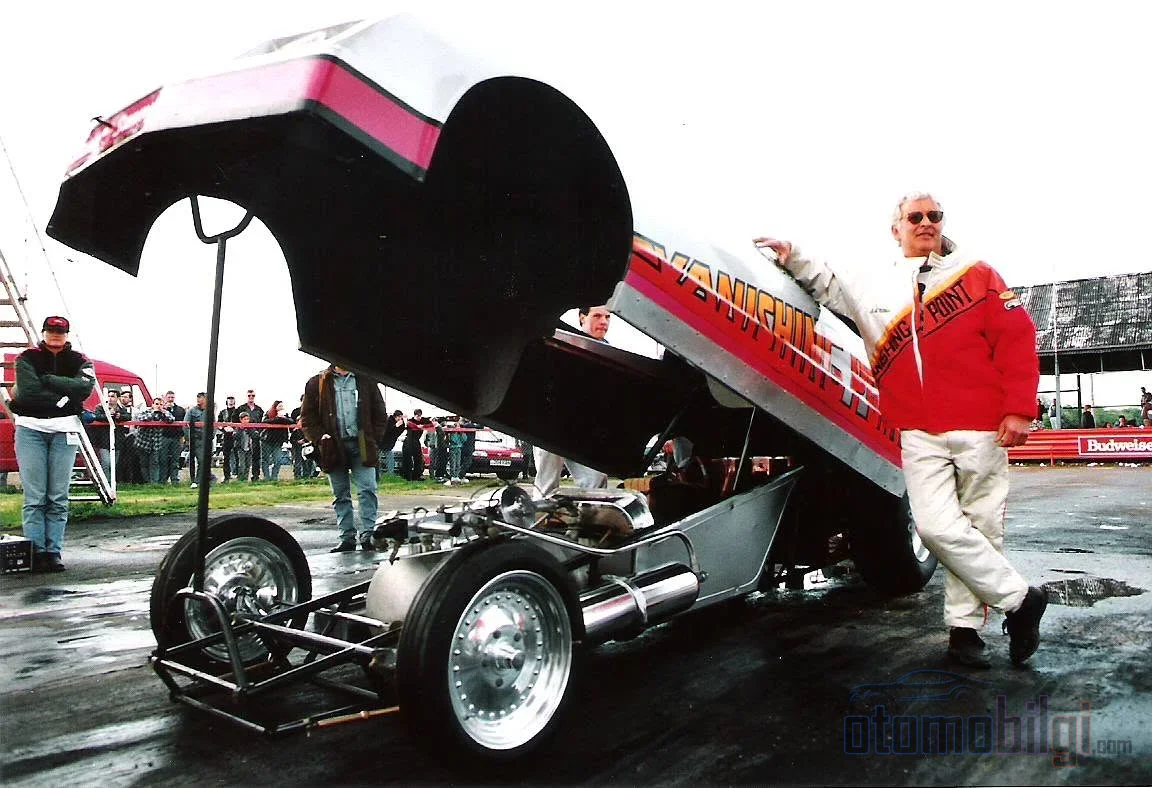
Sammy Miller, aka Slam'n Sammy, was one of the rare names of the 1970s who both built and drove both dragsters and Funny Cars. In 1974 he moved from piston racing to rockets. His first vehicle, Spirit of '76, was the first Funny Car to race with rocket power in the USA and broke records one after another on the tracks it ran. The vehicle that followed it was Vanishing Point, the hero of our story: a Funny Car with a Vega body and a hydrogen peroxide powered rocket engine.
Miller came to England's legendary track Santa Pod Raceway with this car and in 1979 performed the first run below, sorry, above 300 mph in the United Kingdom: He caught 307 mph, roughly 494 km/h, in 4.20 seconds. Later, at the 1981 World Finals, he was preparing with his LSR Dragster named Oxygen, powered by a hydrogen peroxide rocket, for runs under four seconds. The man was a complete speed freak, and the likable kind.
And in 1984, that moment came. Vanishing Point completed the quarter mile at Santa Pod in 3.58 seconds, with a trap speed recorded as 386.26 mph. This run became both the world absolute ET record and the Santa Pod track record, and according to the British Drag Racing Hall of Fame it still stands as the absolute ET record at any drag strip in the world. Let's also say that Miller didn't just break the record and enjoy himself; about 10 years later, around 1994, he returned to England to try to improve his own 3.58. So the biggest rival of his own record was himself.
How Does It Compare to Today's Records?
It is worth stopping here to draw a clear picture, because when numbers fly around, people can get confused. The comparison below shows the difference between the rocket era and the piston era at a single glance.
| Record | Holder | Value |
|---|---|---|
| Absolute quarter mile ET record (1984) | Sammy Miller, Vanishing Point | 3.58 s, 386.26 mph |
| Top Fuel ET, 1000 feet | Brittany Force (2019) | 3.623 s |
| Top Fuel speed, 1000 feet | Shawn Langdon (2026) | 346.95 mph |
| Funny Car ET, 1000 feet | Robert Hight (2017) | 3.793 s |
Did anything catch your eye? Brittany Force's 3.623 second Top Fuel record is quite close to Miller's 3.58. But pay attention: After safety modifications, the NHRA permanently reduced the race distance to 1000 feet, that is 305 meters. 1000 feet is shorter than a full quarter mile, that is, 1320 feet. That means modern Top Fuel cars are posting these times over a shorter distance than the one Miller ran; what they would do over a full quarter mile is a matter of speculation. That's why 3.58 stands as an incomparable peak in a category all its own.
A note on the viral content as well: The figures like 580 km/h circulating on the internet are nothing but rough estimates; the recorded trap speed was 386.26 mph, which is roughly 621 km/h. So the reality is even crazier than what was claimed. In September 2026, Shawn Langdon recorded the fastest official speed in drag history at 345-346.96 mph, but that too was over a 1000-foot run.
The Short and Fiery Era of Rocket Dragsters
Rocket dragsters weren't a craft that began and ended with Sammy Miller. In 1977, Texas stuntwoman Kitty O'Neil drove on the tracks in the hydrogen peroxide-powered car of Ky Michaelson, nicknamed Rocket Man. O'Neil's main fame came from somewhere else: On December 6, 1976, in the Alvord Desert in Oregon, she broke the women's land speed record by averaging 512.710 mph in the three-wheeled SMI Motivator rocket car. What's more, on that run she was using only an estimated 60 percent of the car's thrust. Other names in the cast: Larry Nagel's Pocket Rocket raced between 1981 and 1983, reaching speeds of over 247 mph with its hydrogen peroxide motor. Fearless Fred Goeske, meanwhile, carried a rocket engine producing 3500 pounds of thrust and hydrogen peroxide tanks in his pickup. Yes, a rocket in a pickup. What these men had in common was pushing not the limits of speed, but the limits of the mind.
So what took such a fun category off the tracks? There are two answers, and both are interconnected. The first was hydrogen peroxide fuel becoming prohibitively expensive. The second was safety. Rocket cars were banned at most events on safety grounds. In fact, this attitude wasn't new: The NHRA had barred jet cars at a much earlier date, in November 1961, out of fear of the danger a technical malfunction could cause and on the grounds that they were far too dangerous. In the 1960s, nearly all power units other than valved internal combustion engines were ruled out. In other words, the fate of the rocket dragsters was written from day one; only a handful of bold names turned that fate into records for a decade.
There was a dynamic on the organizational side as well: Jet and rocket exhibition cars becoming a permanent fixture on the tracks could have meant being overshadowed by the racing classes. Legendary Top Fuel cars don't like standing in anyone's shadow. In the end, the rocket class was pushed outside the official rulebooks, and the track records were written into the history books of the tracks one by one.
Why Is 3.58 Seconds Still Unbreakable?
We now have all the pieces of the answer. Let's sum it up briefly and clearly: Sammy Miller's 3.58-second quarter mile record cannot be broken because the rocket class has been banned from racing and hydrogen peroxide fuel is expensive; moreover, the NHRA's permanent reduction of the race distance to 1000 feet has completely eliminated the comparability of records set over the full quarter mile. Today, no vehicle class officially racing on the track even has a chance to repeat Miller's run over the full 1320 feet; rockets are banned, and piston-powered cars race over a shorter distance.
There is also a practical reality: In recent years, some have tried to break the record, and those attempts ended in crashes. Running the quarter mile with a rocket was a borderline challenge even in 1984; today, pushing those limits requires both technology and courage and the rules' permission, and two of the three are missing.
My take is this: 3.58 is not just a time, it is the signature of an era. Rocket dragsters were the heroes of perhaps the shortest, brightest, and least controlled period in drag racing history. Sammy Miller left us in 2002, but that 3.58 etched into the timing towers at Santa Pod quietly reminds us at every race night, at every Top Fuel launch: Speed had a limit, and a rocket had seen that limit 42 years ago. Do you think this record will ever be broken? Something inside me says it could only happen with another rocket - that is, if that rocket is allowed to race on the track, of course.
Sources
- Rocket car - Wikipedia
- Sammy Miller (engineer) - Wikipedia
- National Records - NHRA
- Sammy Miller - British Drag Racing Hall of Fame
- Remembering Slammin' Sammy Miller - Drag Race Central
- Rocket Man Slam'n Sammy Miller
- Sammy Miller Vanishing Point 3.58s Santa Pod Track Record
- Trakbytes Hall Of Fame; Sammy Miller
- 346.96 MPH: Top Fuel Dragster Breaks All-Time NHRA Speed Record - The Drive
- 3 ways Kitty O'Neil defied death - PBS American Masters