Hybrid e-CVT Maintenance: The 90,000 Km Rule and Its Cost

When reviewing the maintenance list of hybrid cars, brake pads, engine oil and coolant are always discussed; but the oil of the e-CVT, the heart of the drivetrain, is often overlooked. Even more interesting, while some manufacturers give no clear mileage for changing this oil, some recommend concrete intervals for severe use. When the question comes from an owner, things get even more complicated: is the e-CVT a classic CVT, an automatic transmission, or something entirely different? The aim of this guide is to open up that question with engineering logic and clarify the maintenance, failure profile and cost expectations of this unique hybrid-only drivetrain.
What Is an e-CVT and Why Is It Different from a Classic Transmission?
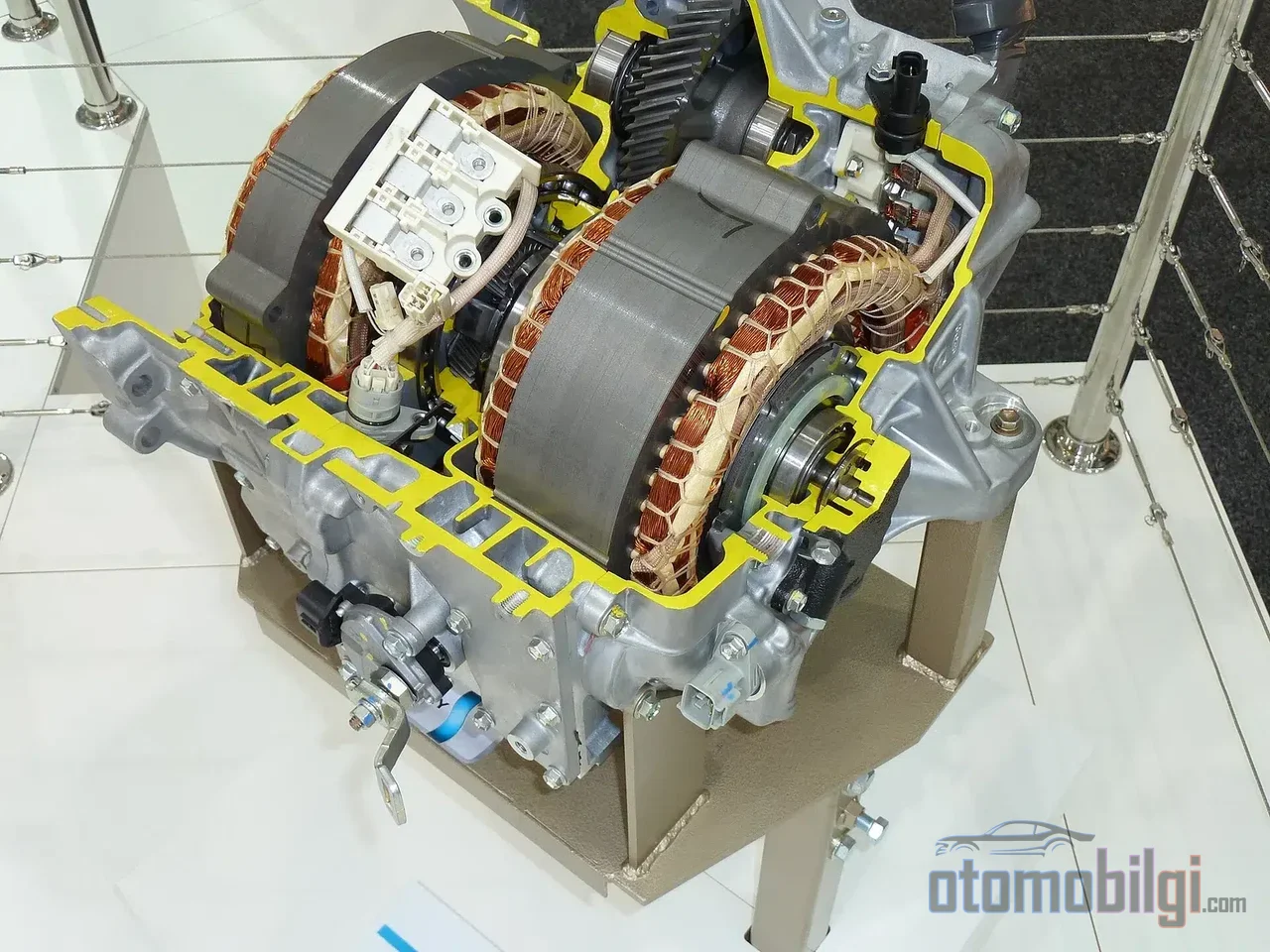
First, let's clear up the confusion in the name: the e-CVT is not a belt-driven or chain-driven continuously variable transmission (CVT). The similarity in name is a historical legacy; the mechanical structure is completely different. In Toyota's Hybrid Synergy Drive system, the e-CVT is a power-splitting system consisting of a single planetary gear set and two motor-generators. The internal combustion engine splits power into two paths through the planetary gear set: while part of it goes to the wheels, part is spent on generating electricity through Motor Generator 1; Motor Generator 2 contributes to the drive.
The practical result of this layout is as follows: there is no clutch in the system, no gear shifts, no torque converter. The effective gear ratio between the engine and the wheels is changed continuously and steplessly by adjusting the speeds of the two electric machines. A single planetary gear set provides, in practice, an infinite gear ratio. There are no wearing brake plates, clutch surfaces or hydraulic valve blocks like in a classic automatic transmission.
Honda's hybrid system follows the same philosophy: electric motors and gears are used instead of a belt; however, the placement of the motor-generator and drive motor differs from Toyota's. In both brands, the drivetrain is a single compact unit that works on the power-splitting principle and is also referred to as EVT (electronic continuously variable transmission). In parts catalogs it sometimes appears as transaxle, sometimes as hybrid transmission; this confusion in naming frequently sparks debates on ownership forums as well.
Highlights
- The e-CVT is not a belt-driven CVT; it is a power-splitting system consisting of a planetary gear set and two motor-generators.
- Toyota highlights a transmission oil change at around 90,000 km or every 7 years under severe use; no official interval is given for some model years.
- The real risk window for the oil usually opens in vehicles in the 100,000-150,000 mile band.
- Classic CVT repairs can go up to the range of $3,000-8,000; the e-CVT structure comes out more favorable in this cost equation.
- On the Honda side, an inspection after approximately 90,000 miles, with drain-and-fill when needed, is common practice.
Is Transmission Oil Change Really Necessary?
Short answer: yes, it is necessary; but there is no single universal figure for the interval, and the reason is not neglect but differences in definitions. Toyota's official information center states that there is no single answer for transmission fluid changes and that the vehicle-specific schedule in the owner's manual must be followed. For some current models such as the 2026 Toyota Highlander Hybrid, the manufacturer does not set any fixed change interval; the decision is recommended to be made at service inspection based on the condition of the fluid and how the vehicle is used.
On the other hand, there are concrete intervals in official bulletins for severe usage conditions. Toyota's WS-type transmission fluid is rated for 100,000 miles in conventional automatic transmissions under normal use; under severe conditions this interval shortens considerably, with recommendations such as 90,000 km / 60,000 miles or 7 years coming to the fore. Ownership experiences also fall within this band: original service recommendations generally circulate in the 90,000-120,000 mile range. There are also more aggressive figures in circulation, such as 2-3 years or 45,000 miles; these are not manufacturer documents but cautious third-party recommendations.
Why the "Lifetime Fluid" Claim Is Misleading
The idea that transmission fluid never changes over the vehicle's life still appears in marketing language, but it has weak grounding from an engineering standpoint. The fluid's job is not only lubrication: carrying heat away from the gears and motor-generator bearings and keeping metal particles in suspension are also entrusted to it. Over time the particle load increases, and the fluid's viscosity and thermal capacity degrade. Practical data shows this: the real risk window usually opens in the 100,000-150,000 mile band. In other words, cars whose owners say "no problems ever" have mostly simply not reached that band yet. A high-mileage Auris Hybrid owner's maintenance discipline - changing fluid and filter at 200,000 miles and maintaining the car with coolant and transmission fluid top-ups - is the clearest example of the vehicle still being healthy at that mileage.
The Maintenance Difference Between Toyota, Honda and Hyundai
The three brands' hybrid drivetrains are three different engineering answers to the same problem, and their maintenance approaches reflect this difference.
| System | Structural Feature | Fluid / Maintenance Practice |
|---|---|---|
| Toyota e-CVT (Hybrid Synergy Drive) | Single planetary gear set + two motor-generators; power splitting | Up to 100,000 miles under normal use; 90,000 km / 7 years under severe conditions; no interval for some 2026 models, inspection-based |
| Honda e-CVT | Electric motors and gears; no belt | Inspection after roughly 90,000 miles; an occasional drain-and-fill does no harm |
| Hyundai hybrid drivetrain | Hybrid layout based on a 6-speed automatic | The classic automatic transmission maintenance schedule is followed according to the manufacturer's documentation |
There is one more detail on the Toyota side: for hybrid models the general maintenance schedule is not 10,000 but 5,000 miles, and this schedule frames decisions about transmission fluid as well. On the Honda side, a drivetrain that does not leak consumes no fluid; the change interval in practice exceeds the warranty period. So oil changes on a Honda are not a wrong procedure, but there is no need to rush them. A widespread and clear maintenance source specific to Hyundai's hybrid transmission has not yet matured as much as Toyota's and Honda's; with this brand, sticking to the transmission maintenance item in the owner's manual is the healthiest path.
e-CVT Failure Symptoms and Cost Expectations
Thanks to its structural simplicity, the e-CVT has a less troublesome failure profile than classic belt-driven CVTs; but it is not problem-free. Symptoms seen in belt-driven CVTs, such as juddering, droning, slipping and overheating, are characteristic problems of those systems, and repair costs can rise into the $3,000-8,000 range. In the e-CVT, the failure profile is different: complaints mostly manifest as vibration and noise, and at an advanced stage one of the motor-generator units (for example, the reduction motor on the drive side) can fail. A definitive repair figure for reduction motor failure has not yet been published reliably; commercial service data in Türkiye shows e-CVT maintenance in the 1,200-1,800 TL band and conventional CVT oil changes in the 800-1,200 TL band, but these prices were published without a stated date and should be verified against current service pricing.
There are strong signals that, under correct operating conditions, the lifespan of the e-CVT unit is similar to that of an internal combustion engine; on the Honda side, there is a circulating claim of reliability beyond 300,000 miles. Still, a single drivetrain component does not tell the whole hybrid equation: the high-voltage cable corrosion and recall process experienced in the 2019-2020 RAV4 Hybrid shows that, independently of the e-CVT itself, the hybrid driveline as a whole requires maintenance.
The Oil Change Itself Is Also a Risk Management Exercise
An e-CVT oil change is a more delicate procedure than an ordinary transmission oil change. The steps on the Honda side summarize this well: the vehicle must be warmed up, the underbody cover removed, the fill plug loosened first and then the drain plug, and the oil temperature kept within a certain range during controlled draining. Metal accumulation on the magnetic drain plug is a valuable diagnostic signal about the unit's internal condition. The price of not performing the procedure properly can be heavy: there are known cases of a Honda owner paying roughly $4,200 for a transmission replacement after a routine oil change. The debate between those who argue that overly frequent changes are harmful and those who argue that an occasional drain-and-fill is beneficial also takes on meaning at this point: the correct answer lies not in frequency but in procedure quality. The concern that dealership service centers may work with a focus on speed and skip these checks increases the importance of having the work done by a service experienced with hybrids.
Is e-CVT Maintenance Necessary? The Clear Answer
Yes, it is necessary; but not in a panic - on a schedule. Thanks to its beltless, clutchless and shiftless design, the e-CVT has a smaller failure surface than classic transmissions; but the oil quality is a critical variable for the gears spinning inside and the high-revving motor-generators. The practical recommendation is this: follow the vehicle-specific interval in your owner's manual; set yourself an upper limit such as 90,000 km or 7 years for severe use (extreme heat, frequent stop-and-go, towing, mountain roads); never enter the 100,000-150,000 mile band without any oil change. Have the change done by a service shop familiar with the e-CVT procedure and performing magnetic plug inspection. This discipline is one of the cheapest insurance policies that lowers the total cost of hybrid ownership.
Sources
- How Often Should You Change Your Transmission Fluid? - Toyota
- Toyota Transmission Fluid Change Intervals
- 2026 Toyota Highlander Hybrid Transmission: Specs & Service
- 2026 Toyota RAV4 Hybrid Maintenance Schedule
- Hybrid Transmission Fluid: Lifetime Fluid Myth Debunked
- Hybrid eCVT Transmission Fluid Change Info - Civic11Forum
- eCVT Fluid Change - CR-V Owners Club
- How to Change Transmission Fluid in a 2014-2022 Honda Accord Hybrid e-CVT
- e-CVT vs. CVT Transmission: What's the Difference?
- Replacement of Transmission Fluid for CVT - Toyota Owners Club