Jaguar XK120 at 213 km/h: The Jabbeke Record
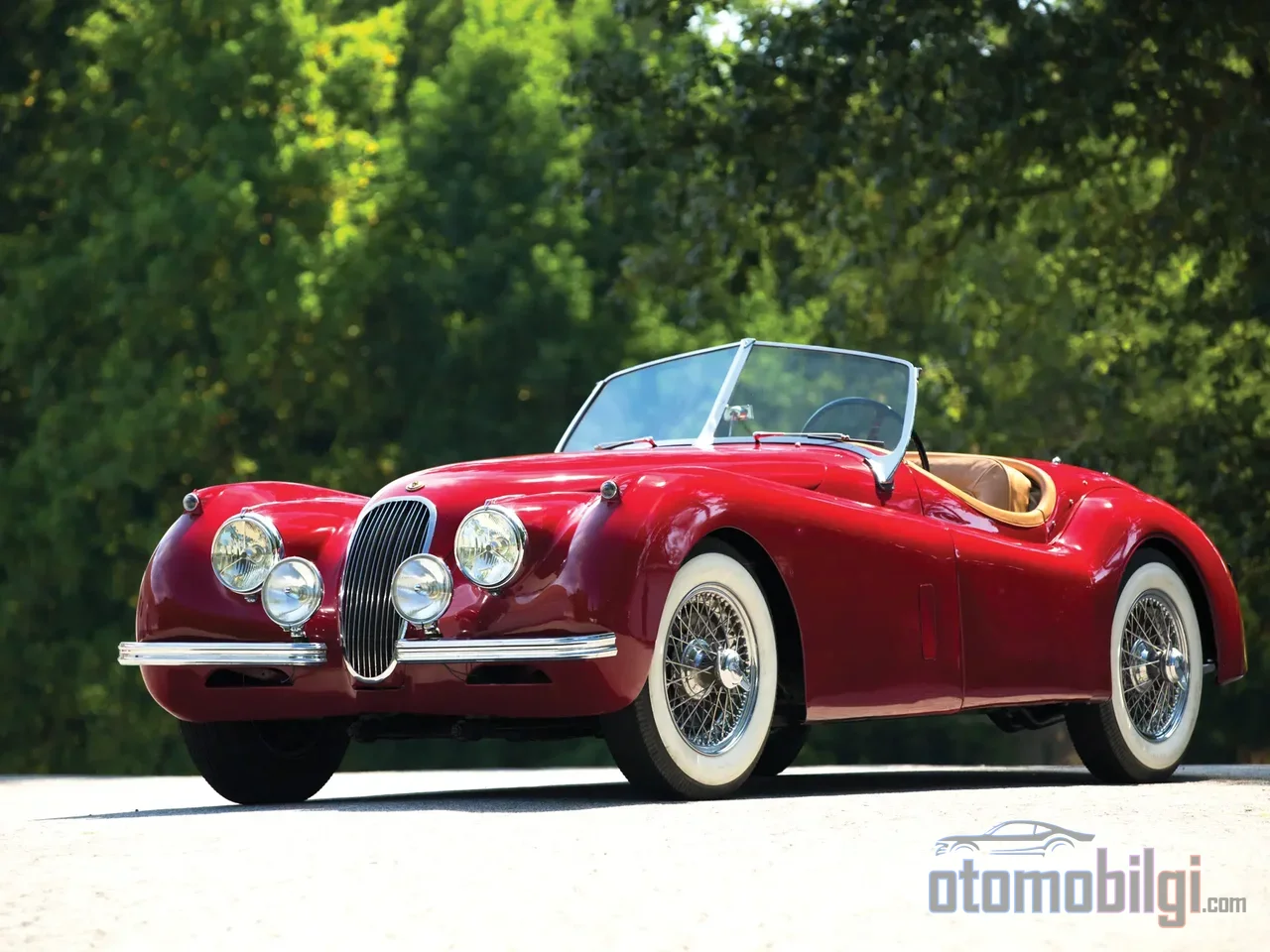
October 1948, the Earls Court Exhibition Centre in London. The war had just ended, Britain was still living on rationing, and people were looking at ordinary, small cars. In a corner, however, stood a roadster that was low, long-hooded, and with its curvaceous wings seemed to cry out speed even while standing still: the Jaguar XK120. In an environment where no one expected a sports car revolution, this car exploded like the biggest bomb of the pavilion. So how did this show car go into series production, become the world's fastest production car, and lay the foundations of the post-war sports car market? Let's get started, because this story is truly the kind that deserves a movie.
It Actually Should Never Have Gone into Production
Yes, you read that right. The XK120 was not originally planned as a production model. Jaguar's main goal was to showcase the newly developed XK engine at the 1948 London Motor Show. The engine was the real star; the car was like the showman carrying it. But the fair visitors were so enthusiastic, and orders and demand grew so much, that founder and design chief William Lyons decided on series production. The first production cars left the Holbrook Lane factory in Coventry in June 1949, and one of the first roadsters was delivered to a most unexpected name: Hollywood legend Clark Gable.
The car displayed at the show was the first prototype, and it was remarkably similar to the production version. What was the difference? Almost none. The only noticeable difference was the windscreen's outer posts: the posts that were straight on the prototype were made curvaceous in series production. That's all. So the show car brought to the show and the car sold were almost exactly the same, and this was an incredible situation for that era.
What Does "120" Mean?
The name comes from a very simple reason: the car's top speed was 120 mph, roughly 193-200 km/h. At its launch, the XK120 was the world's fastest production car. "X" represented the experimental engine type, and "K" stood for its sequence; at first the car was referred to as the "XK Open Two Seater Super Sport", and later the emphasis on speed would grow stronger.
Highlights
- The XK120 appeared at the 1948 London Motor Show as a showcase for the XK engine, and went into series production due to demand.
- On 30 May 1949, on the Jabbeke road in Belgium, a two-way average speed of 132.6 mph (approximately 213 km/h) was measured.
- The 3.4-liter inline six-cylinder XK engine produced 160 hp; in the SE version it rose to 180, and in the C-Type-headed option to 210 hp.
- Total production was 12,055 units: the most commercially successful high-end sports car of the post-war era.
- Its 1950 Le Mans performance triggered the birth of the Jaguar C-Type, which won Le Mans in 1951 and 1953.
The XK Engine: The Golden Letters on Its Forehead
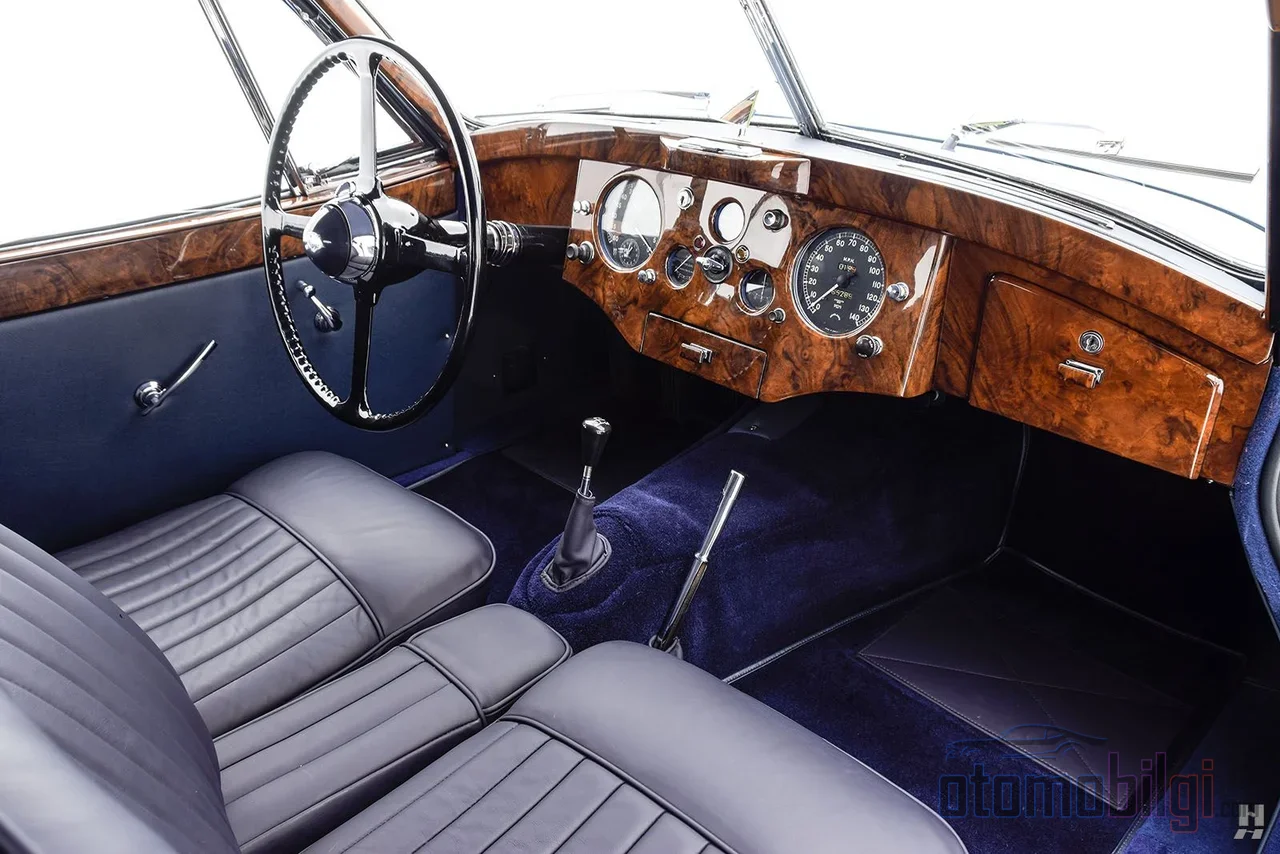
Now let's make a little engine stop, but don't worry, it's not like a lecture. The 3.4-liter (3442 cc) inline-six engine designed by chief engineer William Heynes carried double overhead camshafts. A cast-iron block, an aluminum head, and hemispherical combustion chambers; With two SU carburetors, it produced 160 hp at 5000 rpm and 195 lb-ft of torque at 2500 rpm. Let me give an analogy from everyday life: While the ordinary vehicles of that era were like a bicycle frame, the XK engine was like a lightweight running shoe on a marathon runner's legs. The gearbox was a four-speed manual made by Moss, and the chassis was a shortened, simplified, and lightened version of the MkV's.
The body side is also interesting: the first 242 cars were built with aluminum panels on a wooden frame. In early 1950, a full steel body was adopted, which added about 51 kg to the car. The aluminum-bodied version weighed about 1200 kg and, with a top speed of 125 mph, completed the 0-62 mph sprint in just over 9 seconds. Sounds ordinary today, doesn't it? For that era, this was equivalent to launching a rocket.
Jabbeke and Montlhéry: The Roads Where Records Were Born
May 30, 1949, the empty Ostend-Jabbeke motorway in Belgium. Test driver Ron Sutton is at the wheel of the prototype with chassis number 670002. While officials from the Royal Automobile Club of Belgium took the measurements, the car, with a small aero screen and an alternative top gear ratio, reached a two-way average of 132.6 mph, roughly 213 km/h. When a tonneau cover was fitted to the passenger side, it clocked 135 mph. Fully equipped, that is, with the windscreen, hood, and side windows in place, it still averaged 126.5 mph. So the 120 mph promise in its name was more than real; it was even exceeded.
The record hunt did not end there. The banked Montlhéry circuit in France became the new home of endurance records. In October 1950, Stirling Moss and Leslie Johnson averaged 107.6 mph over 24 hours. In August 1952, the team of Moss, Johnson, Bert Hadley, and Jack Fairman, with the fixed-head coupé version, covered 16,851 miles at a continuous day-and-night average of 100.31 mph over a full seven days, setting five class records and four world records. Driving nonstop at an average of 160 km/h for a whole week; imagine, more exhausting than studying on a bus for a week.
In October 1953, Jaguar test driver Norman Dewis, at Jabbeke with an XK120 modified with a glider-dome single-seat canopy, set a world record average of 172.4 mph over the flying mile. In April 1953, the same car had done 140 mph, and when a Pegaso beat it, Jaguar returned to the field. It was a matter of pride, after all.
The Shining Star on the Tracks: The Road to Le Mans
The XK120 began its racing career with a storm as well. In August 1949, Leslie Johnson won the 1-Hour Production Car Race at Silverstone, with Peter Walker finishing second just 5.6 seconds behind. In 1950, Johnson finished third in his class in the Palm Beach race in Florida; Phil Hill won the Pebble Beach Cup, Stirling Moss the Dundrod Tourist Trophy, and Ian Appleyard the Alpine Rally, all with the XK120. In the Mille Miglia, Johnson took fifth place overall. This car was not just a straight-line monster; it got the job done on every circuit.
But One Detail Is Very Important
The XK120 itself never won Le Mans. In 1950, it was in third position when it retired with a clutch failure. Here is the real story: Seeing this promising performance, William Lyons approved the development of the C-Type (XKC), and the C-Type won Jaguar's first Le Mans victory in its debut race in 1951, with Peter Walker and Peter Whitehead. The winning car covered the 3,611 km distance at an average of approximately 150 km/h. In 1953, the C-Type won Le Mans once again. So Jaguar's racing identity grew from the seed sown by the XK120. Not so the grandson could surpass the grandfather, but the grandfather paved the way for the grandson.
A Silhouette Drawn in Two Weeks
The design story is legendary as well. William Lyons shaped the body in less than two weeks in 1948, and one of the defining silhouettes of post-war automotive design emerged. Just think: today a vehicle's design process takes years, while Lyons drew a line that went down in automotive history in two weeks. Four wings wrap completely over the hood and flow toward the rear, Lucas headlamps are mounted inside the wings, and at the front a vertical oval grille dominates. The cockpit sits at the rear, with an easily removable split windscreen for racing. There is not even an exterior door handle; you enter by pulling an interior cord. Bare, pure, purpose-focused.
The XK120 was produced in three body types: the open two-seater roadster (OTS), from 1951 the fixed-head coupé (FHC) with lockable doors and a walnut-trimmed dashboard, and from January 1953 the drophead version (DHC) with a folding soft top. The SE, or Special Equipment, package that arrived in June 1951 raised the compression to 9.0:1 and delivered 180 hp; with the C-Type head in April 1953, 210 hp could be reached. Production ended in 1954, and its place was taken by the XK140. With a total production of 12,055 units, it became the most commercially successful high-end sports car of its era; although figures by body type vary by a few units in sources, the overall picture is clear.
| Version | Period | Highlighted Feature |
|---|---|---|
| OTS (Roadster) | 1948-1954 | Open two-seater, the original form |
| FHC (Coupé) | 1951-1954 | Fixed head, walnut-trimmed dashboard |
| DHC (Drophead) | 1953-1954 | Folding soft top, liftable windows |
Its Role in the Birth of the 300SL and the Chain of Icons
Here is the least known but most impressive part of the story. At Le Mans in 1950, Mercedes-Benz team manager Alfred Neubauer saw three Jaguar XK120s on the track and was seriously impressed. This impression played a role in the development of Mercedes' legendary SL line. The Mercedes 300SL, which entered the production line in 1954, is today considered one of the greatest icons in automotive history with its gullwing doors. So if we set up the chain: The XK120 set the fairs on fire, broke records, opened the road to Le Mans, and pushed rival manufacturers to build sports cars. It is mentioned among the most iconic vehicles of its generation's Europe and is described as the most influential sports car of the post-war period. It was the car that charted Jaguar's roadmap and built the bridge extending to the E-Type.
How Valuable Is It Today?
In the world of collectors, the XK120 still maintains its star status. As of 2026, a 1950 aluminum-bodied roadster in good condition is valued at around 215,000-223,000 CAD. Looking at 1954 models, sale prices range across a very wide band, from 13,000 dollars to 570,000 dollars; the median value is around 87,000 dollars. If the difference is this large, the reason is simple: body type, condition, and originality determine everything.
So, Did the XK120 Really Open the Door to the World of Speed?
The short answer: yes, it did, and it did so on three fronts. One: with its measured speed of 213 km/h at Jabbeke in 1949, it held the title of the world's fastest production car, making it possible for ordinary people to imagine crossing the 200 km/h threshold with a production car. Two: through the C-Type, crowned by the 1950 Le Mans performance and the victories of 1951 and 1953, it established Jaguar's racing identity; the brand's first Le Mans victory was precisely the product of this chain. Three: it spurred its rivals, Mercedes above all, into action and accelerated the birth of icons like the 300SL. With its production run of 12,055 units, it also proved that sporty cars could be a commercially serious market. A car that began as an auto show stunt opened the doors of modern sports car culture. Lyons was right: the XK120 was fast even when standing still; but according to history, it never knew how to stand still.
Sources
- Jaguar XK120 Guide - Supercar Nostalgia
- 1948-1954 Jaguar XK120 roadster - Carolina Jaguar Club
- Jaguar XK120 (1948 - 1954) - Supercars.net
- 1949 Jaguar XK120 - Concept Carz
- Jaguar XK120 - Wikipedia
- Jaguar Motorsport Moments - jaguar.com
- Jaguar C-Type - Wikipedia
- A History of the Mercedes-Benz SL - The SLSHOP
- 1950 Jaguar XK 120 valuation - Hagerty