How Did the Mazda MX-5 Turn Simplicity Into Victory?
Share This Page
With specs that looked ordinary on paper in 1989 - 114 horsepower, 955 kilos, two seats, a folding roof - the Mazda MX-5 managed to become the best-selling two-seater sports car in history. Its secret lay not in power, but in lightness and that perfect bond between driver and car. This is the story of a car that turned simplicity into victory.
Highlights
- First MX-5: 114 hp, 955 kg, 0-60 mph in 9.1 seconds
- In May 2000 531,890 units produced, a Guinness record
- On February 4, 2011 900,000.th vehicle produced; total sales exceeded 1 million
- 2026 model year price in the US starting from $30,730
Now think about it: you are introducing a car in 1989. No super speed in the ad, no massive engine, no flashy spoiler. A 1.6-liter engine, 114 horsepower - meaning weaker than even today's ordinary city cars. Hmm, how did this car become an icon? The answer is so beautiful that it remains one of the automotive world's favorite lessons: driving is not a speed race, it is a matter of feeling.
Jinba Ittai: What Does "Horse and Rider as One" Mean?
Mazda's magic word in this story is jinba ittai: in Japanese it means "horse and rider as one." The phrase comes from the Japanese tradition of mounted archery. The archer, on horseback, can act without thinking about what the horse will do - flowing with the horse as a single organism. Mazda's engineers sought exactly this in the car: the moment you turn the steering wheel, the car responds without hesitation, and you and the machine become one being.
This philosophy is not just a nice sentence; program manager Toshihiko Hirai led his team directly with this ideal. The intuitive bond between driver and car began as something unique to the MX-5, but over time it became embedded in the design backbone of all Mazda models. In other words, that idea conceived for a sports car project is the source of the harmony you feel even when driving a family car today. Pretty cool, isn't it?
It All Started with a Journalist's Curiosity
The leading role in this story belongs not to an engineer but to an automotive journalist: Bob Hall. While touring Mazda's headquarters in the late 1970s, he met R&D chief Kenichi Yamamoto and immediately spoke his mind: build a lightweight car that would keep alive the fading British roadster tradition. Hall later worked at Mazda's US branch, and Yamamoto brought the idea back to the table - and this time things got serious.
Hall's prescription was extremely clear. Front-wheel drive? No. Mid-engine? No. Fixed roof? Absolutely not. The formula: a folding roof, rear-wheel drive, and driving pleasure prioritized over performance. In other words, rather than joining the horsepower war, to produce the thing that makes a person smile. So why was this prescription so on target? Because in the late '70s British and European roadsters were dying off one by one - the market had emptied, and no one was filling that gap with a reliable product.
The War Against Kilograms
This is where Hall's biggest obsession comes into play: weight. Hirai is said to have been deadly serious about weight, and this obsession is felt in every centimeter of the car. For example, the backbone chassis idea was rejected due to collision safety; the strong panels required for side impact resistance came almost for free in a monocoque body, but when the backbone chassis was added on top, the car would have become heavier than its big brother, the RX-7. Can you imagine? If an MX-5 had been heavier than an RX-7, the project would have ended on day one!
There are other examples of the extreme attention to detail: a metal limit stopper was added to the gear lever to bring back that solid feel of the old British roadsters. Nobody would ever order such a thing; but those who love driving feel the difference instantly.
A Lotus Elan Copy? The Real Question Debated
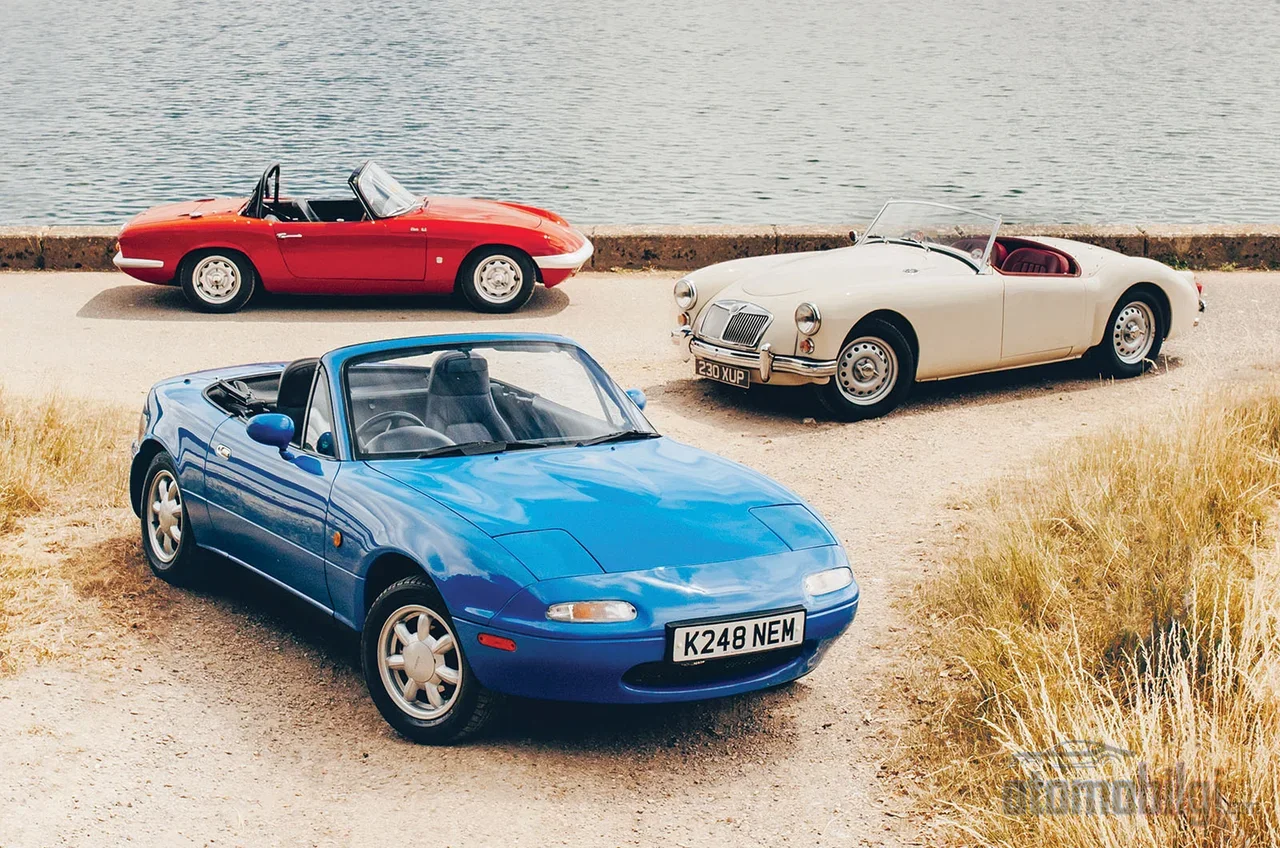
The popular narrative usually goes like this: the MX-5 is a modern copy of the Lotus Elan. But what is the truth? The situation is actually a bit more nuanced. The Power Plant Frame - that ingenious support structure connecting the gearbox to the rear axle and preventing gear shudder - was clearly inspired by the Elan. The Elan's sound and road-holding peak were also at the top of the MX-5's target chart. But according to Bob Hall, the story doesn't end here: the engine (apart from its sound) and body design were not inspired by the Elan. Most of the engineers even worked without ever seeing an Elan! Hall explains the external resemblance as "convergence" - two teams solving the same problem arriving at the same point, as it were.
And let's not forget the design's hidden history: the MX-5's famous pop-up headlights were not an aesthetic choice, but a necessity imposed by California's headlight height regulations. There was no Elan-like grille in the early designs; when frontal impact regulations moved the grille down below the bumper, that "Elan feel" emerged on its own. Mark Jordan's early sketches, on the other hand, looked more like a Ferrari than an Elan - there was even a 250GTO-inspired front character.
The Real Family Tree: British Roadsters
The MX-5's roots extend not to a single tree, but to a forest. The MG TD and Triumph TR2 laid the foundation. The Austin-Healey 100/6 brought everyday usability innovations: wind-up windows, an easily erected roof. The MGA Twin Cam (1958-60) showed Hall the pinnacle of the British sports car, and the Elan proved what sound and road holding should be like in the future. So the MX-5 is not a copy, but a distillation of 60 years of roadster wisdom. That's why, although there are many sources telling us "godfather" stories, the real picture is richer.
| Model | Engine | Power | Weight | 0-60 mph | Production |
|---|---|---|---|---|---|
| Mazda MX-5 1.6i (1989-97) | 1598 cc DOHC | 114 hp | 955 kg | 9.1 sec | 431,506 (Mk1) |
| Lotus Elan S2 (1962-73) | 1558 cc DOHC | 105 hp | 549 kg | 8.7 sec | 8,650 (Type 26) |
| MGA Twin Cam (1958-60) | 1588 cc DOHC | 108 hp | 977 kg | 13.3 sec | 2,111 |
Looking at the numbers in the table, doesn't it make you laugh? Even though the MX-5 is nearly one and a half times heavier than the Elan, it tested faster in the quarter mile - in one measurement the Elan was right ahead at 8.5 seconds, while the MX-5 reached 60 mph in 8.86 seconds and pulled ahead in the quarter mile with 16.78 seconds. Japanese craftsmanship versus a little British legend, and the score is nearly even!
One Million Sales: How Was the Record Broken?
Now let's get to the real bombshell part. The MX-5 first entered the Guinness Book of Records in May 2000 with 531,890 units produced and took the title of "the world's best-selling two-seater convertible sports car." Then, on February 4, 2011, production of 900,000 units was celebrated as a new Guinness record. Today, total sales have exceeded 1 million and the model is still selling in its fourth generation. That alone is not enough: Wheels Magazine chose it as Car of the Year in 1989, 2005 and 2016 - that is, across three separate generations; Sports Car International declared it the best sports car of the 1990s.
So is the secret of success really just "adding reliability to the British"? This is exactly where the debate comes to life. There is a strong objection to this popular explanation: after the MX-5, imitators with the same advantage appeared, like the BMW Z3. But the only name to reach 1 million was the MX-5. So reliability was necessary but not sufficient on its own; the real difference lies in being designed not to be fast, but to feel good.
Four Generations, One Idea
Following the generations of the MX-5 is like watching how a simple formula is preserved:
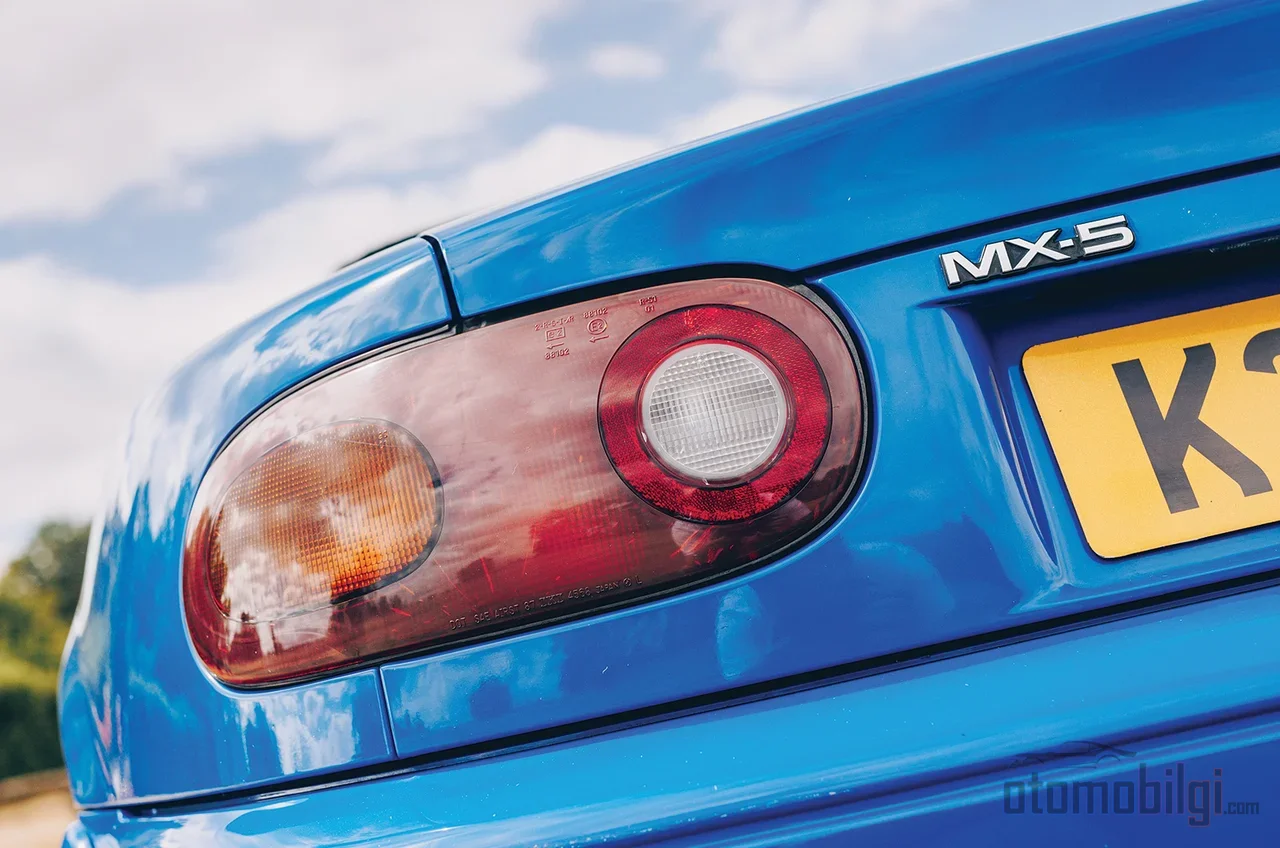
- NA (1989-1997): Pop-up headlights are unique to this generation; first a 1.6-liter engine (about 115 hp), then a 1.8-liter engine.
- NB (1998-2005): The pop-up headlights said goodbye; in 2004 the turbocharged Mazdaspeed arrived with about 180 hp.
- NC (2005-2015): The era of the optional retractable hard top and the 2.0-liter engine.
- ND (2015-present): Shorter and lighter than the previous generation; additionally, the RF (Retractable Fastback) coupe variant was added.
Meanwhile, in the automotive world, every new generation grows, gets fat, and loses its soul. The ND coming out lighter than the previous generation is proof of how stubborn this brand is. And the "Which Miata is the best?" debate never ends either: the NA is defended for its lightness, the NC for its superior balance and comfort. Which one are you on - the classic with pop-up headlights, or the modern and lightweight one?
Is the MX-5 Still Meaningful in 2026?
Yes, and even right now it is one of the most sensible purchases on the market. For the 2026 model year, the MX-5 in the US starts at $30,730 with the cloth-top version; two seats and limited cargo space are still part of the formula. Car and Driver says no significant change is expected for 2026; when models with automatic transmission arrive with 26 city / 35 highway / 29 combined MPG figures, the daily usability debate is closed as well. The Toyota GR86, Subaru BRZ and Honda Prelude are pointed to as the closest rivals.
So is the 2026 MX-5 an affordable sports car, or a future classic? The answer is both. In an era where everything simple, fun, and accessible is getting expensive, the MX-5 stands like a last bastion. Although forums talk about Mazda working on a new, lighter MX-5, this is not yet based on an official announcement - but we still haven't stopped dreaming, of course!
The bottom line: at a time when power and flash rule the world, the MX-5 proved that lightness and feel can become icons. A journalist's dream, a team's obsession with weight, and a four-letter Japanese philosophy - here before you is the best-selling roadster in history. Do you think simplicity has ever been this victorious?
Sources
- How the Mazda MX-5 was inspired by a pair of British roadsters - Classic & Sports Car
- 900000th Mazda MX-5 to Set New Guinness World Record - Mazda Newsroom
- The History Of The Mazda MX-5 Miata - MazdaUSA
- 2026 Mazda MX-5 Miata Convertible Roadster - MazdaUSA
- Mazda MX-5 - Wikipedia
- Always the Answer: A Brief History of the Mazda Miata MX-5 - OnAllCylinders
- Mazda Dictionary | Jinba Ittai - Mazda UK
- How the Mazda Miata Became the Best-Selling Roadster in History - Robb Report
- 2026 Mazda MX-5 Miata Review, Pricing, and Specs - Car and Driver
- Why this convertible remains the best budget sports car in 2026 - How-To Geek
- Rock 'n' roll: Mazda MX-5 Miata versus Lotus Elan - Remember Road
- The Mazda MX5 is not a modern day Elan, it's an MGB! - ViaRETRO
- 1990 Mazda Miata and the 1991 Lotus Elan SE - Medium/Motorious