Why Is the Ferrari 250 GTO Still the World's Most Expensive Car?
Share This Page
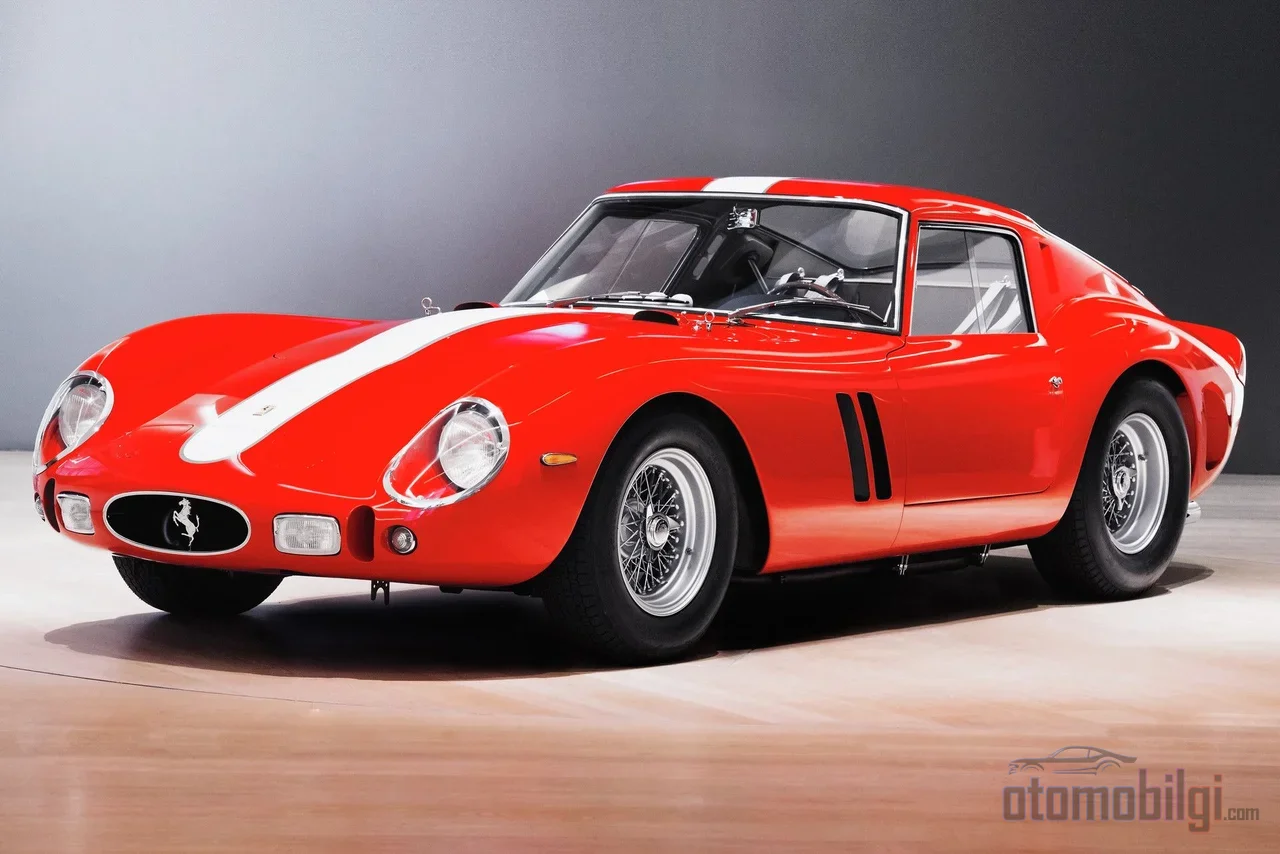
The Ferrari 250 GTO, of which only 36 units were produced between 1962 and 1964, which won consecutive class victories at Le Mans, and which today reaches 40-70 million dollars at auctions; that is, the blue chip of the automotive world, still standing at the very top of the world's most expensive cars. So how does a car appreciate this much? The answer to exactly this question is hidden in this car's story.
Highlights
- Total production: 36 units (1962-1964)
- Engine: 3.0-liter V12, approximately 300 PS
- Le Mans GT class victory: 1962, 1963, 1964
- Auction record: $48,405,000 (2018)
- In a private sale, the 70 million dollar level was exceeded (2018)
Why Is the 250 GTO So Expensive?
The short answer: Three things coming together at once. Low production, enormous racing success, and timeless design. There are very few other cars that bring these three together. Just imagine, we are talking about 36 cars in the entire global luxury car market. This is a rarity born of Ferrari stretching the rules and getting the job done with fewer vehicles, in an era when an entire class was needed.
For the FIA's Group 3 Grand Touring homologation, the rules were clear: You need to produce at least 100 vehicles within 12 months. Ferrari, however, got the job done with 36 vehicles by relying on the documentation of the previously homologated 250 GT SWB. The legend that the missing cars were lined up and photographed at the factory, thus shown as 100, is popular but not true; the number really is 36. And the madness is pure Ferrari: buyers were personally selected and approved by Enzo Ferrari and his North American dealer Luigi Chinetti. So the car was already, from the start, the key to an exclusive club. Its price when new in the US was around $18,000; practically free when compared with today's figures.
The Origin Story: The Answer Given to Rivals
In the early 1960s, Ferrari was struggling in the GT class. Facing it were serious rivals such as the Jaguar E-Type, Aston Martin DB4 GT Zagato, and later the AC Cobra and Shelby Cobra. Ferrari's answer was to mount a V12 from the Le Mans-winning 250 Testa Rossa onto the chassis of the 250 GT SWB, the best GT car until that time. The resulting name was also meaningful: Gran Turismo Omologato, that is, the homologated gran turismo. In short, GTO.
The Adventure of the Prototypes
It did not happen overnight. In 1961, two prototypes were tried. The first was a berlinetta with Pininfarina bodywork converted from the 250 GT SWB; it was eliminated with an engine failure at the 1961 Le Mans, but took a GT class first at the 1962 Daytona Continental with Stirling Moss. The second is another story: because of its roughly shaped aluminum body, the car nicknamed Il Mostro, meaning "The Monster" or "The Anteater", was tested by Moss at Monza and lapped faster than the 250 GT SWB. A strange-looking laboratory mouse laid the foundation of history's most valuable automobile.
Bizzarrini's Mark and the Great Resignation
Development was led by chief engineer Giotto Bizzarrini. Needless to say, someone who put real effort into aerodynamics; He had tests run in the wind tunnel at the University of Pisa, and designed a low, long nose, three air intakes, and in early tests a rear spoiler. Then came the famous crisis in Ferrari's history: In the major dispute of 1962, Bizzarrini and most of the engineers were fired. After development, it was carried forward in the hands of Mauro Forghieri and Scaglietti. So the design of the 250 GTO is not the signature of a single genius; it is a joint work born of a team effort, even from the midst of a crisis. The bodies were produced by Scaglietti, and even today this hand-made body is part of the car's identity.
Engine: The V12 from the Testa Rossa
The engine is the heart of the matter. The 3.0-liter (2,953 cc) Colombo V12 known as the Tipo 168/62 Comp comes from the Le Mans-winning version of the 250 Testa Rossa. Full aluminum block, dry sump lubrication, and six Weber 38 DCN carburetors. Power is approximately 300 PS @ 7,500 rpm, torque 294 N·m @ 5,500 rpm. On the transmission side, there was a new 5-speed gearbox with a Porsche-type synchromesh. For the time, these were serious technologies.
The chassis side is based on the 250 GT SWB: hand-hammered oval tube frame, A-arm front suspension, live rear axle with Watt's linkage, disc brakes, and Borrani wire wheels. The car weighs between 880-950 kg, with a wheelbase of 2,400 mm. So the power-to-weight ratio is still worth talking about even today. The interior is purely race-focused: no speedometer, fabric seats, no carpet or headliner. The metal shift gate detail became a tradition in later Ferrari models. And the bright red Rosso Cina went down in history as the car's most iconic color.
The Years That Became Legendary on the Track
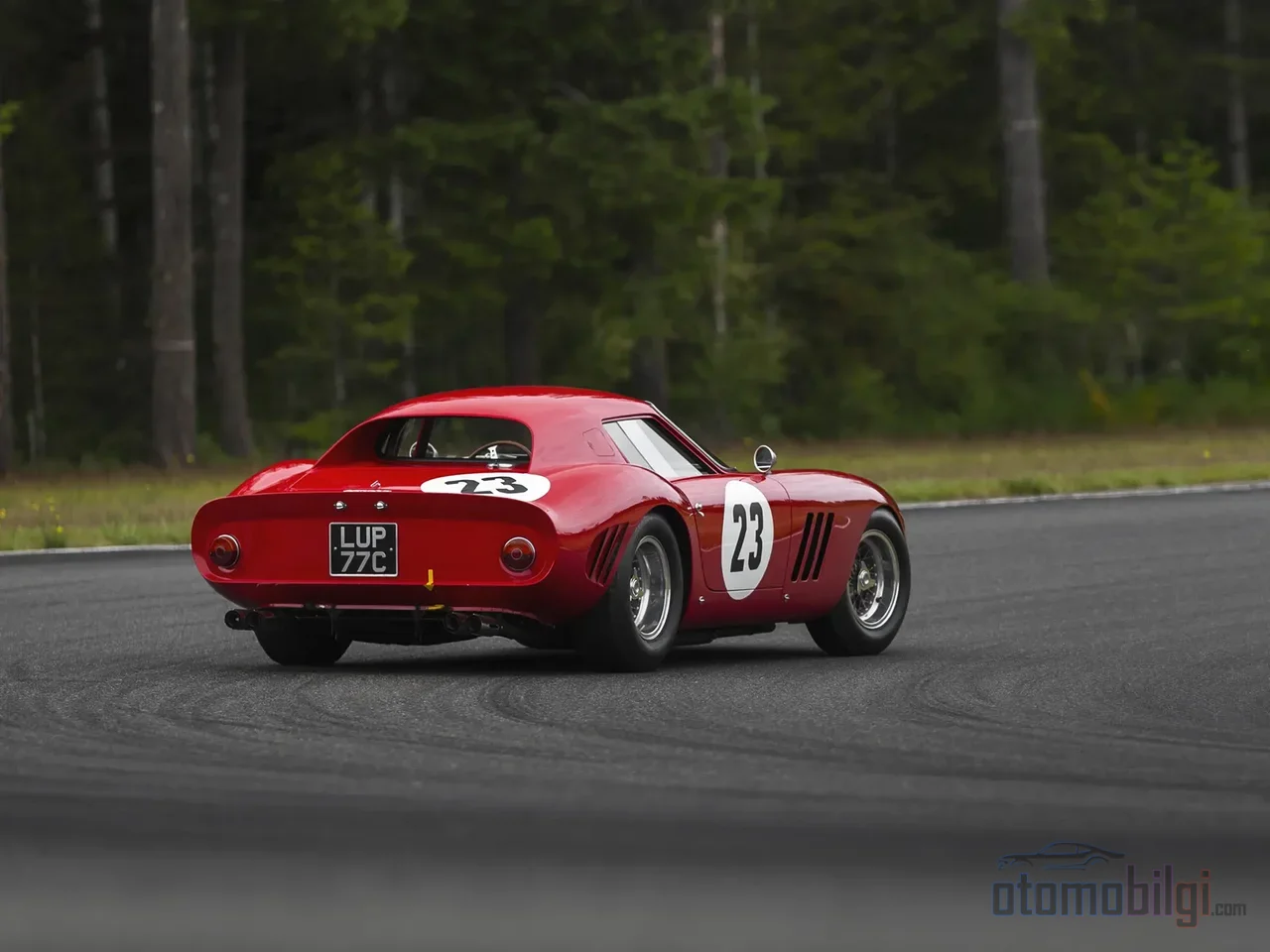
The 250 GTO's racing record is the strongest justification for its high price. Its debut came at the 1962 12 Hours of Sebring: second place overall with Phil Hill and Olivier Gendebien, while its sibling, the 250 Testa Rossa, sat at the top. Then came a GT class victory and second place overall at Le Mans in 1962 with Jean Guichet and Pierre Noblet; the GTO won the Le Mans GT class three years in a row in 1962, 1963, and 1964. Ferrari also closed the over 2,000 cc class of the FIA International Championship for GT Manufacturers as champion in 1962, 1963, and 1964. Victories in the Tour de France Automobile in 1963 and 1964 were a bonus.
There is also the story of the Series II-bodied cars in 1964. Phil Hill and Pedro Rodriguez took an overall first place at Daytona on behalf of NART; for a front-engined car to still be able to compete at that level of sportscar racing was nearly an impossibility under the conditions of the era. While rivals were shifting toward mid-engined designs, the GTO was one of the last front-engined cars able to compete at the top. Scuderia Ferrari raced the car until 1965, then gradually withdrew from the international scene.
Series II: The 1964 Body and Little-Known Differences
In 1964, Ferrari faced a dilemma: The FIA did not homologate the 250 LM for the 1964 GT class, and the GTO's competitiveness had to be preserved for one more year. Mauro Forghieri and Mike Parkes redesigned the bodywork; it was inspired by the aerodynamic features of the 250 LM. As a result of this update, 3 new cars were produced and 4 older cars were converted by the factory. Some sources count this group as 9 cars, saying they are distinguished by the "14 louvre" detail; the widely accepted figure, however, is the 3+4 scheme. The performance gain is nothing to exaggerate either, as the goal was mostly to update the aerodynamics. These 1964-bodied cars today form a separate category among collectors, and some see the value gap between them as a jump up a class.
Then there are the numbers mixed into the story: 3 units of the "330 GTO" were built with a 4.0-liter engine and a bulge on the hood; some counts raise the total to 39. The 330 LMB and 275 GTB/C Speciale are also sometimes referred to as GTO variants, but the core GTO story revolves around 36 cars.
Value History: From 4,000 Dollars to 70 Million
And here comes the craziest part. These cars once changed hands like ordinary used vehicles. In 1965, a 250 GTO was sold for 4,000 dollars; in 1969, the lowest recorded price of 2,500 dollars was seen. In 1977, Pink Floyd drummer Nick Mason bought one with his album earnings for about 35,000 pounds. In 1985, Ralph Lauren bought one for 650,000 dollars. Then the ceiling came crashing down: 13.3 million dollars in 1989, a retreat to 2.5 million dollars in 1996 during the 1990s crisis, then a climb back up.
On the auction side, the milestones are as follows: In 2014, a 250 GTO sold for 38,115,000 dollars, making it the most expensive car ever sold at auction at the time. In August 2018, at an auction in Monterey, 48,405,000 dollars was paid including the buyer's premium; this still stands as the record for the most expensive car sold at auction. In June 2018, in a private sale, 70 million dollars was discussed for a 1963 GTO, and this is accepted as the highest recorded price for a Ferrari. In November 2023, at an auction in New York, a 1962 330 LM/250 GTO went for 51,705,000 dollars; some publications present this as "the most expensive Ferrari ever sold," but the 70-million-dollar private sale still leads.
2026 turned out to be an interesting year. In January 2026, at Mecum Kissimmee, Bianco Speciale, the only GTO delivered in white from the factory, sold for 38.5 million dollars. Expectations were in the 60-70 million dollar range; the result fell well short of expectations. Some read this as the blue-chip segment cooling off, while others see it as simply a mixed year. In short, record sales are still at 2018 levels, but the market is no longer climbing as fast as it once did.
Is It Still the Most Expensive Car in the World Today?
The honest answer: The question of who holds the auction record is a bit tangled, but the 250 GTO's position at the top remains solid. The $70 million private sale still stands as a Ferrari record; the Mecum sale in 2026, however, sent a cooling signal on the auction side. Yet there is one thing nobody can deny: When a production run of 36 cars, three Le Mans class victories, and decades of recorded value appreciation come together, the 250 GTO cannot stop being the blue chip of the collector car market. So by "blue chip" we mean a car that, like Apple in the stock world, is always reliable and always positioned as the most valuable asset. The 250 GTO is exactly that.
Its legacy: Why Are We Still Talking About It?
The story of the 250 GTO is like a textbook on how a car becomes an icon. Rarity alone is not enough; there are other cars built in just 36 units, but nobody is paying $70 million for them. Racing success alone is not enough either; there are plenty of Le Mans-winning cars. Becoming an icon happens when engineering brilliance, Scaglietti's hand craftsmanship, Enzo's buyer-selecting ritual, and 60 years of value appreciation all stack on top of each other at the same time. Moreover, in the hearts of the Tifosi, this car is the symbol of one of the most romantic eras of the racing world: an era when rivals were serious, winners were decided on the track, and technology fought from scratch every year.
Today, getting inside the door of a 250 GTO is a lifelong dream for many people. What would you pay for this car if it were yours? Or better yet: If you could have bought one for $4,000 in 1965, would you still keep it in your garage, or would you have sold it and bought a house? While you think about your answer, I am sure of one thing: The name of the 250 GTO will be remembered until the very last page of automotive history.
Sources
- Ferrari 250 GTO
- Ferrari 250 GTO (1962) - Ferrari.com
- Ferrari 250 GTO, fifty years on…
- Ferrari 250 GTO: The Ultimate Guide
- Ferrari 250 GTO Achieves $38,115,000 - Bonhams
- The Most Expensive Ferrari Ever Sold - Car and Driver
- Ferrari 250 GTO auctioned for $38.5 million - The Supercar Blog
- Collector Car Market Update: 2026 H1 - Lockton
- Is the Ferrari 250 GTO Yesterday's News?
- Art & Muscle - Avants