How Did the Ferrari Testarossa Become a Pop Icon of the 80s?
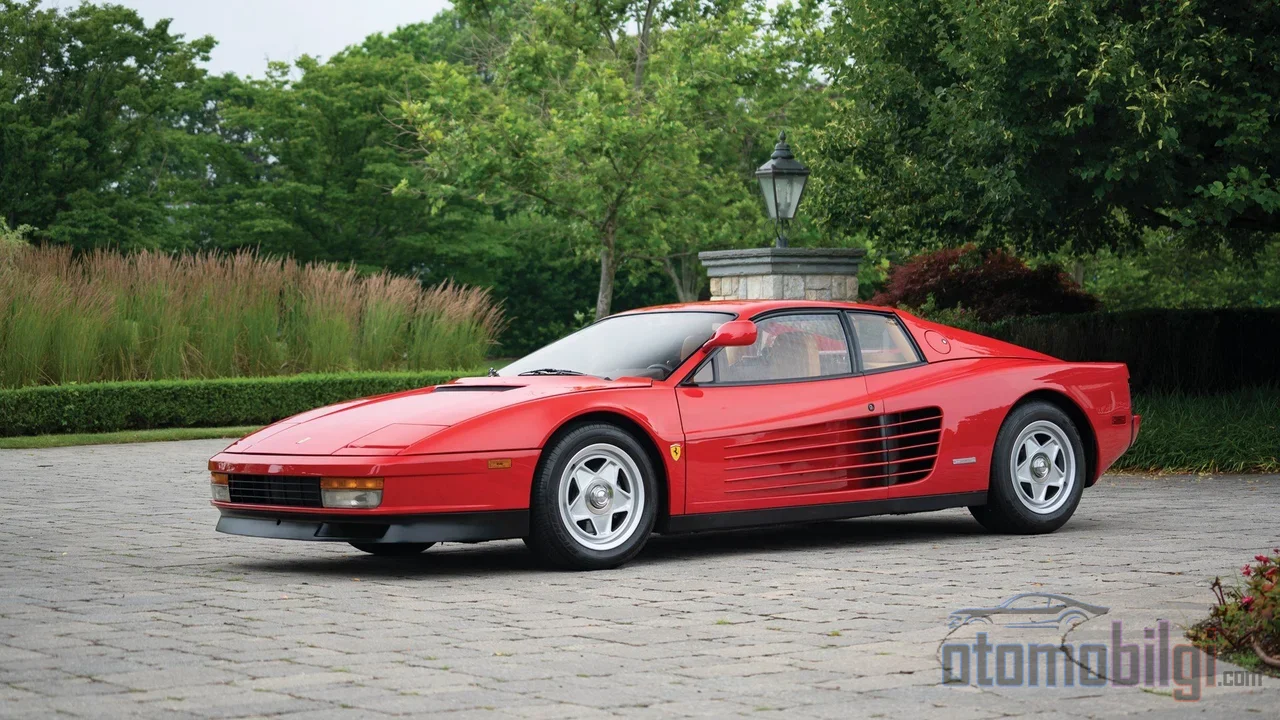
What hung on the wall of a high school in 1985? Most likely a red Ferrari, complete with those famous cheese-grater side strakes... But why was this car never remembered as just a car? The story of the Ferrari Testarossa is less a tale of engine legend and more a cultural journey through TV screens, arcade halls, and bedroom posters. If you're ready, let's take a look behind the curtain of the brightest red of the '80s.
First, let's admit this: The Testarossa was not a groundbreaking car in a technical sense. Yes, with its 4.9-liter 12-cylinder boxer engine producing 390 PS, a 0-100 km/h acceleration of 5.8 seconds, and a top speed of around 290 km/h, it was an impressive machine. But it wasn't the pistons that made it a legend. What made it a legend was precisely its appearance in the Florida nights of a TV series in 1986.
The Wide Shoulders Born at the Paris Motor Show: 1984 Debut
Ferrari unveiled the Testarossa (Type F110) at the 1984 Paris Motor Show. The car was the successor to the Berlinetta Boxer, known as the 512 BBi, and bore the signature of Pininfarina. In the design team, Leonardo Fioravanti served as design chief; Emanuele Nicosia initiated the design, while Ian Cameron, Guido Campoli, and Diego Ottina were also on the team. Fioravanti's aerodynamic expertise was one of the key factors that shaped the final form of the drawing.
The result? A bold and assertive body, half a foot wider than its predecessor at 1,976 mm. In Ferrari's own words, this design is regarded as a remarkable example of form serving aerodynamics and a revolution in Ferrari design. Sergio Pininfarina, however, politely described the drawing as an exaggeration of flashiness - and he was right; that very exaggeration would become the car's greatest weapon.
How Did the Strakes Become a Regulatory Accident?
Here's my favorite part of the story: those famous side strakes - nicknamed the cheese grater or egg slicer in English-speaking countries - were not an aesthetic freedom, but a regulatory necessity. Some countries did not allow large open holes in the bodywork. The designers first tried to shrink the radiator intake, then turned the problem into a style statement. The emblem of the late '80s was born from bureaucracy being forced into creativity.
There were smart moves on the technical side, too: twin side-mounted radiators replacing a single front-mounted radiator solved the problem of the predecessor 512 BBi's cabin overheating. With a drag coefficient of 0.36, it was significantly better than the Lamborghini Countach's 0.42 - so much so that no rear spoilers were needed. The single side mirror, positioned high on the driver's side, gave the car a distinctive silhouette; on US models, the mirror was lowered in 1987 and a passenger-side mirror was added.
Highlights
- The Testarossa was unveiled at the 1984 Paris Motor Show with its Pininfarina design.
- The 4.9-liter naturally aspirated flat-12 engine produced 390 PS of power and 490 Nm of torque.
- A total of 7,177 units were produced from the original Testarossa; all versions combined reached approximately 10,000 units.
- Before its placement in the Miami Vice series, the car was actually a Corvette-chassis replica in the first two seasons.
- The side strakes were born from the meeting of body-hole legislation in some countries with the design language.
Where Does the "Red Head" Name Come From?
The Testarossa name is not a marketing invention, but a tribute. The name, meaning "red head" in Italian, refers to the red-painted valve covers on the 12-cylinder engines. The actual reference goes back to 1957: The 250 Testa Rossa had won the World Sports Car Championship that year and reached the Manufacturers' World Championship in 1958. Ferrari engineers, led by Carlo Chiti, developed the Colombo-designed 3.0-liter V12 engine, achieving over 300 hp and speeds above 160 mph.
So when you bought a Testarossa in 1984, you were buying not just a wide-hipped supercar, but a surname woven from Ferrari's racing victories. So how did this prestigious name become a legend on television channels instead of roads? That's where Miami comes in.
Miami Vice: A Replica Scandal and a Real Ferrari
Now let's move on to one of the greatest TV anecdotes of all time. In the first two seasons of Miami Vice, the black Ferrari driven by Crockett wasn't even a real Ferrari! It was a replica built on a Corvette chassis - and Ferrari was not at all pleased about it. According to reports, Enzo Ferrari was bothered by the publicity the replica generated and proposed a mutual agreement: the replica would be removed from the series, and Ferrari would provide real Testarossas. Thus, starting from the 1986 season, that iconic white Testarossa began appearing on screens.
The story doesn't end there. Thanks to Enzo Ferrari himself being a Miami Vice fan, Don Johnson was given a silver Testarossa as a gift following the white car in the series. Producer Michael Mann, meanwhile, owned a specially painted blue metallic Testarossa. The series itself was also heavily fed by 80s New Wave culture: The music of artists like Glenn Frey and Tina Turner, along with music and fashion choices, offered a flawless 80s aesthetic package - and at the top of that package was a white Testarossa.
From Arcades to Yuppie Culture
That same year, in 1986, Sega's arcade game Out Run was released, and this game, set on sunny coastal roads with a red convertible, cemented the Testarossa's place in popular culture. This meeting of the television screen and the arcade screen was decisive in the car becoming identified with 80s "yuppie" culture. After Miami Vice, the car's public recognition took a huge leap; the Testarossa was no longer a car magazine topic, but had become a wheeled summary of an era's fashion, music, and aesthetics.
The list of famous owners completes this picture: Elton John, Rod Stewart, Michael Jordan, Mike Tyson, Alain Delon, M.C. Hammer, Dr. Dre, John Carmack, and F1 driver Gerhard Berger. Is there any trump card as important as who the buyers were for a car to become a wall poster?
Poster Wars: Testarossa or Countach?
On the walls of the 80s, the Testarossa was never alone; the Lamborghini Countach was always there. This duo is the constant centerpiece of "ultimate 80s poster car" debates, and it is a showdown the Top Gear team has compared as well. It is said that the Countach actually appeared in 1974 with much simpler lines, while the Testarossa was seen as a more modern and cleaner design within the 80s. In comparison tests, the Countach pulled ahead in corners while the Testarossa had the advantage in straight-line speed.
An interesting statistic: Between December 1984 and July 1989, the Testarossa appeared on the cover of an automobile magazine a full 10 times - but in comparison tests it could be beaten by the Countach, the Alpina B10 Bi-Turbo and the BMW M5. The press's technical praise was limited; its cult status was limitless. The gap between these two actually summarizes the main thesis of our article all by itself.
The Fender Fad: The Cultural Legacy of the Side Strakes
The most tangible evidence of cultural influence was the imitation attempts: the side strakes gave birth to a broad body kit fad, ranging from the Pontiac Fiero to Mazda pickups ("Truxtarossa" kits!) and even the Honda VFR motorcycle. The popularity of today's wide-body aesthetic in the aftermarket world can also be seen as a continuation of this legacy. A single design detail had launched an entire industry.
Production Figures and Today's Collector Value
The Testarossa became one of the most produced models in Ferrari history: Between 1984 and 1991, 7,177 original Testarossas were built, followed by 2,261 units of the 512 TR between 1992 and 1994, and 501 units of the F512 M between 1994 and 1996 (75 of them for the North American market). Around 10,000 units in total - a phenomenon so big it cannot be expressed in numbers for Ferrari, and it is remembered as the most successful model in the history of 12-cylinder Ferraris.
| Version | Production Years | Units |
|---|---|---|
| Testarossa (original) | 1984–1991 | 7,177 |
| 512 TR | 1992–1994 | 2,261 |
| F512 M | 1994–1996 | 501 |
So where is it today? An average Testarossa sale hovers in the range of roughly $130,000–180,000; the F512 M, meanwhile, can reach up to $1.2 million at auction. In terms of the driving experience, forums describe it as a fast and comfortable road car, not a track car - in other words, it was received more as a lifestyle statement than a driving passion, and that is how it is collected today as well.
Why Did Its Name Become So Iconic? The Short Answer
If I had to compress the essence of this story into a single sentence: The Ferrari Testarossa built a solid foundation with the clever, regulation-born solution of its straked design and the prestige of its 1957 racing heritage, but what made it an icon was Miami Vice, Out Run, wall posters and 80s yuppie culture - not a technical revolution, but a popular culture victory. Although it lost to some of its rivals in comparison tests in the automotive press of the era, no rival ever came close to its cultural reach.
In 2026, the Name Returned
The final act of the story has yet to be written: Ferrari has revived the Testarossa name with the 849 Testarossa. The new model sets an absolute record for a production Ferrari with its maximum output of 1,050 cv, and arrives with a retro styling emphasis; European deliveries begin in the second and third quarters of 2026, and prices are being discussed at roughly between 565,000 and 634,000 dollars. This name, stretching from the red-valve-covered ancestor to the modern grandchild of hybrid power, has continued to live in pop culture for 40 years.
Looking back, what the Testarossa taught us is simple: some cars become immortal through their engines, others through their stories. The Testarossa carried both, but it found its heart on the screen, on the poster, and in the arcade joystick. The next time you see those strakes, you will now know what you are looking at: the signature of an era with a red head.
Sources
- Ferrari Testarossa
- MASTERPIECE OF STYLE: Ferrari History
- The Original 1:1 Scale Pininfarina Ferrari Testarossa Design Study
- Your handy Ferrari Testarossa (1984-1991) buyer's guide
- Ferrari Testarossa: Specs, Price & the 1980s Flat-12 Icon
- The origin and launch story of the 40-year-old Ferrari Testarossa
- Ferrari 250 Testa Rossa