Ferrari F40: Still One of the Most Sought-After Modern Classics
Share This Page
Just imagine: the most passionate car man in the world, approaching the end of his life, puts pen to paper one last time. What he is about to leave behind is not a will, but a car. What's more, that car has no carpet, not even a door handle - instead, a cord. And because of these "missing parts," it has become a legend that is hard to find on the market today. Yes, we are talking about the Ferrari F40, and isn't it absurd that fewer parts can mean more money?
The story of the F40 is not an ordinary launch story. It is not the product of a giant corporation's marketing plan, but of the stubbornness of an old, stubborn man. What I will tell you in this article is exactly this: why do some cars become more than fast - they become a cult? I will go through one by one the birth story of the F40, its deliberate sparseness, its Wall Street adventure, and today's auction madness. Buckle up, turbo boost is coming.
Key Highlights
- The last model personally approved by Enzo Ferrari: The F40 was unveiled on July 21, 1987.
- Twin-turbo 2.9-liter V8: 478 PS of power, 577 Nm of torque, a top speed of 321 km/h.
- Launch price of $399,150; in 1989 it sold for up to seven times its list price.
- A total of ~1,315 units were produced; it had no carpet, no sound system, and no door handles.
- Today, good examples fetch over $3.6 million, and a low-mileage example sold for $6.6 million.
Enzo Ferrari's Last Signature: How Was the F40 Born?
In 1987, Ferrari was celebrating the 40th anniversary of its founding. What such a year obviously calls for is a celebration car. But the F40's real adventure began earlier. Chief engineer Nicola Materazzi brought an idea to Enzo Ferrari's desk in 1984: to build a monster for a racing category called Group B, where road cars had to prove their performance on the track. A small team began working on the 288 GTO Evoluzione on Saturdays - to answer this category, in which the Porsche 959 was also competing.
Then the FIA ended Group B at the end of 1986. Though it seemed like bad news, it was actually quite the opposite: that crazy program developed for racing turned into a road car. The project officially began on June 10, 1986, and a single instruction came from Enzo Ferrari: the car was to be finished in 11 months. The strange detail is this - even the unveiling date was changed by one man's stubbornness. When Enzo learned that Fiat would present the Alfa Romeo 164 at the Frankfurt Motor Show, he demanded the launch be brought forward by more than two months. The result: on July 21, 1987, the F40 made its debut at the Civic Centre in Maranello.
And the most emotional part of the story: this became the last Ferrari personally approved by Enzo Ferrari. The man passed away the following year, in 1988. So the F40 is not just an anniversary car; it is the final sentence of an era, of a man, of a vision. The plan at launch was 400 units - but a total of somewhere between 1,311 and 1,315 would be produced, 213 of which were destined for the US.
F40 vs. the Porsche 959: Technology or Passion?
The 1980s supercar scene resembled an arms race, and on the other side of the ring stood the Porsche 959. The F40 was both a 40th anniversary celebration and, it is said, an answer to the 959. But Ferrari's marketing people kept these two reasons apart: they say the F40 would have been produced even without the 959, because the F40 was the product of an entirely different philosophy. The comparison between the two cars is still the spice of conversations today - while the 959 is described as a spaceship, the F40 is found raw, loud, and unfiltered.
So what did the period tests say? In 1988, Ferrari invited journalists to Fiorano and asked them to try the 959. The general verdict of the major car magazines was that the 959 was technically more mature. The F40, however, won on the emotional side, that is, on the heart side. At Nardò, Ferrari could not exceed 321 km/h with two cars; the Porsche 959 S (339 km/h) and the Ruf CTR (342 km/h) overtook it. But here is the interesting part: The F40 did not surrender the title of the fastest production vehicle with more than 500 units produced to anyone until the Lamborghini Diablo arrived. Who could refuse such a title?
The F40's Technical Specifications: A Legend in Numbers
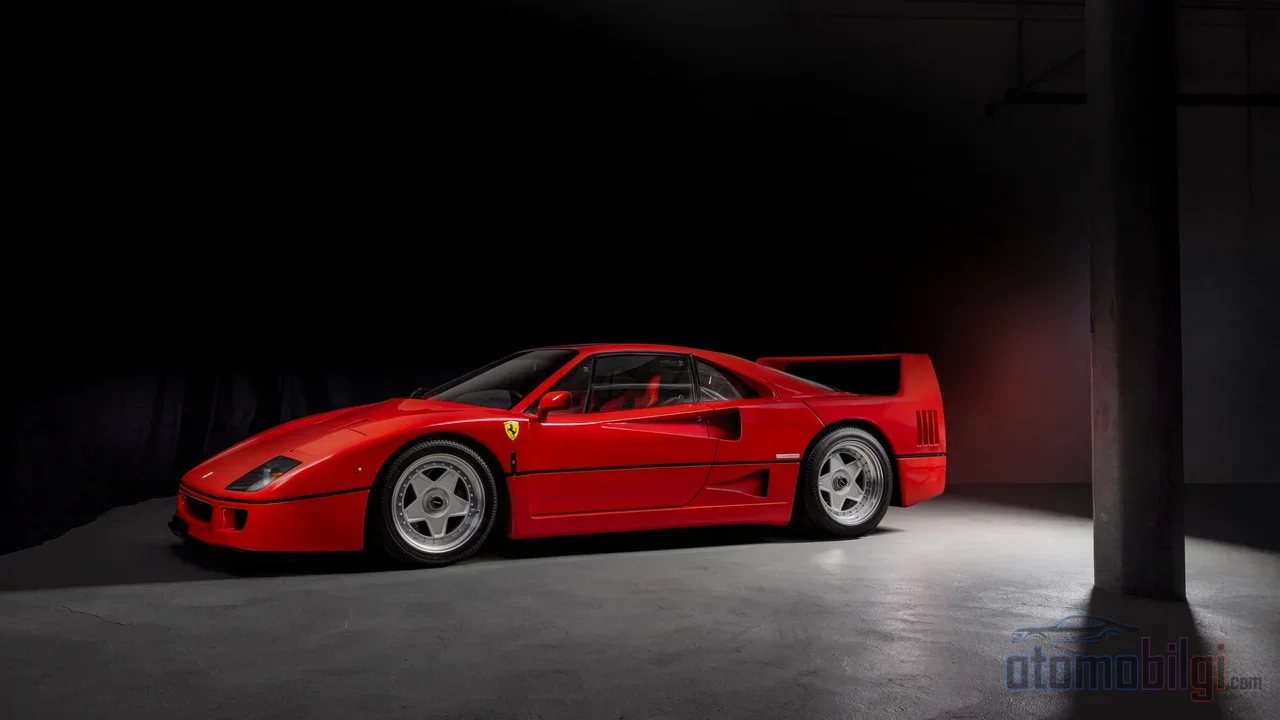
Now, to the real question: why is this car talked about so much? Let's look at the technical picture. The body came out of Pininfarina, from the hand of Pietro Camardella and under the supervision of Aldo Brovarone. Kevlar, carbon fiber, and aluminum panels were used - so not classic steel sheet, but practically space-age materials. The drag coefficient is Cx=0.34. In an independent measurement, 0-100 km/h was clocked at 4.7 seconds, with a top speed of 321 km/h. For 1988, these were science fiction numbers.
| Specification | Value |
|---|---|
| Engine | 2,936 cc (2.9 L) twin turbo, intercooled 90° V8 |
| Power | 478 PS @ 7,000 rpm (US version 484 PS) |
| Torque | 577 Nm @ 4,000 rpm |
| Transmission | 5-speed manual |
| Kerb weight | 1,254 kg (Europe), 1,369 kg (US) |
| Dimensions | 4,430 mm length, 1,970 mm width, 1,124 mm height |
| Production | 1987-1993, approximately 1,315 units |
One more oddity: The F40 became the last car with a forced-induction engine (that is, turbocharged or supercharged) in Ferrari's lineup until the California T in 2014. In other words, Ferrari abruptly shut down its turbo line and returned to naturally aspirated engines only for years. For the 80s, turbo meant the future; Ferrari's step back actually shows how detached the F40 was from the pragmatism of that era, and how emotional it was.
Deliberate Simplicity: No Carpet, No Glass, No Conveniences
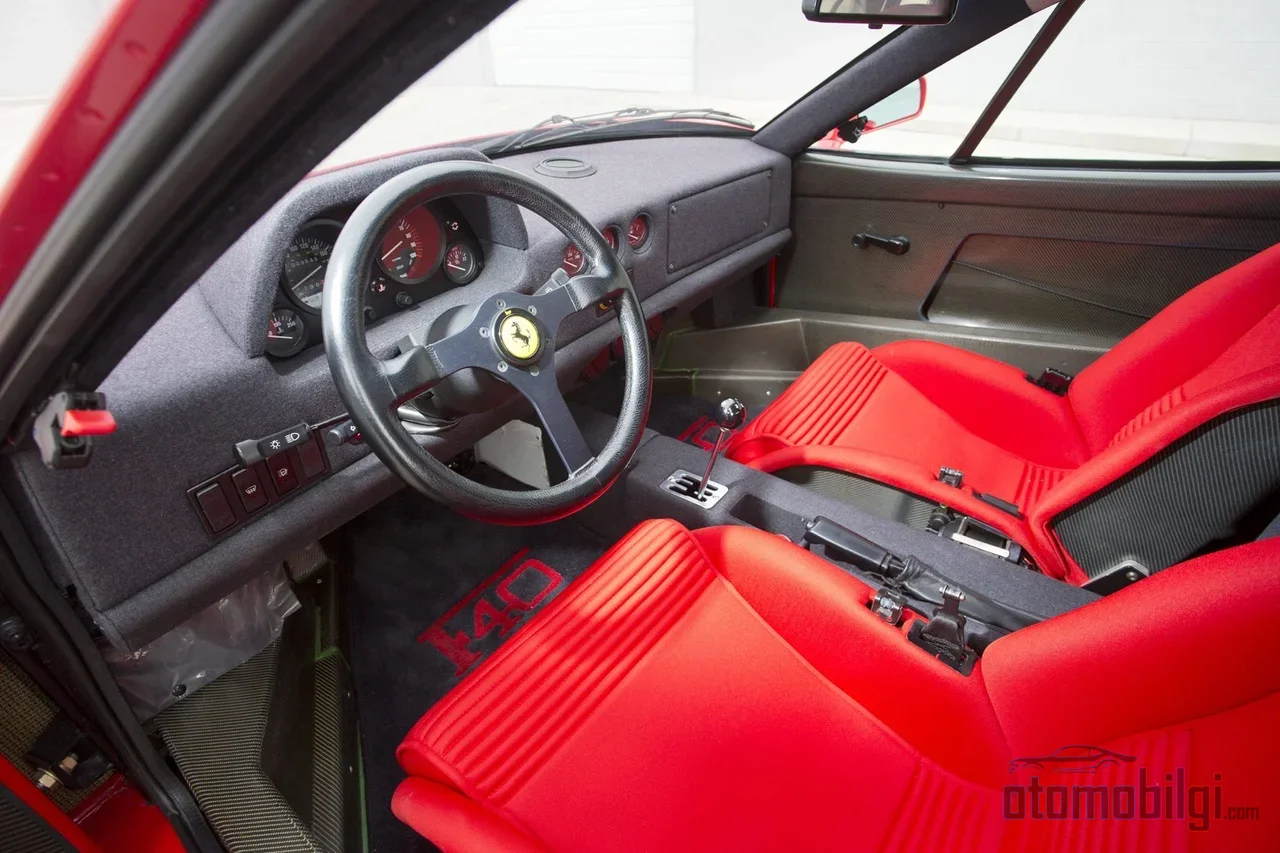
This is the part that truly turned the F40 into a legend. Most car brands try to say "the most luxurious, the most comfortable" at launch. Ferrari did exactly the opposite: The F40 has no sound system. There is no glovebox. Leather upholstery, carpet, door panels - nothing, nothing at all. There isn't even a door handle; in its place there is a cord you grip and pull. There is a mid-level version of air conditioning, but this was a kind of pact of sacrifice made not to sit in a luxury vehicle, but to take a race car out into traffic.
Even the windows are not glass: polycarbonate, i.e. plexiglass, is used instead. The first 50 cars have sliding Lexan windows; later cars switch to roll-up windows. All cars leave the factory in Rosso Corsa with left-hand drive - the only exception being the at least seven right-hand-drive modified examples built for the Sultan of Brunei. Pirelli also joins the game, developing a special asymmetric-tread P-Zero tire with a Kevlar-reinforced carcass for the F40. So this car, piece by piece - from its tires to its glass - serves a single goal: lightness. On some cars the paint is so thin that the raw carbon fiber beneath can be seen - would you read this flaw as a flaw, or as proof of perfection?
This minimalism did not please everyone at the launch. Some observers, looking at the prices paid for the 288 GTO and the 959, saw it as a calculated money-making move. Over time, that judgment reversed completely: those "shortcomings" turned the car from an expensive technology showcase into a true driving machine. Today, for many, this is the heart of the idea that it is, in any case, the greatest road Ferrari of all time. Technology can age; passion does not.
The F40's Price Journey: From the Wall Street Bubble to 6.6 Million Dollars
The 1987 launch price was $399,150 - roughly five times that of the 288 GTO, more than 1 million dollars in today's money. But what was included in the price was not just the car: buyers also received a factory visit and driver training. So going to Maranello to take delivery of your car was a natural part of F40 ownership.
Then Wall Street culture of the 1980s came into play. Money was plentiful, the status competition was heating up. Speculators even planned to wait for Enzo Ferrari's death and profit from the price increase. In 1989, the F40 sold for up to seven times its list price. Just imagine: you buy a car, and without ever driving it, your fortune multiplies. By 1990, the bubble bursts, and it is estimated that only 10 percent of the delivered cars were used - the cars were no longer vehicles but assets sitting there like banknotes. Meanwhile, the racing world does not stand still: In the F40 LM version, the same 2.9-liter twin-turbo V8 is tuned to up to 720 hp; the Competizione, with 700 PS and about 367 km/h, moves onto a whole different orbit.
The price chart tells a dramatic story of ups and downs: In 1990, an F40 owned by Nigel Mansell sold for a period record of 1 million pounds, and that record remained unbroken into the 2010s. In 2003, the car could be had for around $308,000 - the bottom of the bubble had been reached. Then the collectible value rose again: figures of around 3.6 million dollars are discussed for a good-condition 1987 F40, and average transaction values follow a similar trajectory. A low-mileage example found a buyer for 6.6 million dollars. Modified examples, meanwhile, are being repriced at a much bigger discount than "pure" cars; in other words, the market is paying increasingly more for originality.
Why Is the F40 Still One of the Most Sought-After Modern Classics Today?
The answer to the question has several layers. First: the story. A car born with Enzo Ferrari's personal approval, the last signature before his death - this is a legacy that no marketing budget could buy. Second: rarity. A production run of approximately 1,315 units is not an insignificant number by today's demand, but it is not very large either. Third: philosophy. Against modern supercars drowning in electronic aids, the F40's deliberate simplicity becomes more valuable every year. The shared opinion of many experts is that in today's world of safety and regulation, a car like the F40 could never be produced again - and this very impossibility is the very thing that makes the car special.
In 2026 the modern classic market is alive; rare Ferraris are leading the way, and the dollar volume in the modern classic market is growing dramatically. The F40, meanwhile, has now gone beyond the automotive world: collectors, musicians, sports stars - the car is referred to as a cultural phenomenon and the ultimate status symbol. More beautiful, faster and rarer Ferraris have been produced; but none is considered as special as the F40. Perhaps the summary of the whole story lies hidden in this sentence: The F40 was not a technological peak, but an expression of passion - and passion has no expiration date.
Sources
- Ferrari F40 - Wikipedia
- Ferrari F40 (1987) - Ferrari.com
- Enzo's final masterpiece: The F40 - Ferrari.com Magazine
- 1987 Ferrari F40 Base Value - Hagerty Valuation Tools
- Ferrari F40 Market - Classic.com
- The Revenge Of Pure Gas: F40 Values Surge 66% Above Hagerty Value - CarBuzz
- Ferrari F40 values 2026: originality premium widens - Classictimers
- The Last True Race Car for the Road - Hypebeast
- Collector car market: performance, trends, and opportunities - Lombard Odier
- Ferrari F40 Specs, Price, Production & F40 LM History - Ferrari Lake Forest
- Ferrari Market 2026: Recent Auctions & Models to Watch - digitalautofi