Why Is the Lancia Stratos Considered a Revolution in Rally History?
Share This Page
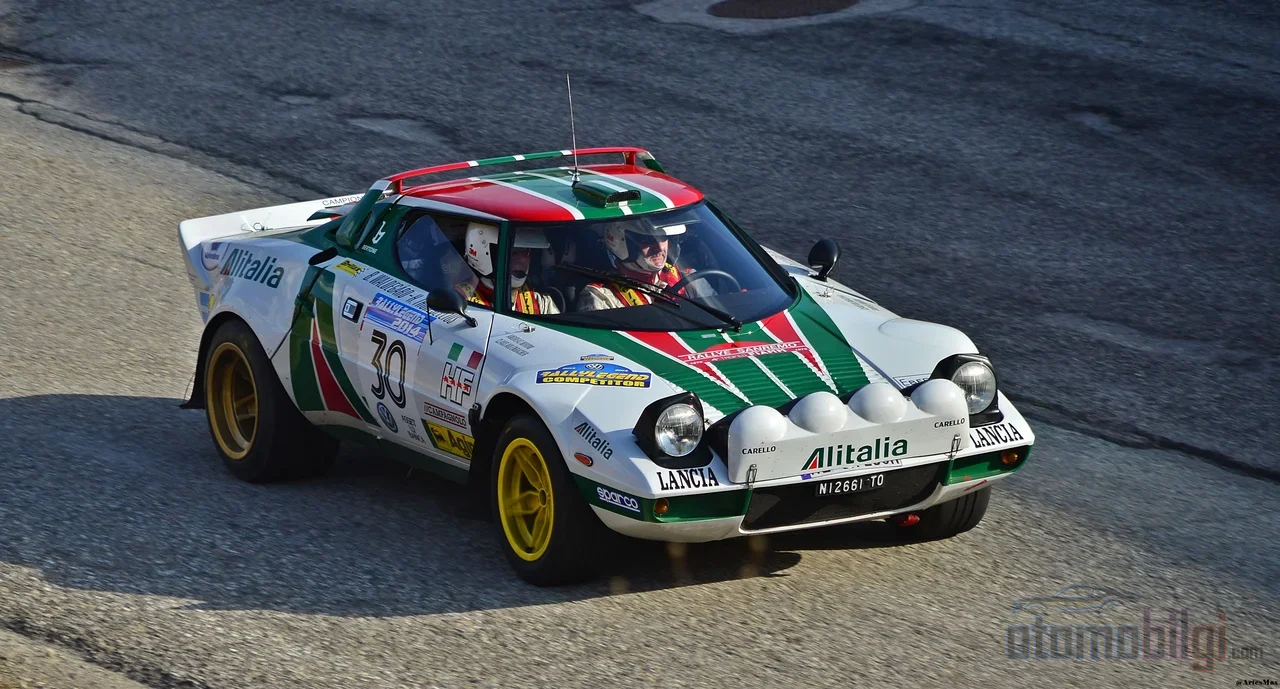
The Lancia Stratos is the first automobile designed and built from scratch for the rally world; by winning three consecutive WRC manufacturers' championships in 1974, 1975 and 1976, it completely redefined how racing cars should be built. With Bertone's wedge-shaped body, the Ferrari Dino V6 engine, and its tiny but ambitious character, it virtually conquered the rally scene of the 1970s. So how did a concept car become such a legend? Let's take a look at the story from the beginning.
Highlights
- First production car designed from scratch for rallying - approximately 492 units produced (1973-1978)
- Ferrari Dino 2,418 cc V6 engine; up to ~320 hp in racing versions
- 1974, 1975 and 1976: three consecutive WRC manufacturers' championships
- Stradale road version: 190 hp, 0-100 km/h in 6.8 seconds, top speed 232 km/h
- The Stratos Zero concept at the 1970 Turin Motor Show was only 84 cm tall
Why Is the Stratos Considered the First Car Designed Specifically for Rallying?
Until that time, rally cars were generally derived from road cars: You would take a standard production model, lighten it, reinforce its roll cage, and send it to the stages. This is exactly where the Stratos began to change the game. The Lancia Stratos HF (project code Tipo 829) was drawn from the very first meeting for a single purpose: to win rallies. The road version was a requirement of what we call homologation - the rule that a car must be approved in a certain number of production units to compete in the free category - not the main product.
The design decisions were made according to this single goal as well. An incredibly short wheelbase of 2,180 mm and a wedge-shaped, low body were chosen. The aim was not tremendous power, but lightness and agility: the Group 4 racing version weighed only 880 kg. The interior was also entirely driver-focused; no picnic baskets were being carried here - it was all about chasing results. In short, the Stratos ushered in a new era in rallying, and after it, everyone began thinking about racing cars in this way.
How Did an Orange Concept Turn Into a Rally Legend?
Perhaps the most colorful part of the story is its origin. Until those years, Lancia traditionally handled its design work with Pininfarina and Zagato; the door had never been opened to Bertone. Nuccio Bertone, however, knew that Lancia was looking for a rally car to replace its aging Fulvia model and prepared a striking concept. He even built a working prototype using the drivetrain of a Fulvia Coupé belonging to a friend. Quite the entrepreneur, isn't he?
Stratos Zero: The Show at the Factory Gate
This concept was introduced as the Stratos Zero at the 1970 Turin Motor Show. It had an orange, wedge-shaped body and was only 3.58 meters long and 84 cm tall - imagine, almost half the height of a Toyota Corolla's roofline! Underneath it had the Fulvia's 1.6-liter V4, but it shared almost nothing with the production version. Bertone personally drove the Zero to the door of the Lancia factory to complete the show and took the car under the barrier, and did not forget to collect the applause of the workers either. A complete Hollywood scene.
The 1971 Prototype and the Price of the Short Wheelbase
A year later, at the 1971 Turin Motor Show, things got serious: the Stratos HF prototype appeared on stage in fluorescent red. Its design was signed by Marcello Gandini - the same Gandini who had previously drawn the Lamborghini Miura and was at that time working on the Countach. The prototype's most famous feature was its crescent-shaped wraparound windshield: forward visibility was perfect, rear visibility... practically zero. But in rallying you usually drive looking at the tip of your nose anyway, so nobody's heart was troubled. The kinship with the Miura was also hard to miss: signatures like the twin hood lids and upward-opening door windows were present in both cars. On the Stratos, the front lid opened forward over the spare wheel, while the rear lid opened backward, step by step, over the engine with a black louvered panel.
Why Did Enzo Ferrari First Say 'No'?
While looking for a heart for the Stratos, Lancia's most audacious idea came to mind: Ferrari's Dino V6. During the development process, first the Fulvia engine and then the Lancia Beta engine were tried; neither was enough to carry the job. But Enzo Ferrari, who saw the Stratos as a rival to his own Dino V6, initially did not approve the engine sharing. The project leaders - team manager Cesare Fiorio, British racing driver and engineer Mike Parkes, and factory driver Sandro Munari - had to wait. Nicola Materazzi's contribution was significant in the chassis and suspension calculations.
Things were resolved when Dino production came to an end: Ferrari gave its approval and delivered 500 units of the engine to Lancia. The result was a wonderful pairing: a 2,418 cc, 24-valve V6, mounted transversely just in front of the rear axle. The road version produced 190 hp and 226 Nm of torque, while the race versions reached about 275 hp with the 12-valve layout and about 320 hp with the 24-valve layout. The rally version of this engine, also used in the Fiat Dino and Ferrari 246 Dino, had turned into a true storage-compartment monster.
The Homologation Marathon: The 500-Unit Rule and the 492 Reality
To compete in the Group 4 category, 500 units of the car's road version had to be produced. Production began in 1973, with Bertone as the body manufacturer and final assembly done at Lancia's Chivasso plant, and the Stratos was homologated for the 1974 WRC season. But there is an interesting detail: total production remained at approximately 492 units. One reason for this was Ferrari's reluctance to supply more than 500 Dino V6 engines. Another detail not to be dismissed: In the 1976 season, the minimum production number required for Group 4 was lowered to 400, so the figures eased up a bit, but the series was already largely complete. Series production ended in 1975.
| Specification | Stradale (Road) | Group 4 (Race) |
|---|---|---|
| Engine | Ferrari Dino 2,418 cc V6, 24 valves | Ferrari Dino 2.4 L V6 |
| Power | 190 hp | ~275 hp (12 valves) / ~320 hp (24 valves) |
| Torque | 226 Nm | - |
| Weight | 980 kg | 880 kg |
| 0-100 km/h | 6.8 seconds | - |
| Top speed | 232 km/h | - |
| Production count | ~492 (total, 1973-1978) | Homologation required ~500 |
The design was consistent on the chassis side too: a steel space frame structure, a reinforcing cage integrated into it, and a fiberglass body on top. In other words, the car was made to be both sturdy and light. With a total length of 3,710 mm, the Stratos was shorter than even today's hatchbacks.
On Tracks and Stages: Three Consecutive Championships
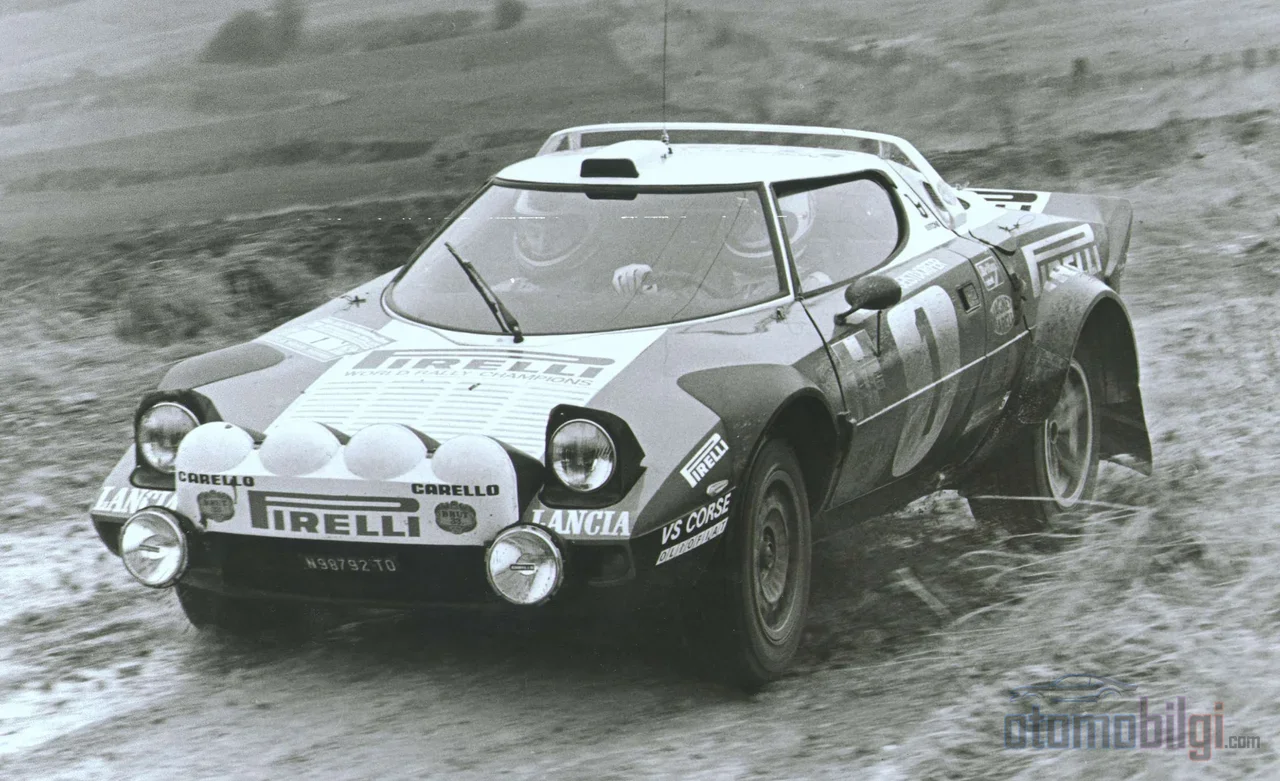
The Stratos's racing record clearly tells how it dominated the mid-1970s. It took its first victory on April 8, 1973, at the Firestone Rally in Spain, a round of the European championship. Then the world stage opened up: In 1974, 1975 and 1976, it won the WRC manufacturers' championship three times in a row - with Sandro Munari and Björn Waldegård at the wheel.
Its dominance at the Monte Carlo Rally is a legend of its own: In 1975, 1976 and 1977 it reached the top three times, all with Munari, and then once again in 1979 with the privateer Chardonnet Team. A record 5 victories in the Tour de France Automobile between 1973-1980, three wins in the Giro d'Italia automobilistico (1974, 1976, 1978), and the 1974 Targa Florio victory are also on the list. Perhaps the most striking of all: driven by privateer Bernard Darniche, nearly a decade after the prototype, it won another WRC event at the 1981 Tour de Corse. This car had far more in its body than just stamina.
Adventures Beyond Rallying
The Stratos didn't live only on dirt stages. At the 1976 24 Hours of Le Mans, the car driven by Christine Dacremont and Lella Lombardi finished 20th overall and took 2nd in the GTP class. On the rallycross side, Franz Wurz won the first European Rallycross championship recognized by the FIA in 1976 with a Stratos; Andy Bentza, meanwhile, became ERC GT Division champion in 1978 - and he was driving the world's only 3.0-liter Stratos.
So why aren't there more championships? The answer isn't technical, it's entirely political: When the Fiat group handed rally responsibility over to the Fiat 131 Abarth, factory support for the Stratos was withdrawn. Even without support, the car could collaborate with private teams; in fact, after the decision in favor of the Fiat 131, two Group 5 turbo 'silhouette' Stratos were built for circuit racing (engineered once again by Nicola Materazzi). They didn't achieve the desired success against the Porsche 935s, but they performed well in hybrid events. Another blow came from the rules: In the 1978 season, the FIA banned 24-valve cylinder heads in Group 4.
The Stratos's Legacy: Movies, Games and New-Generation Interpretations
How do you know when a car has become a legend? Its place in popular culture. The Stratos Zero appeared in Michael Jackson's 1988 film Moonwalker and sold for €761,600 at an Italian auction in 2011; it has been displayed in museums such as the Petersen Automotive Museum and at the 2014 High Museum of Art 'Dream Cars' exhibition. On the video game side, it appears in almost every major franchise: the Gran Turismo series, Forza Motorsport, Project Gotham Racing 2, DiRT Rally 2.0, the WRC series and more. I'm sure you've heard this engine's sound on virtual stages too!
Concept Chain: From Sibilo to New Stratos
The Stratos story didn't end in 1978. That same year, Bertone produced the Lancia Sibilo concept based on the Stratos (its wheelbase was lengthened from 2,180 mm to 2,280 mm). At the 2000 Turin Show, Gandini designed the Stola S81 'New Stratos' concept - this car was later converted to an electric motor in 2014. At the 2005 Geneva Show, the Fenomenon Stratos concept - designed by Chris Hrabalek, developed by Prodrive and featuring a 419 hp V8 - took the stage.
The most tangible link, however, is the New Stratos: Commissioned by Michael Stoschek and based on the Ferrari 430 Scuderia (with the chassis shortened by 200 mm), this car produces 540 hp from its 4.3-litre V8, weighs just 1,247 kg, completes 0-100 km/h in 3.3 seconds and reaches a top speed of around 320 km/h. Ferrari did not approve the small-series production plan, but on February 10, 2018 Manifattura Automobili Torino, led by Paolo Garella, announced it would begin production of 25 cars, and production has continued since that date. Lancia also marked this legacy by celebrating the 50th anniversary of its first international victory.
Why Do We Still Feel the Magic of a Rally Car Today?
The Stratos revolution isn't about a car; it's about a mindset. Until it came along, racing cars were thought of as 'exaggerated versions' of road cars. The Stratos proved how powerful purpose-driven design - that is, conceiving a car, in every detail, for a single goal - could be in rallying. The short wheelbase, the lightweight body, the driver-focused cockpit and the determination in engine choice: all were parts of the same idea.
At the origin of the philosophy you see when you look at modern rally cars today stands this automobile. Moreover, it's not just the generations that raced against it, nor the armchair pilots who recount it to their grandchildren; even half a century after its first international victory, the Stratos is still talked about, driven in games and displayed in museums. Do you think there could be a greater legacy than that of an automobile? In my view, the answer is clear: rarely.
Sources
- Lancia Stratos
- Lancia Stratos HF Gr. 4
- Lancia Stratos HF
- Lancia Stratos, one of the most successful rally cars of all time, is celebrating today the 50th anniversary of its first international victory
- Lancia Stratos: From Radical Concept to All-Conquering Rally Champion
- History - Lancia Stratos
- 1970 Lancia Stratos HF Zero
- 1974 Lancia Stratos
- Lancia Stratos Bertone Sibilo Guide