How Did the Porsche 959 Redefine the Supercar Concept?
Share This Page
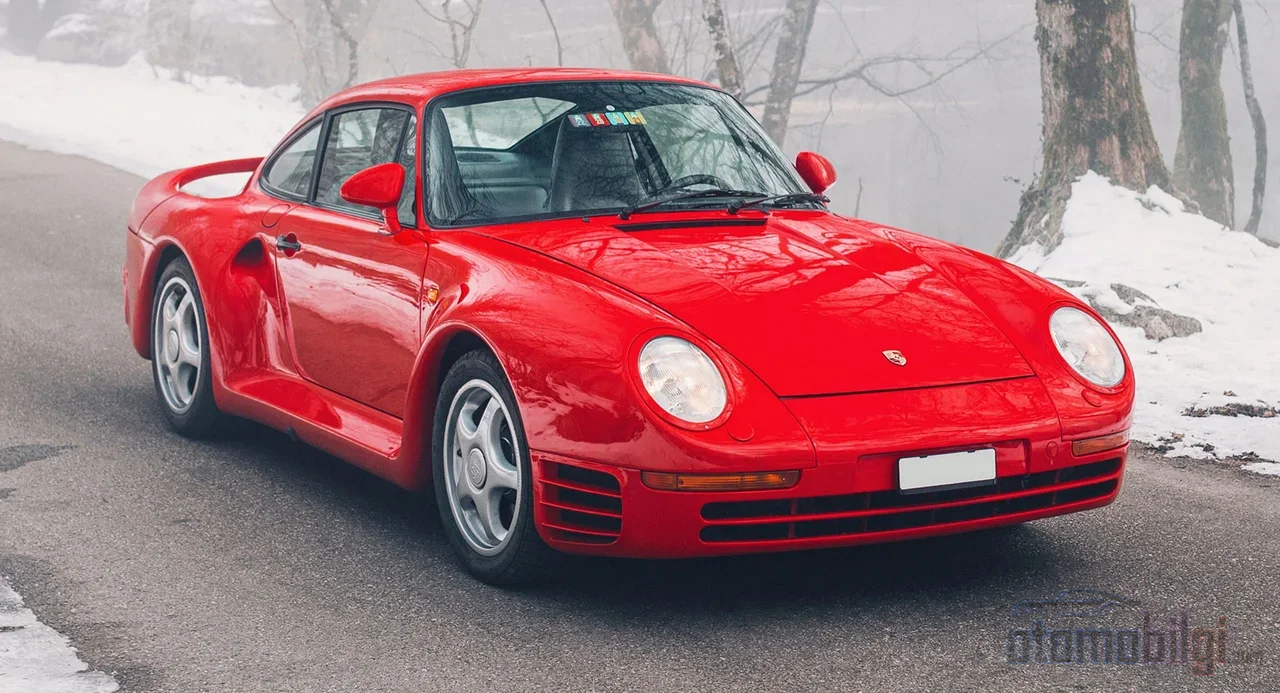
The Porsche 959 is a technical masterpiece born from Porsche's Group B rally program, produced between 1986 and 1993, and at the moment of its introduction the world's fastest road-legal production car (317 km/h) - it effectively redefined the concept of the modern supercar with its all-wheel-drive system, sequential twin-turbo charging, and advanced use of materials.
Highlights
- 2,849 cc sequential twin-turbo flat-six engine, 450 PS and 500 Nm of torque
- At its introduction, the world's fastest production car: 317 km/h
- Only 337 units were produced in total; 292 of them were series customer cars
- 1st and 2nd place at the 1986 Paris-Dakar, class win at the 1986 Le Mans
- In 2026, a 959 Sport sold at auction for $7,045,000
Imagine this: It's the mid-1980s, computers are just beginning to enter our lives, and a German company launches a car developed for racing with technology so advanced that even today supercars are still following the path this car blazed. When I first read this story, my jaw literally dropped; you'll see just how many facets this medal has. Let's get started!
A Madness Born from Group B Rally: The Birth Story of the 959
The story begins in 1981. As soon as Peter Schutz took the CEO's chair, chief engineer Helmuth Bott came to him with an idea: to explore what could be done with the rear-engined 911 and to develop a completely new all-wheel-drive system. In Bott's view, the ideal proving ground for this system was Group B rallying, which in those years was run on pure madness. The project's original name was boldly Gruppe B.
The catch here was the homologation rules: to race the rally car, the FIA required at least 200 road cars to be produced. So Porsche, in order to race, first had to build the world's most advanced road car. A bittersweet irony emerged later: by the time production was ready in 1987, Group B had already been canceled a year earlier. A car born for racing went on to become a legend in a world without racing.
The Technology Behind It: Why Is the 959 Considered the First Modern Supercar?
Now let's get into the technical part, because the 959's legendary status comes entirely from here. Let me give you an analogy from daily life: do you know what turbo lag is? It's like the engine first brewing the tea when you press the accelerator, and then suddenly boiling over. The 959 eliminated this.
Sequential twin-turbo and engine
At its heart is an air-cooled flat-6 with a displacement of 2,849 cc, sequential twin-turbo charging, and four valves per cylinder; the cylinder heads, however, are water-cooled. The engine was based on the 956/962C race cars and is fed by Bosch Motronic 2.1 injection. The sequential system directs the entire exhaust flow to a single turbo at low rpm; this way, turbo lag almost completely disappears. This type of system was seen here for the first time in a production car. The result: 450 PS at 6,500 rpm, 500 Nm at 5,000 rpm.
PSK all-wheel-drive system
The all-wheel-drive system called PSK (Porsche-Steuer Kupplung) distributes torque dynamically. In normal driving, 60% of the power goes to the rear axle; but under hard acceleration the ratio can shift up to 80% rearward, and returns to 50:50 during braking. In short, the car decides on its own where to send torque at every moment - in 1986! Even the transmission has a story: the first gear of the six-speed manual box carries the gelände label, meaning terrain, in order to pass noise regulations.
Suspension, materials and details
The electro-hydraulic suspension adjusts ride height between 120 mm and 180 mm; as speed increases, the car lowers automatically. Aluminum and aramid (Kevlar) composite were used instead of steel for the body panels; the floor was Nomex. Considering that this was even the first use of Kevlar in a production car, the 959 truly was a test bed. On top of that, hollow magnesium alloy wheels and a system that monitors tire pressure - a first in series production. On the aerodynamics side, the Cd value drops to 0.31 and aerodynamic lift is completely eliminated. With a curb weight of 1,450 kg, Auto, Motor und Sport measurements returned 0-100 km/h in 3.7 seconds and a top speed of 318 km/h; this record was recognized by Guinness. Some variants saw 339 km/h in testing.
| Specification | Value |
|---|---|
| Engine | 2,849 cc twin-turbo flat-6 |
| Power / Torque | 450 PS @ 6,500 rpm / 500 Nm @ 5,000 rpm |
| Top speed | 317 km/h (339 km/h in some variants) |
| 0-100 km/h | 3.7 seconds (measured) |
| Curb weight | 1,450 kg |
| Production | 1986-1993, 337 vehicles in total |
From Sand to Pavement: Dakar and Le Mans Victories
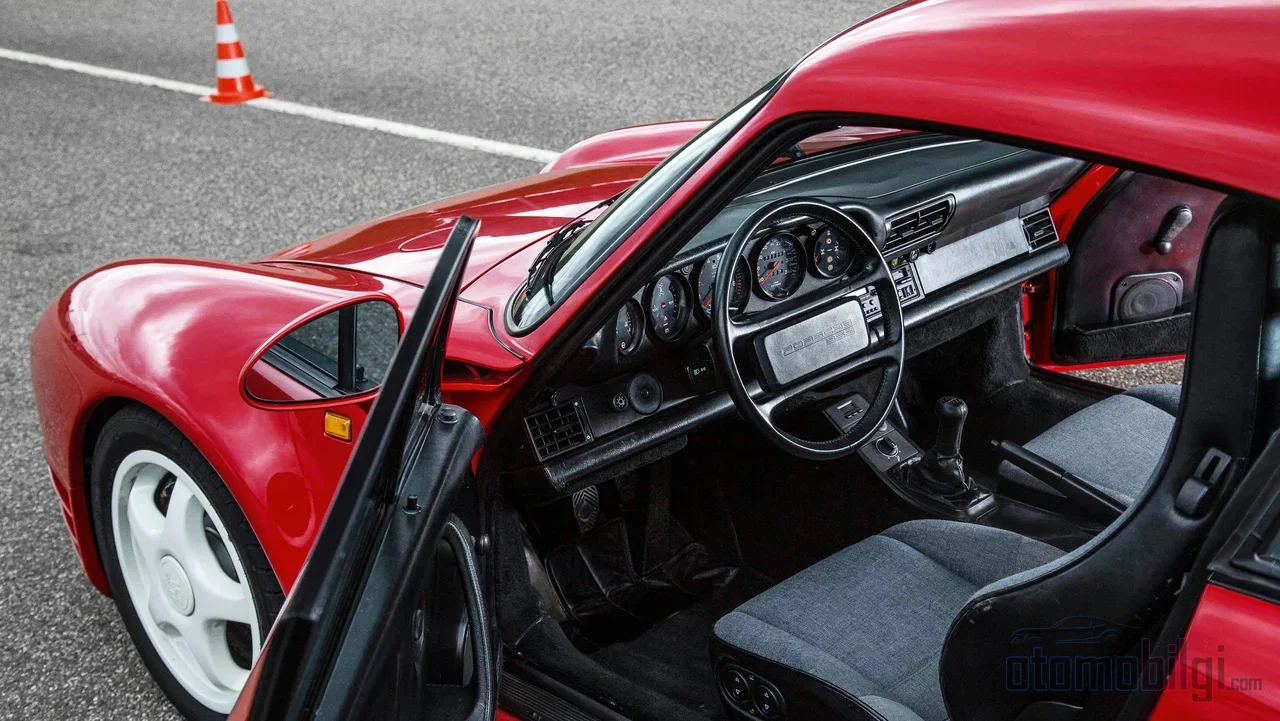
The 959's racing sides were fun too. The first development cars, based on the 911 Carrera with all-wheel drive as the 953, entered the 1984 Paris-Dakar and won first place with René Metge; Jacky Ickx finished sixth, and the third car came 25th. . In 1985, the three-car team could not finish Directions happily; but in October of the same year, the twin-turbo cars appeared at the Rallye des Pharaons and won with Saeed Al-Hajri and John Spiller. The real goal came at the 1986 Paris-Dakar: Metge first, Ickx second, and the third car sixth. In a rally covered in sand and mud, the technical masterpiece closed its book.
The track version, the 961, took class first at the 1986 Le Mans and seventh overall. In 1987 it was eliminated from the race after Kees Nierop's crash and fire; the car was later restored and is on display at the Porsche Museum. A more radical version, the 959 S, reached 339 km/h at Nardò with 515 PS, but only 29 units were produced.
Against the Ferrari F40: Two Philosophies, One Decade
Perhaps the most enjoyable of all supercar rivalries: the 959 versus the Ferrari F40. The F40 arrived in 1987, and with its twin-turbo V8 producing 478 PS, Ferrari's claimed top speed was slightly higher. But the philosophies were opposites: The F40 was a light, bare-bones monster with a carbon body on a steel tube chassis and turbo lag; the 959 was all-wheel-drive, twin-turbo, more modest looking, and a usable everyday marvel of engineering.
This is how I think of the pair: the F40 is a rock concert, the 959 is a fine orchestra. Which one is better? That debate still rages on and I doubt it will ever end - which, in my view, is the most enjoyable part of the story.
Production Hardships: Low Production, High Price, Customs Drama
Now we come to the most striking part of the story. Building the 959 cost Porsche so much that the expense per car exceeded even half of its selling price of DM 431,550 (roughly $225,000). In other words, every sale was made at a loss; the 292 series production customer cars built were delivered between 1987 and 1988. Production did not take place at the main Zuffenhausen plant, but at the Karosserie Baur facility under Porsche inspectors' supervision; most of the interior stitching was also completed there.
As for the US market... things were dire. Porsche designed the car solely to European safety standards and deliberately ignored NHTSA standards - contrary to popular belief, the claim that it did not provide cars for crash testing is not true. The result: no 959 was road legal in the US, and after the 1988 import legislation, legalization became impossible. The most famous victim was Bill Gates: the 959 he bought in 1988 sat in a customs warehouse for a full 13 years. However, when the Show or Display law championed by Otis Chandler, Gates, and Bruce Canepa came into force on August 13, 1999, the car was freed; Canepa also launched an upgrade program in 2003 that made the car road legal in the US.
In 1992/1993, 8 more cars were built from spare parts at Zuffenhausen - all with Komfort trim, four red and four silver, priced at DM 747,500. Today these are the most sought-after 959s.
Today's Collector Value: Why Is the 959 Still the Gold Standard?
Every now and then, and by 2026, the picture confirms the legend. At RM Sotheby's auction in Monterey on August 15, 2026, a 1989 959 Sport found a buyer for $7,045,000 - one of only 29 Sports ever built, surpassing the previous record by a full $1,540,000. The same season, a 1988 Komfort sold at The Quail for $2,865,000. The overall picture is this: Komfort examples mostly trade in the $1.3-1.7 million range, Sport versions around $4.9 million, and Canepa-modified cars change hands above $2 million. A car that lost money on every sale in the 1980s fetching these figures today... now that is what you call a legacy.
Legacy: What Did It Leave to Today's Supercars?
The 959's influence is still felt. It was among the first cars to bring all-wheel drive to pure high-performance sports cars; Porsche's first all-wheel-drive road car laid the foundation for the 911 Carrera 4 (964). From the 993 generation onward, all-wheel drive became standard on turbo 911s; The twin-turbo approach was also carried over to future models. And there is an honorable medal: In 2004, it was declared number one on the list of the Best Sports Cars of the 1980s.
It is possible to debate whether the Miura or the 959 was the first true supercar - but no one can deny that the technological DNA of today's supercars is largely based on this German vehicle. I leave you with one question: Was squeezing sequential turbocharging, all-wheel drive, and a Kevlar body into a single car in 1986 madness, or genius? I think it was both - and that is exactly why automotive history is beautiful.