How the VW Golf GTI Gave Birth to Hot Hatch Culture?
Share This Page
The Volkswagen Golf GTI, launched for sale in 1976 with a 110-horsepower engine fitted to an ordinary family hatchback, is the car that gave birth to the modern performance automobile and the entire hot hatch category. What began as an unofficial project by young engineers is today one of the most beloved sagas in automotive history. So how did a small three-door hatchback single-handedly give birth to an entire segment? Let's tell the story.
Highlights
- The initially planned production quantity 5,000 was; in the end, 461,690 units of the Mk1 GTI were sold.
- 110 hp of power, 780 kg curb weight, 0-60 mph in 9 seconds, top speed 182 km/h.
- The golf ball detail on the gear shift knob was the invention of chief designer Herbert Schäfer.
- The Wörthersee GTI Meeting has been held since 1982; at its peak it reached 200,000 people .
- The GTI celebrates its 50th birthday in 2026.
It All Started with a Secret Office Project
Did this story start in a garage, like in baseball movies? Partly yes, but the picture is a bit more complicated, and in my opinion that's exactly the most interesting part. In 1974, half a dozen people working at Volkswagen devised a secret plan to develop a sporty version of the Golf. Among them was the company's press officer, Anton Konrad. There was no official assignment; in other words, people were spending their own time, of their own volition, chasing a dream.
The image from the rumors of a garage project running entirely in the dark is a somewhat exaggerated version of the legend. Board Member for Technology Hermann Hablitzel was the name who kept the project alive, and in early March 1975 the project was presented to Board Chairman Toni Schmücker. The secret Sport Golf officially became development order EA195 that day. In other words, even before top management said yes to the project, names like engineer Alfons Löwenberg had been quietly advancing the development. In short, the story has both a passionate rebellion and a gradual officialization - and I think that's exactly why it seems so believable.
The first prototypes were built with a carbureted 100 PS engine. This engine had actually been developed for the Audi 80 GT, and its 1,471 cc displacement had been increased to 1,588 cc with a cylinder bore of 79.55 mm. Some of the parts had been, to put it mildly, quietly sourced from the parts depot. Then in May 1975 came the critical approval: 5,000 units of production. That figure was no coincidence; it was the minimum production quantity required to participate in motorsport. So the team positioned the car exactly on top of the homologation limit - clever, right?
Where Did the GTI Name and the Golf Ball Gear Shift Knob Come From?
When the engine met Bosch K-Jetronic injection and rose to 110 PS, the project moved to a whole different dimension. The nice irony here is this: K-Jetronic was actually a system developed for emission control, but the VW team used it for pure performance. That's just how some of the best ideas in world automotive history are born.
There was also a small drama over the name. Suggestions went back and forth between TS and GTS; in the end GTI was chosen. But what does that letter "I" mean? That's still debated: to some it's the initial of the German word Einspritzung, meaning injection (though then the car would have been called GTE); to others it's the Italian Gran Turismo Iniezione. Its world premiere took place in September 1975 at the IAA in Frankfurt, and the first press reactions were not as optimistic as you might think - some wrote that the car was as powerful as it was hard to handle. Time, of course, proved them wrong.
My favorite detail is the gear shift knob: chief designer Herbert Schäfer was a golf enthusiast himself, and he fitted a golf ball onto the gear lever. From that moment on, the golf ball-shaped shift knob became the signature of the GTI. Isn't it amazing that such small, playful touches are still remembered fifty years later?
From the Beetle to the Golf: A Generational Shift
For the GTI to take the stage, the Golf had to exist first. Launched in May 1974, the Mk1 Golf was a Giugiaro design and was positioned as the official successor to the Beetle. Unibody construction, MacPherson front suspension, a water-cooled transverse engine, and front-wheel drive - the exact recipe for the modern compact car. A little trivia along the way: the name Golf doesn't come from the game of golf; it comes from the German word for the Gulf Stream. It's part of the same wind-naming tradition as the Scirocco, Jetta, and Passat. The Scirocco, launched six months before the Golf, also effectively served as the guinea pig for the new technical foundation.
Let's also correct a common misconception: the Beetle is not VW's best-selling model. As of 2024, the Golf is the world's third best-selling car with over 37 million sales, behind the Toyota Corolla and the Ford F-150. It was this simple hatchback that dethroned the legendary Beetle and determined the heir to postwar Germany's most iconic car. The GTI, built on this solid foundation, proved both that the postwar economy now had a young audience demanding performance and that practicality and speed could go hand in hand. An interesting engineering note: an oil cooler from the Beetle was added on top of the transmission for the GTI's engine cooling - the old friend was not forgotten.
The Mk1 GTI in Numbers: This Much Power at This Weight Is Still Impressive Today
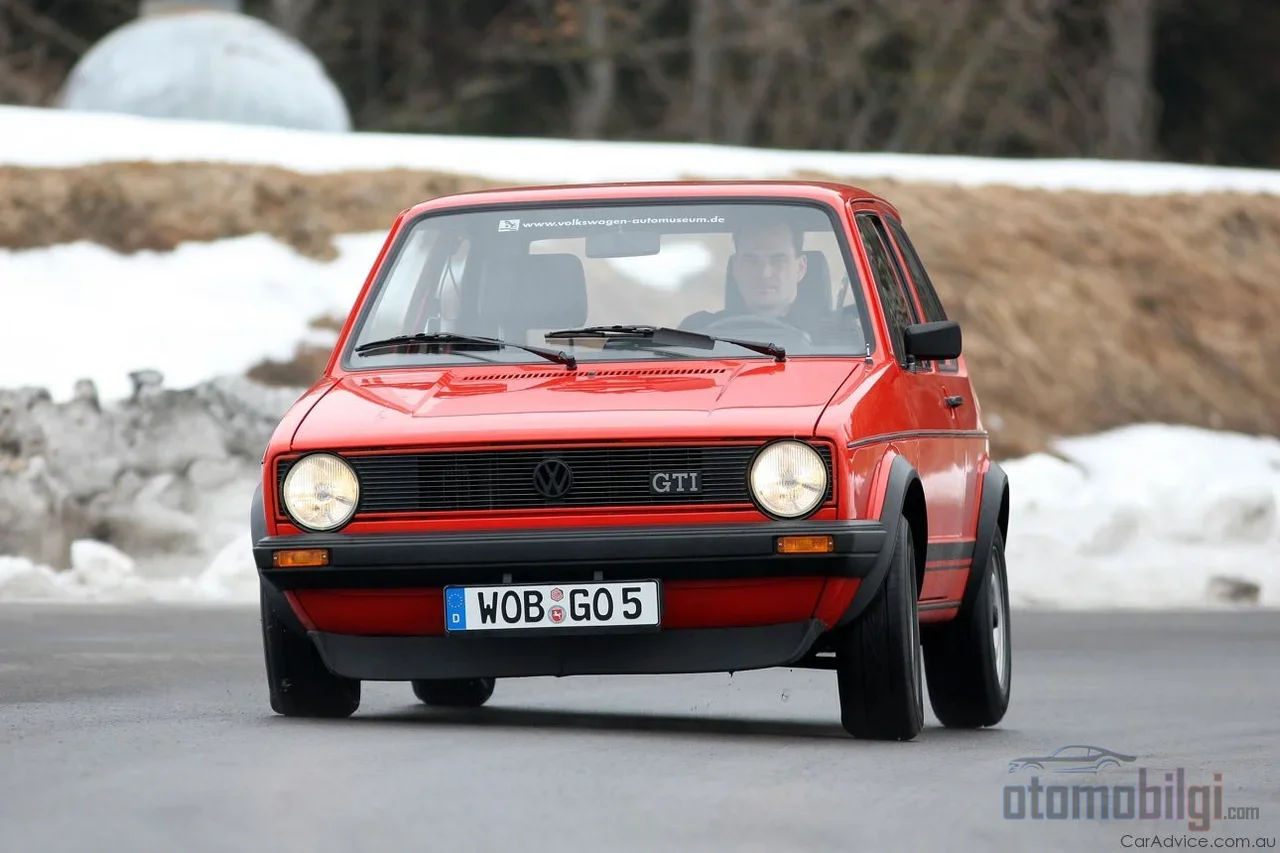
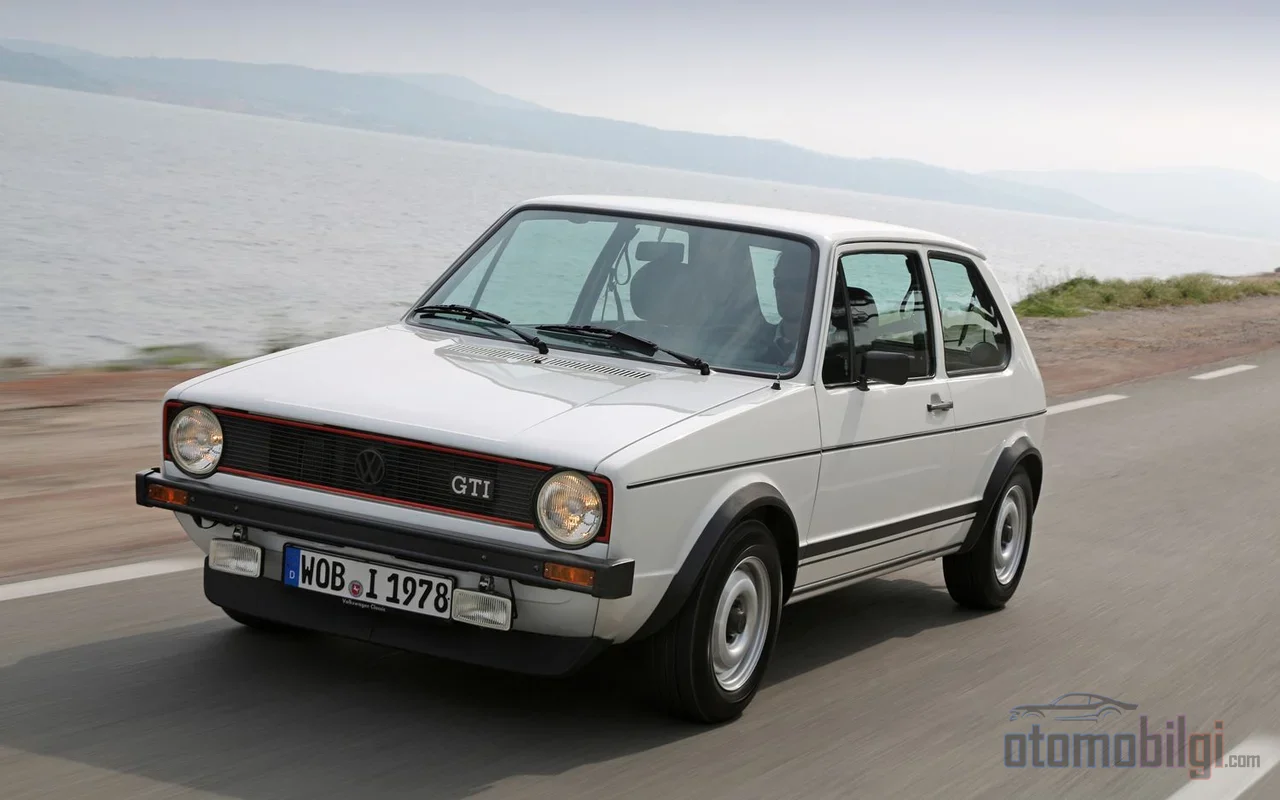
It's not just the horsepower that makes the GTI special, of course. With an engine 57% more powerful than the standard 1.5-liter gasoline unit, its suspension lowered by 20 mm, a track 14 mm wider, ventilated front disc brakes, and that famous red stripe around the grille, the GTI was a sports car perched on top of an ordinary Golf. Inside, there were tartan-patterned seats, an oil pressure gauge, and a tachometer. At launch there were only two color options: Mars Red and Diamond Metallic Silver.
| Specification | Value |
|---|---|
| Power | 110 hp @ 6,100 rpm |
| Dry weight | 780 kg |
| 0-60 mph | 9 seconds |
| Top speed | 182 km/h |
| Launch price (June 1976, Germany) | 13,850 DM |
| Launch colors | Mars Red, Diamond Metallic Silver |
Demand went far beyond everyone's expectations. The initial plan was 5,000 units; production reached 461,690 units and daily output was raised from 50 to 500 GTIs. Let's add a note here: the engineers insisted that the GTI meet the same quality and reliability standard as all VW production, which is why its market launch after the show was slightly delayed. The right call; because the GTI's message was this: a sports car you can use every day. If you use it every day, it has to hold up.
1982 and 1983: The Engine Grew, The Farewell Drew Near
In 1982 the engine went from 1.6 liters to 1.8 liters (1781 cc); torque increased and the 0-60 mph time dropped to 8.2 seconds . The 1983 model year was the Mk1 GTI's last, and it made the farewell memorable with a special series: around 1,000 units of the Campaign were produced (named Pirelli in Europe). Equipped with a sunroof, 14-inch Pirelli wheels, twin headlights and a leather steering wheel, this series was a special version with 112 PS. There is also the story from across the ocean: the version named Rabbit GTI only reached the US in 1983, and 1984 was the final year of Rabbit production. So the legend didn't spread to every corner of the world at the same time - but wherever it reached, it caught on.
The Hot Hatch Wars: Everyone Chased After It
Now let's come to the real question: who invented the hot hatch? The honest answer is that there were fast hatchback attempts before the GTI. Ford tried with the Lotus Cortina and RS Escort; Triumph with the Dolomite Sprint. But it was VW that turned the idea into a culture, into a passion. That's why the Mk1 GTI is regarded as the archetypal hot hatch and the term was in fact created by this car. The philosophy of "performance reaching the people" was exactly this: a young person who couldn't afford an expensive sports car could experience the same excitement with a three-door Golf.
Of course, competitors didn't stay silent. The French answer was the Peugeot 205 GTI; developed as a rival to the Golf GTI, this car soon won the hearts of enthusiasts. The comparisons still continue: the Golf GTI is more refined but heavier and less agile; the 205 GTI 1.9 outran both the Ford Escort RS Turbo and the Golf GTI in speed. Even today, when the question "which is the best hot hatch" comes up in car conversations, two names keep coming back: Golf GTI and 205 GTI. That, to me, is the measure of a car - having created a culture big enough to share the crown.
Wörthersee: The Festival of Three Letters
Just as much as a car itself, the culture that forms around it is proof of its iconic status. From 1982 onwards (according to some accounts, from 1981), GTI owners began gathering around Lake Wörthersee in Austria, and this gathering gradually became the largest and most established GTI festival in the world. At its peak, the crowd reached 200,000 people ; from the mid-2000s the event also gained official VW sponsorship. Imagine: a car that started like your garage project, half a century later, drawing hundreds of thousands of people to the shore of a lake. To me, that is one of the purest forms of automotive passion.
The rest of the story is a bit melancholic: the local municipality ended the event over environmental and sustainability concerns, and from 2024 onward the GTI gathering moved from Reifnitz to Wolfsburg, VW's hometown. Those legendary days on the lakeshore are now pages in history, but the gathering tradition lives on.
Fifty Years On: Is the GTI Still at the Top?
In 2026 the Golf GTI celebrates its 50th birthday, and VW is marking the occasion with numerous national and international classic events and special models. The star of the celebrations is the Golf GTI EDITION 50: the most powerful production GTI ever, producing 325 PS and completing the 20.832-kilometer lap of the Nordschleife in 7:44.523 leaving all previous production VWs behind. Tripling from the 110 PS it started with in 1976 is the finest proof of how solidly this story was built. Note: the original figures use metric units and local formatting.
Meanwhile, a few practical notes for Mk1 GTI enthusiasts: today a mint-condition example changes hands from £20,000, with the best ones around £30,000. Since corrosion protection is weak on pre-1980 vehicles, the inner wheel arches, lower edges of the A-pillars, sills, window surrounds, and spare wheel well must definitely be checked; a rusty body burns your wallet as much as your driving pleasure.
A Small Engine, A Great Legacy
The GTI's story reminds me every time of this: icons are often born not from huge budgets, but from the persistence of passionate people. The after-office endeavor of half a dozen people turned into 461,690 sales, a new market segment, and half a century of festival tradition. That three-door hatchback that determined the Beetle's successor, defined performance that reached the people, and added the term hot hatch to the dictionary is still at the center of debate in 2026. Do you think it's still the best hot hatch, or has the crown belonged to Peugeot for years? Whatever your answer, I think the debate itself is the GTI's greatest legacy.
Sources
- Golf GTI history
- The original turns 50: Volkswagen celebrates five decades of GTI in 2026
- Buying Guide: Volkswagen Golf GTI Mk1 (1976-1983)
- VW Golf Mk1 History
- Volkswagen Golf Mk1
- GTI Meet at Lake Wörthersee
- VW GTI meet leaves Wörthersee
- 10 Reasons Why The Peugeot 205 GTI Is The Greatest Hot Hatch Ever
- Peugeot 205 GTI vs VW Golf GTI Mk1 - hot-hatch showdown