How Did the Lamborghini Countach Become a Legend?
Share This Page
The Lamborghini Countach is the best answer to how a car poster hung on a wall can create a legend: starting from a radical prototype unveiled in Geneva in 1971, with around 2,000 units produced between 1974 and 1990, it became the defining supercar of the 1980s with its scissor doors and V12 engine. It was technically behind many of its rivals and unpleasant to drive; but as a wall poster, it shaped the imagination of millions of young people and laid the foundation for today's supercar design.
Highlights
- First prototype LP500, March 1971, became the star of the Geneva Motor Show.
- Production 1974-1990 lasted until; in total, around 2,000 units were built.
- In the LP400, the 3,929 cc V12 produced 375 PS at 8,000 rpm producing power.
- Five versions were produced: LP400, LP400 S, LP500S, LP5000 QV, and the 25th Anniversary Edition.
- The last Countach May 7, 1990 came off the line on.
The Moment It All Began in Geneva: The LP500 Prototype
Ferruccio Lamborghini had only one thing in mind: to create a crowned successor to the Miura. In 1970, chief engineer Paolo Stanzani began working under the project name "LP112." The team included test driver Bob Wallace, assistant engineer Massimo Parenti, and the young design genius Marcello Gandini. The result took the stage at the Geneva Motor Show in March 1971 and became the undisputed star of the show. Photographs of the prototype graced the covers of magazines around the world.
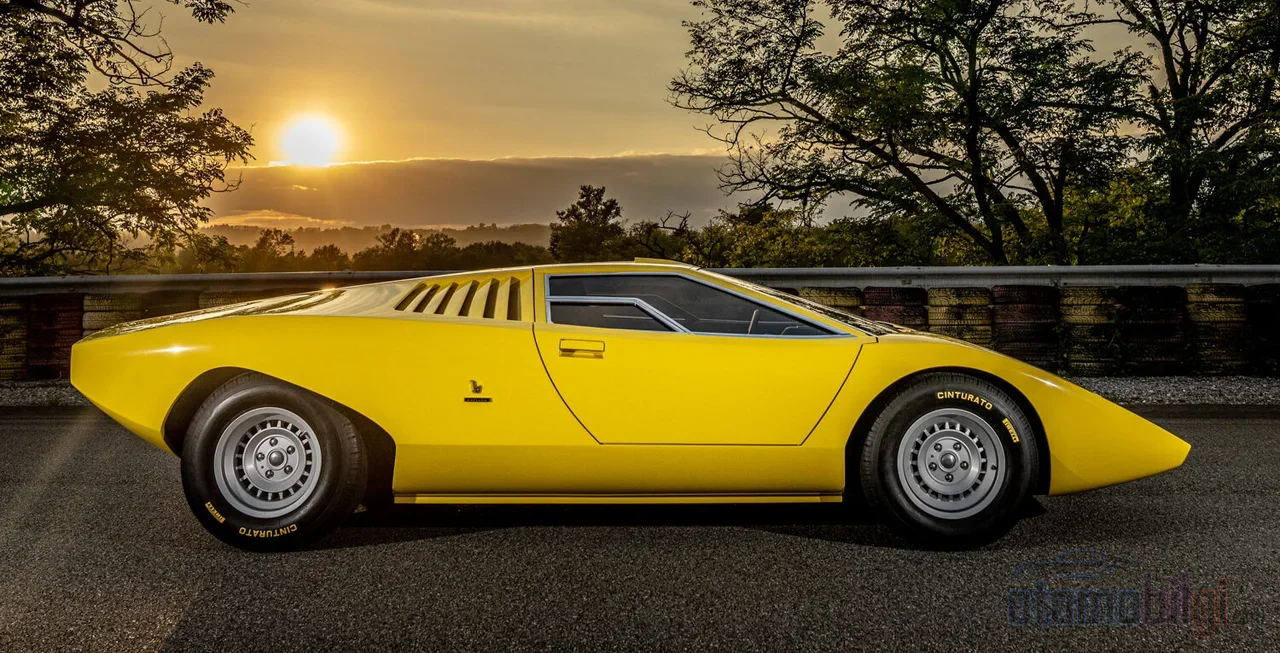
Hear the numbers once, and you'll understand why everyone's jaw dropped: LP500 was 185 cm wide, but only 103 cm tall. The nose tapered to a fine grille; retractable headlights were used, with no bumpers, no spoiler, not even side mirrors. Looking at it from today's perspective, imagine a spaceship floating on the road. Hidden beneath the body was a partial spaceframe made of 107 kg of steel sheet and tubing - at the time, this technique was genuinely used in Formula 1 cars; seeing it in a road car was almost science fiction.
Fine details on the prototype were abundant too. Because rear visibility was disastrously bad, a periscope-type mirror was mounted in the middle of the car, as if it had popped out of a submarine. The instrument panel featured warning lights inspired by aircraft and ships, even a self-diagnosing system. Exciting figures like 440 hp were being told about the prototype's 5-liter engine, but during Bob Wallace's road tests in 1971, this engine tore itself apart; the remaining tests continued with the 3.9-liter engine. In any case, the LP400's actual power remained at 375 PS at 8,000 rpm - which is even lower than the Miura SV. Some blame the choice of Weber carburetors. And the most painful part: the one-of-a-kind LP500 prototype was destroyed in a crash test in March 1974.
Where Does the Name "Countach" Come From?
Lamborghini's tradition follows bulls; Miura, Islero, Jarama... But the Countach breaks this chain from a completely different place. The name comes from the Piedmontese word "contacc" - an exclamation uttered in a moment of great surprise or admiration. Translated into English, it roughly means "wow!". Gandini recounts that the name was given as a joke during the night shift; he even asked Wallace how the word would sound to English ears. So one of the most iconic names in automotive history may literally have been born as a joke. I think this is my favorite part of the story.
There is also the LP abbreviation: Italian for "longitudinale posteriore", meaning "longitudinal at the rear". It describes the engine being placed at the rear, parallel to the car's long axis. This layout was a first in a road-going V12 - and it remains a signature Lamborghini still carries today.
Scissor Doors and the Wedge Shape: The Design Revolution
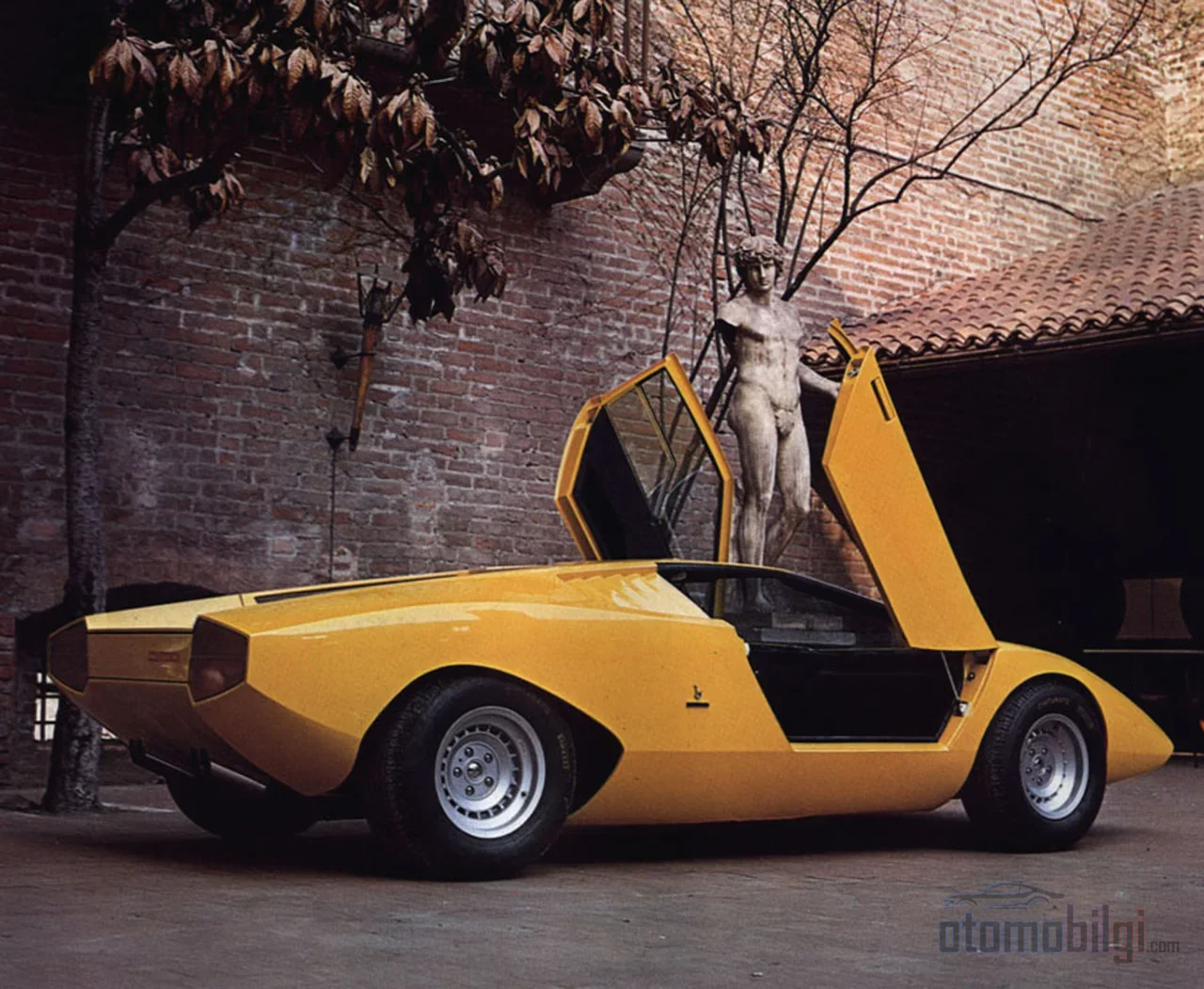
Gandini's wedge idea was not a notion conjured out of thin air. The 1968 Alfa Romeo Carabo concept and the 1970 Lancia Stratos Zero were earlier attempts at this radical, nose-down-to-the-ground shape. The Countach, however, became the car that truly exploded the wedge in the public eye and made it immortal. The sharp-angled "Italian Wedge" shape dominated the design language of Italian supercars for decades.
The scissor doors are also a product of the same engineering brilliance. They were not just for show: the body was so wide, so low, that if you opened a normal door in tight spaces it would either hit a wall or not open at all. The doors pivoted upward, toward the sky, supported by gas struts. But of course the stylistic effect is a separate layer - the moment the door opens, the car transforms into a spectacle. This solution, first seen on the Carabo, became Lamborghini's signature with the Countach.
The interior, meanwhile, is a comically impractical world. Because the body is wide and the cabin narrow, Countach owners have a famous trick: when reverse parking, they open the door and sit on the sill. Yes, really. Sitting inside those famously wide wheel arches is one of the coolest yet most uncomfortable seating experiences in the world.
The Production Journey: Five Versions, Nineteen Years
The first production model LP400, was introduced at the 1974 Geneva Motor Show. Over its 19-year lifespan, the basic 1971 prototype shape changed almost not at all - a design that stands the test of time is a truly rare thing. But as the years passed and widened wheel arches, spoilers, carburetor covers, and bumpers were added to the body, the car gradually swelled. Let's look at the five versions produced:
| Version | Year | Notable Feature |
|---|---|---|
| LP400 | 1974 | First production version; 375 hp, 151 units produced |
| LP400 S | 1978 | Wide wheel arches, new wheels and tires |
| LP500S | 1982 | Engine enlarged to 4,754 cc |
| LP5000 Quattrovalvole | 1985 | 5,167 cc, four valves per cylinder |
| 25th Anniversary Edition | 1988–1990 | Final version; the last example rolled off the line on May 7, 1990 |
The engine itself is the heart of the story. The Lamborghini V12, designed by Giotto Bizzarrini in 1963, was a first on the road with its longitudinal mid-engine layout. Growing over the years from 3,929 cc to 5,167 cc, its valve count increased, but that mechanical, "analog" character was never lost. If there are those today who think the heart of a supercar still needs to be a V12, they have this engine to thank.
The Bedroom Poster Phenomenon: The Car That Shaped Imagination
Now we come to the real question: why did the Countach never come down from the walls? The answer is simple: its design was striking, and production was very limited. In the 1980s and 90s, having its poster hung on bedroom walls was the fastest way for the car to enter young people's imagination. A red Countach poster was a symbol of wealth, rebellion, and excess in that era. In fact, according to collectors, the most iconic automotive wall poster is a red Countach hung on a wall. The original 1984 posters are sold today as collectibles - in my view, even a piece of paper gaining auction value is proof of the car's cultural power.
The beautiful part is this: most of the millions of teenagers who hung the Countach on their wall never drove the car, and perhaps never even saw one in real life. But that poster was the spark that ignited a passion for automobiles. It was precisely this car that drew the shape of the supercar dream - low, wide, sharp, winged, with scissor doors. The silhouette that appears in a child's mind today when they think of a supercar is actually the legacy of Gandini's 1971 drawings.
The Driving Reality: How Good a Car Would It Be If It Weren't a Legend?
Everything so far has been glitz; but let's be honest, the driving experience is another story. When a 5000S was tested by a motoring magazine in 1983, the writers' summary was this: too much of everything - too low, too flat, too many grilles and air intakes, too much power in the engine, too much tire on the road. In short, "excess to the point of vulgarity." Forward and side visibility is poor, and the body is enormously wide. Those who have experienced it describe it as like driving an old Mack truck; it is not a super-light and agile vehicle - it feels big and heavy in your hands, and it is not a super sports car that slides around like a hot hatch either. They say it doesn't have a single user-friendly aspect - yet it is still dizzying and a good investment.
This is exactly why the Countach is a controversial legend: weak as a driver's car, unique as an icon. But why does this contradiction work? Because the car's value wasn't in its track performance, but in its imagination generation. If a car makes you dream more instead of taking you faster, that is when it deserves to become a poster. The Countach was able to remain a legend even though it fell behind technologically, because it combined a design revolution and poster culture in a single body.
Legacy: The Common Ancestor of Today's Supercars
The Countach's most lasting legacy was the widespread adoption of its sharp-angled wedge design language. According to Lamborghini's design team, the LP500 gave birth to the design DNA of all subsequent models - meaning every sharp-lined, low and wide Lamborghini you see on the roads today is, in some way, a continuation of that 1971 show stand. Gandini's line shaped not only his own brand but the entire Italian supercar world for decades.
The LP500's Resurrection and the New Countach Debate
The sweet ending to the story came at the end of 2017: at the request of collector Albert Spiess, Lamborghini's Polo Storico department rebuilt the destroyed LP500 prototype. The craftsmanship took 25,000 hours to complete. Pirelli reproduced the Cinturato CN12 tires from the archive plans; the original yellow color was identified from PPG archives and revived under the name "Giallo Fly Speciale". The result was unveiled at Villa d'Este in 2022. In other words, the car destroyed in a crash test in 1974 was resurrected roughly half a century later. Only a true legend deserves such a story.
In 2021, the Countach name returned with the Sián-based hybrid Countach LPI 800-4 - limited to just 112 units, and Lamborghini presented it as a continuation of the bold design that has inspired supercars for generations. The reception was mixed: nostalgic enthusiasm on one side, debates on the other about whether it was disrespecting the heritage or paying tribute to it. Critics saw the new model as a superficial nod to the original; according to many enthusiasts, the original Countach was Lamborghini's greatest design until it was spoiled by added wings and inflated versions. In my view, the real message is this: an icon's name can be brought back, but the feeling of hanging that poster on the wall and losing sleep at night cannot. If it were you, which one would you hang on your wall?
Sources
- Lamborghini Countach - Wikipedia
- Resurrected Icon - Recreating the Lamborghini LP 500 Countach Prototype
- Lamborghini Countach: History, Generations, Specifications - MotorTrend
- Tested: 1983 Lamborghini Countach 5000S - Car and Driver
- Market For Dorm Room Wall Poster Cars Explodes - Hagerty
- Why Do Lamborghini Doors Open Up? Here's How It Started - Motor1
- May 7, 1990 - The Last Lamborghini Countach
- Lamborghini Countach LPI 800-4 - Lamborghini
- Lamborghini Countach Driving, Engines & Performance - TopGear
- Cars With Scissor Doors - Lamborghini Models - Lambocars
- The Original Countach Was Lamborghini's Greatest Design - The Autopian
- Why the Lamborghini Countach is the best car of all time - InvestFourMore
- Why Lamborghini Won't Be Making Modern Versions of Its Classic Models - Robb Report