Maserati Grecale mHEV: Mild Hybrid in the Luxury Segment
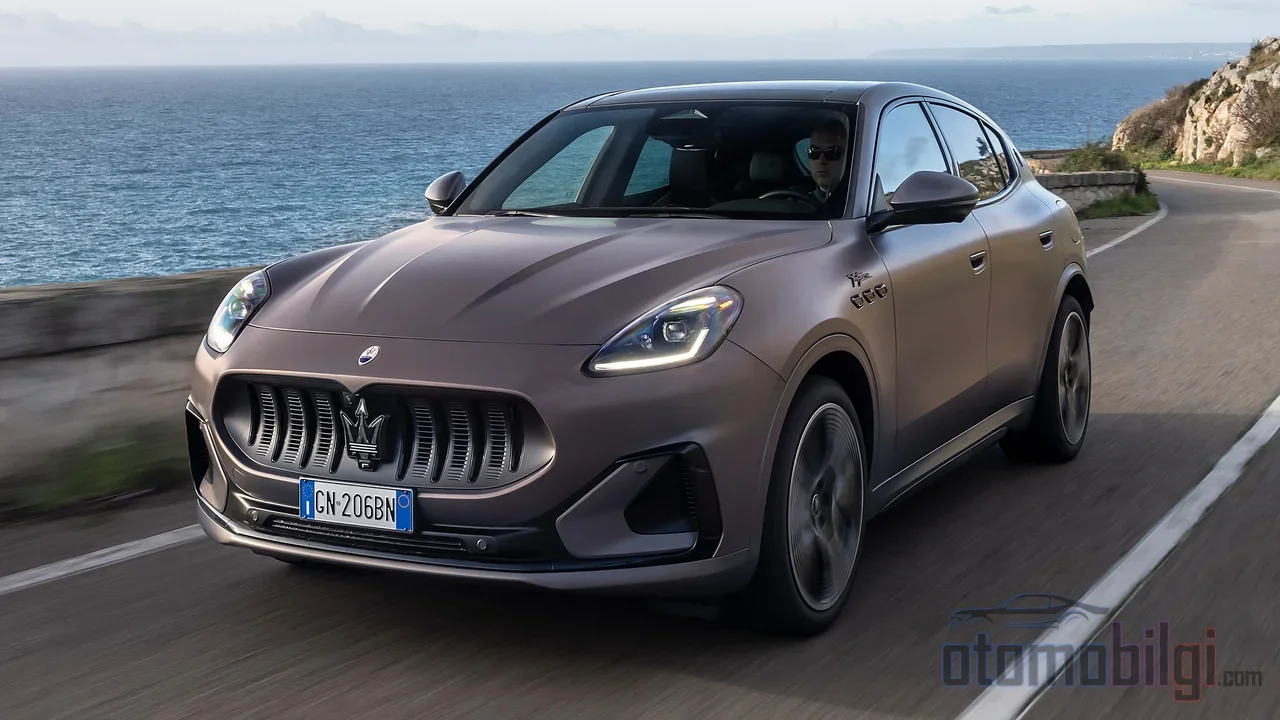
If you were expecting a V6 under a Maserati carrying the name of one of the Mediterranean's harsh winds, you might be surprised: Grecale's main mild hybrid versions come with a four-cylinder, 2.0-liter, 48V electrically assisted gasoline engine. Moreover, this combination comes quite close to the performance territory where its German rivals' gasoline SUVs sit. So what kind of character does an Italian premium SUV gain with a mild hybrid architecture? Below, I examine the picture with data, from the system's working logic to its consumption profile, and from trunk dimensions to competitor comparisons.
What Is the Maserati Grecale mHEV and Which Versions Is It Sold In?
The Grecale, named after a wind blowing in the Mediterranean and introduced in 2022, is Maserati's most accessible model. Its production is carried out entirely in Modena; the model shares a 50 mm stretched derivative of the Giorgio platform used by the Alfa Romeo Stelvio. Length 4,873 mm; meaning it stands on the physically wider side of the mid-size performance SUV segment.
In world markets, the mild hybrid lineup is based on two main versions: GT / mHEV 300 and Modena / mHEV 330. There is also a 250 hp variant that appeared in catalogs for a short period, but the main mild hybrid options today are the 300 and 330 hp versions. The Trofeo at the top of the lineup is not an mHEV: it is a separate world with the 523-530 hp Nettuno V6 that completes 0-62 mph in 3.8 seconds.
Highlights
- MHEV 300: 300 hp, 0-62 mph in 5.6 s
- Modena mHEV 330: 330 hp / 450 Nm, 0-62 mph in 5.3 s
- WLTP consumption range: 8.8-9.3 l/100 km
- Trunk in 2.0 mHEV models: 535 liters
- ZF 8-speed automatic and standard AWD
Why Does the 48V Mild Hybrid System Work With Four Cylinders Instead of a V6?
At the heart of the Grecale's mHEV is a 2.0-liter four-cylinder gasoline engine from the GME T4 family, which also serves in the Alfa Romeo Stelvio and Jeep Wrangler. Three components stand out on the electrical side of the system: the 48V battery, a belt-driven starter-generator (a single unit connected to the engine via a belt that serves as both starter and generator), and the e-Booster.
The logic chain here is as follows: In a mild hybrid architecture, the electric motor does not drive the car on its own; it provides torque support to the internal combustion engine, smooths start-stop operations, and recovers energy during braking. The e-Booster, meanwhile, masks turbo lag by supplying instant extra air without waiting for the turbo geometry to come into play. The result is a measurable torque support that gives a four-cylinder engine a fullness at low revs that could be likened to a six-cylinder. This support materializes in the Modena mHEV 330 with the 450 Nm of torque being maintained across the 2000-4000 rpm range.
Transmission and drive modes
Power is transferred to a standard AWD system through ZF's eight-speed automatic transmission; long, silver shift paddles behind the steering wheel catch the eye. Five modes determine the driving character: Comfort, GT, Sport and Off-Road are standard; only the Corsa mode exclusive to Trofeo sits at the top of the lineup. In mHEV versions, the GT and Sport modes also indirectly shape when the electrically assisted torque kicks in; the recommendation for fuel above 95 octane is a detail consistent with the torque this engine delivers.
Consumption Profile in the City and on Long Journeys: What Does WLTP 8.8-9.3 l/100 km Mean?
The WLTP figures for the mHEV 300 correspond to 30.7-32.4 mpg, roughly the 8.8-9.3 l/100 km band; the Modena mHEV 330 is right next to it with 32.1 mpg and 199-203 g/km CO2. With the 64-liter fuel tank, this consumption allows real-world ranges of 650-700 km on a single tank - without the range anxiety a fully electric rival carries.
The American EPA measurement completes the picture from a different angle: 22 mpg city / 29 highway / 25 combined for the Modena mild hybrid. It is normal for two different measurement methods to give two different figures for the same car; while WLTP is based on more cautious laboratory cycles, the EPA produces more favorable results in its highway-weighted cycle. From an engineering standpoint, the takeaway is clear: this system does not save as much as a full hybrid in the city, but by staying in the efficient zone of the four cylinders at highway pace, it falls below the gasoline averages of its class.
Interior and Luggage Practicality: How Comfortable Is It for Daily Use?
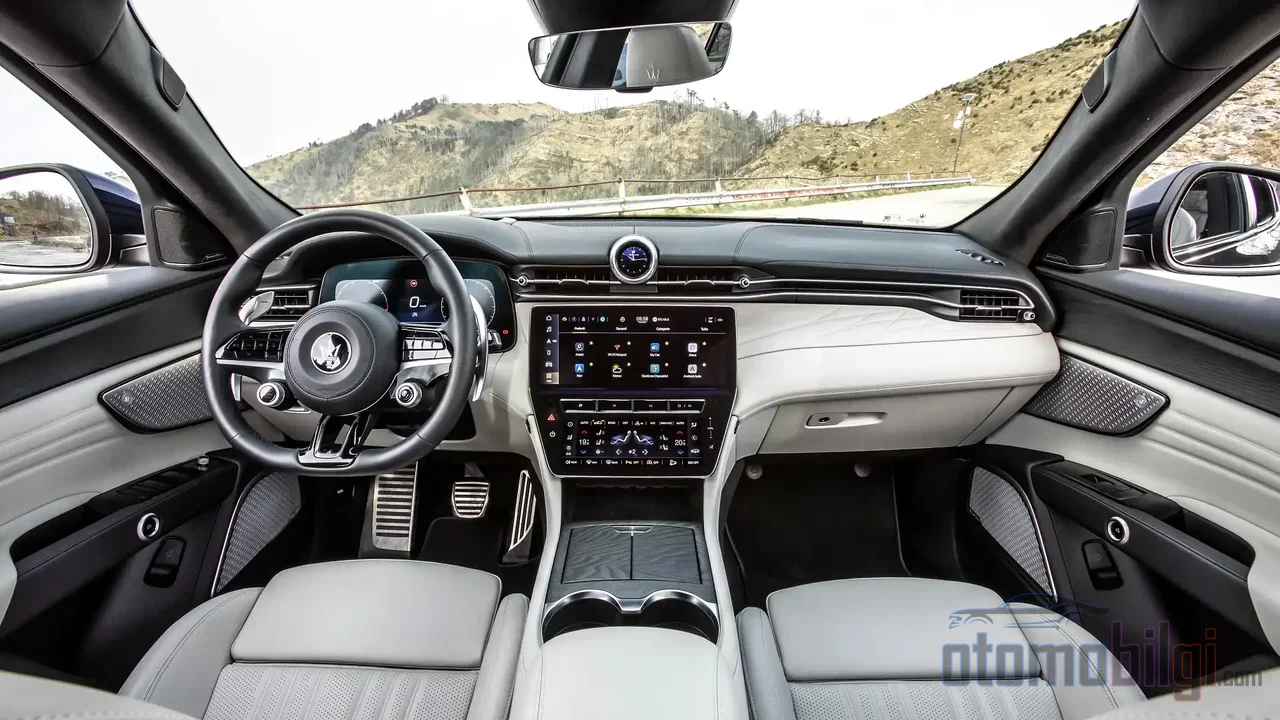
In the cabin, there is a 12.3-inch panel, Maserati's largest central screen in its history, an equally large digital instrument cluster, and a separate 8.8-inch comfort screen below. The digital clock can also serve as a Chronometre or g-meter function if desired - a digital-era translation of an Italian GT tradition. On the multimedia side, there is Maserati Intelligent Assistant, voice command support, optional head-up display, and remote connection via a smartphone app. The sound system is signed by Sonus faber; it goes up to 21 speakers.
The luggage dimensions are within the acceptable range for the class: 535 liters in 2.0 mHEV models (rising to 1,625 liters with the rear seats folded). Two adults are comfortable in the rear seats; the person in the middle travels on a narrower seat in terms of shoulder width. The optional air suspension and the three-zone climate control equipped with a 6.5-inch rear touchscreen are options that noticeably raise long-distance comfort. On the safety side, Level 2 Advanced Driving Assistance systems are available.
Where Does Grecale Stand Apart Against the BMW X3, Mercedes GLC and Porsche Macan?
Grecale is positioned at the center of the X3-GLC-Macan axis; yet all three rivals do not follow the same strategy. The X3 and GLC prioritize practicality, while the Macan prioritizes a sports-car-style driving character. Grecale targets, between these two, the buyer seeking a balanced and, in its own words, a different driving character. In terms of dimensions, it is about 5 inches longer, 2 inches wider, and 2 inches taller than the Macan; this difference can be read as an advantage reflected in rear knee room in the cabin.
| Benchmark | Grecale mHEV | Competitor positioning |
|---|---|---|
| Length | 4,873 mm | About 5 inches longer than the Macan |
| Power (Modena) | 330 hp / 450 Nm | Torque advantage over the 2026 X3 of 332 lb-ft |
| 0-90 km/h (Modena) | 5.3 sec | About 1 sec advantage over the X3 (dealer data) |
| 0-100 km/h (Modena) | ~5.4 sec | - |
| WLTP consumption | 8.8-9.3 l/100 km | Average for the gasoline premium SUV class |
| Character | Balanced, upmarket positioning | X3/GLC are practical, Macan is sport-focused |
The performance figures are impressive, but the price list pushes the Grecale noticeably upward: In Canada, the 2026 Grecale starts at 95,300 CAD while the X3 starts at 60,400 CAD. The difference is paid for with the brand itself; the Grecale is presented as a more exclusive choice. The material quality debate, however, cuts both ways: while owners praise the artistic details of the cabin and the rear space, those looking for handling precision on par with the Macan can be critical on some points.
Reliability: What You Need to Know About the 48V Battery?
The 2.0 engine itself is a unit widely proven in the Stelvio and Wrangler; no serious issues are anticipated on the engine side. The item that really needs attention is the 48V battery: while some owners report trouble-free use, some reports show that battery discharge and electrical faults can go as far as leaving the car stranded. On forums, one owner shared that the 48V battery he had fully charged overnight dropped to 50% by morning; in another case, the car went to the service center on a tow truck because of a dead battery, and the repair took about two weeks. In the overall recall data, seven campaigns and four owner complaints are seen across the model years; there is no registered recall for the 2026 model year.
On the warranty side, 3 years with unlimited mileage; the service interval is 1 year / 12,500 miles. Since fault reports in the electronic systems cluster around the climate control and multimedia, checking the battery and electrical components before a used purchase is a practical precaution.
The Model's Roadmap: What Did the Facelift and Folgore Change?
The Grecale was updated in Summer 2026: The front fascia was reshaped with a more aggressive look inspired by the MCXtrema, race-themed bumpers and enlarged air intakes. Its fully electric sibling, the Folgore, also progressed in the same lineup: A dual-motor setup producing about 550 hp / 820 Nm on a 105 kWh battery and 400V architecture completes the 20-80% range in 29 minutes with 150 kW charging power; with the update, battery preconditioning and increased range were also added. So the mHEV is no longer a transition phase; it is a permanent lineup member filling the accessible middle ground between the Nettuno V6 Trofeo and the Folgore.
Conclusion: Whose Car Is a Mild Hybrid Maserati?
To sum up the identity of the Grecale mHEV in one sentence: combining a four-cylinder 2.0 engine with 48V electric support, delivering 330 hp and 450 Nm, it sits at the accessible yet still exclusive edge of the premium performance SUV class - a daily-usable Italian GT-SUV. Those who think of the system as a full hybrid will not find a revolution in city consumption; the 8.8-9.3 l/100 km WLTP band is consistent with the gasoline realities of the class. What you get in return is smooth torque backed by the ZF transmission and standard AWD, a Modena-built body, and a more balanced driving character that sets it apart from the German trio. On the other hand, the discharge incidents in the 48V battery should be known, and the budget must be wide enough to cover the noticeable price gap versus the X3. To put it in engineering terms: the system is not class-leading in every area, but it is a coherent package that defends its own identity with data.
Sources
- Maserati Grecale is the Everyday Exceptional (Maserati official)
- Grecale: the new Maserati SUV (Stellantis Media)
- Maserati Grecale 48V MHEV 300 5dr Auto
- Maserati Grecale Estate 48V MHEV 330 Modena (AutoExpress)
- Maserati Grecale 48V MHEV 330 Modena (Top Gear)
- Maserati Grecale technical sheet
- Maserati Grecale MPG (Edmunds)
- 2026 Grecale vs X3 comparison
- Grecale Reliability (US News)
- Grecale Forum - battery topic