What Is the 12-Volt Battery in Hybrid Cars For, and Why Is It Still There?

Share This Page
The 12 volt battery in hybrid cars powers all the low-voltage electronics, from the door locks to the control units, and actually wakes the vehicle up by triggering the relays that connect the high-voltage drive battery to the system. The large hybrid battery, on the other hand, only handles the propulsion; if the 12 volt battery dies, the car will not start even if the drive battery is completely full. That is why the most common cause of failures in hybrids is not the big battery, but this small auxiliary battery.
Key Highlights
- Without the 12 volt battery, the hybrid vehicle cannot power up; the high-voltage battery is completely disconnected from the circuit by a relay.
- While the drive battery is designed to last 8-15 years, the 12 volt battery typically lasts 3-5 years.
- Jump-starting works just like in a conventional car, but the high-voltage battery must never be touched.
- AGM-type batteries are 40-100% more expensive but last longer and charge faster.
What does the 12 volt battery do in a hybrid vehicle that already has a big battery?
The two systems are not each other's backups, but each other's complements. The high-voltage drive battery runs at around 300 volts; in models from some manufacturers, it goes up to a range of 400-900 volts. This battery only powers the electric motor. The 12 volt battery, meanwhile, powers all of the vehicle's low-voltage consumers: door locks, remote control and alarm sensors, windows, seat and steering adjustments, driver assistance systems, cameras, control units, infotainment and audio systems, fans, mirror heaters. In short, most of the things you touch and interact with when you get in the car run on the 12 volt side.
Its critical role comes at system startup. While the vehicle is off, the drive battery is completely disconnected from the circuit by a relay due to the high voltage. When you turn the ignition, the 12 volt battery first powers up the control computer; the computer runs its self-tests and activates the relay, connecting the drive battery to the system. The first link in this chain is the 12 volt battery - if the battery is dead, the computer will not boot, the relay will not close, and the car cannot wake up.
Another critical function concerns safety: the 12 volt system also controls the relays that shut down the high-voltage system in the event of a collision. Having low-voltage electronics manage the high voltage creates an additional layer of safety. Moreover, in some hybrids, the electric power steering and brake assist systems are also on the 12 volt side; this is also the system used to start the engine initially.
Why can't the drive battery replace the 12 volt battery?
A reasonable question: why don't we feed the electronics directly with all 400 volts? The answer comes down to three layers.
- Safety: Anything above 400 volts is a voltage that should not be energized at every point of the vehicle at all times. During shutdown, the battery is disconnected from the system; on the 12 volt line, the risk level is the same as in a conventional car.
- Built-in standard: In the automotive industry, the 12 volt architecture has been a well-established standard for decades. Rather than redesigning the entire vehicle with high-voltage compliant electronics, preserving the existing architecture is a much cheaper and proven solution.
- Legal requirement: Even when the engine is off, systems such as warning lights, hazard lights, and locks must remain functional. For this reason, an always-energized high-voltage line is not preferred; instead, a disconnectable and safe 12-volt source is chosen.
There is also a difference on the chemistry side: lead-acid batteries can be safely charged at sub-freezing temperatures, whereas this is problematic with lithium chemistries. Still, development has not stopped; some fully electric models have moved to longer-lasting lithium-ion 12-volt batteries.
Where is the 12-volt battery located in a hybrid and how is it charged?
The location varies considerably depending on the model. In some vehicles it is in the engine bay; in some models it is in the trunk or under the rear seat, and in some it is hidden behind the cargo area trim panel. For reasons of thermal management and weight distribution, there are also models where the 12-volt battery is placed next to the main battery. If the battery is in the trunk while the engine bay is where the jump-start needs to happen, there are separate and clearly marked connection points - in practice, this is the recommended connection location for the jump-start procedure we will discuss below.
On the charging side, things work differently from a classic alternator. In hybrids, where the engine does not constantly spin, a DC-DC converter takes over the alternator's role: it produces 12 volts from the high-voltage battery and fills the battery, usually with a low-amperage, long-duration charging method. In plug-in models connected to a charging station, the 12-volt battery also charges automatically. In many hybrids, the machine connected to the engine is tasked with three roles at once: motor, generator, and starter.
Why won't a hybrid vehicle start when the 12-volt battery is depleted?
Remembering the startup chain described above, the answer comes naturally: if the battery is dead, the computer cannot power up, the relays do not close, and the drive battery cannot be connected to the system. The resulting picture mimics a major battery failure; yet the source of the problem is usually the 12-volt auxiliary battery. This is the most common cause of a no-start complaint in a hybrid vehicle - not the hybrid battery itself.
Symptoms and causes of depletion
The typical symptoms are: warning lights illuminated on the dashboard, inconsistent starting behavior, and general electrical irregularities. There are usually three causes behind the depletion: loose battery terminals, extremely cold weather, and parasitic current draws - that is, a component silently draining the battery while the vehicle is off. Cases where the battery drains completely within a few days while parked have been documented; some users report that the battery depleted within 48 hours after only a short drive.
There is also a non-fatal but annoying scenario: in some hybrid and electric models, the charging connector is electrically locked and a manual release procedure may be required when the battery is empty. In addition, some manufacturers start a countdown that grants the vehicle a limited number of restart attempts after a jump-start; when this right is exhausted, battery replacement and system reset become necessary.
How do you jump-start a hybrid vehicle from the 12 volt battery?
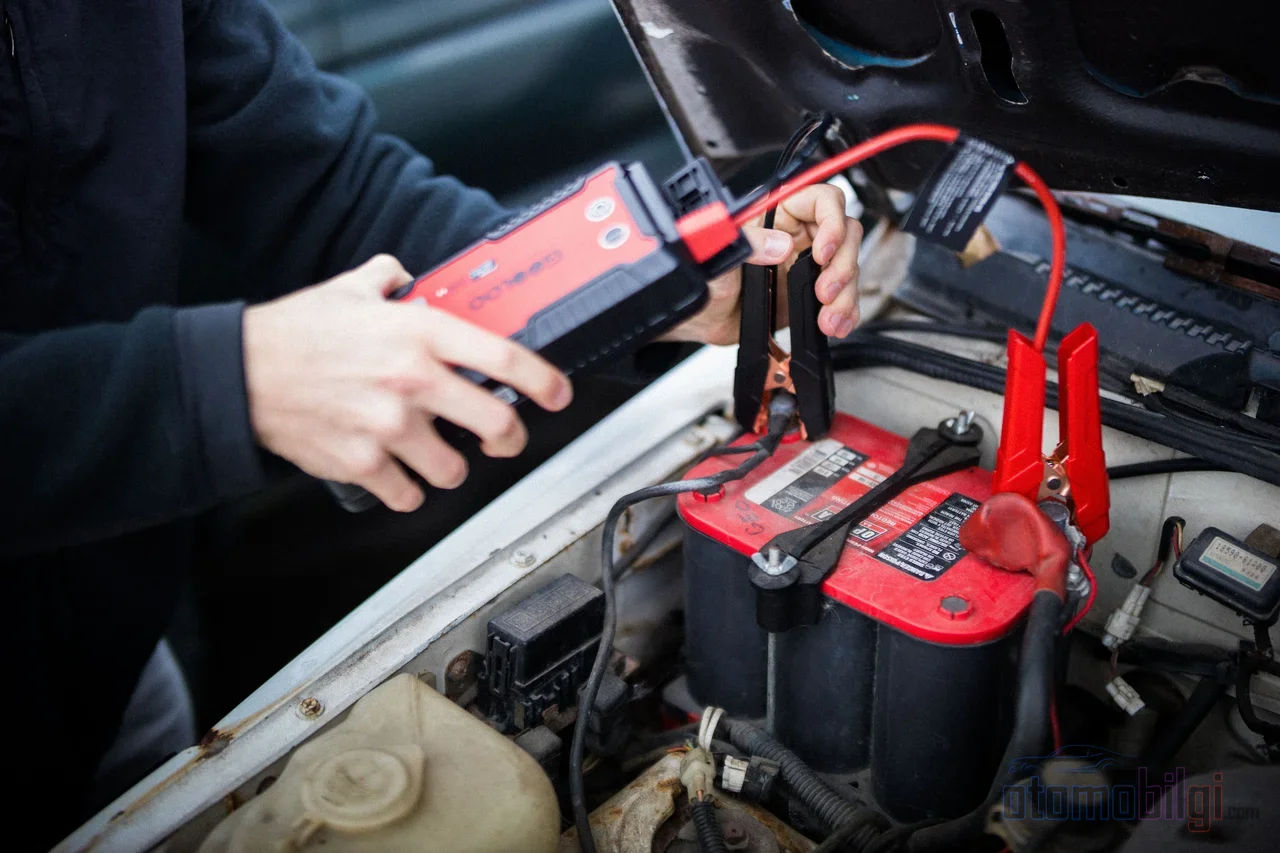
Good news: a hybrid can be jump-started from its 12 volt battery just like a classic car. The procedure is also familiar - switch off all electrical consumers, secure the hood, locate the jump-start point and connect the cables in the correct order. Pay attention to two rules:
- Connect to the correct point: Even if the battery is in the trunk, make the connection at the clearly marked jump-start point in the engine compartment; this is the recommended method both for access and for safety.
- Do not touch the high-voltage battery: The orange cables and the hybrid battery pack should never be interfered with; this system should only be serviced by trained technicians.
Lifespan, maintenance and battery selection
The common lifespan expectation for 12 volt batteries is 3-5 years; cold climates shorten this period, while in favorable conditions there are examples reaching up to 10 years. The comparison with the large battery in a hybrid is striking: the traction battery is designed for a life of 8-15 years and 160,000-320,000 km (100,000-200,000 miles). The 12 volt battery in a hybrid should actually wear out less, since its main job is to power the control modules and starting the engine is rarely needed; on the other hand, compact size and start-stop systems can accelerate wear.
| Feature | Flooded (lead-acid) | AGM |
|---|---|---|
| Maintenance requirement | More conventional structure | Maintenance-free, vibration-resistant |
| Cost | More economical | 40-100% more expensive |
| Lifespan | Typically 3-5 years | Up to 10 years |
| Charging speed | Slower | Faster |
| Common usage | Classic hybrids | Electric vehicles and vehicles with start-stop systems |
It is true that AGM emits less gas; but whether it necessarily lasts longer is open to debate. Some manufacturers differentiate between AGM and flooded in terms of charging voltage - the wrong charging profile can wipe out AGM's advantage as well. When replacing, choosing the chemistry suited to your model is critical for compatibility with the charging system.
How much does replacement cost?
There is an important distinction here: sources mostly mention the cost of the high-voltage traction battery - that is the big job, reaching a range of 2,000-8,000 dollars and protected under warranty for 8 years/160,000 km. The 12 volt auxiliary battery itself remains in the price range of a classic car battery; if AGM is chosen, you pay 40-100% more than the flooded type. So the feared scenario - a big battery replacement - is in practice the least common expense; the frequently encountered expense is the 12 volt replacement that comes every few years.
Practical tips for a long life
- Do not park the vehicle for extended periods; in a parked car, the 12 volt battery continuously powers the control modules and silently drains.
- Periodically check that the terminals are not loose or corroded; a loose connection is one of the main causes of premature failure.
- Battery capacity drops in severe cold; take starting inconsistencies seriously during the winter months.
- Do not ignore warning lights and electrical irregularities; a weak battery can give the impression of a major battery failure.
- Have the battery tested when it reaches 3-5 years of age; rather than waiting for it to die completely, a planned replacement protects you from being stranded on the road.
In short, the formula is simple: in a hybrid, the large battery provides the drive, while the 12-volt battery keeps the system running. A driver who does not neglect the small battery eliminates most of the problems that mimic a failure of the most expensive component right from the start.
Sources
- What Is the Purpose of a 12-Volt Battery in an EV? – Mazda USA
- Thinking About Buying a Hybrid? 4 Key Facts You Should Know About Hybrid Batteries – MotorTrend
- Hybrid Batteries: Everything You Need to Know – Car and Driver
- Changing the 12V Battery – Ford Plug-In Hybrid Owner Manual
- How to Jumpstart a Hybrid Car Battery – AutoZone
- How to Jumpstart a Hybrid Battery – Firestone Complete Auto Care
- Can You Jumpstart a Hybrid? – Toyota of Orlando
- Diagnosing and Correcting a Bad Battery in Hybrid Models – Midtronics
- AGM Battery vs. Lead Acid Battery – AAA
- Hybrid Battery vs Regular Car Battery – PitStopArabia