Is 48-Volt Mild Hybrid Really a Hybrid, or Just Marketing?
Share This Page
Short answer: a 48-volt mild hybrid is not a hybrid in the full sense; it does not deliver drive power to the wheels with an electric motor, but is rather an enhanced start-stop and energy recovery system. Still, it reduces consumption in a measurable way and improves comfort. In other words, it is a technology that sits right between marketing and engineering and should be read with an understanding of what it actually promises.
Highlights
- Mild hybrids cannot move the car on pure electricity; they only assist the engine.
- In the P0 architecture, real-world savings reach up to 15%; independent measurements show a range of 9-10.5% .
- A 48V battery is about 0.5-1 kWh; in a full hybrid it is 1.3-2 kWh, and in a plug-in hybrid 10-20 kWh.
- The system is not plugged in; the 48V level is not considered dangerous to humans and is not subject to heavy high-voltage safety requirements.
Is the 48-Volt Mild Hybrid Really a Hybrid, or Just Marketing?
To give an honest answer to this question, the technical definition must first be clarified. A mild hybrid (MHEV) is an architecture that adds a small electric drive to the internal combustion engine. This drive recovers braking energy, stores it in a 48-volt battery, and assists the engine during moments of sudden load. But the critical limitation is this: the electric motor alone cannot get the car onto the road. The US Department of Energy's alternative fuels data program is unequivocal on this point: mild hybrid systems cannot move the vehicle on electricity alone; they are cheaper than full hybrids but provide less fuel savings.
So does that make it a "marketing product"? No. What the system can do is real: a start-stop that can completely silence the engine during idling, energy recovered during braking, electric torque support of up to 12 kW at takeoff, and smooth, vibration-free restarting. What it cannot do is also real: there is no pure EV mode. Someone buying a mild hybrid car thinking it runs on electricity alone would be paying for the wrong product. The correct engineering framing is this: an MHEV is an assistant, not a second driver.
The Heart of the System: Belt-Driven Starter/Generator and a Two-Battery Architecture
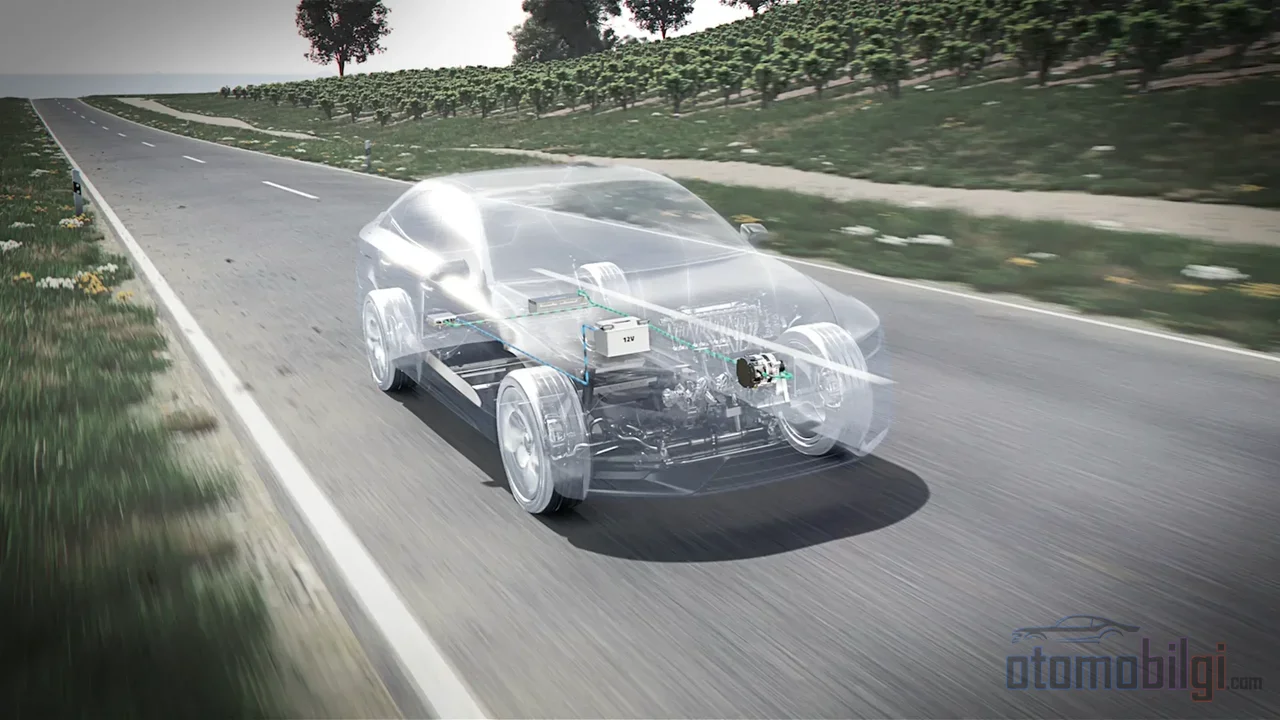
The technical backbone of the mild hybrid is the belt-driven starter/generator (referred to as BSG or BISG). In the most common P0 topology, this unit replaces the classic 12V alternator, and power transfer is done via the belt to the crankshaft. In other words, the mechanical connection is the alternator belt we already know; that is why its integration into existing platforms is cheap and fast.
On the electrical side, a dual-battery layout is used: the 48-volt Li-ion battery powers the inverter and generator, while the familiar 12V battery continues to run the radio, headlights, and window regulators. The two systems are connected via a DC/DC converter. The logic behind choosing 48V is also measurable: this voltage is below the high-voltage threshold considered dangerous for humans. Thus, the heavy safety requirements, special insulation protocols, and extra costs of full hybrids do not come into play. For the same reason, 48V can also easily supply high-power consumers such as the electric brake booster and driver assistance systems.
What Can It Do, and What Can't It Do?
- What it can do: Long-duration engine-off start-stop, brake energy recuperation, instant torque support (boost), comfortable pull-away, and short driving phases with the engine off (coasting).
- What it can't do: Pure electric driving, charging from an outlet, prolonged engine shutdown.
Technical literature states that pure electric movement is possible "either not at all or with serious limitations": in P2/P3 topologies, parking and traffic creep mode, and temporary AWD in P4 are technically feasible. But these do not mean covering the entire journey on electricity alone. GM marketing the Malibu, Aura, and Vue models as "hybrids" in 2007, despite these cars not being able to drive on electricity like the Prius, is an early example of this conceptual confusion.
How Does It Differ from Full Hybrid and Plug-in Hybrid?
Three fundamental variables distinguish the three hybrid types: battery size, voltage level, and pure electric driving capability. The table clarifies this:
| Feature | Mild Hybrid | Full Hybrid | Plug-in Hybrid |
|---|---|---|---|
| Battery capacity | ~0.5-1 kWh (48V) | ~1.3-2 kWh (high voltage) | ~10-20 kWh |
| Pure electric driving | None / very limited | Possible over short distances | 40-80 km range |
| Charging from an outlet | No | No | Yes |
| Savings potential | 15-25% (depending on topology) | Up to 45% in the city | Highest with regular charging |
| Cost and weight | Lowest | Medium | Highest |
The practical translation is this: a mild hybrid version is significantly cheaper on the price list than its full hybrid or plug-in hybrid siblings. Volvo's dealer-sourced data offers a striking comparison: while mild hybrids deliver 10-15% better consumption than gasoline cars in the city, full hybrids can offer up to 45% better values in the city. Not the same amount of money, but not the same category of benefit either.
Real Savings in the City and on Long Journeys: What Do the Numbers Say?
It must be said that there is a gap between manufacturer claims and independent measurements; the reason for the gap is the measurement method and usage scenario. SEG Automotive, developer of the belt-driven P0 system, claims up to 15% savings in the real world, calculating more than 1,500 liters of fuel, approximately 4 tons of CO2, and at least €2,000 in savings over 150,000 km. Since it is manufacturer data, it should be read with caution.
The independent figure is more modest: Oak Ridge's 2020 study found 3.6-5.5% for micro-hybrids, while for mild hybrids it is 9.0-10.5% has measured combined consumption reduction. The two sets of figures do not contradict each other; one represents the topology's upper limit under ideal conditions, the other mixed real-world usage. Hyundai's official data also confirms how the system works: during braking and overrun phases, the starter/generator operates like a generator with up to 10-12 kW of recovery power.
City vs. Highway Split
The system's architecture determines where it gains. Stop-and-go traffic is the environment where start-stop and energy recovery are triggered most frequently; for this reason, the 48V system can reduce consumption by up to 15% in city and combined driving. On the highway, however, the engine already operates at a steady load in its efficient zone, braking is rare, and the window for the system to contribute narrows. Full hybrids provide structurally better efficiency in stop-and-go traffic; the mild hybrid's contribution on the highway is marginal.
In terms of driving feel, the mild hybrid feels almost no different from a normal gasoline car - and this is actually an advantage. Experiences from user forums (for example, the accounts of an owner of a 48V-equipped BMW M340i, anecdotal in nature) show this: the most tangible daily gain from 48V is the imperceptible start-stop, i.e. comfort; some users, however, find the fuel savings "too small to matter." When making a consumption-focused purchase decision, these two expectations must be separated.
Why Do Brands Prefer This System?
The answer has three components: CO2 reduction, sellable consumer benefit, and low integration cost. The 48V unit can be mounted by belt in place of the alternator in an existing vehicle, so it does not require a complete powertrain revision. The math on the emissions side is also clear: in the EU, a saving of 10 g/km CO2 per vehicle avoids a penalty of roughly EUR 950 and this amount effectively covers the cost of the P0 system. It also reduces emission peaks by preheating the catalytic converter during cold starts - a valuable feature for Euro 7 compliance.
The size of the market shows how serious the claim is: according to market analyses, global annual 48V mild hybrid production was expected to exceed 10 million in 2025, and the number of vehicles equipped with the belt-driven P0 scheme has surpassed 4.5 million. Mercedes-Benz and Mercedes-AMG, on the other hand, use 48V not for consumption but to noticeably boost performance; this is a different job description for the same architecture.
Which Models Have It?
The system is still active across a wide range in 2026: Audi A8 and A7, BMW 5 Series, Mercedes C-Class, Volvo V60 CC, Genesis G90, Ram 1500 eTorque, Jeep Wrangler and Wagoneer, as well as the Fiat 500 and Panda Hybrid (with BSG) are among the widespread users of this architecture.
Ownership Experience: Maintenance and Battery Cost
Because a mild hybrid's battery is small, the bill in a failure scenario is also smaller compared to a full hybrid. While a full hybrid battery replacement can cost 2,000-8,000 $, some mild hybrid batteries are at around the 1,000 $ level, and prices tend to fall with manufacturing efficiency. Among Volvo owners, examples of about 1,500 $ including labor are shared; on the other hand, there are also user complaints that some mild hybrid batteries cannot be repaired and result in high repair bills. These are anecdotal data; independent long-term 48V ownership data is still limited. On the warranty side, the known standard applies: most hybrid batteries come with an 8-year/100,000-mile warranty.
Setting the right expectation also matters: the real contribution of a mild hybrid, in return for a modest addition to the purchase price, is to slightly reduce consumption and increase comfort; fuel savings are an "added bonus" in this equation. The quick payback calculations seen in full hybrids (for example, in one CR-V example, the hybrid version saving ~530 $ per year with 9 mpg higher efficiency) should not be directly generalized to mild hybrids, because the mechanism behind them is completely different.
Who Is It Sensible For? Clear Criteria
At this point the decision simplifies. A mild hybrid appeals to this profile:
- It is a practical solution for drivers with mostly long-distance usage who do not want to install charging infrastructure at home.
- For those with regular urban, stop-and-go usage, a full hybrid is a more sensible choice; the city is the full hybrid's turf.
- For those expecting pure electric range, no mild hybrid will do; a plug-in hybrid or fully electric vehicle should be considered.
- For those who prioritize comfort (imperceptible start-stop, smooth launches), the system may be worth the price difference.
Conclusion: the 48-volt mild hybrid is neither a full hybrid nor purely a marketing gimmick. Correctly defined, it is an enhanced start-stop and energy recovery system; it delivers measurable but limited savings, and its biggest tangible contribution is comfort. If you buy it not as a "hybrid" but as a "smarter gasoline car," you will be satisfied with the product you get.
Sources
- All about 48V / Mild Hybrid technology
- Here's How a "Mild Hybrid" System Works
- Hybrid Electric Vehicles - Alternative Fuels Data Center (US DOE)
- Quantifying the Impacts of Micro- and Mild-Hybrid Vehicles (Ou et al., 2020)
- Hyundai 48-Volt Mild Hybrid System
- BAS hybrid
- 48-Volt Mild-Hybrid System Explained
- Best Mild-Hybrid Cars for 2026
- How Does a Mild Hybrid Compare to a Regular Hybrid
- What Is a Mild Hybrid Vehicle?
- What You Need to Know About a Mild Hybrid
- What is a mild hybrid?
- Hybrids That Save You the Most Money on Gas