When Does a Hybrid Car Run on Electricity, and When Does It Run on Gasoline?
Share This Page
A hybrid vehicle runs on electricity at start-up, at low speeds and while braking; it runs on the gasoline engine at high speeds, during acceleration and on hills. These transitions are commanded not by the driver but by the energy management system, the vehicle's brain: at the moment of decision, it looks at the power demand, the battery charge level and the battery temperature. In every condition, the system selects the engine that maximizes fuel economy.
Highlights
- EV mode in most full hybrids provides electric driving up to around 40 km/h ; the threshold is not fixed, power demand and battery condition determine it.
- Conventional hybrids are on average 40% more fuel-efficient than gasoline vehicles.
- Most plug-in hybrids have 32-80 km of all-electric range; once the battery is depleted, they behave like a conventional hybrid.
- Sustained battery temperatures above 25 °C can double the degradation rate; cold weather temporarily reduces capacity.
- Early and gentle braking collects more energy through regenerative braking and extends the duration of EV mode.
The Brain That Decides the Transition: How Does the Energy Management System Work?
A hybrid vehicle has two motors: an internal combustion engine and one or more electric motors. The software that manages them simultaneously and decides at which moments how much power to draw from each is the energy management system. Every millisecond, the system calculates several inputs: the torque demanded at the wheels, the current speed, the accelerator pedal position, the battery charge level and the battery temperature. The output is simple: where to get the power from.
The logic chain is built as follows. The electric motor delivers its torque instantly at low rpm; that is why it is ideal for starting off and low speeds. The internal combustion engine, on the other hand, reaches most of its power only at high rpm; that is also where it is efficient. The system meets low power demands with electricity and high power demands with gasoline, and at every point between the two it searches for the most efficient combination.
The architecture varies by design. In parallel hybrids - the most common design - the engine and electric motor are connected to the wheels through a mechanical link; the two can provide drive together or separately. In series hybrids, only the electric motor turns the wheels; the gasoline engine actually drives a generator. This architecture is seen mostly in plug-in hybrids. Most full hybrids, however, operate in series-parallel: they split the power between the two sources continuously and in steps, and the driver feels these transitions not as a single moment but as a fluid handover.
Hybrid types apply the same logic at different scales
| Type | Electric propulsion | Charging | Fuel economy contribution |
|---|---|---|---|
| Mild hybrid | No, it only provides support; it can shut off the engine at standstill | Regeneration and gasoline engine | Low |
| Full hybrid (HEV) | Yes, at short distances and low speeds | Regeneration and gasoline engine, not from the plug | High |
| Plug-in hybrid (PHEV) | Yes, usually with 32-80 km of range | From the plug + regeneration | Very high when charged, at conventional hybrid level when depleted |
It's important to remember that a mild hybrid cannot move the car on its own: there is no "electric or gasoline" question in it, the gasoline engine always runs; electricity is only an aid. The real transition logic happens in full hybrids and PHEVs.
At Takeoff, On Hills, On the Highway: At Which Moments Does the System Switch to Which Motor?
Breaking daily driving into segments and observing the system's decision in each is the easiest way to clarify the logic.
Takeoff and low speeds: the realm of electricity
In stop-and-go traffic, during parking maneuvers and around the neighborhood, the system mostly relies on the electric motor alone. If the battery is full and the requested power is modest, the car rolls silently; the gasoline engine is either off or not idling - because in a hybrid, the engine can be prevented from idling while the vehicle is stationary. This is one of the biggest items reducing city consumption.
In full hybrids, EV mode is the name of exactly this regime: the system draws power only from the battery. It is typically intended for short, low-speed trips, and in most Toyota-type systems it works up to speeds of about 40 km/h (25 miles per hour). The limit is not a fixed forbidden line; if you floor the accelerator, the system sees a demand exceeding the maximum power it can draw from the battery and engages the gasoline engine.
Hard acceleration and hills: the moment the gasoline engine takes over
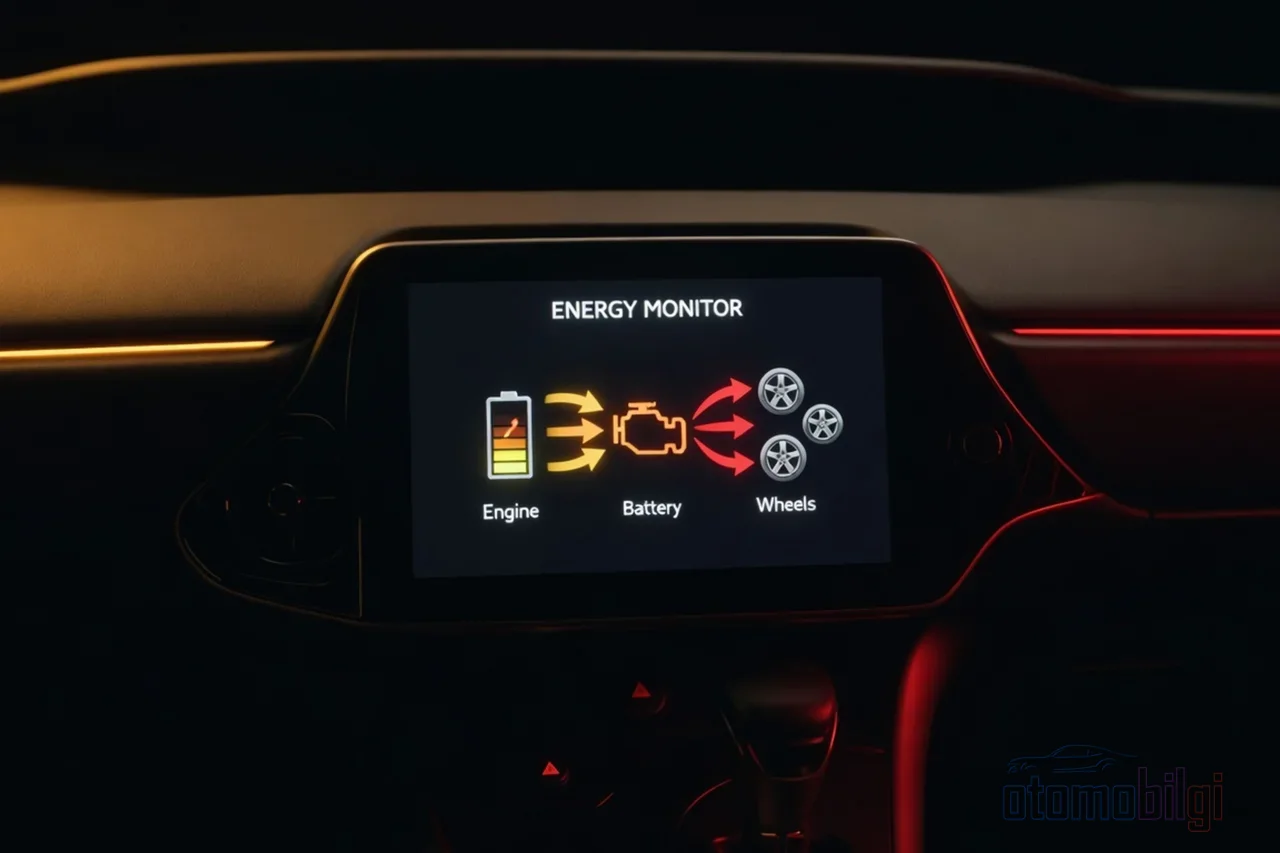
Rapid acceleration and hill climbing push the power demand to a level the battery alone cannot meet. Here the system starts the internal combustion engine; in what we call delayed restart, the gasoline engine first joins the electric motor, and once speed rises and settles at cruising pace, it takes over the job alone. The driver usually notices this through a slight vibration and the power flow diagram on the instrument panel: the arrow instantly flips from the battery to the engine.
The engineering logic here is this: to run the gasoline engine in its most efficient rev band, under load. The electric motor fills the gap during the transition moment, so the gasoline engine is never strained in an inefficient, lightly loaded region.
Highway cruising: the region where the gasoline engine is most comfortable
At steady highway speed, the internal combustion engine is already in its efficient zone; the system mostly relies on the gasoline engine and keeps the electric motor on standby for support when needed. The hybrid's biggest advantage is not here: it is most efficient in stop-and-go traffic, and at steady highway speed the fuel economy advantage drops noticeably. The question "Do hybrids switch to gasoline above 80 km/h?" is therefore common - but the switchover speed is not fixed. The threshold depends not on speed but on instantaneous power demand and battery state; some hybrids can already switch to gasoline at much lower speeds.
Braking and descents: the recharging part
When you brake, the electric motor works as a generator and stores the kinetic energy that would otherwise be lost during braking back into the battery; this is called regenerative braking. The same mechanism also works on descents: in some vehicles the "B" gear position increases regenerative braking. In city driving, every stop is actually a small charging process - and this charge makes it possible for the next start-off to be electric. A hybrid is not charged with a plug; it fills its battery entirely through this recovery and the gasoline engine.
How Do Battery Charge Level and Temperature Change Transitions?
In the decision table of the energy management system, two variables determine almost everything: how much energy remains in the battery and the battery's temperature.
When the charge level drops, the system becomes conservative: EV mode shortens, the gasoline engine engages earlier and more often, and it may even generate extra power to charge the battery while running. This picture is most clearly seen in PHEVs: when the battery energy runs out, the internal combustion engine kicks in and the vehicle behaves like a conventional hybrid until it is plugged in. This is the practical problem for PHEV owners - deciding at any given moment which of the two sources will deliver the best use is the job of the energy management strategy, and manufacturers treat this optimization as a control problem they continually improve.
Temperature, on the other hand, affects things in two directions. In the cold, the battery's capacity drops and its internal resistance rises; the system restricts output and input, and as a result the hybrid consumes more fuel in winter. This restriction is temporary and does not permanently damage the battery - the vehicle computer protects itself while the battery is cold. Once the battery warms up, it returns to normal. In extreme heat, the opposite scenario plays out: when battery temperature rises, the system may reduce the charging speed to prevent overheating. Continuous 25 °C operation above can double the battery's degradation rate; long summer drives with accumulated high heat shorten battery life because there is not enough cooling in between. Short drives and rest intervals protect the battery. The result: even on the same route, transition behavior changes with the season; on a winter morning, EV mode lasts shorter than on a summer afternoon.
Can Drivers Manage Transitions for Fuel Savings? Example Scenarios
You cannot change the system's decisions, but you can influence its inputs. Keeping the battery as full as possible and keeping power demand smooth is an adequate summary; in practice, the following scenarios apply.
- City stop-and-go: Read traffic lights from a distance and coast by slowing down. Early and gentle braking recovers more energy than a hard stop and extends the duration of EV mode. When it is safe, reduce your speed before braking; on descents, use the "B" gear if available.
- Acceleration: Press the accelerator pedal gradually, not abruptly. Hard acceleration instantly demands power from the battery beyond the ECO line and the gasoline engine enters immediately; a gentle request makes an electric start-off possible.
- Highway: If possible, use a steady speed; variable speed means constant gasoline-electric switching. A common practice among PHEV users is to reach highway cruising speed in EV mode and then switch to hybrid mode - some drivers report this as the most efficient combination, but the general advice is to leave EV mode to the natural hybrid logic rather than forcing it with a separate button.
- Long descent: Instead of pressing the brake pedal, coast; regeneration charges the battery throughout the descent and lets you come to a stop electrically at the intersection at the bottom.
The common denominator is this: every gentle brake and every coast buys the next electric kilometer. What fills the battery is not the gasoline engine, but mostly the kinetic energy you recover while braking.
Frequently Asked Questions
Why does a hybrid use electricity at takeoff and gasoline on the highway?
Because each motor is efficient in a different region. The electric motor delivers instant torque and is efficient at low speeds; the internal combustion engine only reaches most of its power at high speeds and revs. The system uses each motor for the task where it is most efficient; this provides better economy with a smaller gasoline engine than a single motor would.
What does the EV mode button do?
When available, it enables driving on electricity alone; it is designed for low speeds and short distances. The typical limit in most systems is around 40 km/h, and it works if the battery is sufficiently charged. It is ideal for parking maneuvers and quiet, low-emission driving.
When does the gasoline engine kick in on a PHEV?
Usually when the battery energy is depleted; from that point on, the vehicle operates like a conventional hybrid until it is plugged in. Some PHEVs can also run full-time in a gasoline-electric mixed mode. There are models whose total range capacity in hybrid mode exceeds 960 km.
Conclusion: Leave the Decision to the System, Keep the Inputs to Yourself
A hybrid's electric-gasoline switching is not a puzzle for the driver to guess, but a control problem driven by measurable inputs: when power demand rises, the gasoline engine; when it stays low, electricity; when the battery depletes or cools, gasoline; braking and descents, electric gain. The driver's share is to steer these inputs correctly - gentle throttle, early braking, coasting up to a stop. The system calculates the rest to maximize fuel economy in every condition.
Sources
- How Do Hybrid Electric Cars Work?
- Comparing Electric, Hybrid, and Gas Vehicles | NYSERDA
- How Do Hybrid Cars Work? - Consumer Reports
- Toyota Hybrid Drive Modes
- AAA Study Reveals Temperature Impacts on EV and Hybrid Performance (May 2026)
- How does battery degradation affect hybrid system performance? - Solarif
- How Summer Heat Affects Hybrid & Electric Vehicles
- Hybrid driving tips for best fuel economy - Toyota UK Magazine
- Hybrid Driving Tips - GreenCars
- Energy Management Strategies for PHEVs - NREL (Gonder 2007)
- Plug-in Hybrid-Electric Cars - DriveClean CA