What Do the EV, Eco, and Power Modes in Hybrid Cars Actually Do?
Share This Page
The EV, Eco, Normal and Power (Sport) modes in hybrid cars are different commands given to the same engine-electric motor pair: they change throttle pedal response, the thresholds at which the engine kicks in, and how the battery is used. In short, these modes do not increase or decrease the car's power; they decide when, from which source, and how the existing power is delivered. Choosing the right mode for the right scenario tangibly improves fuel consumption and the share of electric driving.
Key Takeaways
- EV mode is typically designed for speeds below about 40 km/h and for short distances; with a full battery it usually provides around 1-2 km of electric driving.
- Eco mode softens throttle response and runs systems like the air conditioning economically.
- Power (Sport) mode does not increase horsepower; it sharpens power delivery and raises consumption.
- Regenerative braking works regardless of the mode and reduces brake pad wear.
- Modes with the same function are named differently from brand to brand: Eco/ECO/ECON, Power/PWR/Sport.
What Do the EV, Eco and Power Modes Actually Command?
At the heart of a hybrid there are two power sources: an internal combustion engine and an electric motor. The car's computer decides at every moment how much power to draw from which source and how much of the braking energy returns to the battery. Drive modes are the way to intervene in this decision logic. When you switch modes, no new physical component is engaged in the car; the only thing that changes is the map the software applies to the throttle pedal, engine speed and battery usage.
From an engineering standpoint, the job description of the four basic modes is as follows:
- EV mode: Forces the system to run on the electric motor alone as much as possible. It is for short distances and low speeds; in manufacturer data the speed limit is usually stated as about 40 km/h (25 mph).
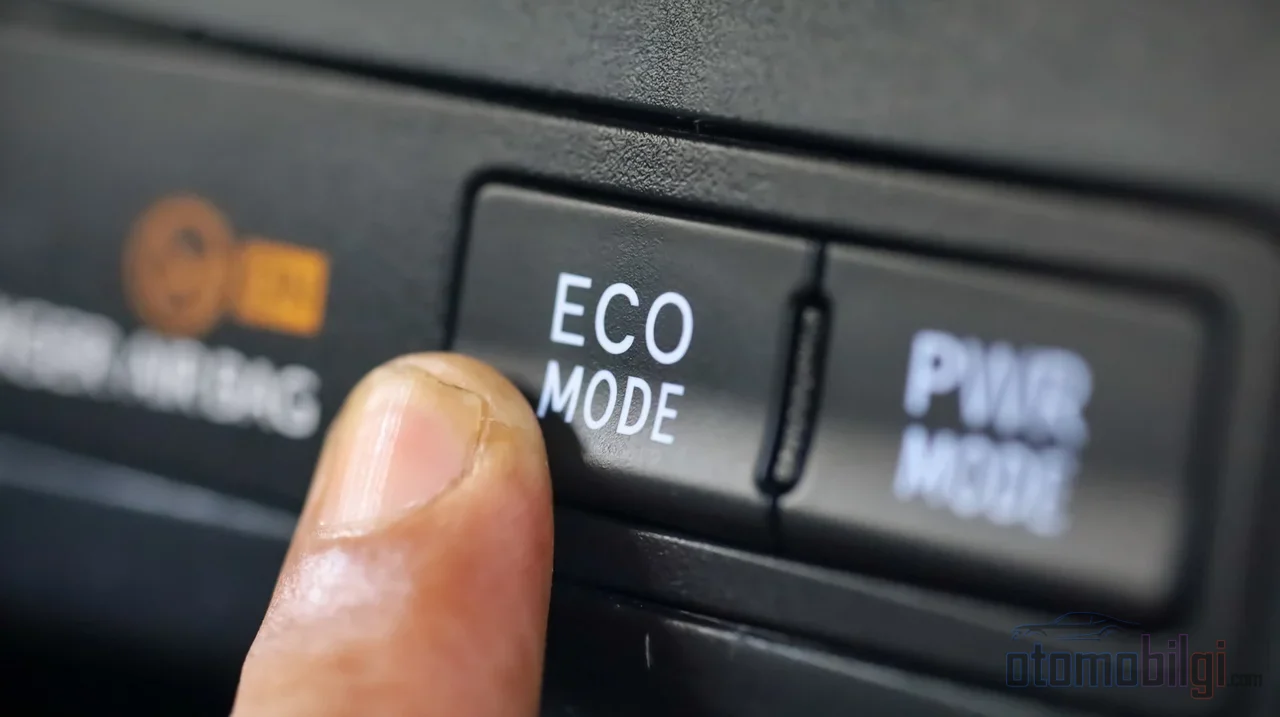
- Eco mode: Softens throttle response and limits the consumption of auxiliary systems like the air conditioning. The goal is fuel economy alone.
- Normal mode: The factory-set balance; it is the default setting in which the system is left to its own optimization for daily driving.
- Power/Sport (PWR) mode: Sharpens throttle and steering response, holds engine speed higher, and draws more generously on the battery for acceleration support.
Let us clear up the most common misconception right away: Power mode does not increase the engine's horsepower; it only optimizes the delivery of the existing power. The car feels more agile because pedal input is interpreted more aggressively, but mechanically no new power is created.
How Far Can You Actually Go in EV Mode?
In self-charging (full) hybrids, EV mode does not promise the long range seen in plug-in hybrids. It is typically designed for around 1 mile (about 1.6 km) of electric driving; with a fully charged battery combined with low speeds, user experiences show that a few kilometers are possible. The purpose of this mode is not range, but quiet, emission-free progress in certain scenarios: enclosed parking areas, residential zones, early-morning neighborhood departures, and stop-and-go heavy city traffic.
The availability of EV mode depends on the battery charge level and other conditions. When the battery drops below a certain level, the system does not allow this button to operate; this is not a defect, but part of the logic of protecting the battery. If you demand more power than the electric motor can provide (for example, on a hill or when accelerating), the system automatically engages the gasoline engine regardless of the mode.
Consumption and Battery: Which Mode Changes What?
The effect of the modes on consumption is directly related to the character of the accelerator pedal. The softened throttle response in Eco mode prevents sudden acceleration, reducing consumption in city use; the reduction in air conditioning output also contributes to this equation. In Power mode, the picture reverses: the engine is held at higher revs, the battery is drained faster for acceleration support, and fuel consumption increases. It is technically possible to stay in Power mode continuously, but you pay the bill at the pump.
The difference between modes is also noticeable on the battery side. In Eco mode, in some hybrids the system charges the battery to a certain level (around 75% according to user observations) and then shuts off the gasoline engine, preferring to run on electricity, while in Sport mode the engine runs more frequently to keep the battery charged. Claims circulate in forums that Eco mode wears out the battery faster due to the increased charge-discharge cycles; this view has no verified basis in official manufacturer data, and the level of evidence is low.
Regenerative Braking: A System Independent of Mode
Regenerative braking is a system that converts the kinetic energy that would otherwise be lost during braking into electricity and charges the battery, and it works no matter which mode you are in. It is at its most efficient especially in city driving where stop-and-go traffic is heavy; this is why hybrids generate more electricity in the city than on the highway. There is also a tangible side benefit: since the mechanical brakes are used less, brake pad wear is reduced. The most practical way to charge the battery on the road is to avoid hard braking and make predictive, long, and gentle braking maneuvers; downhill roads are ideal for this because there is no engine load.
It is necessary to set reasonable expectations about the magnitude of the recovery rate: user measurements show that regenerative braking recovers roughly 6-9% of the initial kinetic energy. So braking energy is not a free charging station, but a compensation mechanism that recovers part of the inevitable loss.
Which Mode Makes Sense in Which Scenario?
The cleanest way to turn mode selection into a decision is to divide driving into scenarios. On short, low-speed journeys, EV mode is a clear gain: exiting the parking area, passing through the neighborhood, progressing within residential zones. In stop-and-go city traffic, the hybrid system already operates at its most efficient point; here, Eco mode also enforces throttle discipline on your behalf. On the highway, the picture changes: at high speeds, air resistance becomes dominant and electric driving is impractical; it makes more sense to cruise within the internal combustion engine's efficient rev range. Therefore, switching back to Eco or Normal mode before entering the highway is more economical than insisting on EV mode.
Power mode's legitimate domain is narrow but real: steep uphill climbs, exiting narrow intersections, overtaking, and merging onto ramps. In these maneuvers, sharp throttle response and a high, sustained engine rpm serve safety purposes. Normal mode, on the other hand, is the unsung hero; the system's own energy management is already quite intelligent and covers most of daily use.
| Scenario | Recommended mode | Reason |
|---|---|---|
| Parking area, residential zone, short distance | EV | Silent, emission-free electric driving; effective below approximately 40 km/h |
| Stop-and-go city traffic | Eco | Soft throttle response and economical climate control operation reduce consumption |
| Daily mixed use | Normal | The system's own optimization gives the most balanced result |
| Overtaking, ramps, steep hills | Power/Sport | Sharp throttle response and high engine rpm; consumption increases |
| Highway cruising | Eco or Normal | Electric driving is inefficient at high speeds; the engine's rev range is advantageous |
Additional Functions in Plug-in Hybrids: Save, Charge, and Battery Preservation
In plug-in hybrids (PHEVs), the mode logic is taken a step further because the battery is larger. Some models feature a Save function that prevents the battery charge from dropping below a selected level; the idea is simple: reserve the electric range for the city portion where you will truly need it. Some models also have a function that charges the battery on the road, but the source of this energy is gasoline, which is not economical compared to home charging. The only scenario where the charge function makes sense is generating a charge on downhill roads without engine load.
An even more advanced layer also exists: systems that use geographic data (hills, route profile) based on the destination entered into the navigation to pre-optimize engine and electric transitions. The vehicle plans where it will drive electrically and where it will switch to the gasoline engine along the route, based on route information. On the Toyota side, there is also a B mode that strengthens engine braking; it provides speed control on long descents without wearing out the brake pads.
Naming Differences Across Brands
The same function is not called by the same name in every brand, and this causes confusion when comparing. The basic equivalents are as follows: the economy mode is called Eco in Toyota and Lexus, and ECON in Honda. The performance mode is Power or PWR in Toyota, and Sport in Honda and Hyundai. Honda's Accord offers four drive modes, while models like the Civic Hatchback have three-mode systems: Normal, Sport, and ECON. Hyundai's set is broader: It offers modes such as Eco, Comfort, Sport, Smart, and Snow, and in the Tucson Hybrid, Eco mode provides a daily balance similar to Normal. Land Rover PHEV models have the default HYBRID and EV modes, plus Save and route-based energy optimization functions; in BMW PHEVs, there is a HYBRID mode, ELECTRIC mode, and the eCONTROL (Battery Hold) button that preserves the battery.
The practical takeaway is this: When comparing two cars at the showroom, look not at the mode names but at the logic behind them. One car's Comfort mode may do the same job as another's Normal mode.
Frequently Asked Questions
Can I stay in Sport mode all the time?
Yes, technically you can; the vehicle will not develop a fault. However, the sharpened throttle response and the battery being used more aggressively for acceleration support raise fuel consumption. It is not an economical choice for daily driving.
Which mode is the most efficient?
This question is open to debate in user communities; the majority view is that the automatic/hybrid mode, where the system makes its own decisions, or Normal mode is the most efficient. Although it is occasionally claimed that Sport mode yields better consumption in certain driving styles, this remains at the level of individual experience and does not constitute a general rule. Safe recommendation: Normal for mixed use, Eco in the city, Power when needed.
What is the best way to charge the battery?
Not the mode button, but driving style. Avoiding harsh braking, making long and gentle braking maneuvers, and if possible choosing downhill routes maximizes regenerative gains; because the system recovers braking energy no matter which mode you are in.
Ultimately, the modes are simply different sets of instructions given to the hybrid's brain. Cover short distances silently in EV, hand over throttle discipline to the software in the city with Eco, leave the daily balance to the system with Normal, and save Power for moments when you truly need it, such as overtaking and hills. The rest comes down to using the brake pedal gently; that part provides gains that no mode can give you.
Sources
- Driving Modes | Guide to Driving PHEVs | Range Rover
- Hybrid driving tips for best fuel economy – Toyota UK Magazine
- Toyota Hybrid Drive Modes – Capovalley Toyota
- ECO Mode and EV Mode: What Do They Do? – Wilsonville Toyota
- ECO, POWER, or EV Mode: What's the Difference? – Hometown Hybrids
- 4-Mode Drive System – Honda Info Center
- 3-Mode Drive System – Honda Info Center
- All Hyundai Drive Modes Explained – Bob King Hyundai
- PHEV BATTERY HOLD drive mode – BMW USA FAQ
- What is Regenerative Braking in Hybrid Cars? – SEAT
- Regenerative Brakes: How Do They Work? - Kelley Blue Book
- How long on EV mode? - ToyotaNation