How to Check Battery Health When Buying a Used Hybrid?
Share This Page
When buying a used hybrid, you should read the gauge behavior to understand battery health, check cell voltage balance with an OBD device, check for fault codes, and do a realistic 20-30 minute test drive. A single sign is not enough; when all four are evaluated together, a weak package almost always gives itself away. This guide walks through the four steps in order, explaining technical terms in plain language.
Highlights
- SoH above 85% is considered excellent, below 50% is considered critical.
- The P0A80 code indicates that the pack needs replacement.
- A short test drive will not reveal weak cells; 20-30 minutes is required.
- In many manufacturers, the battery warranty stays with the vehicle, not the person.
What Is SoH, and Is It Confused with SoC?
At the heart of every check you make before purchase are two concepts. SoH, or State of Health, shows the battery's remaining capacity as a percentage compared to its new state; it is the true measure of how much life is left in the pack. SoC, or State of Charge, is the current charge level and changes constantly throughout the day. The bars you see on the gauge show SoC; SoH, however, can only be read through a diagnostic device. A buyer who misses this distinction assumes a battery that looks full is healthy - when in fact something full can also be faulty.
The second fundamental concept is cell balance. A hybrid battery pack is not a single block; it consists of many cells connected in series. In a healthy pack, the voltage difference between cells remains at the millivolt level. When a cell weakens, a voltage gap opens up and the entire pack is dragged down to that weak cell's level. Capacity drops, fuel economy deteriorates, and the system starts storing fault codes. The purpose of the OBD check is precisely to be able to see this difference.
First Reading via the Gauge: What to Look For Before the Test Drive?
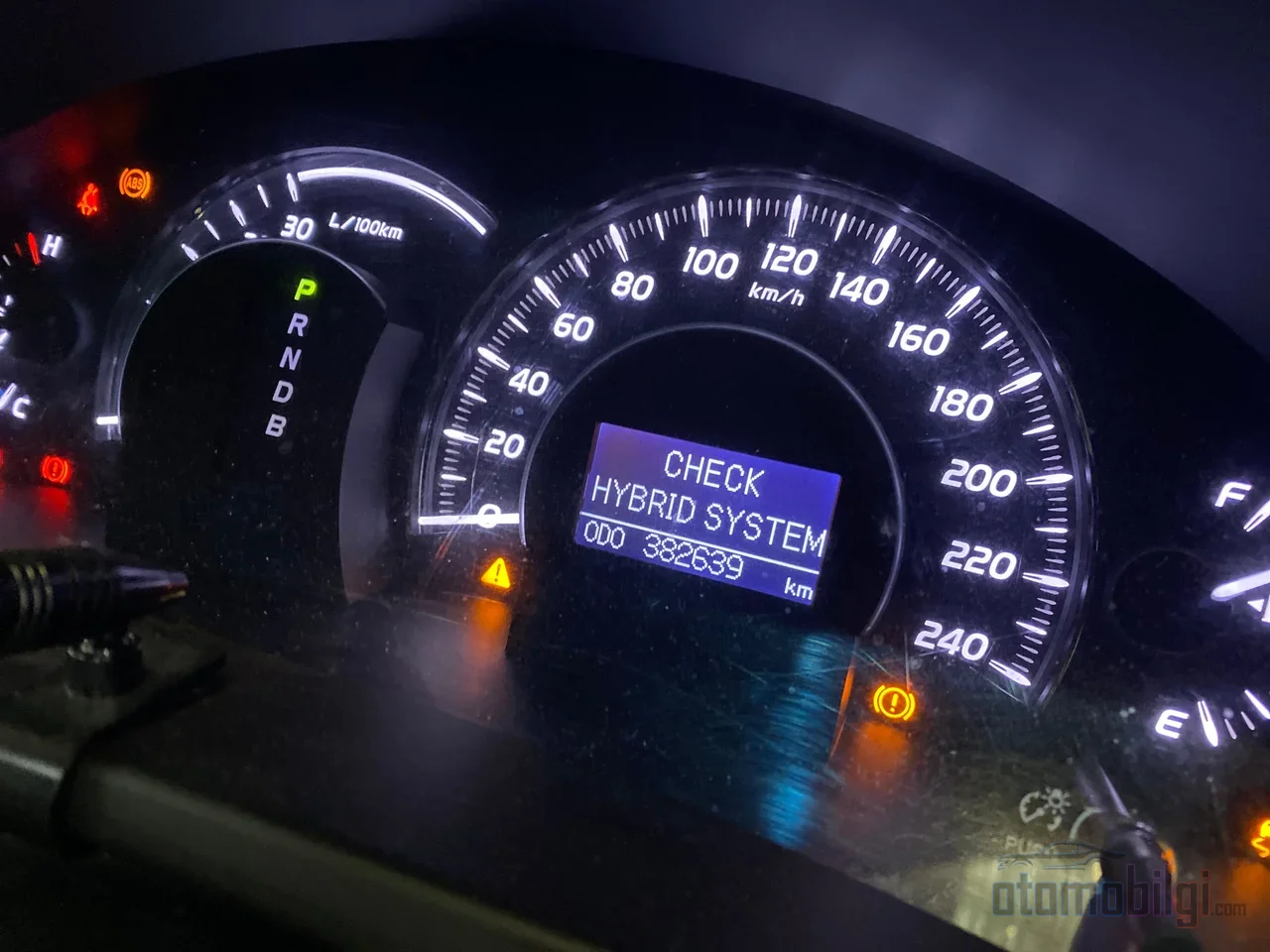
When you turn the ignition on, it is normal for all warning lights to flash briefly; the system is performing a self-test. The problem is when the lights do not go out. A steady check engine light, a hybrid system warning, the IMA light on a Honda, or the red triangle with an exclamation mark on a Toyota is a red flag, and you should walk away from the vehicle without needing an explanation.
If there is no warning light, move on to the gauge's behavior. A healthy battery gauge stays at a mid-level, roughly in the 40-80% band; it rises with regenerative charging when you brake, and drops gradually when you accelerate. A gauge that jumps around, one that stays stuck constantly very low, or one that drains quickly in normal use is the first signal that something is wrong inside the pack. For example, the Toyota Prius tries to keep six blue bars on the system; this level corresponds roughly to 60% SoC, and deviations are easily noticed.
The third check that is often overlooked is the cooling fan. A faint hum coming from behind the rear seat is normal; squeaking, rattling, or blocked air vents are signs of trouble. A faulty or inefficiently working fan overheats the battery and starts an accelerated degradation cycle. A fan failure worth a few thousand lira can cost you ten times that in battery replacement.
Reading Cell Voltage Balance via OBD: Why You Shouldn't Trust the Dashboard
The dashboard only tells you what the system wants to show the outside world. For an accurate picture, a diagnostic device is plugged into the OBD2 port, and cell or block voltages, internal resistance, and SoH data are read from the hybrid battery menu. A professional scan gives you the following picture:
- Battery health percentage
- Individual cell and block voltages
- Stored fault codes, including erased ones
- Battery temperature data and charge-discharge patterns
- Inverter status
A practical warning is needed here: not every OBD scanner can read hybrid battery SoH. Basic code readers and general mechanic equipment are not sufficient for this job; you need a workshop specialized in hybrids or a device capable of reading this data. App-based tools that have become widespread among Prius owners can give you a quick idea; in fact, a weak result obtained in a two-minute discharge test can catch a pack that hasn't yet produced even a single fault code. But the final word still belongs to professional testing.
Fault Codes: What Does Each Code Mean?
The codes shown by the diagnostic device are your most concrete bargaining chip. The two most critical ones are:
| Code | Meaning |
|---|---|
| P0A80 | The pack needs to be replaced; it usually comes together with a dashboard warning |
| P0A7F | Deterioration detected in the hybrid battery pack |
| P0AA6 | High voltage insulation fault; usually seen with a red warning |
You should also know that the hybrid system warning does not by itself mean a battery failure. The system reports that it has stored a fault but does not say which part is faulty; a weak 12V battery, a clogged battery cooling system, the inverter, or a sensor failure can trigger the same light. The out-of-code symptoms of an impending battery failure are: declining fuel economy, changing fan behavior, dashboard irregularities, power loss during acceleration, and inability to enter EV mode.
Behaviors to Watch For on the Test Drive
The seller's suggested lap around the block is not enough; weak cells usually reveal themselves after the 20th-30th minute of driving or on an incline. Don't hesitate to ask for a mixed drive that includes city traffic, highway, incline, and idle, 20-30 minutes of driving. During this time, watch for the following behaviors:
- EV mode test: Below 40 km/h the car should run silently and travel at least 1-2 km on electricity alone. If the engine never switches to EV or drops out of it instantly, that's a warning sign.
- A/C test: Turn on the air conditioning at idle; in many hybrids the compressor runs on the battery while the engine is off. Hot air blowing or the engine being forced to kick in points to a weak pack.
- Brake test: Regenerative braking loses its effectiveness when the battery cannot accept the recovered energy. Brake hesitation or a feeling of reduced deceleration is both a fault signal and a safety issue.
- Gauge stability: Constant fluctuation of the charge gauge during driving may indicate a faulty battery or a charging system problem.
- Fuel economy: If consumption is more than 25% above the expected value, battery degradation is likely.
Failure to hold a charge and sudden power drops are also on the same list. When you open the throttle on a hill, the system suddenly cutting electrical support is the clearest sign that the pack is collapsing under load.
How Should You Interpret the SoH Percentage?
If the diagnostic result gives you an SoH percentage, make your decision based on these thresholds:
| SoH | Condition | Meaning for the buyer |
|---|---|---|
| 85-100% | Excellent | Performance like new |
| 75-85% | Good | Normal wear, several years of life |
| 65-75% | Moderate | Noticeable degradation; a replacement budget should be set aside within 1-3 years |
| 50-65% | Poor | Replacement needed in the near future |
| Below 50% | Critical | Immediate replacement; walk away if it is not reflected in the price |
A vehicle just below the moderate band can make sense with the right price negotiation; one in the critical band should only be considered after deducting the battery replacement cost. Meanwhile, take the skepticism about refurbished batteries seriously: in a vehicle that has had a pack replacement, post-refurbishment lifespan cannot be guaranteed; increased fuel consumption, slower acceleration, and a noisy fan tell the real story more clearly than the codes.
Warranty Transfer and Red Flags
The good news is this: many manufacturers transfer the hybrid battery warranty when the vehicle changes owners; the warranty is tied to the vehicle, not the first owner. In the USA, the federal standard for hybrid systems is 8 years / 100,000 miles; California's 10 years / 150,000 miles mandate is stricter. Since exact terms vary by manufacturer, model, and first registration date, follow these three steps in order: find the warranty start date, confirm the remaining duration, and check the transfer conditions.
Read the seller's attitude as a test method as well. Stay away from a seller who does not allow battery testing; if the seal on the pack cover is broken or the modules are not identical to one another, there are signs of repair. A missing service record and a price significantly below market also fall into the same category. Remember, the risk is not only in the battery: one Prius owner had to pay over $3,000 for a brake booster failure at 158,000 miles. Hybrid components are general, so your budget should include a surprise margin.
Understanding the management logic also inspires confidence: for example, in Ford hybrids the HV battery is kept in a 30-55% charge range to prevent overcharging and deep discharge; this strategy extends pack life. A buyer who knows the vehicle is trying to maintain this band interprets the deviations on the gauge much more accurately.
Conclusion: Apply the Four Checks Together
Gauge reading, OBD cell balance check, error code scanning, and an extended test drive; none of these alone gives a definitive result, but together the four reveal the truth about a used hybrid's battery. A buyer who wants to shorten the process settles for the gauge and a short drive; yet weak cells escape precisely these short procedures. Setting aside 20-30 minutes of your time and an hour of an expert workshop's time is, compared to a pack replacement bill, the cheapest insurance from an engineering standpoint.
Sources
- Check Hybrid Battery Health Used Car: Buyer's Guide
- How to Check Toyota Hybrid Battery Health - Carista
- How to check your car's hybrid battery - OBDeleven
- What Failure Symptoms Indicate a Degraded Used Toyota Hybrid Battery
- Hybrid Battery Warning Light: What Owners Need to Know
- Hybrid system warning meaning - Auto Star Garage
- Signs Your Hybrid Battery Might Fail Soon
- Diagnosing and Correcting a Bad Battery in Hybrid Models - Midtronics
- What Happens When a Hybrid Battery Dies - Exclusively Hybrid
- Can You Drive a Hybrid Car with a Failed Battery in the UK? - Greentec Auto
- What Is Battery SoH - go-e
- Battery SoC and SoH explained - BioLogic
- What to Check When Buying a Used Hybrid Car - CarVibe Houston
- Battery warranty transfer with used EV - Gumtree Guides
- Is there a diagnostic that can be done on a used hybrid car's battery pack?
- How do you read Dr. Prius app - PriusChat
- How to determine your battery State of Health - Kia Niro Forum
- How can you tell when your hybrid battery is about to go out? - Reddit r/prius
- If buying a used hybrid, can I have the battery tested for an estimated lifespan?