What to Pay Attention to While Waiting in Line for Fast Charging?

Share This Page
At the fast charging station by the highway, your turn has finally come, you plug in the cable, the vehicle accepts the plug - then you look at your phone and get lost in a conversation. Three vehicles are waiting behind you. When the charge shows 82%, the current has dropped to a third, but you are still waiting for 100%. At exactly this moment, a question you never experienced at a gas station arises: When do I need to leave? The least written-about yet most frequently encountered part of everyday electric vehicle ownership consists of exactly these moments.
For a driver coming from gasoline vehicles, habits do not work here: there is no queue lane, no attendant, and filling the tank does not take minutes. A fast charging station operates with an informal set of rules revolving around a shared infrastructure. This article lists those rules along with the engineering logic - from queue rights to the 80% rule, from the unplug dilemma to holiday route congestion in Türkiye, it brings together everything you need to pay attention to while waiting in line for a fast charge in a single guide.
Queue culture: How is queue right determined if there is no queue lane?
Charging stations do not have an established queue system like gas stations. The common norm is the first-come, first-served principle. The problem starts here: Recognizing the waiting driver is not always easy. Waiting visibly at a regular parking spot with your car, not blocking the exit lane, and briefly asking other drivers to clarify the situation when it becomes unclear who owns the queue is the method that progresses with the least friction.
Managing queues is becoming institutionalized in some countries: In the United Kingdom, a charging network operator tried marshalls at some stations to organize queues during busy periods - this is not yet a common practice. So at the vast majority of stations, what maintains queue discipline is not management, but the common courtesy of drivers. The 80% rule, which we will explain in the next section, is the most concrete measurable form of this courtesy.
Highlights
- In DC fast charging, the average charging time from 10% to 80% is about 20 minutes; an additional 20-30 minutes may be needed for the last 20%.
- After 80%, the battery protection protocol kicks in and the charging speed drops noticeably.
- Some networks apply an every-minute idle fee if you do not unplug your vehicle when charging is complete.
- Unplugging another vehicle's cable without permission can damage the charging port or the cable.
The 80% rule: Why does the last 20% make everyone wait?
There is engineering behind this rule, not superstition. When the battery reaches 80%, the vehicle's battery management system (BMS) switches from constant current to constant voltage, and the charging speed drops noticeably. This slowdown is not a malfunction, but a protocol designed to protect the battery: As the voltage limit is approached, it is necessary to avoid excessively raising the cell voltage and to keep the increasing internal resistance and thermal management in balance.
Let us give a concrete example. While the Volkswagen ID.3 goes from 10% to 80% in fast charging in about 30 minutes, it may demand an additional 20-30 minutes for the last 20%. So as occupancy increases, the time savings reverse: The first 70 percent fills faster than the last 20 percent. The drop in charging speed becomes especially noticeable above 85%, and at this point continuing on your way is the better choice both in terms of time and queue courtesy. The purpose of fast charging is not a 100% full battery but a continuing journey; those with home charging leaving the space for those who genuinely need public fast charging is part of the same logic.
Some operators have turned this problem into an economic tool. Tesla states that charging above 80% is deliberately designed to be slow to prevent battery damage, and charges a per-minute congestion fee for charging above 80% when the station is full. In Europe, networks such as IONITY and Fastned have also started applying idle fees to discourage drivers who do not move their vehicles when charging is complete. In the UK example, Tesla offers a 5-minute grace period; if station occupancy is above 50%, a fee of 50 pence per minute may be charged, and 1 pound at full capacity. Some charging points impose a fixed time limit (for example, 45 minutes) or a parking fee. In short, not moving your car once charging is complete is no longer merely a matter of etiquette, but directly a matter of your wallet.
The unplugging issue: Can you unplug someone else's charging session?
Not without permission - this rule applies not because the cable is cheap, but because of the risk it carries and the hardware reality. Many vehicles lock the cable in the port during charging, and an unauthorized unplugging attempt can damage the charging port or the cable. Some older EV and PHEV models (such as those with a Type 1 connector) may lack a locking mechanism, but this does not justify freely pulling the plug; the backbone of charging etiquette is permission and communication.
The opposite of unplugging is just as important: A vehicle whose charging is complete but has not moved means a full socket for the next in line. In this case, the right thing to do is not to intervene in anger, but to contact the driver through the car window or with an appropriate note - one of the most recommended methods is to leave a short information note on the passenger window. A problem that seems impossible with a locked cable is often solved with a one-line message. In the event of a malfunction, communication is again essential: A faulty charging point should be reported both to the operator and to charging apps, so that the next driver does not lose the same amount of time.
The right socket, the right power: Who does high power belong to?
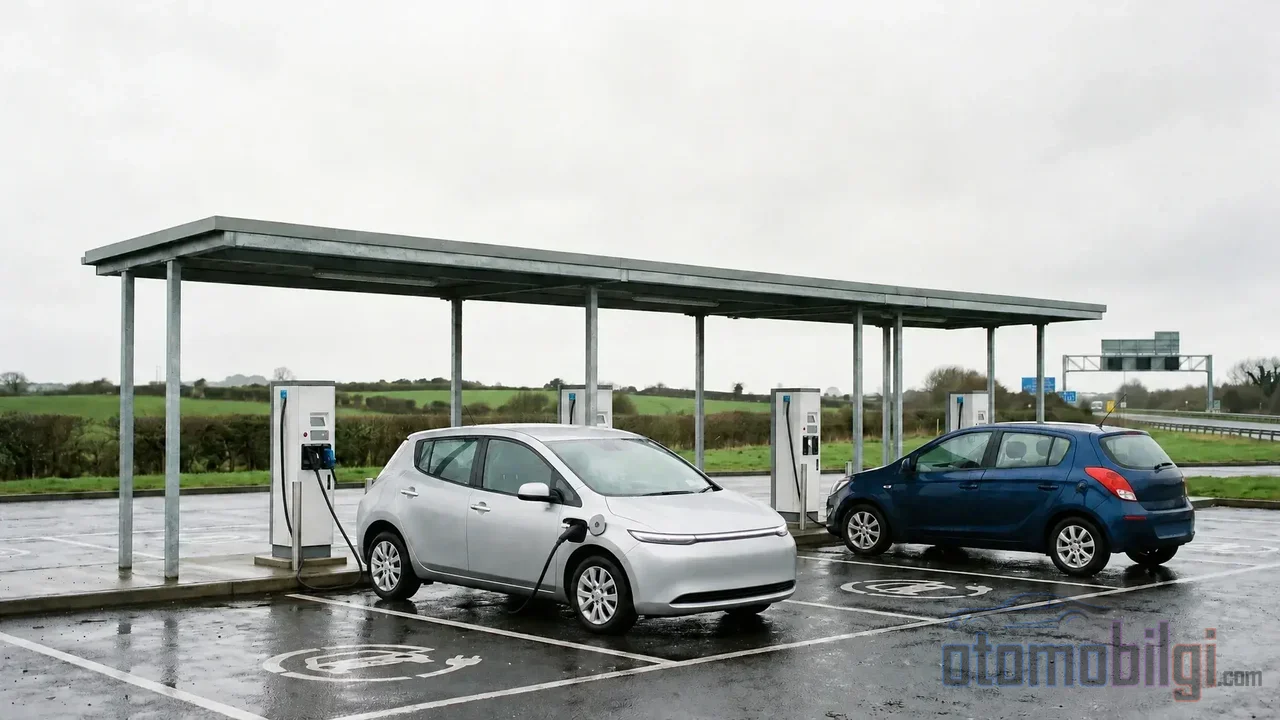
The most common inefficiency at fast charging stations arises from a mismatch between the power a vehicle can accept and the power the unit can deliver. A vehicle that charges at a maximum of 50 kW - the classic example being the Renault Zoe - should not occupy a 400 kW-class unit; that socket should be left for vehicles that can genuinely accept high power (such as the Porsche Taycan or Audi e-tron GT). The scale is evident from this: The Chevy Bolt accepts about 55 kW and can use only a small fraction of a 350 kW unit's output; the Taycan, meanwhile, can charge at an average of 213 kW. During off-peak hours this choice is free, but when a queue forms, the power hierarchy kicks in automatically: Small vehicles charging at low power avoiding DC stations during peak hours and turning to AC units saves both their own time and someone else's socket.
The PHEV issue is also debatable. Plug-in hybrids have the right to use charging points - that is an indisputable fact. However, plugging a PHEV that charges at 7.2 kW into a 50 kW fast charger is an inefficient use of the unit's capacity; during busy hours this choice is not the right one. You may use it, but if an ordinary EV needs fast charging, a modest approach is expected.
Cable reach, power sharing, and connector differences
Parking direction is the detail most often gotten wrong on the first fast-charging attempt. If the charging port is at the rear, you need to back in; if it is at the front, park nose-first. With front-ported vehicles, you may need to cross the line for the cable to reach; Supercharger cables are designed for rear-mounted ports. Knowing where your port is before entering the station keeps the waiting queue from getting tense.
The second detail is power sharing: Two cables connected to the same stall split the power between two vehicles. That means parking at the vacant stall next to you means measurably faster charging than joining a busy one. The third detail is the connector standard: NACS (formerly Tesla), CCS and CHAdeMO are the three common standards; From the 2025 model year onward, major manufacturers are switching from CCS to NACS, while in Europe Type 2 + CCS is standard. For vehicles in Türkiye, verifying in advance that the plug matches your port and the connector offered by the unit settles at the outset a topic that would otherwise be debated at the station.
One final hardware note: A cold battery accepts fast charging slowly. Many vehicles preheat the battery en route when a fast-charging point is selected in navigation - giving the route to the vehicle before entering the station shortens the time you will spend in the queue.
Congestion in Türkiye: What happens on holiday routes?
The reason these rules are so critical in Türkiye lies in the speed of the infrastructure's growth. As of 2026, the country has thousands of charging points, the number of licensed operators is growing, and DC fast charging is becoming widespread along highway routes. According to projections, Istanbul has the highest density, with a charging point every 2-3 km on both the European and Anatolian sides; Ankara and Izmir follow it. On the pricing side, with August 2026 data, AC charging is in the 9.90-11 TL per kWh range and DC fast charging in the 12.90-15.95 TL band. Congestion is also measurable: In August, 3,527,070 charging transactions were carried out at charging stations across Türkiye and 97,469 MWh of electricity was consumed - this second figure should be read with the caveat that it is share-based.
The real test comes with intercity holiday traffic. It was reported that during the past Ramadan Feast, some stations experienced congestion due to the increase in travel, and the risk of a holiday charging crisis came to the agenda. During holiday returns, demand concentrates at specific points on main arteries; therefore, planning the stops along your route before the journey is not a preference but a necessity. The same picture is visible on social media: It is being discussed how drivers waiting at Superchargers especially for cheap charging, and those who have planned poorly, are increasing the congestion. When the wait gets long, the way out is this: Finding nearby alternative stations with apps like PlugShare or Chargemap both saves time and distributes the load away from a single point. Some of the queue conflict stories circulating in social media videos are content that is hard to verify; but in every concrete example, it is confirmed that the solution to potential tension lies not in arguments but in the rule set above.
The golden rules of the fast-charging queue: Summary checklist
This entire guide, which equates to the reader's decision, can be reduced in practice to the following ten-item rule set:
- Accept the first-come, first-served norm; wait visibly, and ask the drivers if the order is unclear.
- Do not block the exit path; update your waiting position as the queue moves forward.
- Accept the slowdown after 80%; leave when you have sufficient charge for your journey.
- Move your car once charging is complete; if you delay, you may encounter an idle fee.
- Set a charging-complete alert or a timer; tie checking your phone to this.
- Know the maximum power your vehicle accepts; do not occupy a high-power device with a low-power vehicle during busy hours.
- PHEV users should avoid fast DC devices during busy hours and prefer the AC unit.
- Pay attention to the parking direction; if the port is at the rear, park in reverse, if at the front, park nose-in.
- Do not unplug someone else's cable without permission; resolve the issue with a note or verbal communication.
- Report a faulty device to the operator and the charging app; if anyone is waiting, find an alternative station using the app.
Your first fast-charging experience is also a measure of how much of your gasoline habits you need to let go of. Three things a driver who fills up the tank and leaves never thinks about - the socket belonging to someone else, the power being shared, and the queue being invisible - are part of the daily routine with an EV. None of these rules is a legal obligation; but each produces a measurable benefit: your own time, the next person's time, and the station's total capacity. At a busy station, correct behavior is the same thing as the technically most efficient behavior - from an engineering standpoint, what we call charging etiquette is actually the user manual for a shared power source.
Sources
- 10 Tips to Master the EV Charging Etiquette
- EV Charging Etiquette: 5 Rules For Public Charging Stations
- Electric car charging etiquette
- EV Charging Etiquette
- The unwritten rules for electric vehicle owners
- Why EV Charging Slows After 80%
- Fast Charging Station Guide
- Charging Stations Map
- EV Charging Fees 2026
- EV charging etiquette: Is stretching a cable a crime?
- Charging Guide for First-Time Electric Vehicle Buyers