Does Charging an Electric Car at Night Really Make Your Bill Cheaper?
Share This Page
Charging an electric car at night significantly lowers your bill if your household subscription is genuinely on a three-time (multi-time) tariff; on a single-time tariff, night charging itself provides no savings. For a vehicle with a 60 kWh battery, home night charging costs about 25 kurus per kilometer, while daytime charging can exceed 50 kurus. So the real determining factor is not the hour, but which tariff your bill is calculated on.
Highlights
- Night window on the three-time tariff 22:00-06:00 and can reduce charging cost to roughly half of the daytime rate.
- A vehicle with a 60 kWh battery at full charge on the night tariff consumes approximately 90 TL, while on the single-time daytime tariff it is around 180 TL worth of electricity.
- Public DC fast charging is 2-3 times the cost of home charging; highway charging can be 4-5 times more expensive than home.
- Smart meter conversion began on March 1, 2026; switching to the three-time tariff requires a smart meter.
- Switching tariffs is done through the distribution company and is free of charge.
Why Is Nighttime Electricity Cheaper, and How Does It Work?
What determines the cost is not nighttime itself, but the tariff you use. There are two basic structures for household subscriptions. On the single-time tariff, the same unit price is paid at every hour of the day; it is easy to calculate but offers no hourly advantage. On the three-time tariff, the day is divided into three windows: daytime 06:00-17:00, peak 17:00-22:00 and night 22:00-06:00. Each window has a different unit price, and the lowest is the night window.
There is a critical distinction here: your electronic meter's display showing the daytime, peak and night breakdown does not mean your bill is calculated on the three-time tariff. If your subscription is single-time, every kilowatt-hour you draw at night is billed at the same price as daytime. So plugging in the car when you get home in the evening does not make anything cheaper by itself; the subscription must have been moved to the three-time tariff.
Night, Day and Station: The Real Cost per Kilometer
Let's go through a concrete model. In a typical electric car with a 60 kWh battery consuming about 18 kWh per 100 km, a full charge corresponds to roughly 350 km of range. If you calculate the kilowatt-hour at about 3 TL on the single-time tariff, a full charge comes to around 180 TL, which equals about 51 kurus per kilometer. When you move the same charge to the night window of the three-time tariff, estimated models can bring the kilowatt-hour down to around 1.50 TL; a full charge drops to 90 TL and the per-kilometer cost to about 25 kurus. It should be noted that this 1.50 TL figure is an estimated model, and current household tariffs can in fact be higher in the night window; prices vary by region and supplier.
| Charging Location / Window | Approximate Price (kWh) | 100 km Cost* |
|---|---|---|
| Home - night window (three-time) | 1.50-3.26 TL | ~25-59 TL |
| Home - single-time / upper tier | 3.2-4.8 TL | ~58-86 TL |
| Public AC station | 9.90-11 TL | ~180 TL |
| Public DC station | 12.90-15.95 TL | ~216-252 TL |
| Gasoline (comparison) | - | ~438-520 TL |
*Assuming 18 kWh/100 km consumption; rates change frequently, so current prices should be checked.
The table clarifies two things. First, home charging is far cheaper than public stations under any condition; even the most economical AC station costs 2-3 times the home rate. Second, switching to the night tier further reduces the already low cost of home charging. As of the end of 2025, the number of electric cars in traffic exceeded 330 thousand; most drivers who read this table carefully are turning to home charging.
What Does a Driver Covering 1,000-1,500 Km per Month Pay?
In Türkiye, the average user covers 1,000-1,500 km per month. That distance means 180-270 kWh per month, assuming 18 kWh/100 km consumption. At this level, a driver who charges at home has a vehicle-related electricity cost of roughly 700-1,100 TL per month; the lower bound of this range is approached with the night rate.
Covering the same distance by charging outside is much more expensive. A driver covering 1,500-2,000 km per month who completes charging at stations is expected to pay 400-600 TL more per month compared to home charging. This difference works proportionally the same way for 1,000-1,500 km profiles: charging at home at night means paying roughly 7-8 times less per 100 km than a gasoline vehicle. For a driver covering 15,000 km per year, this translates into an annual saving on the order of 53,000-57,000 TL compared to gasoline.
A profile relying solely on DC fast charging reverses this picture. A DC cost of 1.5-2 TL per kilometer approaches the fuel cost of a diesel vehicle per 100 km. Keeping fast charging as an exception in urban use is the single most effective decision on the cost side.
The Tiered Rate Trap: Why Is the Vehicle Billed at the Upper Tier?
Residential electricity rates work in tiers: consumption up to 240 kWh per month is billed at the low tier (about 3.2 TL/kWh), and above that at the high tier (about 4.8 TL/kWh). Since electric vehicle charging adds 180-270 kWh on top of the household's existing consumption, it most likely pushes the home into the high tier. That is why, when realistically calculating the vehicle's electricity, the upper tier price, i.e. about 4.8 TL/kWh, should be taken as the basis.
Although this sounds bad, it does not change the cost perspective: even 4.8 TL/kWh is less than half the cheapest public station. In a three-time rate, regardless of the tiered structure, the unit price of the night tier remains clearly advantageous compared to the single-time upper tier; the real issue is how the total daily consumption is distributed across the tiers.
How to Switch to the Three-Time Rate?
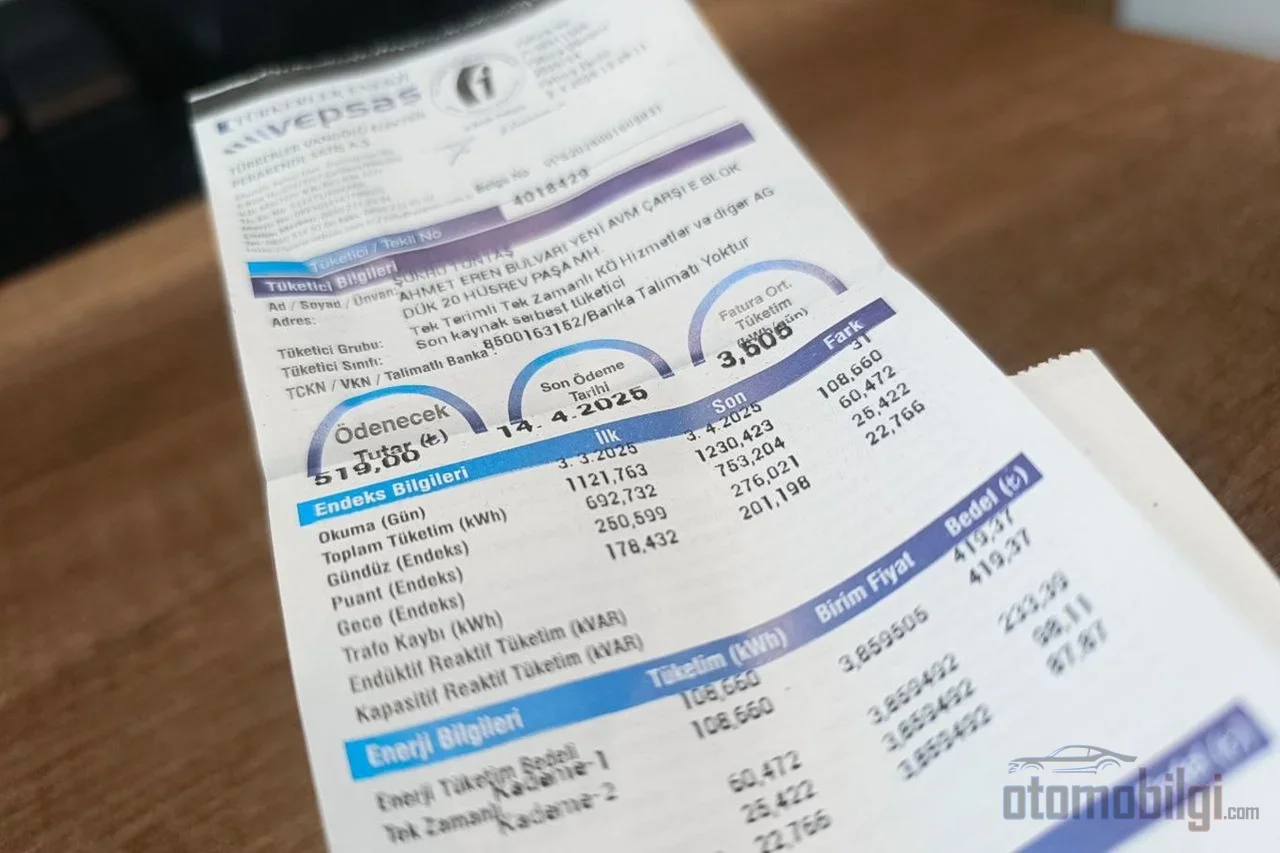
The technical prerequisite for the switch is a smart meter. Smart meter transformation covering more than 50 million subscribers in Türkiye started on March 1, 2026; it is applied to new connections in the first phase, while meters are replaced for existing subscribers as their inspection period expires. There is no mandatory replacement for mechanical meter owners, but requesting a multi-time rate requires switching to a smart meter.
The process consists of the following steps:
- Submit a three-time-of-use tariff request to the electricity distribution company in your region. The switch is free of charge.
- If your meter is a smart meter, the request is processed quickly; if you have a mechanical meter, a meter replacement is required first.
- After the switch, check the tariff information on your first bill: Make sure to verify whether the bill was calculated as single-time-of-use or multi-time-of-use.
Scheduled charging is practically a lifesaver in this process. Almost all electric vehicles have a scheduling feature, and most wallboxes allow charging to start automatically after 22:00. This way, you can plug in the car in the evening and find it fully charged in the morning; there is no need to keep the charging time in mind.
Peak Hours and Other Points to Consider
The three-time-of-use tariff does not suit everyone. Electricity is expensive during the peak hours between 17:00 and 22:00; in a high-consumption household where the oven, air conditioner, heater, and vehicle charging are running simultaneously during these hours, a significant portion of the night-tariff advantage can melt away. Before deciding, you need to look at your home's entire daily consumption distribution. For households with balanced consumption throughout the day or heavy evening consumption, it is usually more sensible to stay on the single-time-of-use tariff.
There are also a few additional items reflected on the bill:
- Charging losses: The energy drawn from the meter is somewhat higher than the energy reaching the battery; the bill cost of a full charge comes out slightly higher than the value in the list.
- Cold weather: If the battery needs to be heated, the cost of a full charge can increase by a few percent.
- Occupancy fee: Some public operators charge up to 5 TL per minute to those who do not remove their vehicle from the station after charging is complete.
- Price stability: Public tariff prices change frequently; with the regulation that came into force in February 2026, operators are required to set a single price for AC and a single price for DC, and the power-based increasing pricing practice has ended.
Frequently Asked Questions
Is electricity after 22:00 at night cheap for everyone?
No. The low price of the night tariff applies only to subscribers who choose the three-time-of-use tariff. On single-time-of-use bills, there is no price difference between night and day.
Who should switch to the three-time-of-use tariff?
Those who can charge their vehicle between 22:00 and 06:00, those with low daytime household consumption, those who can limit their consumption in the evening hours, and households with schedulable devices benefit from this tariff.
How big is the difference in vehicles with large batteries like the Togg T10X?
Togg T10X charging from 20% to 80% at home costs about 173 TL, while completing the same charge at a DC station can rise to the 717 TL level; the difference also grows as the battery gets bigger.
If charging outside is a must, what is the most economical way?
AC stations should be preferred as much as possible; AC prices range from 9.90 to 11 TL/kWh, while DC ranges from 12.90 to 15.95 TL/kWh. Since there are more than 130 charging networks in Türkiye, price comparison by operator is possible.
Conclusion: The Decision Lies in the Right Tariff + Right Time Combination
Night charging genuinely brings the bill down at a low cost, conditional on one requirement: your subscription being on a three-time-zone tariff and the charging being scheduled in the 22:00-06:00 window. When these two conditions are met, the cost per kilometer drops to half of daytime home charging and to as low as one-third of station charging. If one of the conditions is missing - especially if the subscription is single-time-zone - night charging does not change any component of the cost. The advantage also decreases noticeably if you cannot manage the peak-hour window in a high-consumption household. Therefore, taking two minutes to calculate your own bill and your daily consumption distribution before changing your tariff is the step that provides the most accurate return on investment.
Sources
- Is Charging an Electric Vehicle at Night Cheaper? A Guide to the Three-Time-Of-Use Tariff
- Electric Vehicle Charging Fees 2026: How Much Is 1 kWh in TL?
- Electric Vehicle Charging Cost in 2026: At Home and at Stations
- Calculating Electric Vehicle Charging Cost in 2026: At Home and at Stations
- How Much Does Charging My Car at Night Cost? (2026)
- The smart meter conversion covering more than 50 million subscribers in Türkiye starts on March 1
- Electricity Meter Replacement: 2026 Rules and Process