Why Do F1 Tires Operate Within a Narrow Temperature Window?
Share This Page
An F1 tire produces real grip only within a narrow temperature range, that is, within its temperature window; below this window the rubber hardens and loses grip, while above it overheating shows itself as failures like graining and blistering. For this reason, the tire is forced to live in a vicious cycle between softness and durability: to go faster you choose a softer compound, the soft compound heats up quickly and dies quickly; the durable hard compound never delivers that mesmerizing single-lap pace.
Highlights
- The optimal operating temperature is around 100°C; for the soft compound the window is approximately 90-110°C, for the hard one 100-120°C.
- Pirelli has been the sole supplier of the series since 2011; its contract is valid until the end of the 2027 season.
- In 2026 the dry tire range consists of five compounds: C1 through C5.
- Graining is the failure of a cold tire, while blistering is the failure of an overheated tire.
- Blankets heat the tires to a maximum of 70°C before they go onto the track; during a race the temperature can exceed 100°C.
What Is the Difference Between a Road Car Tire and an F1 Tire?
The tire on the car you use on the street is designed to be "good enough" in every condition: summer heat, rain, wet asphalt, an empty parking lot... All with the same tire. An F1 tire, on the contrary, is born to be perfect for a single job, within a single temperature range. Every situation outside of that is a nuisance for it. In other words, an F1 tire is not an all-around athlete, but a sprinter that can set a world record at a single distance.
What we call the compound is actually the special chemical formula of the rubber layer: natural rubber, synthetic rubbers, and lots of additives. By altering these formulas, Pirelli produces softer or harder tires. In the 2026 season, the dry tire range consists of five compounds from hardest to softest: C1, C2, C3, C4 and C5. The softer C6, which was in the range in 2025, was removed in 2026 because it offered no meaningful difference over the C5.
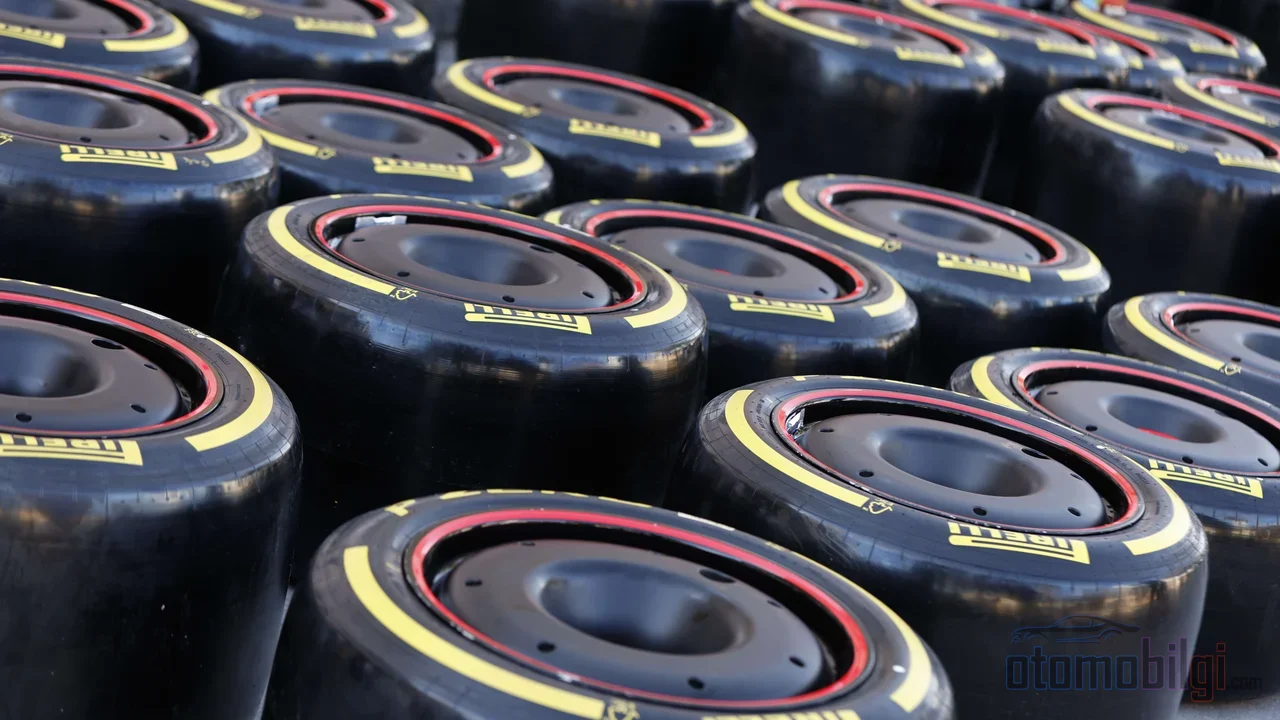
For each race, Pirelli selects three of these five compounds and relabels them according to that weekend: the hardest is Hard (white), the middle is Medium (yellow), and the softest is Soft (red). Alongside them are the green Intermediate and the blue Full Wet. Pay attention: the color on the sidewall does not indicate the tire's absolute hardness, but its ranking among the trio chosen for that weekend. The red band in Monaco may not have the same chemistry as the red band at Spa.
Why Is the Softness-Durability Dilemma Never Solved?
Here is the heart of that famous vicious cycle. The soft compound produces more grip, which means faster laps; but this performance comes at a price: it wears out much faster. The hard compound covers long distances but falls behind in single-lap pace. So expecting a tire to be "both super fast and last 50 laps" is like having your cake and eating it too.
The statistic that surprised me most while watching races throughout this process is this: looking at the lap-by-lap distribution of the first stints of a season, the hard compound carries nearly half the laps, while the soft is used about once every six laps. At Suzuka, the soft compound, despite being the star in qualifying, couldn't complete even a single lap in the race. The red band that looks brilliant in qualifying often becomes mere window dressing over a race distance.
This dilemma has even been written into the rulebook: in a dry race, every driver must use at least two different slick compounds, so at least one pit stop is mandatory. In other words, all those famous strategy games are built on this very nature of the tire.
What Is the Temperature Window, and Why Is It So Narrow?
An F1 tire grips when the chemical bonds inside it reach exactly the right energy level. This range is called the temperature window, and the typical center for the tread is around 100°C. The window is considered to be roughly 90-110°C for the soft compound and around 100-120°C for the hard. Below the window, the rubber is stiff and gives that "plastic container sliding on paper" feeling; the driver shouts over the radio that "there's no grip up front," and we call this understeer.
Above the window is another kind of hell: the tire overheats and the rubber begins to degrade permanently at the molecular level. This is called thermal degradation, and the interesting part is this: in F1, tires usually retire not because the tread physically wears away, but because of thermal degradation. Once the tire heats up and leaves the window, bringing it back is nearly impossible; that's why drivers do tire management every lap to stay within this narrow range, while teams adjust everything from brake balance to suspension stiffness according to the tire's temperature.
Where Do Tire Blankets Fit Into All This?
Before the tires go out on track, they are heated with tire blankets; the blankets are set to a maximum of 70°C. The driver covers the remaining distance, that critical stretch from 70 up to 100, himself on the out lap by weaving the tire in zigzags, heating it with the brakes, and setting as fast a lap as possible. For years, the FIA has wanted to ban these blankets entirely; the rationale is cost and sustainability. But the proposed ban was voted down in the F1 Commission, and for dry tires the blankets continued to be used, at least in 2024.
The main concern, in my view, is entirely reasonable: a lack of grip in a cold-starting tire means a serious safety risk, especially in high-speed corners. Pirelli is also taking an approach that buys time to develop tires that can "start from cold." So the blanket ban ceases to be a debate about principles and turns into a matter of negotiating with the physics of the surface.
Graining and Blistering: The Tire's Two Different Deaths
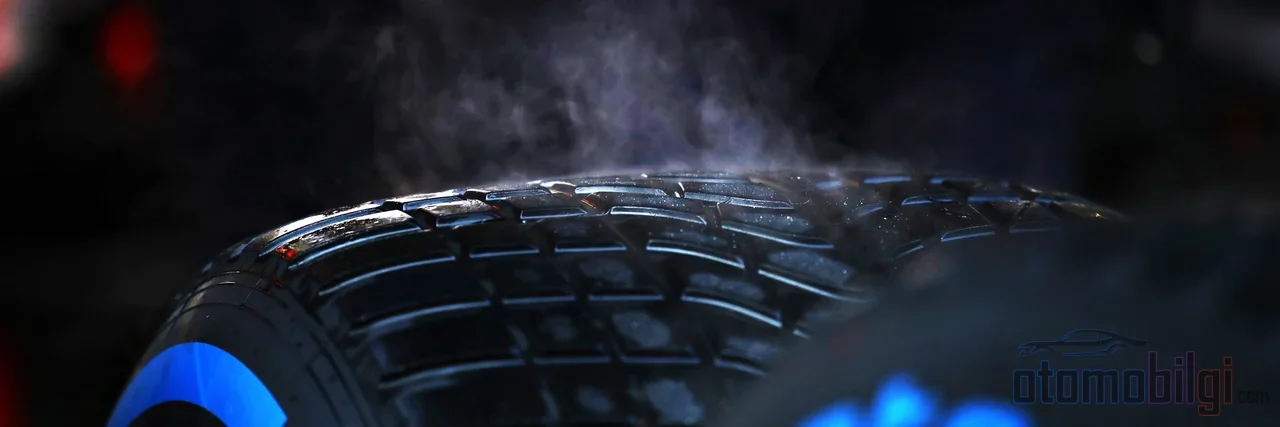
There are two major failures in the world of tires, and telling them apart makes analyzing a race considerably easier. The simple analogy is this: graining is the ailment of a tire that is too cold, while blistering is the ailment of an overheated one.
- Graining: When the tire drops below its operating window, it starts to slide, small particles tear off the rubber surface and these particles stick to the tire's own surface. Grip drops as if sandpaper dust had been poured on the tire. It is most commonly seen at low track temperatures or when the tire is not in the right window. Forcing a cold tire on stiff springs also overheats the surface and invites graining; an overly stiff suspension also forces the tires to act as dampers, increasing heat build-up.
- Blistering: This is the exact opposite, an internal effect. The overheated rubber essentially "boils", gas is released inside and pushes the tread from the inside out. Bubbles break off on the surface and the tire loses material.
And then there is a scenario that is the real villain of the business: thermal degradation. When tire temperature exceeds the compound's optimal window, the rubber permanently degrades at the molecular level; this is an irreversible process. The track surface also affects the job: highly abrasive asphalt wears the tire out quickly, while smooth and soft surfaces extend its life. The answer to the pit wall question "can we take this tire 5 more laps" is actually hidden in the combination of these three concepts.
How Did the 2026 Regulations Change the Tire?
With the 2026 technical regulations, the tires got smaller: while the rim diameter remains 18 inches, tread width decreased by 25 mm at the front and 30 mm at the rear. Total diameter dropped by 15 mm at the front and 10 mm at the rear. The goal is clear: narrower tires create less aerodynamic drag and make the cars more agile. Of course, the price is not paid in the tire's body; it falls on the shoulders of the engineers who have to manage an already narrow temperature window.
Pirelli made a bold enough choice to use all five slick compounds in the first three Grands Prix of the season in order to measure the performance differences of the new generation in depth. It is also interesting to see that experiments like the C6 in the range have been rolled back: even the supplier has admitted that the "softer = better" formula does not always work. Meanwhile, there is also a greener direction: Pirelli produced the first F1 tires with FSC-certified natural rubber, and F1 became the first motorsport race to use these certified tires.
How Is the Pit Wall Battling This Physics?
Now let's put it all together. Every lap, the engineer on the pit wall tries to manage three variables at once: tire temperature, wear rate and remaining race distance. Running the tire without dropping it below the window or overworking it is like playing a short gearing game; if you go too aggressive for a moment, blistering starts, and if you stay passive for a moment, the rival passes you with an undercut. That is why in some races, it is not the fastest car that wins, but the car that can keep its tires in the window the longest.
There are also a few practical factors that affect tire management:
- Track surface: Abrasive asphalt consumes the tire quickly, smooth asphalt extends its life.
- Suspension stiffness: A very stiff setup forces the tire to act as a damper, increasing heat build-up.
- Driving style: The finesse in throttle and brake use determines how tire temperature swings throughout the laps.
Once you grasp the working logic of F1 tires, watching races becomes a completely different experience: you no longer just ask "who's ahead?" but also "whose tires are in the window?" And believe me, the second question often answers the first.
Sources
- The beginner's guide to F1 tyres
- Complete F1 tyre range for the first three Grands Prix of 2026
- Pirelli Motorsport Formula 1: tires for circuit racing
- It's graining, men!
- F1 Tyre Compounds Explained
- Formula 1 Tire Compounds: A Guide to C1, C2, C3, and Beyond
- The science behind tyre degradation in Formula 1
- Graining in F1: cause, difference from blistering and cure
- Tyre Failure – Graining, Tearing, Blistering and Wearing
- Formula 1 to keep tyre blankets for dry tyres in 2024
- What looming blanket ban means for F1
- How do tyre blankets work?
- F1 Tyres: An Ultimate Guide to How They Work
- How To Prevent Tyre Degradation In Formula 1
- Formula One tyres