Tire Strategy in F1 and Pit Stop Calculations for Winning
Share This Page
Tire strategy in F1 is a decision-making area that determines the race result through the combination of compound selection, the temperature window, and pit stop timing. When to switch to which compound, how quickly the tire will wear, and where the pit stop will be made can overtake even the fastest car on track. In other words, in F1 it is not just the steering wheel that wins, but also the calculation.
Highlights
- As of 2026, the dry tire range from C1 to C5 consists of five compounds; the hardest is C1, the softest C5.
- Each driver on a standard race weekend receives 13 sets of dry tires, 5 sets of intermediates, and 2 sets of full wet tires.
- Completing the race on a dry track with two different compounds is mandatory; which means at least one pit stop.
- An F1 tire only delivers its true performance within roughly 80-110°C of temperature.
- Modern pit stops can be completed in under 2 seconds ; in history this has been achieved only 43 times.
From C1 to C5: What do the compounds actually tell us?
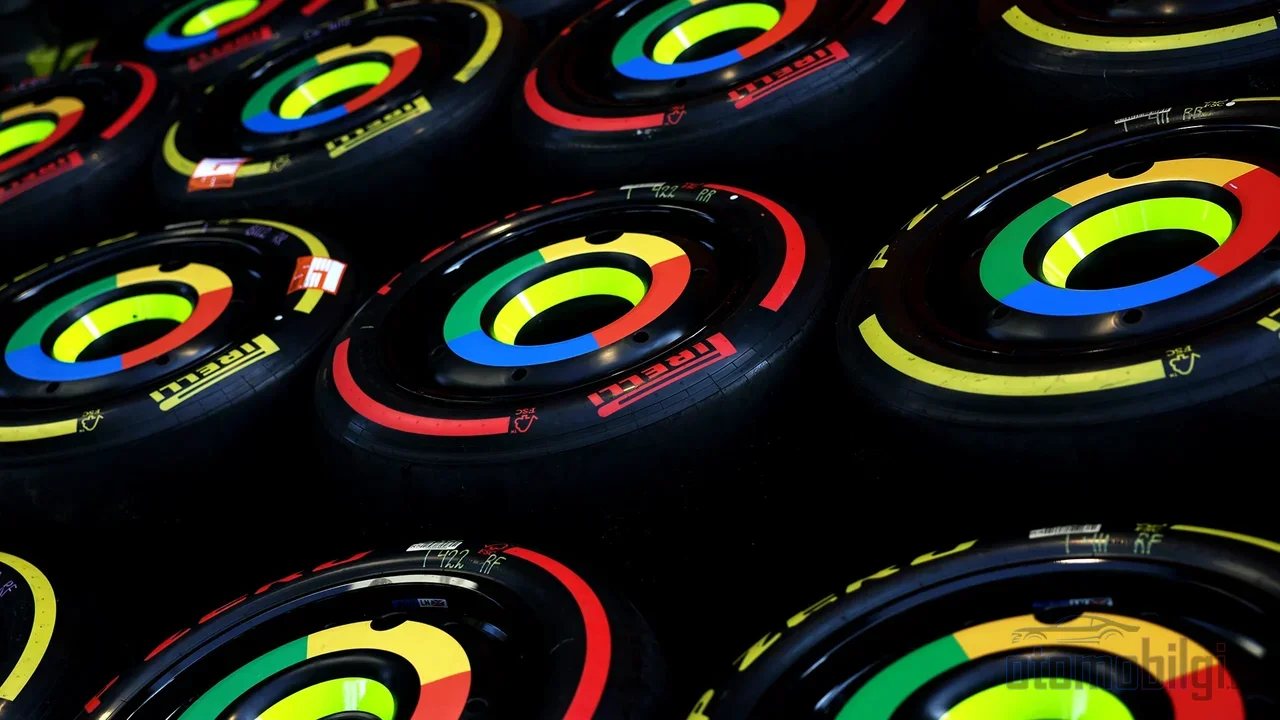
That "C" letter next to the tires stands for the English word compound, meaning the rubber mixture. C1 is the hardest compound, C5 the softest. Those in between form a continuous scale between the two ends: as softness increases, grip increases and durability decreases. The hard compound is the exact opposite - less grip, slower laps, but a much longer life. Think of it like sports shoes: a soft-soled running shoe feels great in the first kilometer, while a hard-soled hiking boot keeps you on your feet all day. F1 teams grapple with the same dilemma.
Pirelli has been the series' sole tire supplier since 2011, and for each Grand Prix it selects three compounds from among C1 to C5. Track character and climate are decisive here: the hardest trio comes to the circuits that stress the tires the most. Over the weekend, these three compounds are given classic names. The softest selected compound with a red sidewall becomes soft, the middle one with yellow becomes medium, and the hardest with white becomes hard . For wet weather, green-sidewalled intermediates and blue full wet tires are also waiting in the bag.
A small footnote: C6, the sixth compound introduced in 2025, was removed from the program for 2026 and the range went back down to five. So today's picture is simple: five compounds, three at each race, three colors.
| Compound | Character | Best suited for |
|---|---|---|
| C1 (hard) | Least grip, most durable | Long stints, demanding tracks |
| C2-C4 (medium) | Balanced grip and durability | The backbone of race distance |
| C5 (soft) | Most grip, least durable | Qualifying laps, short attacks |
| Intermediate | Green sidewall, wet-semi dry | Variable surfaces |
| Full wet | Blue sidewall | Heavy rainfall |
Temperature window and degradation: Why does the tire deteriorate?
Here is the most capricious aspect of the F1 tire: it only works properly within a narrow temperature range. Roughly 80-110°C Below the band there isn't enough grip, and above it the tire eats itself. You can't drive the car as if sitting in an armchair; you have to force, flex, and heat the tires to get them into the window. But if you force them too much, overheating kicks in and two types of wear emerge: thermal degradation and abrasion. So neither failing to heat up enough nor overheating is good.
Degradation, or simply "deg", is the gradual loss of grip over a stint. The clearest sign? Lap times steadily increasing on the same compound. The engineers on the pit wall read this curve and decide "hold on one or two more laps" or "box, box immediately". The driver's driving style also takes the stage here: a style that pushes the throttle and slides the car overheats the tire, while a driver who manages the tire gently can stay fast for laps longer than their rival on the same set. That's why tire management is a separate skill, and half of the strategy rests directly in the driver's hands.
It may seem strange to you, but in F1 "driving fastest" isn't always driving best. Losing a tenth here and there in the slow corners while protecting the tire means being ahead of your rival at the end of the stint. Sometimes math triumphs over spectacle.
The mandatory two-compound rule: Why does the race plan go through the pit stop?
Every driver racing on a dry track must complete the race using at least two different slick compounds. This rule alone builds the skeleton of race strategy: if you're going to use two compounds, you must pit at least once. But in which order? Launch ahead on the softs, catch the rivals, then switch to hards and hang on until the end? Or start calmly on hards, then flood toward the end with softs? These two classic scenarios are what teams brainstorm about at every race.
Know the quota too: on a standard weekend, 13 sets of dry tires, 5 sets of intermediates, and 2 sets of full wets are allocated per driver. An extra set of softs is reserved for drivers making it to the final segment of qualifying. On weekends featuring a Sprint, the dry sets drop to 12, and the wet total rises to 8. And in wet races, the two-compound rule is disabled - the track surface has already made the tire choice on its own.
Let's clarify the theory part too: the soft, offering the highest grip for a short period, is the darling of qualifying; the hard is generally the smarter choice over race distance. That's why pole position is often the short hope of the soft tire, and victory the long patience of the hard.
Undercut and overcut: Chess played on the pit lane
Two cars are going at the same pace, with two seconds between them. The one ahead can't shake off the one behind. This is where the strategists take the stage. Undercut: the car behind pits before its rival, returns to the track on fresh tires, and passes using the advantage of the fresh tires on that out lap. Because a lap on new tires is noticeably faster than laps driven on tires that have been worn for several laps. Pitting early puts pressure on the rival: "you have to drive my lap cleanly".
Overcut on the other hand is the opposite bluff: instead of pitting, you stay out and keep running in clean air. When your rival pits, you overtake them during their slow out-lap. Which is better? It depends on the track. On tracks where overtaking is hard and you cannot get clean air ahead, the undercut is usually the stronger weapon; when your tires are still fresh and you can find clean air, the overcut can win. Teams calculate this decision second by second, looking at the tire degradation curve, the pit stop loss time, and the traffic chart behind them.
Why is a pit stop under a safety car considered "free"?
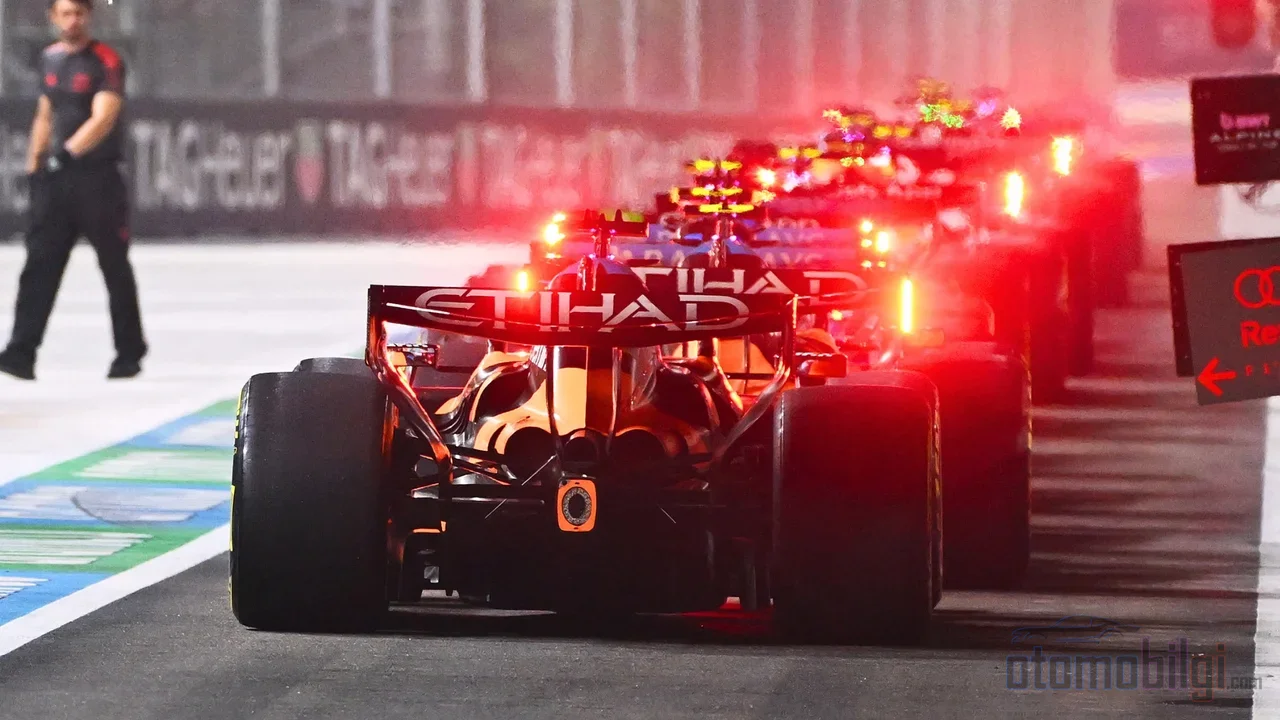
Under normal conditions, a pit stop is painful: the pit lane speed limit, the stop, and the exit back onto the track combined cost you roughly 20-25 seconds to your rivals. A concrete figure from the 2022 United States Grand Prix: under green flag conditions a stop cost about 20 seconds, while under a safety car the same operation stayed at 12 seconds. The source of the difference is simple - because the convoy moves slowly, most of the pit loss is erased; calculations show the loss is about 7.6 seconds less under these conditions.
That is why strategists always have one eye on the possibility of a safety car. If a yellow flag comes out exactly when the pit window is open, a stop effectively becomes almost free and plans are turned upside down in an instant. Even if the car ahead does not want it, it is a golden opportunity for the one behind. There is a downside too: a car that falls into the convoy while its pit window is open spends the race trying to escape from behind the traffic - which is why teams avoid leaving the car in a slow convoy. Also, when drivers see a safety car notification while their stop window is open, they can head straight to the pit without waiting for the radio; even this small detail saves a one or two second radio exchange.
And the stop itself is a show of its own: nowadays tire changes are done in under 2 seconds. Throughout history this feat has been repeated only 43 times, and more than 67% of them came from a single team. The choreography of a twenty-person crew lifting the car off the ground and sending it back on its way in under three seconds - in my view, F1's least told heroism.
The role of the pit stop in the battle for the podium: A short history tour
This strategic logic did not emerge yesterday. Slick tires came to F1 in 1971, but in 1998 regulations forced cars onto grooved tires to slow them down; between 1999-2008 at least four 14 mm grooves were mandatory - because slicks give the most grip in dry conditions. In 2005, tire changes were completely banned and tires were built hard enough to last a 300-kilometer distance; the idea lasted one season, and in 2006 changes returned. Refueling was banned in 2010 and the pit stop turned entirely into a tire affair.
In 2019, the range was reduced from seven compounds to five, and a color code came with hard-medium-soft naming so fans could understand the system. In 2022, the switch was made from 13-inch to 18-inch wheels; with the 2026 regulations the tires shrank another step - tread width decreased by 25 mm at the front and 30 mm at the rear - with the aim of reducing aerodynamic drag. So tires and strategy are the sport's quietest but most constantly evolving area.
The moments when the pit stop decided the outcome are etched into history; even a controversial pit stop call at Monaco 2006 is still mentioned on "most effective pit stops" lists today. It must be admitted: the fastest car on track doesn't always win; the team with the best strategy wins.
Final word: Reading the race from your screen
At the next race, take a minute to look at the tire colors and the pit window. Which compound did they start on, on whose lap times did the degradation curve start to break, who is exposed to the undercut risk? Once you start making this reading, you will see what an infuriating and yet fascinating job the pit wall does. Which tactic would you choose - attack on the softs, or patience on the hards? Whatever your answer, the calculator on the team wall is probably more pessimistic than you. And more often than not, it isn't wrong.
Sources
- The beginner's guide to F1 tyres
- Formula One tyres
- Pirelli Motorsport Formula 1: tires for circuit racing
- Pirelli sets F1 2026 compounds, abandons C6
- F1 Tyre Compounds Explained
- F1 Tyre Degradation Explained: Graining & the Cliff
- The science behind tyre degradation in Formula 1
- Tyre strategy in F1: compound selection, undercut and overcut
- Anatomy of a pit stop: How do F1 teams service their cars in less than two seconds?
- The top 10 most influential pit stops in our F1 history
- How Do Formula 1 Teams Use Tire Strategy to Win Races?