Who Sets Up the Race Strategy in F1 and How
Share This Page
Who decides race strategy in F1? Short answer: no single person. The strategy engineer prepares scenarios with simulations, the race engineer acts as the bridge with the driver, and the risky final call is made by the team principal. In other words, every pit stop you see on screen is actually the product of millions of calculations and the sweat of a few people.
Highlights
- Teams simulate approximately 300 million different scenarios before a race.
- An average pit stop causes a total time loss of 20-25 seconds .
- Since 2007 it has been mandatory to change tyre compound at least once during a race, meaning at least one stop is required.
- Undercut means pitting before your rival; overcut means setting fast laps on old tyres and then pitting.
- The risky final strategy call rests with the team principal on the pit wall.
How is strategy built over a race weekend: what goes into the simulation?
You watch the race on Sunday, but the strategy team has been working since the start of the weekend. At the core of the simulation they build, there are three elements: the tyre model, "free air" optimization, meaning an empty track, and the Monte Carlo method. These sound cool, but let me explain the logic with a very simple analogy: it is like solving all possible question combinations before an exam and studying according to whichever is most likely to come up.
The tyre model measures three things: the pace of a new tyre (base pace), the drop in performance per lap (tyre degradation), and the tyre's total life (tyre life). Once you have these three pieces of data, you can calculate the answer to the question "How many laps will my driver stay fast on soft tyres, and when should I switch to the hard tyre?"
Monte Carlo is the truly magical part. This statistical technique, named after Monaco's casinos, runs thousands of virtual race simulations and calculates the probability of each scenario playing out. To predict the possible outcomes of a race, teams simulate approximately 300 million different scenario combinations using this method. Yes, millions. But be careful: these simulations give you probability, never a certain outcome. The rest is left to the experience of the strategy department and the driver's execution on track.
What data do they work with?
Thanks to telemetry, thousands of data points flow throughout every race: tyre temperature, speed, fuel consumption, engine performance. Tools like RaceWatch, used by the vast majority of teams on the grid, combine machine learning models with real-time tracking of tyre degradation and rival pit stop tactics. Strategists also look at a gap chart called a "gapper plot" to identify undercut opportunities and determine the moment when they can safely pit without losing position.
In fact, Williams' head of vehicle performance described F1 race preparation in 2021 as "a kind of game theory problem". This is a spot-on description, because your rivals' strategies are hidden - when making your move, you also have to predict what they will do.
Who does what on the pit wall: who holds the decision chain?
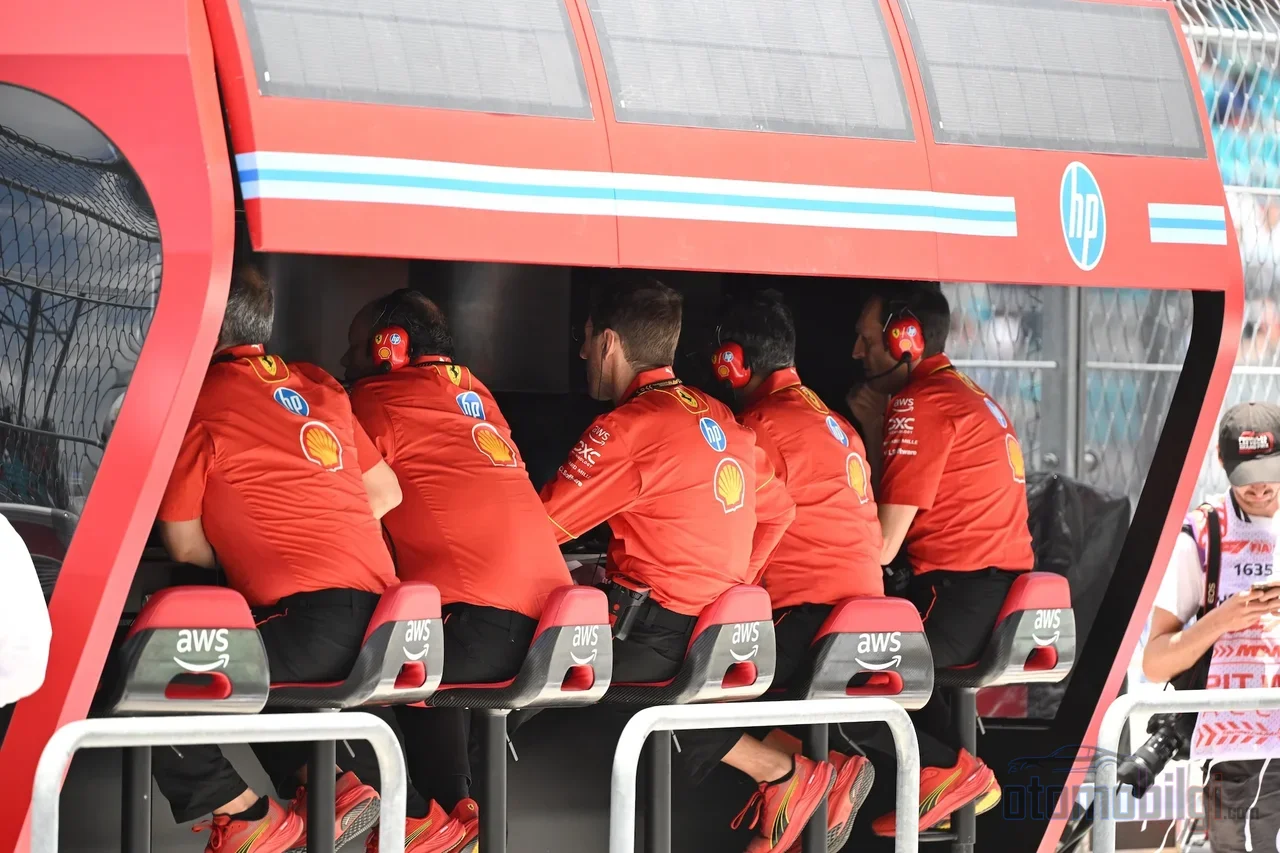
The pit wall is the team's nerve center during the race. Strategists, engineers, and the team principal sit side by side watching the race, each tracking data from their own area. The roles are roughly divided as follows:
- Strategy engineer: Runs pit stop models and live simulations, putting the probabilities on screen in front of the team.
- Race engineer: Responsible for communication with the driver; the voice the driver hears on the radio is theirs.
- Team principal: Makes every risky final decision. If a mistake happens, they are the one held accountable.
This division of labor matters, because strategy is a constantly updated "closed-loop" game. As tire performance, track position, and rivals' moves change, the plan changes too. The simulation gives you the starting plan, and the pit wall revises that plan in real time throughout the race.
What are the undercut and overcut, and when do they work?
These are the pit wall's favorite two-word weapons. Undercut means pitting before your rival and, with the advantage of fresh tires, setting fast laps for a few laps to try to move ahead. Overcut is the opposite: staying on track and setting fast laps on older tires, then pitting after your rival and passing them on track. Which one is better varies from track to track - it depends entirely on tire age at that moment, track position, and the rival's move.
Monaco is a perfect example to illustrate this balance, because on a track with narrow tarmac, the difference between the undercut and the overcut is razor-thin. Race analysts say that in Monaco neither tactic works easily, and that the concept of "free air" determines everything. If there is no car ahead of you, you can fully exploit your pace, but if there is traffic ahead, even the best strategy hits a wall.
What is talked about on team radio?
There is a button on the steering wheel that opens the radio link, and the driver mainly talks to their own race engineer. On the radio, tire wear, strategy, and car condition are constantly on the table; but communication is kept as simple as possible, because the driver's concentration is more valuable than anything. A simple analogy: you wouldn't want to solve a math problem on the phone while driving in heavy traffic, would you?
The radio has its own jargon too. A "push" call means a critical fast lap is being requested before the pit stop; a "manage" call signals that the current tire stint needs to be extended. When you hear the tension in the driver's voice in front of the screen, you now know what is happening: a critical negotiation is underway between the pit wall and the driver.
Where does the decision chain get stuck: Monaco 2020 and Ferrari's unforgettable mistakes
The theory is nice, but the most instructive part of this business is the mistakes. In Monaco 2020, Mercedes admitted that they had sent Lewis Hamilton out on mediums instead of the more durable hard tire; the anxious messages on Hamilton's radio were heard by everyone. Mercedes officials later said that Hamilton had "saved the team" - and yes, he still won that race. But the lesson here is this: when simulations get bogged down in a strategic deadlock over tire concerns, even the biggest team wobbles. Some analysts linked the situation to a deeper tire performance problem, so the "strategy error or car problem" debate is still ongoing.
Ferrari's page, meanwhile, is a separate textbook. Then-team boss Maurizio Arrivabene himself admitted that putting Sebastian Vettel on a two-stop strategy was the wrong call. Analysis of the 2022 Hungarian GP showed that Ferrari's decision errors and reliability problems cost Charles Leclerc approximately 100 points . More recently, at the 2026 Australian GP, Ferrari failed to call their cars in for a pit stop even though track conditions were suitable, losing to Mercedes both race control and approximately 10 seconds ; George Russell won the race.
What we see is this: mistakes are usually not the fault of a single engineer, but the result of a breakdown somewhere in the decision chain. Wrong data goes on the screen, the wrong scenario is presented, and the boss making the risky decision signs off on the worst option. It's like group-project decisions where everyone pitches in but no one fully owns them - only the consequences are watched worldwide.
Safety cars and artificial intelligence: two dynamics that change strategy
The safety car is one of the dynamics that most changes pit stop tactics. When the safety car slows the track, the cost of pitting drops and fuel is saved. That's why during the calm moments of a race, the question "if a safety car comes out, should I pit now?" is constantly on the table at the pit wall. While a normal pit stop costs an average of 20-25 seconds, under a safety car this loss is significantly reduced - and the whole strategy is suddenly rewritten from scratch.
Looking to the future, there's an interesting debate going around: reinforcement learning, i.e. artificial intelligence models, shows promise for real-time race strategy. Academic studies focus on pit stop optimization with machine learning and strategy generation with evolutionary algorithms. But there is no widespread application yet; even if the math is perfect, the simulation faithfully reflecting reality remains a problem to be solved. So at least for now, the final word on a risky decision still comes from the mouth of a human - the team boss.
So what do you see on screen now?
The next time you see a pit stop call, remember this: behind that moment there are roughly 300 million simulated scenarios, a strategy engineer working on tire models, a driver negotiating over the radio, and a team boss who takes the final call and shoulders the risk. Sometimes this chain works flawlessly, and sometimes - as in Monaco - a single tire choice turns everything upside down. That is exactly F1's invisible beauty: the winning formula is sometimes written not on the track, but on the screens of the pit wall. Which team's strategist would you trust?
Sources
- How Formula 1 teams determine the fastest race strategy
- Strategic Decision-Making in Formula 1 - Marcello Saddemi
- How do teams analyse F1 race strategy? | The MIA
- Explainable Reinforcement Learning for Formula One
- How Race Strategy Works In Formula 1
- F1 Race Strategy: Tyres, Pit Stops, and Tactics
- F1 Race Strategy Explained
- How F1 Team Radio Works: Who Drivers Talk To
- F1 Team Radio Jargon Explained: Strategy Calls and Codes
- Bulls' Guide To: Team Radio
- Lewis Hamilton praised for Monaco GP win after Mercedes tyre mistake
- Jolyon Palmer: How Mercedes got it so wrong in Monaco
- Mercedes: Hamilton "saved" us after wrong tyre call
- Why Mercedes' Monaco strategy was always destined to fail
- Ferrari: Two-stop strategy was a mistake
- Hungarian GP: Explaining Ferrari's latest blunder
- Russell wins as Ferrari blunders strategy in F1 2026's Australian GP
- Formula 1 Technical: Importance of a F1 Pit Wall
- Pit wall in F1 (glossary)
- A Thorough Analysis of the Pit Stop Strategy in Formula 1
- Towards Learning-Based Formula 1 Race Strategies