Why Is Residual Current Protection Essential in Wallbox Installation?
An ordinary residual current device mounted on a home distribution board may not fully protect you when charging an electric vehicle. The reason is simple but a physical detail that gets overlooked in most installations: the charging unit inside the electric vehicle converts the grid's AC current into DC, and in the event of an insulation fault, the leakage current flowing to ground does not have to be in the sine wave form that the device recognizes. A wallbox equipped with the wrong device type may look protected on paper, while in reality it operates with a blunted safety layer. This page explains step by step which types provide residual current protection in wallbox installations, why DC leakage is a separate threat, and which combination delivers safety compliant with the standards.
What Does a Residual Current Device Do and Why Does It Work Differently in EV Charging?
A residual current device (RCD) monitors the current imbalance between live conductors and ground; when it detects a leak, it cuts the circuit, preventing the risk of electric shock and fire. In a standard home installation, this definition is sufficient. In electric vehicle charging, however, the picture changes, because there is power electronics in the circuit.
In AC Mode 3 charging, the charging unit inside the vehicle (on-board charger) converts the AC current supplied by the grid into DC. In the event of an insulation fault, the current leaking to ground can flow not only as sinusoidal AC but also as pulsating DC or even as a smooth DC component. In addition, rectifiers and switching circuits generate a constant small amount of leakage current through EMI filters and capacitive coupling, even in systems operating healthily; long cables and numerous chargers gathered in a single cabinet raise this background leakage current. It is precisely at this point that the choice of device type becomes critical: the current form the device can detect must match the current form that can actually occur in the circuit.
The Difference Between Type AC, Type A, and Type B
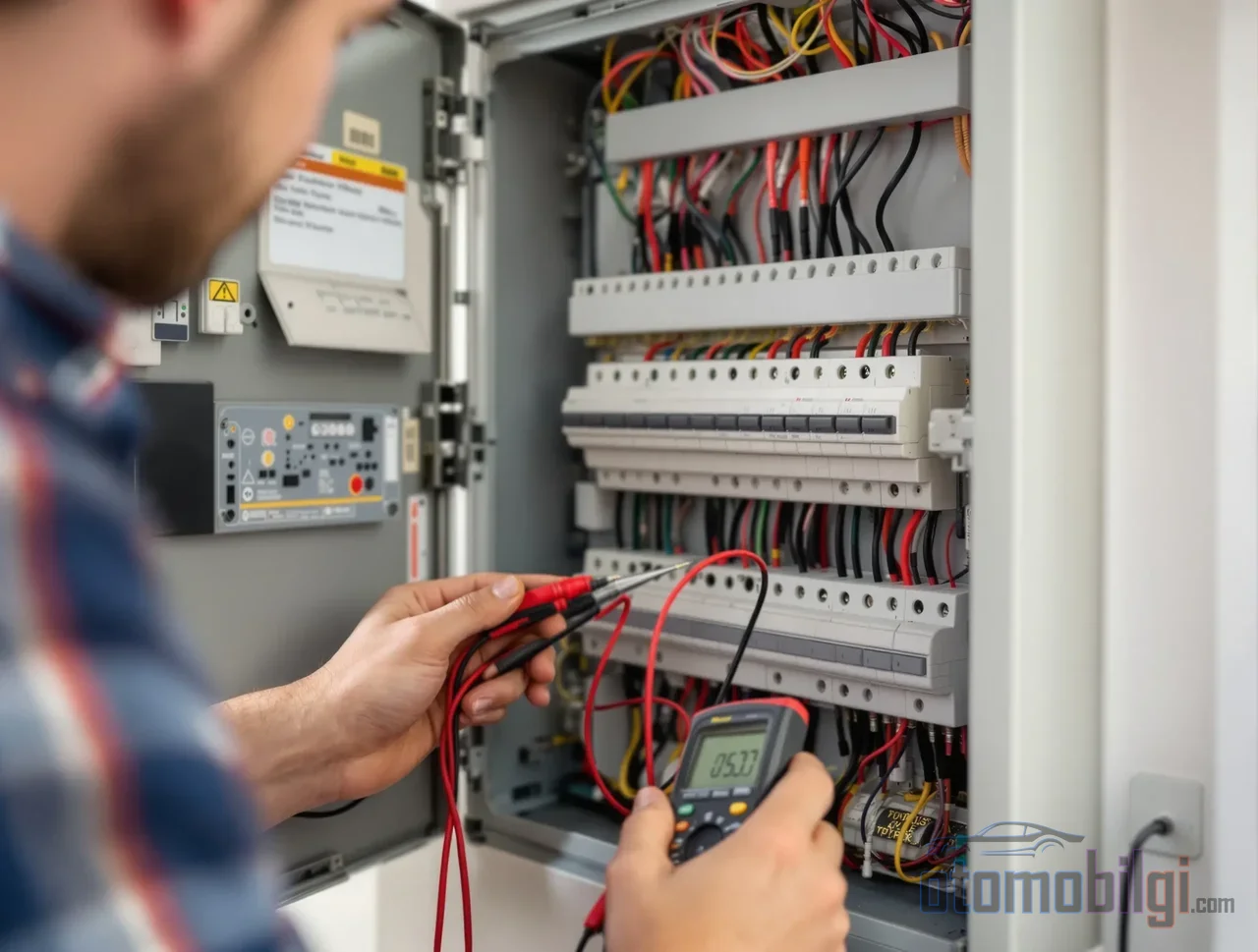
Residual current devices are classified according to the form of leakage current they can detect. The capabilities of the three types for electric vehicle charging can be summarized as follows:
| RCD Type | Leakage Current Detected | Suitability for EV Charging |
|---|---|---|
| Type AC | Sinusoidal AC only | Not suitable |
| Type A | AC + pulsating DC (up to 6 mA) | Suitable with internal DC detection |
| Type B | AC + pulsating DC + smooth DC | The most comprehensive protection in every case |
The first rule that all reliable sources agree on is clear: Type AC must not be used for electric vehicle charging. Since the on-board charging unit can produce a DC component, a Type AC device cannot detect DC faults and leaves a serious shock-risk gap. The minimum level accepted for an EV charging circuit is a Type A device with 30 mA sensitivity; standards deem Type AC insufficient for this application.
DC Leakage and the "Blinding" Problem: The Risk a Standard Device Cannot See
Everything made sense up to this point; now the real problem begins. The on-board charging unit can produce smooth DC leakage current in the event of a fault. Type A relays are tested to withstand pulsed DC current up to 6 mA - but when a higher DC current flows through the circuit, the relay's magnetic core enters magnetic saturation. This is called blinding, and the result is devastating: a blinded relay becomes unable to detect not only DC leakage but even a genuine AC leak. In other words, the relay you believe is protecting the circuit goes blind at exactly the moment it is needed most.
Highlights
- The minimum requirement in an EV charging circuit is a Type A, 30 mA residual current relay; Type AC is not used.
- Smooth DC leakage current exceeding 6 mA can blind the core of a Type A relay, disabling all protection.
- IEC 61851-1:2017 requires a Type B relay or Type A + 6 mA DC detection equipment for Mode 3 devices.
- A Type B relay can add roughly $300-400/€ in extra cost per installation.
The standards' answer to this problem is equipment called RDC-DD (residual direct current detecting device), defined by the IEC 62955 performance standard: a protective device that detects DC leakage current exceeding 6 mA and stops the charging. The rules in the IEC 60364-7-722 family governing the electrical requirements of EV charging installations (IEC 60364-7-722 for EV charging circuits) are also based on DC-sensitive protection. Some countries have made this an explicit requirement: for example, in Sweden, under the rule in force as of May 9, 2024, if a Type A or Type F relay is used, an additional RDC-DD compliant with IEC 62955 is mandatory.
Which Combination Is Safe in Which Situation?
Section 8.5 of the IEC 61851-1:2017 standard defines two valid solutions for Mode 3 charging stations (EVSE): either a Type B RCD, or a Type A RCD combined with equipment that cuts the supply in the event of a DC fault current above 6 mA. So the answer lies not in sweeping generalizations like "Type B everywhere" or "Type A is enough for everything," but in the device's topology and the integrity of the installation.
If built-in 6 mA DC detection is present: Type A is sufficient
If the charging station has a built-in RDC-DD compliant with IEC 62955, the device automatically stops charging when DC leakage reaches 6 mA; the Type A relay never enters the blinding zone and continues to perform its function. This combination is accepted by the standard as a legitimate solution. It is also advantageous on the cost side: while a Type B relay can add roughly $300-400/€ in extra cost to the installation, the combination of a device with built-in DC detection + a Type A relay offers a more economical path.
If there is no built-in DC detection: Type B is mandatory
If the charging station has no 6 mA DC leakage detection, a Type B relay must additionally be used in the circuit. Since Type B detects AC, pulsed DC, and smooth DC leakage alike, it is not affected by the blinding problem; when Type B is used, a separate RDC-DD compliant with IEC 62955 is not needed. Type B is also the general expectation for three-phase, high-power devices at the 22 kW level and for commercial/industrial use. The task to do before installation is simple: check the charging station's catalog and technical specifications to see whether it has DC leakage protection; otherwise, a relay solution providing 30 mA AC + 6 mA DC protection in the circuit is selected.
The variety of products on the market shows both of these paths: while some manufacturers require an external Type B or Type A + RDC-DD combination for certain models, models offering integrated IEC 62955 compliant protection do not need an additional device. Some charging stations on the Türkiye market also declare that they offer internal residual current protection of 30 mA AC + 6 mA DC. If the catalog states "6 mA DC detection built-in", you do not have to switch to the more expensive Type B; if it does not, Type B is inevitable.
Other Parts in the Panel: Fuse, MCB, RCBO and Surge Protector
A residual current relay alone is not a sufficient protection chain. The relay only provides residual current protection; a separate fuse (MCB/MCCB) is required to protect the line from overcurrent. An RCBO, on the other hand, combines both in a single device and simplifies wiring in compact panels. In practice, a typical home wallbox circuit is set up with a fuse dedicated to the charging unit, a Type A or Type B residual current relay, and a surge protector (SPD) against overvoltage pulses; for example, a combination of a 40 A Type A RCD + 40 A circuit breaker + surge protector is a common installation standard.
One view that advocates the layered approach recommends all three elements at once: an MCB that protects the line from overcurrent, a Type A RCD that protects the in-home installation from AC and pulsed DC leakage, and built-in Type B protection in the device that covers everything including pure DC from the device to the vehicle. One point is also important: in many countries, an RCD is also required in the distribution panel even if the charging unit has a built-in RCD, because only an external relay can detect damage in the cable between the panel and the device.
From Installation to Testing: Practical Safety Steps
A safe wallbox installation is as orderly a process as choosing the right relay type. The typical flow follows these steps:
- Survey and assessment of the electrical infrastructure - this must be done by a competent installation expert or electrician.
- Arranging a dedicated circuit fuse for the charging unit and a residual current relay of the appropriate type in the panel.
- Pulling a separate line with a cross-section suitable for the charging power.
- Wallbox mounting and making the connections.
- Testing and commissioning.
The first technical criterion to look at when choosing an electrician is whether the person who will do the installation knows the requirements of EV charging circuits (relay type, DC detection, separate line). Post-installation testing is not a contractual formality either: wallbox test procedures include a multi-step electrical safety test covering measurements on the grid side and the vehicle side (charging connector). In places such as workplaces where many vehicles will be installed in a single common area, many charging units should not be connected behind a single RCD; accumulated background leakage can trigger unintentional interruptions depending on weather conditions and specific vehicle-device combinations.
Short Answer: Which Relay Should Be Used for the Installation?
The clear answer to the question is: An EV charging circuit requires a minimum Type A 30 mA residual current device; if the charger lacks IEC 62955-compliant 6 mA DC leakage detection (RDC-DD), it must be upgraded to Type B. Type AC should never be used in this application. Type A with a device featuring internal DC detection is accepted by the standards and is the more economical solution; for devices without built-in protection, Type B is the only safe option. The entire installation should be entrusted to a licensed electrician, with verification based on the technical declarations in the catalog and completion backed by post-installation testing with real measurements. Safety is not negotiable here - the right combination is chosen once and works on your behalf for ten years.
Sources
- RCD for EV Charging Stations: Type A, Type B, 6mA DC - ETEK
- Wallbox's Commitment to EV Charging Standards - Wallbox
- Type A vs Type B RCCB: Which RCD Do You Need for EV Charging? - Innovative Green Power
- How Safe Is Your EV Charger? What You Need to Know About RCD Protection - Morek EV
- Do I need a Type B RCD for my EV charger? - Evnex
- Type A RCD for EV Chargers: When Is Type B Needed? - ENGN
- Difference Between AC, Type A, Type F and Type B Residual Current Devices - Sigma Elektrik
- Home EV Charging Station Installation - Aydın Elektrik
- Wallbox Testing: Procedure, Standards, Limits & Report - Comemso
- RCD Types for EV Charging - Low Voltage Breaker Insights