Gustave Trouvé: The Inventor That History Books Skipped
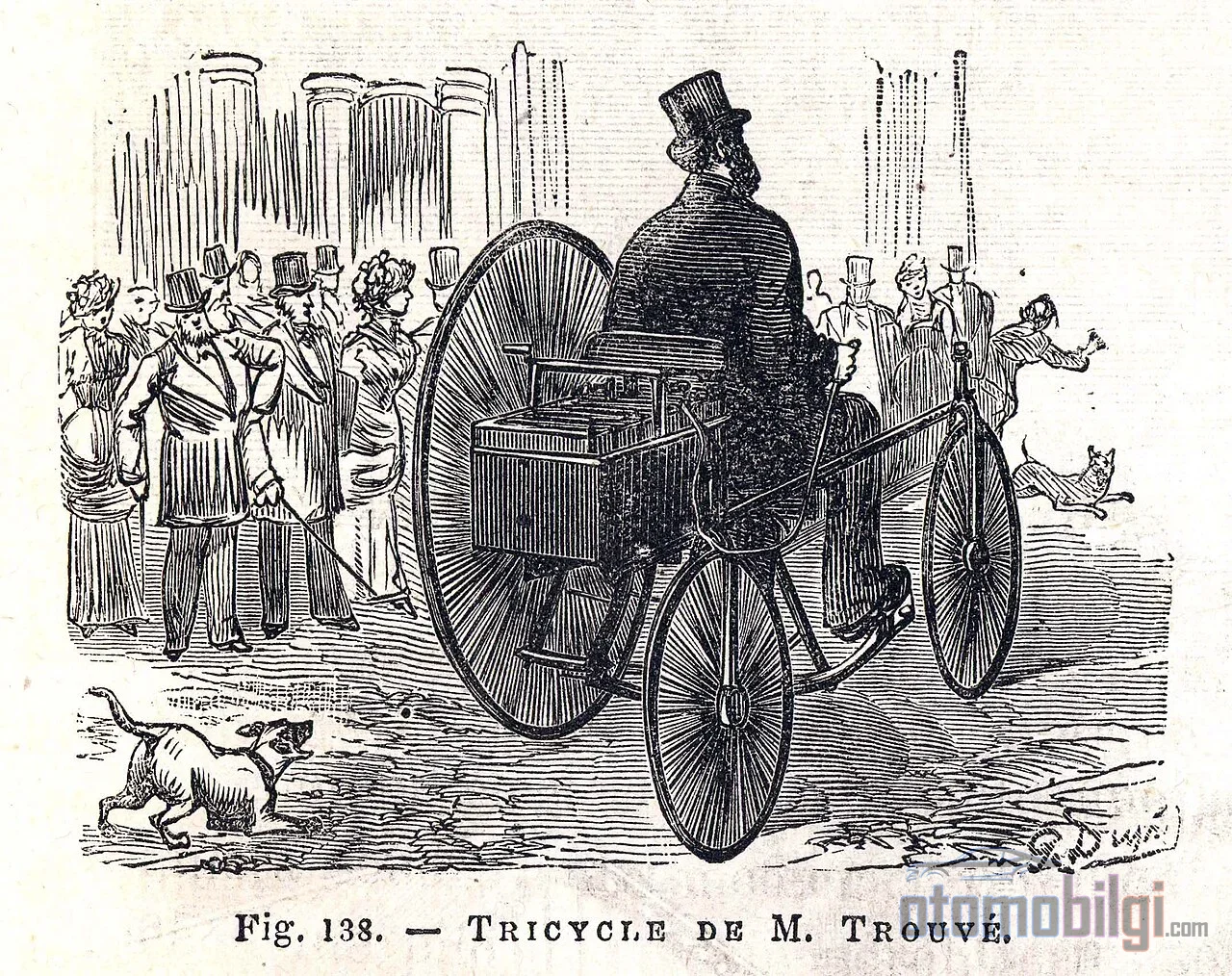
November 1881, Paris. In the heart of the city, on the Champs-Élysées, the greatest technology spectacle of the era has opened its doors: The International Electricity Exhibition. More than 1,700 participants from 15 countries are showcasing everything from electric lighting to motors. But one figure among the crowd is not content with just a booth: French engineer Gustave Trouvé steps outside the exhibition and demonstrates, riding his three-wheeled vehicle through the streets of Paris, that it runs entirely on electricity. Yes, you read that right: about 20 years before the birth of the gasoline automobile, a vehicle traveling the roads on electricity.
So why do most history books mention Flocken or Benz while Trouvé is always skipped over? Why would very few of us remember his name if we tried today? Let's take this story from the beginning; because the true birth story of the electric car is much older and much cooler than you think.
Who Is Gustave Trouvé?
Gustave Pierre Trouvé, born on January 2, 1839, and who passed away on July 27, 1902, was a French electrical engineer and inventor. He received his education at the École des Arts et Métiers in Angers. He is one of the truly versatile geniuses of the 19th century; his skill in designing small-scale devices earned him special respect among the engineers of his day. So, in today's language: he was a master at miniaturizing everything and making it functional. Telephones, lighting, medical devices, marine motors... Trouvé's fingertips left their mark in countless fields.
The critical step in the story of the electric vehicle came in 1880: Trouvé improves the efficiency of a small Siemens electric motor. He develops a new motor based on the eccentricity in the Siemens coil flange, reduces the weight of the components, and reports the efficiency he achieved to the French Academy of Sciences on August 1, 1881. That sounds like a technical sentence, but it is in fact revolutionary: a light and efficient electric motor is now mature enough to power a vehicle.
Highlights
- The International Electricity Exhibition was held in Paris between August 1 - November 15, 1881.
- By converting a Coventry-brand tricycle to electric power, Trouvé created the world's first electric land vehicle in 1880-81.
- The vehicle's battery was rechargeable, and Trouvé drove it on a real road, on Rue Valois in Paris.
- In the same year, Ayrton & Perry also built an electric tricycle; Trouvé's is defined as the first full-scale electric car to be seen in public.
- The original vehicle did not survive to the present day; Trouvé removed the motor and used it for the world's first electric outboard motor.
How Did the Three-Wheeled Electric Vehicle Work?

Now we come to the most fun part of the matter: the vehicle itself. Trouvé did not design the vehicle from scratch as a car; he converted a British-made Coventry pedal tricycle to electric power. In other words, in today's terms, it was a kind of early electric bicycle conversion. There is no purpose-built chassis; sensibly, the lightest and most practical platform available was used. Just like today when someone fits an e-bike kit to their big brother's old bicycle - only 145 years earlier, when there was no such thing as an automobile yet.
The technical setup was as follows: Trouvé's electric motor was connected by chain to the large front wheel. The power source, a secondary battery of his own manufacture, was carried at the rear of the vehicle like a bag, inspired by a bicycle basket. Single seat, with steering and throttle control provided by simple mechanical levers. According to information from Morgenstadt, around October 1881 the vehicle was running on April 19, 1881 with a motor delivering 70 W of power. What does 70 watts mean, you ask? Roughly a little more than the power drawn by an old light bulb. In other words, this vehicle was a masterclass in using every last drop of its power.
Why aren't the speed and range figures clear?
We have to be honest here: we cannot give a single definitive figure for the vehicle's speed and range, and the reason is not conflicting sources, but the fact that measurement documentation for a 140-year-old vehicle was never standardized. The available figures are as follows: one source claims a speed of 12 km/h was reached, while another assessment mentions 18 km/h and a 26 km range; another reports 15 km/h and a 16 km range. In a 2021 replica test, however, the maximum speed was measured at approximately 5 km/h (3 mph). As for the original vehicle's motor power and torque value, no figure was ever published in any reliable record; these values have not been clarified by historians. Perhaps this very uncertainty is the best proof of just how early and how poorly documented a period the vehicle belongs to.
The 1881 International Exposition of Electricity: Electricity's Grand Stage
To understand Trouvé's vehicle, it is essential to understand the environment in which it was born. The exhibition, which started on August 1 and ran until November 15, 1881, was held at the Palais de l'Industrie on the Champs-Élysées and hosted more than 1,700 participants from 15 countries. An international scientific congress was also held alongside the exposition; in other words, Paris was the world's electricity capital that season. In the age of steam engines, electricity, much like artificial intelligence today, was a technology everyone talked about but no one fully knew the limits of.
Trouvé did not pass up this stage. As part of the exposition, he displayed not only his electric tricycle but also his electric boat carrying the same motor and a model airship powered by an electric motor. Just think about it: a single engineer applying a single motor concept to land, sea, and air vehicles. And the rides made in front of the public on Paris's Rue Valois on the occasion of the exposition proved to everyone that the vehicle was not a toy sitting on display, but a real means of transport.
Where Is the Original Vehicle? Here Comes the Most Heartbreaking Part of the Story
So why is this historic vehicle not in a museum today? The answer is both simple and heartbreaking: After the rides, Trouvé dismantled the vehicle. He removed the motor and battery and carried them over to his next big idea: the world's first electric outboard motor. Trouvé, who adapted the same motor to a boat, thereby also opened the door to electric marine transport. By 1890, Trouvé's motors were powering 100 boats in Europe. And in 1883, a scaled-up version of his motor built by Siemens powered the crewed airship flights of the Tissandier brothers. So the vehicle did not fall apart; it lived on by turning into other inventions.
The documentation of the vehicle that survives to this day is also extremely scarce; the fundamental visual source is a single quickly made drawing. This teaches us a lesson: whether an invention survives depends not on the greatness of the invention, but sometimes simply on someone deciding to preserve it.
A replica born in 2021
The story does not end here. At the request of journalist Jeremy Hart, British craftsman Christian Richards built a replica as convincing as possible in 2021 to mark the vehicle's 140th anniversary. The replica was brought to life with a modern e-bike motor and a battery from a commercial vehicle while staying faithful to the original philosophy, and the chain drive and rear battery layout were also preserved. In testing, the vehicle traveled at about 5 km/h; slow, but proof that a 140-year-old idea can still turn a wheel.
Trouvé, Flocken and the "First Electric Car" Debate
Okay, nice story, but I know the question on your mind: "Wasn't this the first electric car?" That's where the nuanced part begins, because the answer depends on which definition you choose.
Many sources point to Andreas Flocken's 1888 Flocken Elektrowagen as the first "real" or "production" electric car. This four-wheeled vehicle with a wooden body resembling a horse carriage was unveiled on the streets of Coburg in the fall of 1888; it could reach speeds of about 15 km/h and carried a 1-horsepower electric motor. But Trouvé's three-wheeler was on the roads about 7 years earlier, in 1881; the difference is that Trouvé's vehicle was a single-seat, three-wheeled conversion, while Flocken's was a full-fledged four-wheeled car design.
If you go further back, you'll see the list widens: Hungarian Ányos Jedlik built the first electric motor in 1828 and ran a small model car. Scotsman Robert Anderson built a motorized vehicle between 1832-39. Robert Davidson developed a vehicle carrying passengers in Aberdeen in 1839, but his batteries could not be recharged. And this is exactly where Trouvé's card comes into play: According to the Guinness records, he built the world's first electric road vehicle in 1880-81, and the vehicle operated with a rechargeable battery, carrying people on normal roads. That's why the most accurate definition is this: Trouvé's vehicle is the first working electric road vehicle with a rechargeable battery that carried people and was used on public roads. And since we're giving the definitive answer: the answer to the question of the world's first electric car varies depending on the definition; the first four-wheeled production car was Flocken (1888), the first successful electric car in the USA was William Morrison's vehicle (1890-91), and the first working and rechargeable land vehicle was Trouvé's tricycle (1881).
There are other witnesses to 1881 as well: in the same year in England, Ayrton & Perry built a tricycle with a speed of about 15 km/h, a range of 16-40 km, and 0.5 horsepower, equipped as the first electric wheelchair and with electric lights. Charles Jeantaud was also producing electric vehicles with the support of Camille Faure. Trouvé's distinction is that it was the first full-scale electric car to be shown in public. Although developments followed over the next decade, such as Camille Jenatzy breaking the 100 km/h barrier with his Jamais Contente in 1899, it all began with Trouvé's quiet drive on Rue Valois.
Why Couldn't He Get a Patent and Why Was He Forgotten?
Another casual irony: the inventor of the vehicle couldn't even get a patent. According to the legislation of the period, there was no sufficiently new element in the invention worthy of protection; because Trouvé had combined existing components (bicycle, motor, battery) into an entirely new whole. Historically, this shows not the originality of the vehicle, but the limits of the patent system of the era.
Among the reasons for his being forgotten are the vehicle being dismantled and lost, the scarcity of documentation, and the fact that the history of the automobile was later written with the triumph of the internal combustion engine. Moreover, electricity back then was competing not with gasoline but with steam; the emergence of the internal combustion engine rewrote the historical perspective, and the early electric pioneers faded from the pages. Yet today, in the very midst of the electric transformation, looking back at the Paris of 1881 reminds us how old a dream this technology is.
Conclusion: 20 Years Before the Age of Gasoline
Gustave Trouvé's tricycle carried people through the streets of Paris with a rechargeable battery, roughly twenty years before the birth of the internal combustion automobile. There was no production line, no charging network, nor a roadmap; there was only a clever engineer, a small motor he developed, and a converted bicycle. He dismantled the vehicle, attached the motor to a boat, gave birth to the world's first electric outboard motor, and found himself a place in the far corners of history. Perhaps Trouvé's greatest lesson to us is this: revolutions do not always arrive with noise; sometimes they pass through Rue Valois quietly, with a 70-watt motor.