How Do They Race Without Seeing What's Behind Them? The Role of the Spotter in NASCAR
Share This Page
When a NASCAR driver sits in the cockpit, they cannot see behind them: the cars have no side mirrors, and safety equipment such as the helmet and the form-fitting seat severely restrict peripheral vision. The person who fills this information gap is the spotter - standing on a high platform above the track and talking constantly over the radio - the driver's eyes. From traffic warnings to flag information, and from crash avoidance to race strategy, this person relays everything second by second, making them an indispensable member of any modern race team.
Highlights
- The spotter works as the driver's eyes because the NASCAR car has no side mirrors
- The profession became widespread in the late 1980s and early 1990s, and was later made mandatory by NASCAR
- On long ovals such as Daytona and Talladega, multiple spotters are on duty
- A spotter is different from a crew chief: one manages the traffic on the track, the other manages the car's setup and strategy
What Exactly Does a Spotter Do, and Where Do They Stand?
A spotter is a trained team member in constant contact with the driver via a two-way radio. The job description is very broad: reporting cars in blind spots, announcing yellow flags, relaying lap times and sector times, helping with overtakes in traffic, and providing crash-avoidance guidance. In short, whatever the driver cannot see on the track, the spotter sees in their place and calls it out instantly.
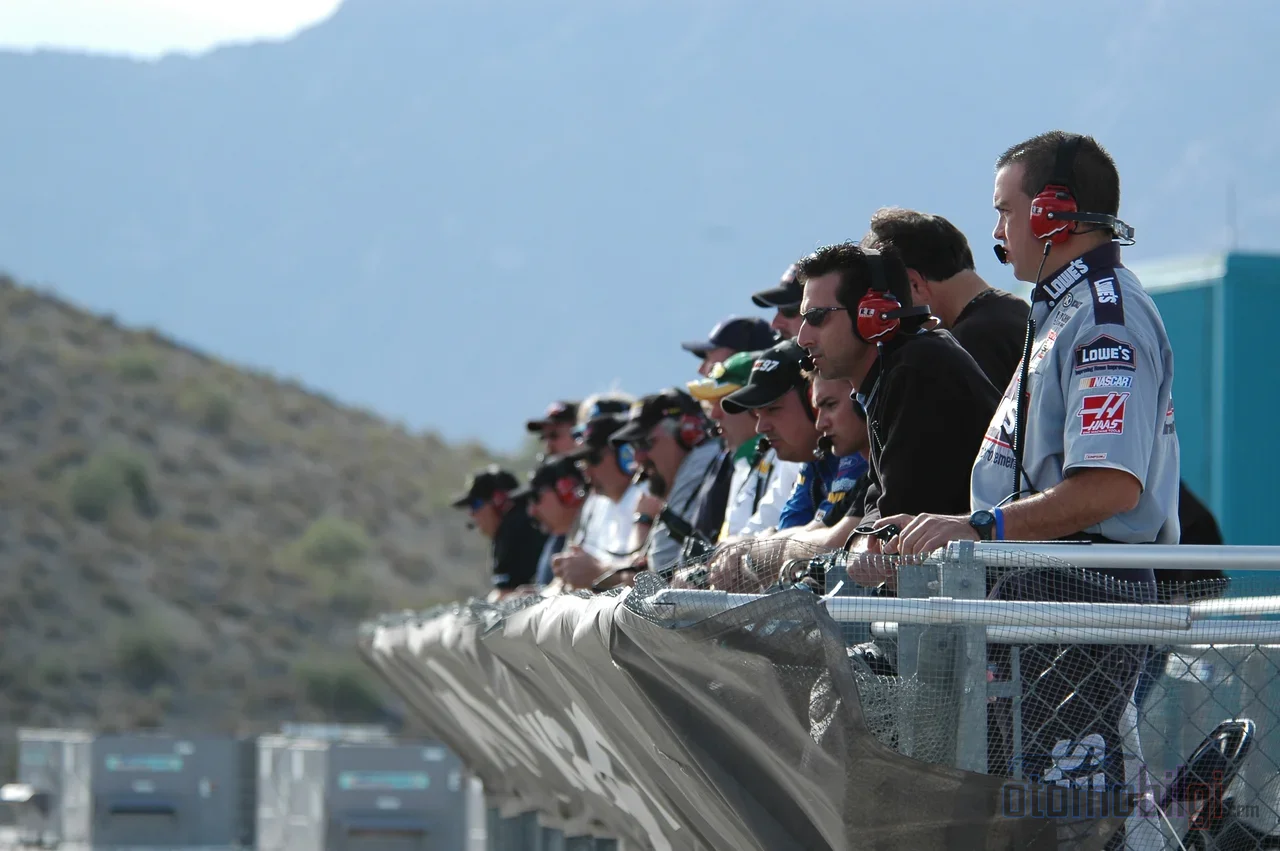
So where does this person stand? Not at the edge of the track, but in a spot right beside it: dedicated spotter platforms built on top of the grandstands, the press center, or the support buildings. Height is critical, because the goal is to see the entire track in a single glance. Another interesting detail is this: each spotter stands at the same point on the same track on every visit, and an informal, seniority-based arrangement has formed. At Daytona, a separate seating area is reserved for the frontstretch spotters in the first section of the suites on the Turn 1 side.
The unseen side of the job, however, is quite grueling. Over a day stretching from practice to qualifying and races that can exceed four hours, they stand for hours on end, and their concentration cannot be broken for even a second. The opportunity for breaks is nearly zero; unshaded sun, wind, and rain are also part of the job. Because the seats in race cars practically swallow the driver, this role - which does not look like an ordinary job from the outside - is in fact a test of physical and mental endurance.
Where Did This Profession Come From? A Brief History of Spotting
Two-way radio communication between the driver and the pit crew began in the 1970s and early 1980s, but back then all conversation was conducted from the pit area, and the topic was always pit strategy and mechanical issues. There was no one watching the traffic on the track. One of the first to notice this gap was Indycar driver Tom Sneva; he is credited as the first driver to use a spotter in major races. The source of inspiration is also interesting: the American football practice of coaches watching the field from a high stand and relaying information.
In the 1980s, teams sometimes ran experiments with people they placed in the observation tower, the photo stand, or the top rows of the grandstand after buying tickets for them. Then these experiments became institutionalized: From the early to mid-1990s, NASCAR standardized spotter organization and made it mandatory. Today, a dedicated area is set aside for spotters at every track. At long ovals like Daytona, Talladega, and Indianapolis, multiple spotters are used because the entire track cannot be seen from a single point.
What's Being Said on the Radio? Here Are Typical Spotter Calls
What I love most about spotter language is its brevity. You can't speak long sentences into the ear of a driver doing 300 km/h; a few words are worth a thousand. The moment the driver gets in the car, a radio check is performed, and every spotter carries a spare radio battery. Then the traffic reports begin. And here's an example of how information is formatted: what class the car behind is in, how many car lengths back it is, and whether it's accelerating toward you - all three are said in a single breath. If the track is empty, the spotter tells the driver that the track is theirs and they can run their own line.
Inside, Three-Wide, and Clear: The Foundation of the Vocabulary
- Inside! Inside! - Means the competitor is attacking from the inside. This warning prevents the driver from drifting toward the apex of the corner and causing an accident; some spotters give advance notice that the rival will look inside.
- Clear high / clear low - Tells which direction is open, that is, the safe side for passing.
- Three-wide - Means three cars side by side, informing the driver that they are stuck right in the middle, like the filling of a sandwich. At Talladega, when both sides are closed, spotters make the situation clear by saying outright: three-wide, you're in the middle.
- Wreck in turn... - Reports which corner the crash happened in, so the driver can plan around the debris zone in advance.
They also have a critical role at the start: drivers in the back rows may not be able to see the flag station. The spotter watches the flag official and, the moment the green flag goes up, shouts "green" three times over the radio to shorten the driver's reaction time. In addition, every driver-spotter pair develops their own jargon and codes - to keep strategies like pit orders from leaking to rivals. Some drivers want a constant stream of information, others prefer a spotter who speaks little; there are even defined periods when complete silence is kept except during the most intense moments of driving.
What's the Difference Between a Spotter and a Crew Chief?
It's very easy to confuse the two, but the division of duties is clear. The crew chief, the head mechanic, works like the team's head coach: they manage the car setup, race strategy, and the entire crew; this role requires mechanical expertise and certifications. The spotter, on the other hand, relays what's happening on the track to the driver - traffic, track position, racing lines, and the on-track execution of pit strategy are their domain. One talks about the car, the other about the track; both live on the same radio network but on different channels.
Let me offer an analogy: The crew chief is the tactician in the garage, and the spotter is the coach with eyes on everything from the very top of the grandstand. Just as a football coach watching the midfield from the stands can see the passing lanes better, a spotter who sees the entire track from above sees everything the driver cannot. On a NASCAR team roster, alongside these two there are also other roles such as race engineer, tire specialist and car chief - the team is an orchestra, and everyone plays a different instrument.
How Does the Spotter Save the Day in the Big One?
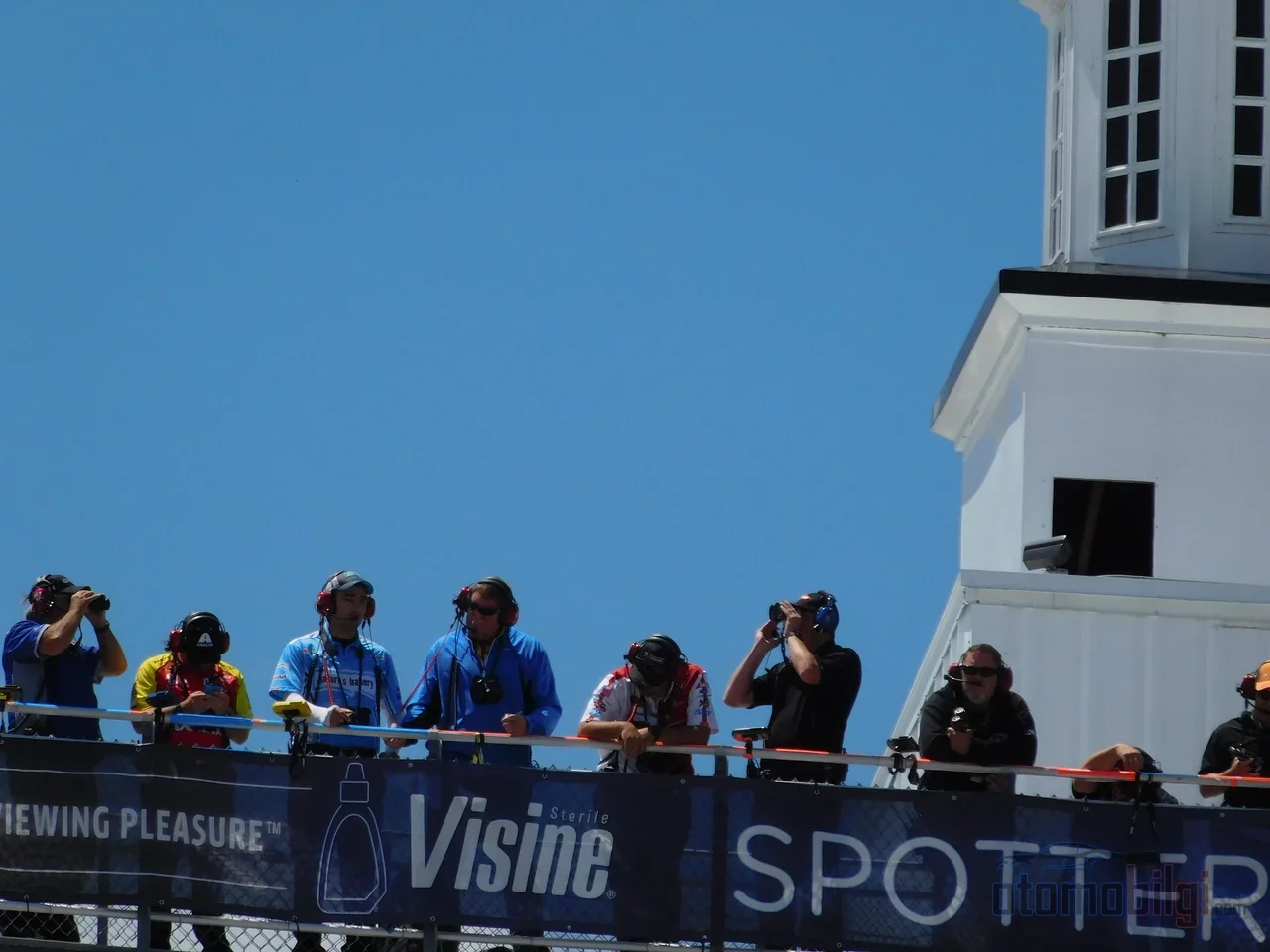
At superspeedways like Daytona and Talladega, dozens of cars race in a packed formation at the same time, and this is where the spotter's role peaks. When there are many cars on track at once, spotters are required to be on the roof; they go far beyond the usual amount of information they provide. Because the nightmare of these tracks is the chain-reaction crash that a single mistake can collect dozens of cars into: the Big One. When a pass is about to happen between three cars traveling at over 300 km/h at the same time, the difference between a successful three-wide pass and slamming into the fence in turn 3 can come down to whether the spotter says "clear" or "still there." Think about that sentence once more - the entire essence of the profession is hidden between those two words.
The Big One also shapes Talladega's strategy; the yellow line rule, which forbids attacks by dropping below the double yellow line at the bottom of the track, is part of this balance as well. In such an environment, managing the traffic and keeping the driver out of trouble makes the spotter the most tireless voice on the track.
Can the Driver Really Never See Behind?
Traditional NASCAR cars have no side mirrors; instead, large convex round mirrors are used that allow the driver to see the front and rear of the car. But since the seat wraps the driver tightly and the helmet narrows the field of vision, the mirrors alone are not enough - and this is exactly where the spotter steps in, completing the driver's missing mirrors. The Next Gen Cup car, meanwhile, brought technology inside: a digital rearview mirror and a rear camera offer the driver a wide rear view through a similar camera image. So as technology advances, the blind spot shrinks - but the track as a whole can still only be seen from a pair of eyes standing high above.
How Can One Communication Change a Race?
The spotters' influence on the track is full of concrete examples. In the 2016 season, it was openly stated that a championship was won thanks to the spotter guiding the driver on how to avoid crashes. In Denny Hamlin's No. 11 car, Chris Lambert's radio direction stood out as extraordinary navigation skill, while TJ Majors, one of RFK Racing's spotters, is earning great praise for his ability to keep his driver up front. The relationships among spotters are also interesting: even on rival teams, they can cooperate - the spotters of two cars running together can synchronize their pit stops so they remain drafting partners, or adjust their drivers to form a group against another car. But the tension is just as real; fights on the track can sometimes escalate all the way up to the spotter's tower.
Relationships aren't always about the smell of roses, of course. Kyle Busch got angry at Carson Hocevar during a Texas race and also lashed out at his spotter; Austin Hill, meanwhile, argued over the radio with his own spotter Derek Kneeland at Kansas. These moments show us one thing: the radio is such a critical line that a single late message or wrong warning can test both the trust between driver and spotter and the outcome of the race at the same time. As spotters themselves say among each other, that voice can sometimes be the only difference between winning and losing.
Next time you watch NASCAR, think about that voice coming through the radio: someone standing at the top of the track, in the wind, on their feet for hours, protecting a driver's life and race every single second. So if it were you, in the middle of a pack coming at 200 mph, who would you trust?
Sources
- Spotter (auto racing)
- A Guide to Race Spotting: Equipment and Communication Tips to Help Your Team Win
- From the Talladega spotters' stand: How to navigate drivers at 200 mph
- High up top: How spotters play extra-pivotal role at Talladega
- Spotters: The Unsung Heroes of NASCAR Safety - Part 1
- NASCAR's spotters: Drivers' eyes in the sky and so much more
- Analysis: How the Big One shapes Talladega strategy
- The Voice in Your Driver's Ear: How NASCAR Spotters and Team Radios Actually Work
- Next Gen NASCAR cars equipped with digital rear view mirror tech
- NASCAR's Yellow Line Rule at Talladega, Explained