How Does the Headlight Washer System Work and Why Is It Mandatory in Some Cars?
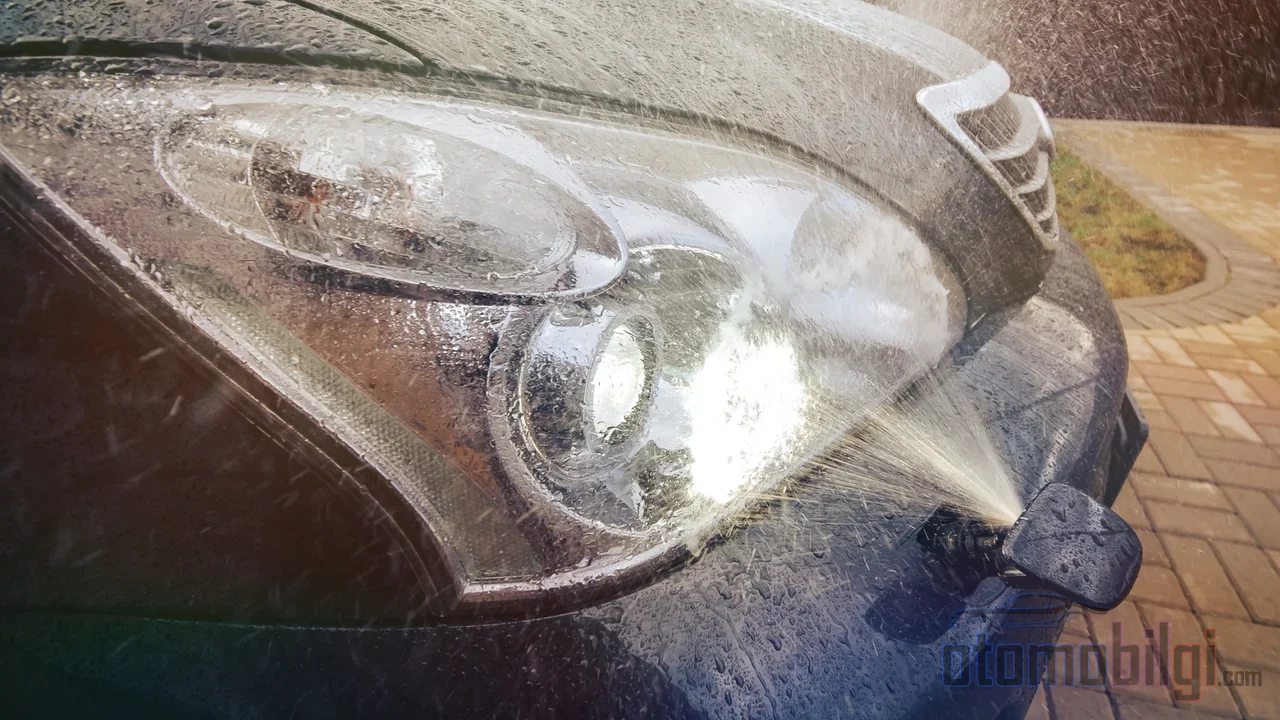
Have you ever noticed that on a night drive your headlights suddenly squirt and wash their own lenses for a few seconds? Most drivers don't even hear that brief hiss, but what's working behind the scenes is incredibly clever engineering: fully liquid-pressure-operated telescopic nozzles with no electricity, heated winter modes, and even a legal mandate imposed by an international regulation. What's more, while this system is fading away in some new vehicles, it is still mandatory in others. So how exactly does the headlight washing system work, and why does it have to come with certain headlights?
How Does a Dirty Headlight Lens Affect the Light?
While driving on the road, everything sticks to the headlight lens: dust, mud, and the salt scattered on roads in winter. Although these form an extremely thin layer, they refract and scatter the light produced by the headlight, preventing it from focusing in the right direction along the road. A dirty lens scatters the light around rather than where it needs to go; as a result, your visibility decreases and glare for oncoming drivers increases. In other words, the headlight washing system is not a luxury detail, but a direct safety component.
There is also the sensitivity of polycarbonate lenses. Modern headlight lenses are susceptible to scratches and UV rays; a mechanical solution like a traditional wiper therefore cannot be used, because it can scratch and stain the plastic lens. That's exactly why engineers chose pressurized water spraying instead of mechanical friction. This system played a major role in the spread of xenon headlights across Europe.
Key Highlights
- A headlight cleaning system is legally mandatory in vehicles with low-beam output exceeding 2,000 lumens.
- Telescopic nozzles open and close without electricity, entirely by liquid pressure.
- Heated nozzles activate automatically in most vehicles at 5°C and below.
- The body is usually made of PBT engineering thermoplastic, and the spray arm is made of UV-stable plastic.
How Does the Headlight Washing System Work?
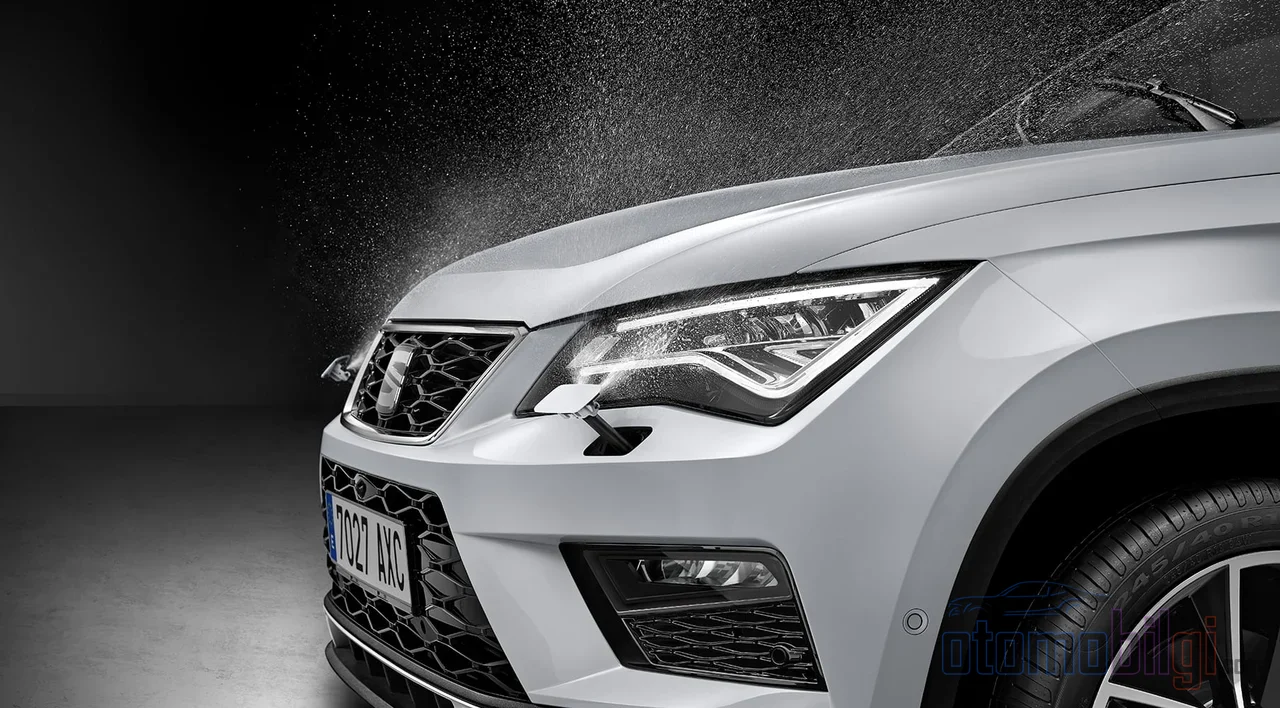
The heart of the system is simple: an electric pump that draws washer fluid from the reservoir, lines that carry this water to the nozzles in the front bumper, and spray tips aimed at the headlight. The pump draws the fluid from the intake at the bottom of the reservoir and feeds the nozzles at high pressure; the nozzles then spray directly onto the headlight lens, tearing off the accumulated layer of dirt. It's essentially a mini version of a pressure washer, but hidden inside the bumper.
Electricity-Free Telescopic Nozzles
The most elegant part of the job begins here. The mechanism known as the pop-up nozzle uses no electric motor at all; the pressure of the fluid coming from the pump both positions the nozzle and performs the spraying. Inside the nozzle there are inner and outer helices, i.e. two elements of the male-female thread type. While the vehicle is parked, a spring holds the outer helix in the parked position beneath the bumper surface.
When fluid intake begins, the helix is pushed upward and the spray arm emerges beyond the bumper fascia. When the inner helix touches the top of the body, the linear movement stops, but the outer helix continues to move; this rotates the internal coil, and the spray arm performs a circular sweep over the headlight. When the liquid is cut off, the spring system pushes back, and the arm rotates in the opposite direction, retracting into its socket inside. In other words, a small amount of water directs a mechanical choreography from start to finish. In my opinion, this is one of the most elegant micro-examples of automotive engineering.
The material choices are also thoughtful: the nozzle body is usually manufactured from polybutylene terephthalate, an engineering thermoplastic known as PBT. The spray arm, which is constantly exposed to sunlight, is made from a plastic with high UV stability; an O-ring provides the sealing. The nozzles are mounted on top of the bumper or on its front face, and in choosing the location the goal is to fully cover the headlight while minimizing the arm length. Vertical mounting is also possible.
Early Designs
Today's telescopic structure did not emerge in a single day. One of Mercedes-Benz's early patents described a nozzle carrier extending telescopically from a cylindrical guide tube. In another, there was a hinged cover covering the opening in the bumper: as the nozzle extended outward, it pushed the cover open itself, and a spring held the cover closed. Such solutions gradually evolved into today's single-piece mechanisms powered by fluid.
Why Is It Mandatory on Some Headlights and Absent on Others?
Now let's come to the legal side of the matter, because this is the most commonly misunderstood part. The rules governing the European side are the UN/ECE regulations under the 1958 Agreement. Gas-discharge, that is, HID/xenon headlights, are regulated by ECE R99; the installation of vehicle lighting systems, their positions, and their switching logic are covered by ECE R48. Self-leveling and headlight washing systems are also part of the test requirements within this framework. On the US side, it is a different world: FMVSS rules apply, and for example retrofitting an HID or LED bulb into a halogen headlight system does not comply with these standards.
The real magic number is this: headlight cleaning devices are mandatory on all vehicles whose low-beam light output exceeds 2,000 lumens. Since xenon headlights easily exceed this threshold, the washing system comes with them; that is why the system is legally required on xenon-equipped vehicles. Another interesting detail of the regulations: even if an additional light source or LED module fails, under UN R149 the headlight must continue to meet the passing-beam requirements.
| Headlight Type | Washing System Status | Explanation |
|---|---|---|
| Halogen | Usually not required | Output usually stays below the 2,000-lumen threshold |
| Xenon (HID) | Mandatory | High output and the plastic lens's susceptibility to scratching |
| LED | Depends on the threshold | Some manufacturers keep the output below the threshold to skip the system |
The picture is even more interesting with LEDs. Many users have noticed that this system no longer appears on new LED-headlight vehicles. Behind this lies the same lumen threshold: some manufacturers design their LED headlights so that the output stays below 2,000 lumens, so that no washing system is required. This leads to confusing situations where one version of the same model has the system while another does not. Considering that high-intensity lights covered by a dirty lens can increase glare, whether the system will disappear entirely is still being debated.
Anti-Freeze Nozzles in Winter: Heating System
The moment headlight washing is most helpless is exactly when you need it most: a freezing winter morning. Since the nozzles are exposed to external elements, the liquid inside them can freeze, and the nozzle mouth can ice over. That is why many vehicles have a heating function for the nozzles, and most manufacturers automate it when the temperature drops to 5°C and below. Even the official manuals of models like the Kia EV9 explain this function clearly: the heating melts the ice on the frozen washer nozzles. There are also systems where the engine heat protects the nozzle lines and the reservoir.
There is even a separate patent on this subject: systems have been designed to keep the washer fluid above a certain temperature at the delivery point. Judging by user reports, the importance of heating is truly tangible; on the other hand, it is known that telescopic nozzles work in winter but the nozzle can break with a large pothole impact, and in some models the jet cap fails to close due to freezing. So the system is strong but not invulnerable.
What Happens When the System Malfunctions?
The theory is nice, but in daily life the headlight washer motor can also fail. The clearest signs are as follows:
- If the headlight washing is triggered but the lens is not washed, the light scatters along the way and night vision noticeably decreases.
- Glare increases for oncoming drivers; this is both a matter of courtesy and safety.
- The nozzle not retracting or the jet cap not closing can be a sign of freezing or mechanical damage.
- In some markets, such malfunctions can cause problems during the periodic technical inspection.
In short, the system not working is not just a visual detail; one of the conditions under which the headlight was approved through homologation is effectively removed. That is why it is worth occasionally checking whether the jets are working.
So What Does the Future Hold for This System?
The story of headlight washing is actually a small summary of how engineering works: first there is a physics problem (dirty lens, scattered light, scratched plastic), then a mechanism that elegantly solves it (the electric-free telescopic nozzle), and then a rule that makes this solution mandatory under certain conditions (the 2,000-lumen threshold). LED technology, playing at the edge of the rules, pushed the system away from some vehicles. So, to give a clear answer to the question: the headlight washing system is legally mandatory when the headlight output exceeds 2,000 lumens; xenon headlights come with it because they exceed this threshold, while with LED headlights manufacturers can design without the system by keeping the output below the threshold.
Lumen counts will determine whether the system disappears entirely in the future; but the harm a dirty headlight lens does to night vision will not change. I recommend watching that brief spray moment when the headlights wash themselves carefully next time - now you too know the mechanism working behind it. Have you ever noticed the headlight washing in your vehicle?
Sources
- Headlamp washer system - US6905078B1
- UN Regulation No. 149 - UNECE
- ECE R99 - Tralert
- ECE standards - Hella TechWorld
- NOLDEN – LED knowledge
- Heated washer nozzle - Kia EV9 Manual
- The Magic Of Heated Windscreen Washers - The Autopian
- Heated windshield wiper washer nozzle system - US5979796A
- USA: Washer system allows HID and Xenon headlight use in Europe - just-auto
- Toyota Headlight Washer Motor Failure Signs - AutoPartsX