Why Haven't Halogen Headlights Died Yet? The Filament and Halogen Cycle
Share This Page
The halogen headlight is a technology whose tungsten filament flows but never dies, because the halogen gas inside works through a regeneration cycle that carries vaporized tungsten back to the filament, and thanks to its cost, thermal durability, and ease of service, it remains a sensible technology even in the LED era. Does that sound a bit exaggerated? Then let's look inside the filament.
Highlights
- The halogen cycle works only if the inner surface of the bulb is at least 250 °C ; below that, tungsten sticks to the glass and the bulb darkens.
- The filament heats up to about 3,000 °C; the cycle can double the lifespan of an incandescent lamp.
- Typical lifespan: halogen 500-1,000 hours, xenon 2,000-3,000 hours, LED 20,000-50,000 hours.
- A halogen bulb usually costs 2-5 dollars; an LED's light is far more efficient than halogen, which converts only about 10% of energy into light.
- The filament's optical position is the reference point of the headlight housing; an LED bulb fitted into a halogen reflector disrupts the beam.
How does a halogen headlight work? The filament and the halogen cycle
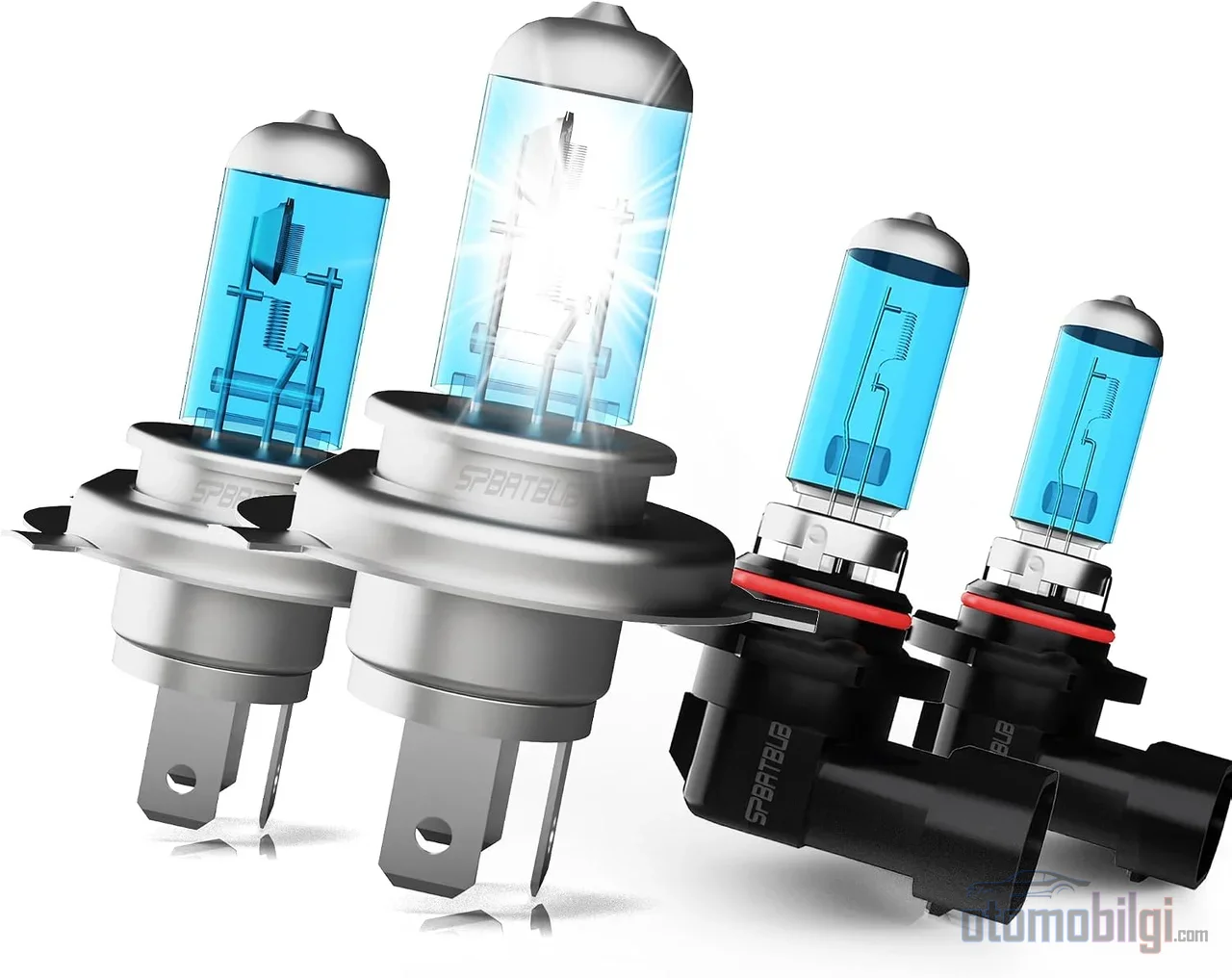
Let's start with the basics. A halogen lamp is essentially an incandescent lamp: Inside, there is a thin tungsten filament, and electricity heats this filament to about 3,000 °C to produce visible light. So what's the difference from a classic incandescent bulb? The inside of the bulb is filled not only with inert gas but also with a small amount of halogen gas (iodine or bromine). This tiny addition is the magical part of the whole technology.
Now let me explain how it works with an everyday analogy. As the filament heats up, just like a piece of ice evaporating, tiny tungsten particles break off from its surface. In a normal incandescent bulb, these particles stick to the glass, the glass darkens, the filament weakens as it loses material, and eventually breaks. In a halogen lamp, however, the released tungsten combines with the halogen gas, turning into a tungsten halide gas that does not adhere to the bulb's surface. When this gas touches the approximately 2,500 °C surface of the filament, it breaks down again: the tungsten is redeposited back onto the filament, while the halogen is set free and the cycle continues. In other words, the lamp repairs itself - an entire chemical cycle constantly spinning inside the bulb.
This cycle has one condition: The inner surface of the bulb must be above 250 °C . Below this temperature, the tungsten starts sticking to the glass and the cycle collapses. This is exactly why halogen bulbs are made compact and small: a smaller surface heats up more easily. That's also why the bulb's material isn't ordinary glass; quartz (fused silica) or high-melting-point glasses like aluminosilicate are used instead. The durability of quartz provides another bonus: The gas pressure inside can be kept very high - some lamps carry pressure up to 15 times atmospheric pressure while cooling. High pressure reduces the filament's evaporation rate, meaning a higher temperature - and thus higher light output - for the same lifespan. Clever, isn't it?
The result of the cycle is also tangible: the bulb surface stays clean, light output remains nearly constant throughout the lamp's life, and lifespan can double compared to a standard incandescent lamp. The halogen gas is generally confused with krypton or xenon; after iodine, bromine was preferred in the form of certain hydrocarbon compounds. Fluorine would also work in theory, but due to its extreme reactivity it damages other parts of the lamp and is therefore not used.
A brief history tour
This idea is actually old. In 1882, a carbon filament lamp using chlorine to prevent bulb blackening was patented. The 1933 patent clearly defined today's logic: the use of iodine and the cyclic return of tungsten to the filament. The real turning point came in 1959: General Electric patented the first practical iodine-based halogen lamp and brought commercial quartz-iodine lamps to market. In some designs of dual-filament lamps like the H4 that entered cars, molybdenum shields were even used to control light between the filaments. So the bulb you carry in your headlight today is the product of more than 60 years of engineering maturation.
Comparing halogen, xenon and LED in numbers
So where does halogen stand against its rivals? Let's clarify things with numbers. Let me say upfront: halogen does not come first in any column. But the table gets interesting.
| Feature | Halogen | Xenon (HID) | LED |
|---|---|---|---|
| Light output | 1,000-1,500 lm | 3,000-5,000 lm | 3,000-5,000 lm (some higher) |
| Lifespan | about 500-1,000 hours | 2,000-3,000 hours | 20,000-50,000 hours |
| Energy use | about 55 W, ~10% converted to light | consumes ~35% less than halogen | the most efficient technology |
| Bulb/unit cost | 2-5 USD | more expensive than halogen | the most expensive |
| Degradation behavior | loses most of its brightness before failing | becomes noticeably dimmer over time | relatively constant over its lifetime |
As you can see, halogen's efficiency table is brutal: about 90% of the electricity it consumes is converted into heat, with only around 10% left as light. Its lifespan is also the shortest. But let's add this: lifespan figures can vary by standard; for general-purpose tungsten-halogen lamps, 2,500-3,000 hours is given as a typical lifespan, while automotive use ranges are shorter. Also, lifespan is incredibly sensitive to voltage. Running 5% above the design voltage increases light by ~15% but cuts lifespan in half. As filament temperature rises, tungsten evaporation accelerates, hot spots thin out, and ultimate failure arrives. So the cycle extends life but doesn't make it infinite.
Why are halogen headlights still installed when LED exists?
Here is the article's crucial question. If LED rules everything, why do car manufacturers still install halogen in millions of cars? The answer comes down to four headings.
- Cost and compatibility: Halogen bulbs are by far the cheapest option in terms of manufacturing and purchasing; a standard bulb costs around 2-5 dollars and is fully compatible with existing headlight housings. An example replacement cost: roughly a 10-dollar bulb plus 40 dollars in labor. With LEDs, on the other hand, it is usually an entire headlight unit that is being discussed.
- Thermal resistance and durability: The quartz body easily withstands high temperatures and high gas pressure. Inside a halogen headlight there is also no cooling fan, driver electronics, or thermal management - a simple, proven structure.
- Color and nighttime comfort: Halogen produces a warm white light. Many drivers say this light strains the eyes less on long night journeys - while this is an anecdotal user tendency, it should be taken seriously as one of the reasons for the preference.
- Ease of servicing: If a bulb burns out, you replace it within minutes; no special equipment, calibration, or software is required.
When these four factors come together, halogen remains the most sensible engineering decision for any vehicle in a cost-critical segment. A system that works close to a thousand times, in every season, on every road, and when it fails is solved with a five-dollar part - very few technologies on the market can back that up.
What about dim conditions? The fog and rain debate
The most common argument put forward by halogen advocates is this: on foggy, rainy nights, warm, yellowish light provides better visibility. In reality, this issue is two-sided. There is a peer-reviewed study indicating that drivers in regions with dense fog will have better visibility conditions with halogen headlights; so the argument's scientific basis is not entirely empty. On the other hand, a lighting manufacturer argues that the widespread belief that halogen is better for bad weather may not always be true in practice. If you say you will be driving in dim conditions, the honest answer is this: there is no guaranteed winner in this matter; the technology choice depends on driving conditions and expectations.
The invisible advantage of the filament: the optical reference point
The unspoken but most structural advantage of halogen is this: the headlight housing - whether reflector or projector - is calculated by centering on the point where the tungsten filament is located. The filament is the design reference for the beam pattern. LED chips, on the other hand, must sit in exactly the same optical position; if the light source shifts a few millimeters forward or backward, the beam does not focus. Even small differences in size and position have serious consequences for the beam pattern; this is why HID bulbs also do not work properly in a halogen reflector.
The practical consequence of this has been discussed repeatedly in forums and technical debates: fitting a retrofit LED bulb into a housing designed for a halogen headlight struggles to produce an optically consistent beam. Even an LED conversion that delivers five times more light at every point of the beam can fail due to positional mismatch at specific points. A poorly placed LED beam drifts upward, becomes uneven, and blinds oncoming drivers. A footnote here: because of the lack of modern headlight regulations in the US that would reduce glare, the mass transition to LED increased the perceived brightness of headlights and made the glare problem worse for oncoming drivers - it made the news in 2023. In short, brightness does not always mean better visibility.
Enemies of lifespan: voltage, dimming, and fingerprints
Knowing how a halogen bulb dies is the key to using it correctly. There are three classic enemies:
- Overvoltage: The lamp is manufactured with enough halogen to keep up with the evaporation rate at its design voltage. If the voltage rises, the evaporation rate outpaces the halogen, the bulb blackens, and its lifespan shortens.
- Dimming: The cycle only works at high filament temperature. Even if you reduce the light by just 20%, the filament temperature drops, the cycle stops, and the lamp shifts into classic incandescent mode; the result can be darkening of the quartz capsule and premature failure.
- Dirt and fingerprints: Oil touching the quartz surface creates a hot spot when heated; the quartz can shift from its glassy form to crystalline form and leak gas, creating a risk of bubbling and explosion. That's why you should never touch halogen bulbs with bare hands - really.
The retrofit trap and the legal situation
The first question from those wanting to switch from halogen to LED is this: Wouldn't it work if I fit an LED bulb into my factory halogen housing? Because of the optical reality I described above, the answer is usually no. Although LED bulbs fitted into a halogen housing may theoretically look brighter, the risk of disrupting the beam pattern affects both your own visibility and the safety of oncoming drivers. The degradation behavior is also interesting: halogen degrades quickly and loses most of its brightness before failing; HID lasts longer but becomes noticeably dimmer over time. In other words, every technology ages in its own way.
The regulatory side is also becoming clear: bans on incandescent bulbs in Europe began in 2009; the production and import of directional mains-voltage halogen bulbs were banned on September 1, 2016, and non-directional halogens on September 1, 2018. Australia banned some halogen bulbs above 10 W starting September 2021, and the United Kingdom announced its plan to end halogen sales for general lighting. It is worth noting: these bans target household and general lighting bulbs; it is not explicitly stated that they cover automotive headlight bulbs. One plus is this: halogen bulbs contain no mercury and are not classified as hazardous waste.
So is halogen really dead?
Let's give you an honest answer: No, and it will not die in the near future either. LED holds an overwhelming advantage in efficiency and lifespan; as of 2026 it leads in many segments in the real world. But halogen is winning a different battle: it is cheap, compatible with every headlight housing, not exactly a technology that forgives even touch, but replacing one costs five dollars and five minutes. There is also a large group of drivers who love its warm white light. In the murky weather debate, meanwhile, there is no winning technology, only preferences that depend on conditions. If your headlights still have halogens, don't be sad - inside them runs a self-repairing chemical cycle. This is a legacy that 60 years of engineering proudly carries. So which would you choose at your next bulb change?
Sources
- Halogen lamp
- Performance investigation of different headlights used in fog - Nature Scientific Reports (Sefer et al., 2023)
- Which is better: LED or xenon headlights? - NAPA Autopro
- Xenon Headlights vs LED vs Halogen: The 2026 Buyer's Guide
- How Does Dimming Alter the Halogen Cycle and Shorten Bulb Life?
- Halogen Lamps: How to Receive the Best Possible Performance and Maximum Life - Katun
- Tungsten Halogen Lamps & Gas Filled Lamps - ILT
- LED vs. HID vs. Halogen vs. Laser Headlights - Carfax
- Types of Headlights - Valvoline Global
- LED vs. Halogen Headlights: Pros Cons And Real Differences - rimthin
- How Long Do Halogen, LED, and HID Bulbs Last? - Headlight Revolution
- LED Headlights Bad Weather Performance - OSRAM
- The Scientific Reason Why You Can't Retrofit LED bulbs - Reddit r/AutomotiveLearning
- Why LEDs should not be run in Halogen reflectors - Tacoma World
- Your Guide to LED Headlight Bulb Beam Pattern - SEALIGHT
- Cars in the U.S. still lack glare-reducing headlights - NBC News (2023)
- Effects of Filament Temperature on Lamp Lifespan and Performance - ResearchGate
- Halogen Headlights: Understanding Their Advantages - The Retrofit Source
- Halogen headlight: characteristics, advantages and prices - AGM Vision