From Halogen to Laser Headlights, A Guide to Vehicle Lighting Technologies
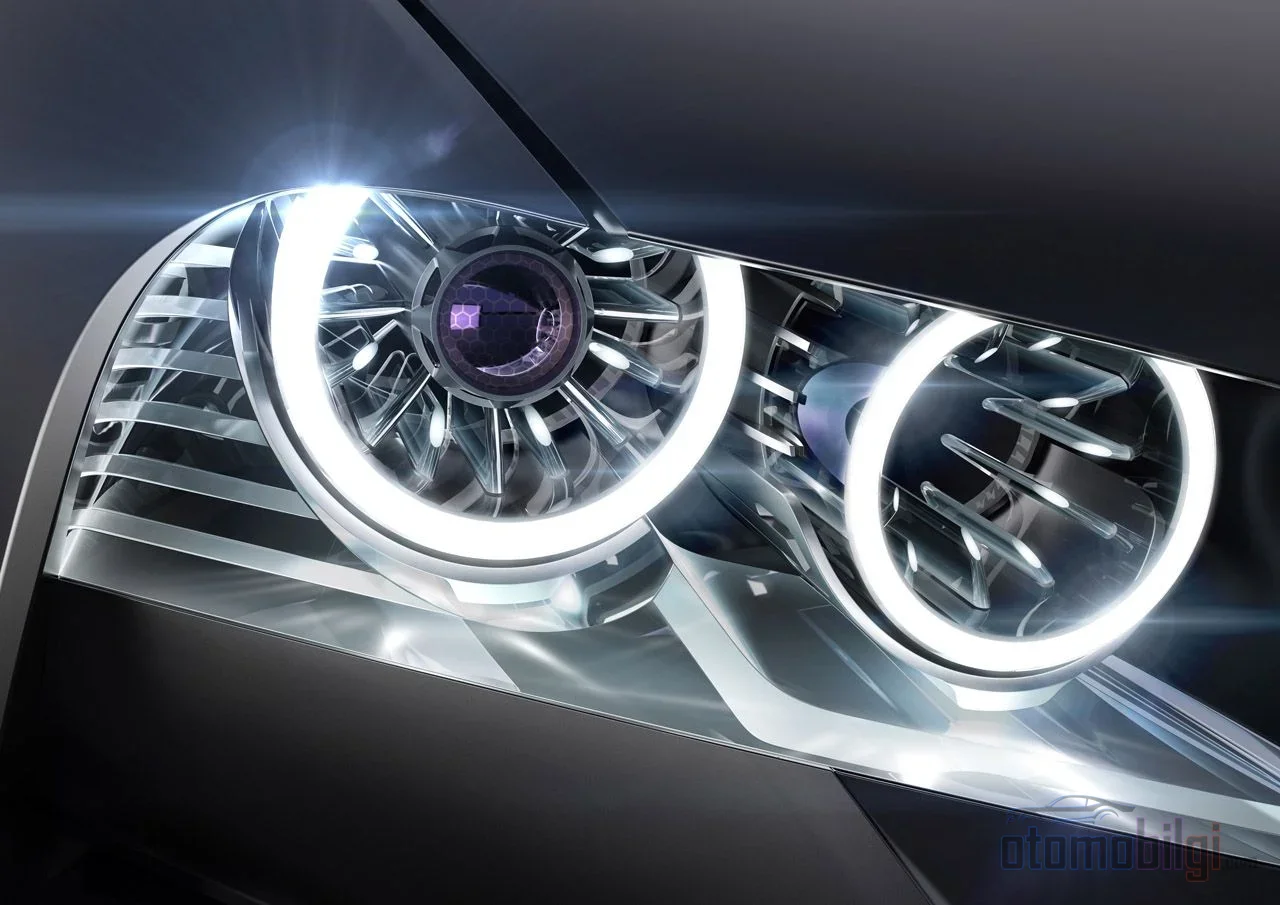
Share This Page
Vehicle headlights fall into five main technologies: halogen, xenon (HID), LED, matrix LED, and laser: Halogen works by heating a tungsten filament to incandescence, xenon by an electric arc within gas, LED by electrons passing through semiconductors, matrix systems by pixel-by-pixel dimming logic, and laser headlights by converting blue laser light to white using a phosphor. This guide explains the engineering logic behind each one and the real differences between them.
Highlights
- A halogen bulb produces light by heating its filament to approximately 2,500 °C; average lifespan of ~1,000 hours
- Xenon headlights work with an electric arc within gas and offer a lifespan of ~2,000 hours
- LEDs consume approximately 10 times less electricity than halogen
- The range of laser headlights is approximately 2 times longer than LED (in the 300-600 m band)
- The global automotive LED lighting market is projected to reach $42.66 billion in 2034
Halogen Headlights: An Old Yet Still Standing Incandescent Filament
Think of the inside of a halogen bulb as a tiny furnace. The tungsten filament sits inside a heat-resistant glass casing filled with a mixture of argon and nitrogen gas; the current from the battery heats this filament to around 2,500 °C, and as the matter glows red-hot, it emits light. So what the headlight actually does is hold a white-hot wire up to the sky. Simple, cheap, and available everywhere - which is why it is still the most common headlight technology.
But this simplicity comes at a cost. Over time, the filament evaporates and sticks to the inner surface of the glass, the filament thins, and eventually breaks; the average lifespan is around ~1,000 hours. The light range is also limited, staying within the 50-100 meter band. On top of that, electricity consumption is high because it produces excess heat. There is also one annoying detail: the halogen bulb is very sensitive to handling. If you touch it with bare fingers, the oil from your fingers causes uneven heating on the glass and shortens the bulb's lifespan. You should always install the new bulb holding it with a cloth or gloves - if you have learned this, you have taken a solid step in headlight matters.
Xenon (HID): No Filament, an Electric Arc Instead
The most elegant thing about xenon is that there is no filament inside at all. The bulb is filled with xenon gas, and the light is produced by a high-voltage current passing through the gas - in other words, an electric arc. There is no filament, so there is nothing to break; with an average lifespan of ~2,000 hours, it approaches twice that of halogen. This arc system works together with an electronic control unit called a ballast, which manages the bulb's voltage.
In terms of light quality, xenon produces a characteristically whitish light that is brighter and more evenly distributed than halogen; it also limits glare scatter. In terms of lumens, the numbers speak for themselves: while halogen produces 1,000-1,500 lm, xenon reaches levels of 3,000 lm and above - that is, roughly 2-3 times the brightness. The range is around 100-200 meters. So why is xenon still used despite being expensive and despite the technologies replacing it? There are two reasons: the parts are complex and expensive, and it takes several seconds to reach full brightness. And there's an interesting requirement - vehicles with xenon headlights must have a headlight washing system. That's because dust and dirt stuck to a dirty lens scatter the xenon light and can blind oncoming drivers. This rule is the clearest evidence in the regulatory world that the "brighter = safer" equation doesn't always work.
LED Headlights: Electrons' Generosity with Photons
The working principle of an LED has nothing to do with heating a filament. When electrons flowing continuously through a semiconductor enter a low-energy "gap" (hole), they release the energy difference as a photon - this is called electroluminescence. In other words, an LED produces light directly from electrons; there is no glowing filament in between. It consumes about 10 times less electricity than halogen, contains no toxic elements like lead, mercury or cadmium, and operates at low voltage.
But LEDs have a weak point too, and it surprises many people: although they don't glow red while emitting light, significant heat builds up at the base of the emitter. That's why a cooling system is essential - considering how hot the engine bay gets, thermal management is a real headache for engineers. Among the best in terms of lifespan: they last longer than halogen and xenon, but their brightness gradually decreases as they age. The range reaches the 150-300 meter band. Their real trump card, however, is design freedom: thanks to their small size, they can be manufactured in any shape and size desired. All those thin, sharp, signature-like headlight lines you see on today's vehicles owe their existence to the LED's tiny size.
Matrix LED Headlights: Digital Light That Dims Pixel by Pixel
Matrix headlights are a layer of intelligence added on top of the LED. The basic logic is this: the light distribution is divided into small segments that can be controlled independently - in other words, pixels. A forward-looking camera mounted behind the windshield detects oncoming vehicles and road users, and based on this data the control unit dims or completely switches off the LEDs in the relevant area, darkening that region. Just as some pixels on a phone screen can light up while others stay dark, a matrix headlight manages the light on the road pixel by pixel.
Why is this so valuable? With conventional systems, when an oncoming vehicle approaches, you switch off the entire high beam and the road ahead of you goes dark. With the matrix logic, the high beam never turns off; only the areas that could cause glare are dimmed. Manufacturers' statements also converge on the same point: some systems create anti-glade gaps to the left and right of the oncoming vehicle while keeping the other areas noticeably brighter; others dim only the relevant light pixels when oncoming traffic is detected, keeping the road view strongly illuminated. In other words, glare-free high beam becomes possible through fully digital, pixel-level control - in my opinion, this is the most impressive engineering achievement of modern vehicle lighting.
Laser Headlights: The Adventure of Blue Laser Turning White with Phosphor
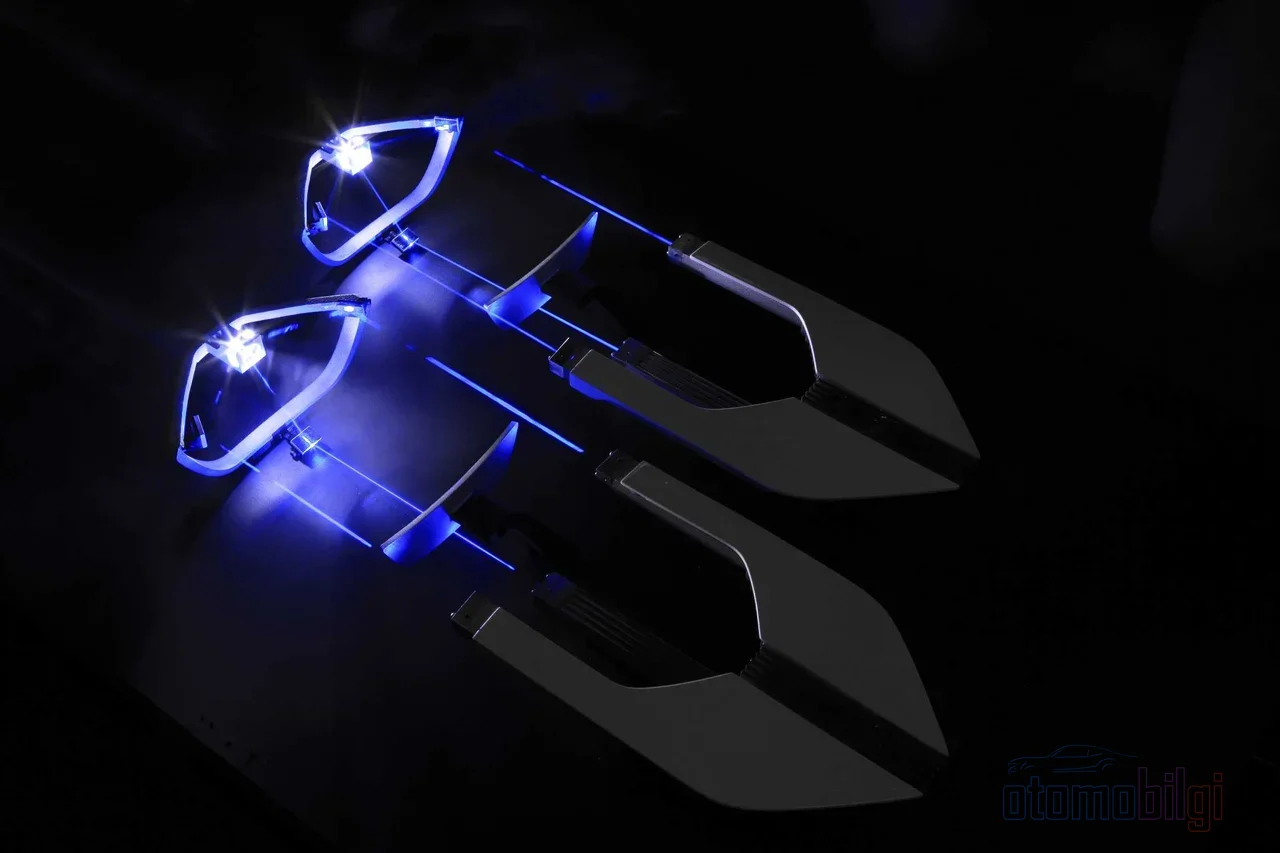
The name sounds intimidating, but don't worry - laser headlights don't shoot lasers directly at the road. At the rear end of the system are blue laser diodes; this light is focused, via a mirror system, onto a lens with yellow phosphor. The ratio of blue light to yellow phosphor determines the brightness and color of the resulting white light; the generated light is then sent back to a reflector and projected onto the road. On the physics side, the process is called stimulated emission: the blue laser at a wavelength of approximately 450 nm energetically excites the electrons in the phosphor, and the phosphor produces white light. Thanks to the phosphor, the color temperature also comes out very close to natural daylight.
The performance figures are serious: the range is roughly 2 times longer than LED, reaching up to 300-600 meters; it produces far more powerful light at two-thirds the voltage of an LED. In academic literature this is called laser-excited phosphor (LEP), and LEPs are immune to the efficiency drop ("droop") problem seen in LEDs. Heat is still an issue - since it can raise the temperature of the phosphor layer, cooling is required, and rotating phosphor converters are even used in high-power applications; in packaging, glass-based phosphor converters are more stable than silicone and cheaper than ceramic.
So why doesn't everyone switch to laser headlights? One constraint is that the laser currently only works on high beam, with LED remaining on low beam, and only activates at certain speed/distance thresholds (approximately 72 km/h). The bigger obstacle, however, is the regulatory side: while FMVSS 108 in the US sets a total limit of 150,000 candela, Europe allows up to 430,000 candela. Adaptive Driving Beam (ADB), which arrived in the US in 2022, also offered a simpler alternative using LED technology, and as flicker-free adaptive LED versions keep improving, laser's investment appeal has diminished. The focus has now shifted from "brighter" to "controlling the beam."
All Headlights Side by Side: Which One Is Different and Why?
| Technology | Light generation method | Lifespan | Range |
|---|---|---|---|
| Halogen | Incandescent tungsten filament | ~1,000 hours | 50-100 m |
| Xenon (HID) | Electric arc in gas | ~2,000 hours | 100-200 m |
| LED | Semiconductor electroluminescence | Longest lifespan, gradual brightness loss over time | 150-300 m |
| Matrix LED | LED segments controlled pixel by pixel | Same basis as LED | LED range + glare-free high beam |
| Laser | Blue laser + phosphor conversion | Long-lasting, requires cooling | 300-600 m |
Looking at this table, you might think "then I'll just get the brightest one," but that's not where the trick lies. Longer range isn't always safer; a headlight that blinds the oncoming driver means danger for both vehicles. The fact that headlight washer systems are mandatory on xenon-equipped vehicles is the clearest proof of this reality. True safety is about where and how the light is distributed, just as much as brightness - and that's exactly where matrix systems get all their value.
Adaptive High Beam and Headlight Assistants: Sensors and Software That Manage the Light
The brain of modern headlights is not just in the bulb; behind it there is a layer of sensors and software. The logic behind headlight assistants is similar across them all: a system that monitors the surroundings with a camera or sensors switches on the high beam automatically when it detects no vehicle within range. The processor quickly calculates the distance, speed and relative position of the oncoming vehicle and instantly switches to low beam when necessary. From Mercedes-Benz's Adaptive Highbeam Assist system to Subaru's and Kia's HBA solutions, they are all built on the same basic idea: trying to give the driver confidence to use the high beams, because frequent high beam use genuinely improves viewing safety.
Adaptive headlights are also part of the ADAS (advanced driver assistance systems) family: they change the headlight's position according to steering movement, controlling direction, distance, brightness and light pattern. So when your headlight turns toward a corner as you enter it, it is not a single bulb doing the work; there is a joint choreography of sensors, cameras and software.
Night Vision Systems: How Does a Thermal Camera Work?
No matter how advanced your headlight is, in the dark you only see the part of the road it illuminates. Night vision systems take a completely different path to overcome this limit: the thermographic camera. A thermal camera detects the infrared radiation emitted by all objects depending on their temperature and converts this radiation into a thermal image through an optical system. Darkness, fog, smoke - none of it matters, because the camera "sees" heat, not light. That is why the camera can even catch a pedestrian in a place no light has touched, through their heat signature.
The system's purpose is to increase the driver's awareness and viewing distance through pedestrian and animal detection. Example figures show just how dramatic the difference is: a thermal system can detect a heat signature at 800 meters and recognize a large four-legged animal at ~400 meters. That is a level of perception far beyond what classic headlight range can offer. There is also an alternative layer: some night vision systems use an approach that amplifies ambient light (light amplification) instead of infrared - in other words, they boost the existing weak light to brighten the image. The two answer different questions, but their goal is the same: seeing earlier in the dark.
Electrochromic Glass: Smart Glass That Darkens with Voltage
Light-related engineering is not limited to headlights; there is also a major transformation on the glass side. Electrochromic glass uses a layer that changes its light transmittance properties when voltage is applied, and this layer provides gradual dimming. In other words, the glass can darken with a button and become transparent again. There are three things that can be controlled: light transmission, heat gained from sunlight and glare. The areas of use in a vehicle match this: instant privacy, dynamic shading and glare control. Electrochromic roof glass has long been used in luxury vehicles like the Audi S5; the driver can limit sunlight with a button. Different technologies also differ in their dimming speed and levels - systems that want fast switching choose different chemistries. In addition to electrochromic, there are other types of smart glass such as PDLC and SPD that control visible, infrared and ultraviolet light using electricity. A nice detail: new-generation electrochromic technologies eliminate the yellow tint perceived in the clear state and darken to more neutral gray tones.
Headlights Are No Longer Just for Seeing: Safety, Design and Communication
So far we have always asked "how do we light the road," but the headlight's role is much broader. On the design side, LED redefined a vehicle's facial features: LED logos, illuminated grilles and dynamic light animations are becoming a new language of communication for brands. When you consider that a car's light signature ahead at night can reveal the brand, it is clear that the headlight acts like an identity card.
The communication side is even more exciting. Researchers are working on visible light communication (VLC) that transmits data while illuminating the road with modulated LED beams - meaning the headlight both lights up and "talks." Academic studies also point in the same direction: vehicle lighting can provide dynamic information to the driver, oncoming vehicles and pedestrians. With the rise of electric and autonomous vehicles, lighting design will play a key role in branding and vehicle-to-environment communication; vehicles will express themselves with light. The market is already locked onto this direction: the global automotive LED lighting market is projected to rise from $26.11 billion in 2026 to $42.66 billion in 2034.
Let me have the final word: headlight technology is no longer about choosing a bulb, but about building a system that manages light pixel by pixel. In this story spanning from halogen to laser, the winner is not the brighter one, but the smarter one. If it were you, which would you choose - range or intelligence?
Sources
- What are Laser Headlights? - Ansys
- The differences between halogen, xenon, LED and laser headlights - TotalEnergies
- Halogen Headlights: Understanding Their Advantages - The Retrofit Source
- Adaptive Lighting with Digital Matrix LED Headlights - Audi USA Media Center
- HD Matrix LED Headlights - Porsche Newsroom
- Matrix Headlights: How They Work - Pulsys LED
- Laser headlight module uses stable glass phosphor - Laser Focus World
- How Laser-Excited Phosphor Works - Ledlenser
- Packaging for Laser-Based White Lighting - ASME
- What is Mercedes-Benz Adaptive Highbeam Assist?
- Automatic High Beam Assist - Subaru
- High Beam Assist - Nissan Global
- What Is High Beam Assist? - Kia UK
- Automotive Thermal Cameras for ADAS - FLIR
- Automotive Night Vision - Wikipedia
- Thermal Driving Assistance - Workswell
- Automotive Night Vision and Thermal Sensing - CDX Learning
- Automotive Smart Glass - Gauzy
- Smart Glass Technologies: A Review - Smart Films International
- Smart Glass - Wikipedia
- Intelligent Automotive Lighting - S&P Global Mobility
- Smart Vehicle Lighting: Communication Through Light - SID/Wiley
- Lighting Signature in Automotive - Endego
- Automotive LED Lights Market - Fortune Business Insights
- Which Is Better: LED or Xenon Headlights? - NAPA AutoPro
- Headlight Comparison: Laser v LED v HID Xenon v Halogen - Drive.com.au