Hat Design as a Brand Language: The Communicative Power of Light
Share This Page
In the darkness of night, as you come out of a corner, can you recognize the oncoming car without looking at its badge? Most of the time you can; because today's vehicle headlights don't just illuminate the road, they tell the car's identity. The daytime running light lines we call DRLs, animated opening sequences, and digital headlights that project symbols onto the road have turned lighting from an engineering task into a brand language. In this article, I will explain the technology behind this communicative power of light.
Highlights
- The first LED daytime running light 2004 came with the Audi A4 ; the first full LED headlight 2008 was used in the Audi A8.
- Laser headlights can send light approximately twice as far as the most advanced LED, up to 600 meters .
- Audi's Digital Matrix LED headlight controls approximately 1.3 million micromirrors per headlight with its DMD chip.
- In the US, rear turn signals can be red; in Europe, amber is mandatory.
- The global automotive LED market is expected to rise from 26.11 billion dollars to 42.66 billion dollars .
How Did Headlights Become a Brand Signature?
There is now a classic saying in the industry: "Lighting is the new chrome in cars." In the past, front grilles and chrome details formed a brand's face; now headlights have largely taken over that role. The reason is technical: halogen and xenon bulbs required large reflectors, while LED allows you to draw very thin lines of light. For this reason, headlights became increasingly thinner and sharper, first in the luxury segment and then in the volume segment.
The story of DRLs was actually a safety story: these lights, which stay on constantly while the vehicle is running, ensure that the car is noticeable even during the day. But when LED made it possible to draw DRLs as thin as and in as many different shapes as desired, the game changed. Some manufacturers now almost hide the main headlights with shading, and what makes them visible is the DRL. The result? The element that defines the car's front face is no longer the classic headlight sphere, but that signature line of light.
DRL or signature light?
These two are often confused. As a simple analogy: the DRL is the light that burns at low brightness for as long as the vehicle is running and ensures visibility during the day. The signature light is more of a lighting used for design identity, which stays on even when the main headlights are off. In practice, the two share the same LED strip in most vehicles; the difference lies in function and brightness. The difference among manufacturers is this: some define the DRL as safety equipment, others as "the fundamental design element that determines the vehicle's impression." In fact, both are correct - daytime visibility provides safety, and the shape of that line sells the brand.
There is one more innovation that strengthens designers' hands: the front light bar. This strip, which connects the two DRLs, turns the entire face into a single light signature. When you add an illuminated grille and an illuminated emblem that glows with low-intensity white LED at night, a complete nighttime identity emerges. Since there is no radiator requirement in electric vehicles, grille lighting is a detail expected to become widespread first in BEVs.
The LED Revolution: Light Sources from 2004 to Today
To understand the concept of brand identity, you first need to know the technology. Let's take a brief historical tour: Audi introduced the LED DRL for the first time with the 2004 A4 . The first LED low beam appeared in the 2006 Lexus LS 600h, while the first full LED headlight came in the 2008 Audi A8. An interesting detail: LED started being used in rear lighting almost two decades before the front - meaning the seeds of the animations in brake lights were planted before headlights.
Today's ranking is roughly as follows:
| Technology | Standout feature |
|---|---|
| Halogen | Traditional bulb, requires a large reflector, gradually giving way to LED |
| Xenon | Gas-discharge lamp, more powerful than halogen; being replaced by LED |
| LED | Compact, efficient, long-lasting; the source of design freedom |
| MicroLED | Tiny, individually controllable LEDs in the thousands per headlight, offering HD road illumination |
| Laser headlight | Roughly twice the range of the best LED, up to 600 meters; activates at speeds like 70 km/h, supporting the LED |
Let's clarify one thing: the laser headlight is not an independent light source; it is a system that supports LED's long-range needs. In other words, that distant spot illuminating 600 meters on the night highway is the work of laser diodes working on top of the LED. Meanwhile, some people compare Matrix LED with laser; as of 2026, the situation is this: Laserlight is ahead in long-range visibility, while Matrix LED is ahead in adaptive capability.
Matrix and Adaptive Headlights: The Formula for Using High Beams Without Glaring
As light grew stronger, so did a problem: glare. Bright modern sources increased the risk of disturbing oncoming drivers, pedestrians, and cyclists. The solution was to split the headlight not into a single beam of light, but into hundreds of small independently controllable segments. We can group the systems under three headings:
- AHB (Automatic High Beam): When the forward-facing camera detects a vehicle within driving range, it automatically switches the headlights from high beam to low beam. The simplest adaptive level.
- AFS (Adaptive Front-lighting System): Adjusts light distribution in curves or on winding roads. Fixed versions use an additional light source, while dynamic versions physically move the light module. Newer generations can offer different lighting patterns based on road type (city, highway) and weather conditions (wet surfaces).
- ADB (Adaptive Driving Beam): This is the real star. Using camera and sensor data, it allows you to use high beams continuously by partially masking the LED segments that would fall on oncoming vehicles. Each headlight has hundreds, even thousands, of independent LED pixels arranged row by row.
Think of the Matrix headlight like this: you have a flashlight with holes in it, and when someone passes by, you close the hole facing that person with your finger. You keep the flashlight on, but no one gets light in their eyes. That is the entire magic of the Matrix headlight: staying on high beam without glaring oncoming traffic.
Digital Headlights That Project Symbols Onto the Road
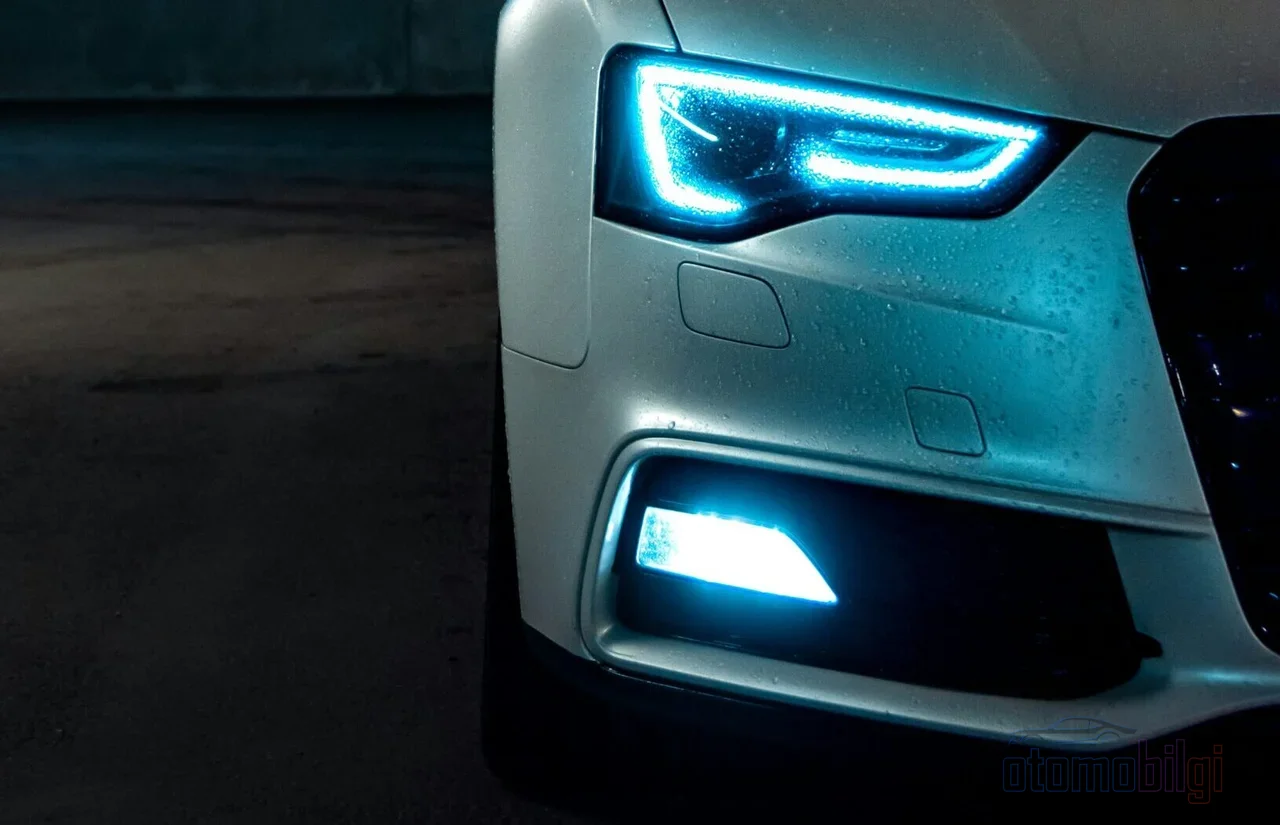
Now let's get to the truly crazy part. In Audi's Digital Matrix LED headlight, a chip called DMD (Digital Micromirror Device) controls approximately 1.3 million micromirrors inside the headlight. Each tiny mirror directs light individually, just like in a projector; the light pattern is shaped in real time. The result: keeping more usable light on the road without sending glare to oncoming traffic.
But is this resolution only good for illumination? No - it also serves communication. Audi's indicator light detects a pedestrian at the roadside in the dark and projects a marker onto the ground in front of the vehicle; the driver easily notices the pedestrian. When working with the lane tracking system, the headlight can draw a lane line on the road and display an arrow symbol if the vehicle unintentionally drifts out of its lane. DS's Matrix LED Vision system also offers Dynamic Light Projection, capable of projecting symbols such as an arrow, a warning, or a crosswalk onto the road. NIO, meanwhile, is developing headlights on some of its vehicles that project messages, symbols, and graphics onto nearby surfaces, for both safety and public interaction. Texas Instruments also officially confirms that its automotive DLP/DMD products are used for symbol projection, driver communication, welcome scenarios, and branding.
This idea is taken so seriously that Carnegie Mellon University demonstrated a programmable headlight called "Smart Headlights" back in 2014: it detected and tracked oncoming drivers and dimmed only the small relevant portions of the beam. The official picture of the future has already been drawn: autonomous vehicles are expected to use their front lights to send messages to other road users like "I'm slowing down," "I'm stopping," or "I'm ready to move."
Welcome and Farewell Lights: Your Car Says Hello to You
That scene where the headlights flash in sequence when you unlock the car is more than an aesthetic show: it speaks to the car's character. Thanks to LED's precision, adaptability, and energy efficiency, animated opening/closing scenes, sweeping signals, and F1-style sequences have become nearly standard in the industry. Mercedes-Benz's DIGITAL LIGHT system in the C-Class is one of the systems offering LED animation and welcome animation.
BMW takes this a step further: Welcome Light Animation, offered via ConnectedDrive, allows the car to say hello or goodbye with its exterior lighting during locking/unlocking, and offers three different effects: Adagio, Vivace, and Allegro. In other words, the choice is yours: a slow-motion greeting or a fast and energetic welcome? The BMW Iconic Glow package combines sound and light sequences with Relaxed, Balanced, and Excited styles. On the luxury side, there is the Bentley Batur : with its cut-crystal effect, it produces welcome animations that give the road a light-refracting-crystal impression. Meanwhile, electric vehicles also use the DRL or front light bar to show charging progress - light is now part of the language the car speaks.
The Regulation Factor: Why Do the US and Europe Look Different?
So why doesn't every car speak the same light language? The answer lies in the rulebooks. In the US, rear turn signals can be red or amber; moreover, the same light element is allowed to function as both a brake light and a turn signal. In Europe, signals must be separate and amber in color; EU versions also feature a rear fog light. That's why the rear of the same model can look completely different in the two markets - those fluid, amber-colored flowing signal strips in Europe are not legal in US versions, so manufacturers are forced to produce different versions.
The story up front is also interesting: with updated lighting regulations, the US finally allowed the adaptive matrix headlights Europe has been using for years. In other words, design freedom is a product not only of engineering but of bureaucracy as well. One market's rules directly shape a car's face at night.
The Future of Light: Will Every Headlight Become a Screen?
The market is heading in this direction too: the global automotive LED market is expected to grow from $26.11 billion to $42.66 billion. As MicroLEDs shrink small enough to be used thousands of times per headlight, a future is being drawn around headlights turning into high-resolution projectors. The vehicle will both see and communicate with its light: it will tell a pedestrian that it's safe to cross, draw its lane, and whisper its brand into the night. My prediction is this: in the coming years, how many "pixels" a headlight has will become a spec talked about as much as engine power. So which brand's light signature do you like the most?
Sources
- OEMs leverage new front lighting technologies to boost brand identity | CWIEME Berlin
- Adaptive Lighting with Digital Matrix LED headlights arrive | Audi MediaCenter
- The DMD-Technology of the digital Matrix LED headlights | Audi
- How Audi's light digitization is pointing the way toward the future | Audi
- Exterior lighting & projection DMDs | Texas Instruments
- Carnegie Mellon's Smart Headlights Spare the Eyes of Oncoming Drivers | CMU
- Welcome Light Animation | BMW USA
- Designer Genes: How Regulations Dictate the Look of New Cars | Car and Driver
- U.S. Vs European Tail Lights: Importer Checklist | Loyolight
- Illuminating the future: The role of animated LED automotive lighting | Infineon Community
- Automotive LED Lights Market | Fortune Business Insights