How Is the Beam Pattern ECE Homologation Test Performed?
If the headlights of an oncoming car aren't blinding you at night, it's most likely because of that invisible map engineers stared at on a wall in a lab years ago. Yes, we mean the homologation tests of the light pattern your headlight projects onto the road - the beam pattern - an engineering ritual no one ever sees but that saves lives every night. So how exactly is a headlight measured in a laboratory, why is that sharp cutoff line taken so seriously, and why might a headlight fail to get approval? If you're ready, let's step behind the curtain.
What Is a Beam Pattern, and Why Aren't Lumens Enough?
When buying headlights, the first number we all look at is lumens, right? But that's not really how it works. Lumens measure the total light a lamp emits in all directions; what actually illuminates the road, however, is the intensity in a single direction, measured in candela. Reach distance depends entirely on this, because illumination at the target decreases with the square of the distance: according to the formula E = I/d², doubling your reach requires four times the intensity. In other words, a bulb that is twice as "bright" doesn't see twice as far as you'd think.
The beam pattern is the photometric map of this intensity measured per direction, and it's defined by four things: the shape of light spread, width of illumination, reach distance, and intensity density. Two headlights with the same lumen value can produce completely different patterns on the road - the reason is usually geometry: where the light is emitted relative to the reflector's or projector's focal zone. What do you think happens if the lamp shifts by 0.2 mm? The angular error is roughly the source position error divided by the focal length; with a 25 mm focal length, that equals about 0.46 degrees, which means a pattern shift of roughly 20 centimeters on a 25-meter test screen. This is a world where the millimeter decides fate.
Highlights
- In ECE, the low beam test is performed at a distance of 25 meters; FMVSS uses 30.5 meters (100 ft).
- At the B50L point representing the oncoming driver's eyes, intensity must remain below 0.4 lux.
- The intensity of a single high beam cannot exceed 215,000 cd, and the combined total of high beams switched on together cannot exceed 430,000 cd.
- In a typical passenger car, the initial headlight tilt is in the 1.0-1.5% range, and the manufacturer must label it with 0.1% precision.
- In February 2022, NHTSA opened FMVSS 108 to adaptive driving beam certification.
What Is Measured on the Photometric Test Wall?
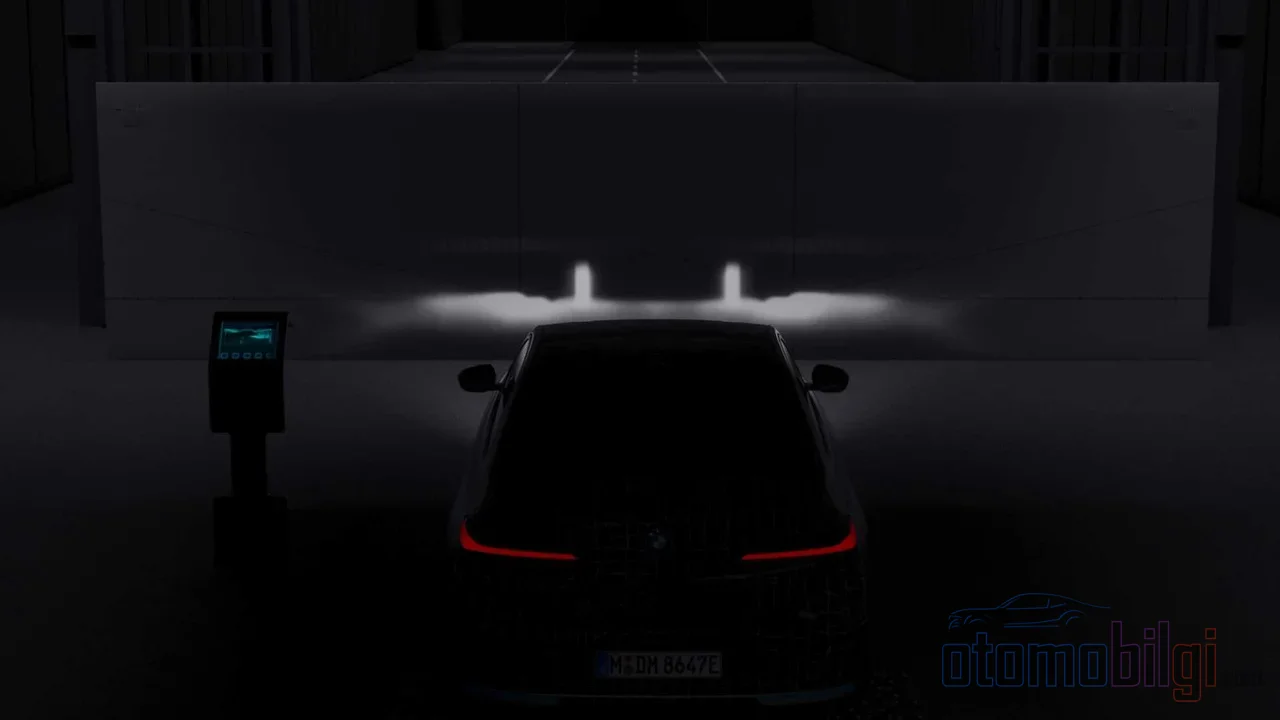
Now let's get to the heart of the matter: the laboratory. In the ECE world, meaning UN regulations, the low beam test is performed at a distance of 25 meters. The headlight projects its light onto the wall in front of it - or more precisely, onto the photometric measurement plane - and engineers measure the intensity values of the defined points on the screen one by one.
The standard ECE diagram has eight main test points: B50L, 25R, 25L, 50R, 50L, 50V, 75R, and 75L. Don't let it confuse you, the logic is quite elegant: the horizontal H line and the 15-degree inclined line form a clear horizon line on the screen; the V axis is the vehicle's centerline. The points above the cut-off line - such as B50L - carry maximum values to protect oncoming drivers; those below - like 75R and 50V - carry minimum values to illuminate the road. So a headlight can fail both for scattering too much light and for illuminating too little.
What the test points mean
- B50L: the eye position of an oncoming driver at a distance of 50 meters; at the 25-meter test distance it must stay below 0.4 lux.
- 50V: the central illumination 50 meters ahead; it must have the highest lux value.
- 25R / 25L: Measures the near-edge spread.
- 75R / 75L: Measures the road shoulders at 75 meters.
High beam has no cut-off line; the job falls to limits instead. The maximum intensity of a single high beam cannot exceed 215,000 cd, and each lamp carries a reference mark found by dividing its maximum by 4,300. The total of all high beams that can be switched on together is limited to 430,000 cd - with a reference value of 100. UN R149, which entered into force on November 15, 2019, consolidated the previously scattered provisions of R19, R98, R112, R113, R119 and R123 under a single roof, and mandated that a headlight must continue to meet passing-beam requirements even if an LED module fails. The standard chart for right-hand traffic is the mirrored version of the left-hand one - Australia's ADR standard is also based on this LHT logic.
Sharp Cut-Off Line: Safety Defined by Millimeters
What exactly is that famous cut-off line? That line where the light is abruptly cut in the passing beam - the one you notice even when looking at a wall. In approved low beams there are two accepted cut-off shapes: the asymmetric "Z" cut with an elbow, rising toward the curb side with a ramp of roughly 15 degrees, and the flat cut with a single sharp horizontal line across the entire width. Both can pass inspection; the criteria are the cut-off height and the absence of light above it on the oncoming side.
So why is this line so critical? Because a sharp cut-off makes aim error visible. In a headlight with LED or bi-xenon projectors, aiming 1 centimeter too high on the wall means light falling into the eyes of an oncoming driver 50 meters ahead. In fact, UN ECE R48 requires that each vehicle's initial low beam tilt be set by the manufacturer with 0.1% precision and labeled on the vehicle; in a typical passenger car this value is in the 1.0-1.5% band, rising to 1.5-2.0 for headlights mounted close to the roof. The "1% rule" is not a universal law - what should be taken as the basis is that value the manufacturer has labeled.
One small warning here: a wall photo is not a complete photometric test. Camera exposure can make a weak pattern look bright or hide the glare above the cut-off; a photo does not give intensity values at defined angular positions. It is a useful screening tool for catching problems like a tilted bulb, a broken cut-off, or a large left-right difference - that's all.
What Is the Difference Between ECE and FMVSS 108?
If you hop continents, the rules change too. In the US, FMVSS 108 (49 CFR 571.108) operates under NHTSA administration and a manufacturer self-certification regime - that is, a different world from Europe's independent type-approval logic. FMVSS photometry likewise sets minimum/maximum candela requirements at test points at angular positions around the H-V axis; the NHTSA laboratory procedure tests replaceable-bulb headlamps at a distance of 30.5 meters, i.e. 100 feet, at 12.8 volts.
The two systems also differ in their approach: E-MARK certified lamps meet stricter requirements in terms of test distance and brightness than FMVSS. On the other hand, the SAE/DOT side demands additional test points that ECE does not want (wider points such as 12, 13, 14, 15) and requires a broad light beam. The points roughly match up as follows: the 50V point corresponds to 7, the 50L point to 8, the 25L point to 10, the 25R point to 11, and B50L corresponds to line 4.
This self-certification regime came at a price: the entry of advanced adaptive headlamps into the US was delayed for years, and while American manufacturers sold matrix headlamps in Europe, they could not offer adaptive lighting in their own market. NHTSA's February 2022 ADB amendment was a step toward closing this gap; the new regulations also aim to increase compatibility with ECE R48 - but ECE is still stricter in the in-photo requirements comparison.
How Do Matrix and Laser Headlamps Get Approved?
Static tests were already complicated enough; now the pattern needs to be certified in motion. A matrix LED headlamp is an adaptive driving beam (ADB) system with individually addressable and controllable LED arrays: it detects oncoming traffic, dims that zone while illuminating the rest. On the ECE side, adaptive tests include the entire set of traditional static headlamp tests plus a dynamic test specific to ADB - measurements are taken while the headlamp, stimulus vehicle and beam pattern are in motion.
In the US, NHTSA, with its final rule published in February 2022, opened FMVSS 108 to the certification of ADB headlamps, and FMVSS 108 evaluates ADB performance under dynamic rather than static conditions. Rivian's adaptive matrix headlamps became the first example activated by a manufacturer in the US through this route. As for laser headlamps: The FDA approved in 2015 a weaker version of the laser headlamp than the European version - really a small summary of the technology gap between the two markets. There is also a rule: in a vehicle compliant with R48, working lamps without type approval cannot be used in place of high beams; the main headlamps must be type-approved, and when the driver switches to low beam, the high beams must all go out together.
Why Might a Headlamp Fail to Get Approved?
That's the most crucial question, isn't it? In the LED retrofit world, the common problems are clear: housing incompatibility, incorrect bulb orientation, incorrect focus alignment, and use in reflectors or projectors not designed for LEDs. The NHTSA laboratory report has concretely shown that the LED array of LED bulbs sold for H11 halogen headlamps does not fit within the 1.4-millimeter filament tolerance box - meaning that when you install an LED into a socket designed to halogen geometry, the light source does not sit in the right place.
Other classic causes: incorrect chip positioning, excessive lumen output without beam control, light scattering too widely, leaving hotspots, dark zones, or glaring into oncoming drivers' eyes. Diagnosis is also an engineering task: if total lumens are high but the hotspot is weak, the problem lies in the source geometry; if the hotspot is good but there is too much light above the cutoff, the issue is in spread, position, rotation, or aim; output that works well in the cold but drops when hot points to cooling or driver thermal protection; if it changes significantly upon reinstallation, base tolerance and locking play are suspect. And the painful truth: increasing power does not solve a geometry problem - it grows both useful and unwanted light together.
The Impact of These Tests on Nighttime Safety
So what is all this effort for? IIHS evaluations represent headlamp patterns with isolux maps using values such as 1, 3, 5, 10, and 20 lux applied to a typical road, and in this evaluation, the low-beam and high-beam curve-vision components were found to be associated with the largest reduction in crash rates. NHTSA research on how much the lighting of oncoming and following vehicles reduces the visibility of potential hazards also shows that glare is a real performance problem. According to widespread driving data, visibility is roughly 250 feet on low beam and 350-500 feet on high beam - you should adjust your stopping distance accordingly.
In short, let's wrap up the answer: the headlamp light pattern is tested in ECE homologation by measuring it at eight defined test points on the photometric plane at 25 meters from the headlamp; above-cutoff points carry maximum values for the oncoming driver, below-cutoff points carry minimum values for road illumination, and cutoff line and tilt tolerances are additionally audited. The dynamic version of the same logic also certifies matrix and ADB headlamps.
Next time an oncoming vehicle does not dazzle you on a night journey, know that behind it there is a wall no one sees, a tolerance of a few millimeters, and a great many lux measurements. A headlamp is safe because it can be measured.
Sources
- UN Regulation No. 149
- FMVSS 108 ADB Final Rule - Federal Register, February 22, 2022
- IIHS Headlight Test and Rating Rationale
- IIHS Headlight Ratings and Nighttime Crash Rates (Brumbelow, 2022)
- NHTSA 811043 - Nighttime Glare and Driving Performance
- LED Headlight Beam Pattern Testing - Pulsys
- Test Strategies for Adaptive Beam Headlights - Intertek
- E-MARK and DOT Photometric Requirement Differences
- How to Aim Headlights - Eleron
- Beam Pattern in Vehicle Lighting Explained