Why Is the Light Line on the Body So Sharp?
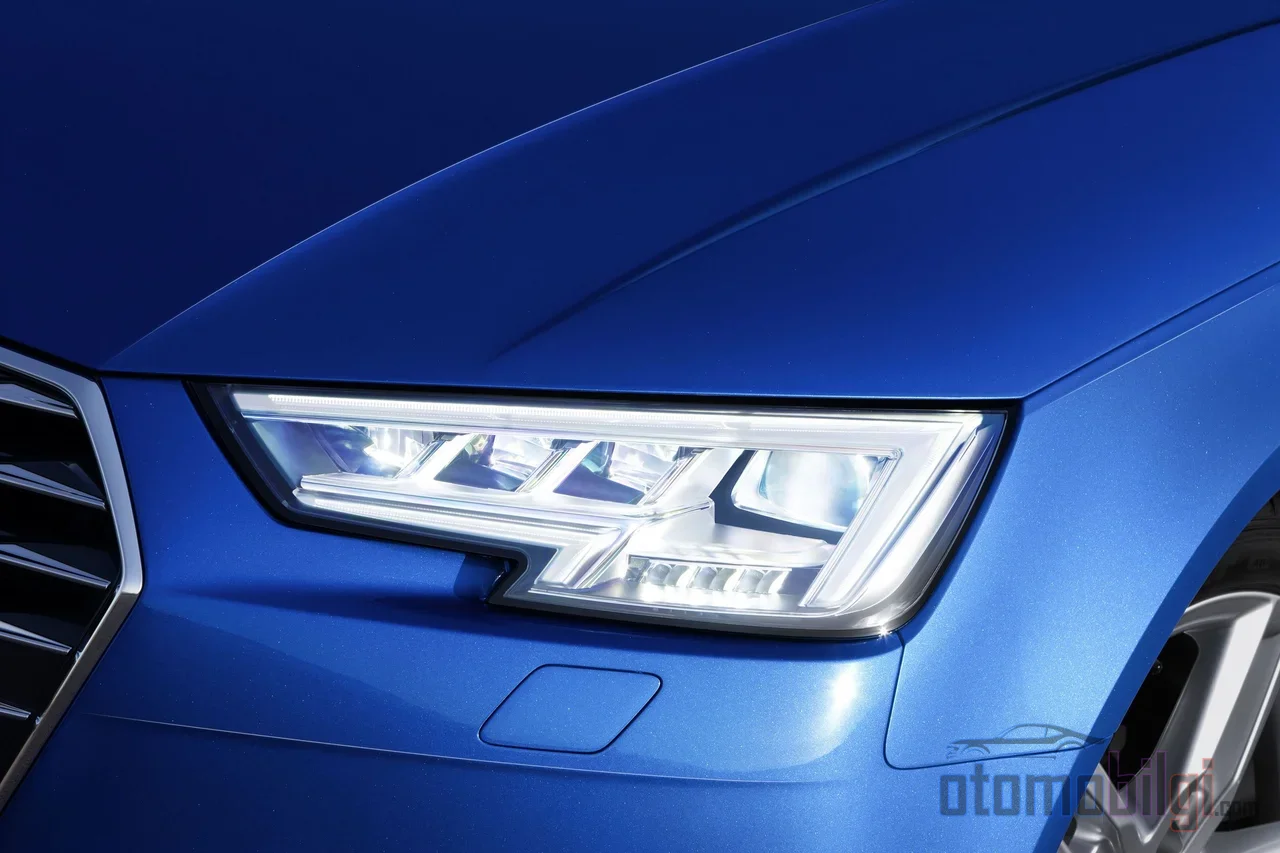
Have you ever thought about how you might come nose to nose with a horn-honking truck while hugging the left side at night? What saved you at that very moment was that sharp boundary of light cast on the road ahead of you: the cutoff line. Pitch black above, bright below - as if someone had cut a line into the light with scissors. So what are the physical and legal reasons why headlight beams have such a sharp boundary on the road? You will see that this thin line - and as I said, it really is a thin line - is a story where engineering and regulation intersect. The answer to why the headlight cutoff line is so sharp is far more fun than you would expect.
What Exactly Is the Cutoff Line and Why Does It Exist?
The cutoff line is the visible upper boundary separating the area illuminated by the low beam (that is, the low headlight) from the dark zone above it. You can see it most easily at night, by looking at a wall or the headlight alignment screen: that line where the light suddenly ends as it goes upward. The high beam has no such strict boundary; it lets its light roam freely all the way to the sky, because that is precisely its job.
This line's job is not simply to be seen. It has several critical duties:
- Controlling the glare for oncoming drivers - that is, not blinding people on the road.
- Preserving the range of the low beam; not wasting light by throwing it upward.
- Providing a reference for vertical headlight adjustment; it is the most practical measurement tool in a mechanic's hands.
- Revealing assembly errors and wrong-type bulbs instantly.
In other words, that line is like the ID card of a low beam. You look at the line and tell what the headlight is doing. But the real question is this: what physically produces that sharp boundary?
How Is the Cutoff Line Formed in Projector Headlights? The Dance of the Shield and the Lens
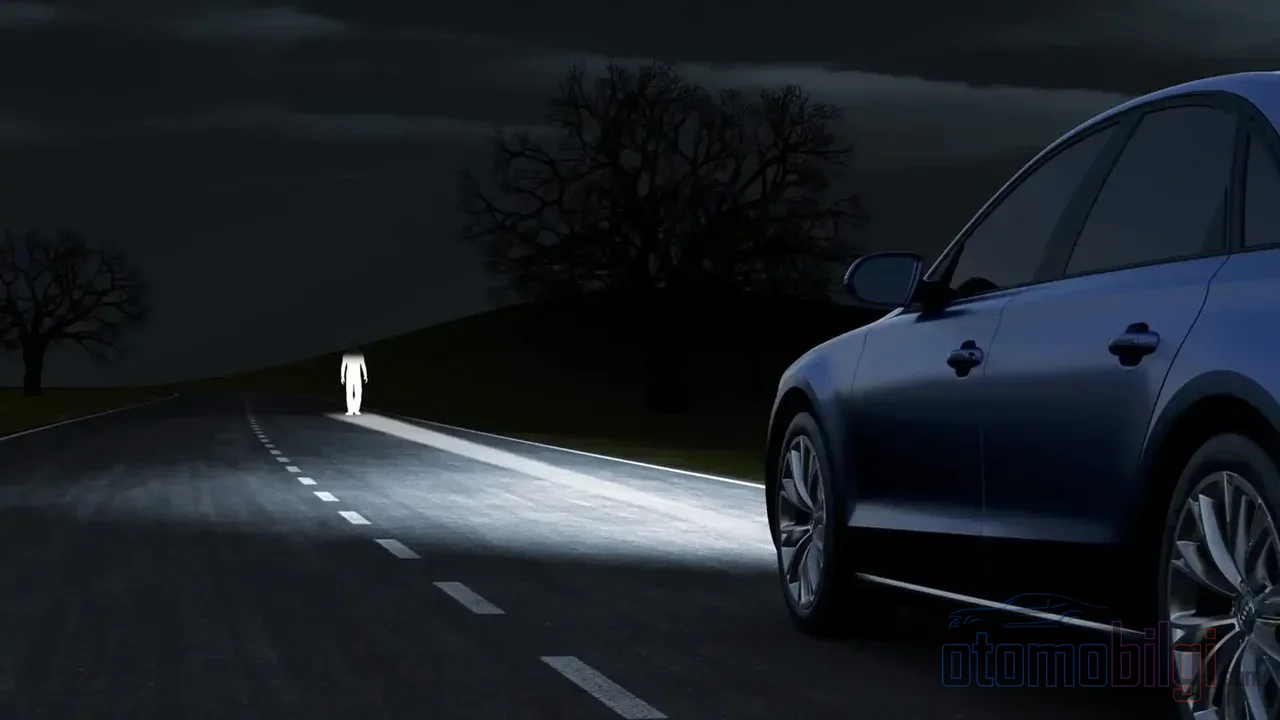
A projector headlight is actually the cooperation of three parts: the reflector bowl, the cutoff shield, and the lens. The light emitted from the light source first strikes and is gathered by the bowl, then reaches a metal shield positioned exactly at the lens's focal point. Here is the entire secret: that tiny metal shield physically cuts off the part of the light that would go upward. The lens then projects the remaining pattern onto the road. So the cutoff line is not a trick of the lens - it is the shadow of a metal plate's silhouette falling on the road. That is why it appears so sharp on the wall: a shadow is sharper than light.
Think of it this way: place a piece of cardboard in front of a flashlight and look at the wall. You will see the cardboard's sharp silhouette on the wall. The cutoff shield in a projector does exactly this; only with millimeter precision and engineering calculation. It is no coincidence that projectors deliver a more focused beam and a cleaner cutoff line - it is by design. Control of upward light is defined in a projector, while in a reflector it is more diffuse. The fact that xenon headlights can only be used with projectors is explained by the same logic: such a bright source in an uncontrolled beam would truly glare terribly at oncoming traffic.
How Is the Light Pattern Shaped in Reflectors?
So what happens if not everyone has projectors in their car? In reflector-type headlights, the cutoff is not the job of a single shield. The light pattern; it is formed by each of the multi-segmented reflector surfaces focusing in a different direction, combined with the patterns on the lens and the precise positioning of the inner shield relative to the light source. So the cutoff line is there too, but it is the collective work of thousands of tiny mirrors - not a single template.
It's nice to know that some modern reflector lamps can produce a very clean cutoff even without a projector. Still, the general balance works like this: a projector gives more homogeneous and focused light; a reflector spreads wider but can show dark spots and a more diffuse upper boundary. Sensitivity to the bulb type you use in a reflector is also higher. This is the main stage of the LED conversion disaster I will touch on shortly.
Left-Right Asymmetry: Why Is That Step There?
If you've looked at a wall at night, you've noticed the cutoff is not flat: one side is horizontal, the other side rises upward. In common parlance it's called the step, kick-up, or Z pattern; in official documents, this break point is called the Elbow. The reason for this asymmetry is very human: while the rising part gives extra light to the roadside - to signs, shoulders, sidewalks - the side where oncoming traffic comes from is deliberately kept low. You read the sign while simultaneously leaving the driver facing you comfortable. Clever, isn't it?
But there is a trap here: the rising part must face away from the oncoming driver. If you install a lamp designed for the wrong side of the road, that rising beam hits the oncoming driver like a flash descending from the sky. In the ECE cutoff used in Europe, the left side is horizontal and the right side rises toward the right; in the DOT approach used in the US, the cutoff arrangement is resolved differently, and US systems can use the horizontal cutoff for vertical adjustment as well. So both systems want a sharp, asymmetric cutoff; they just solve the geometry from a different place. And don't skip this important detail: the DOT/ECE label is not a quality grade. It does not count as an indicator of sharpness or brightness.
The Legal Side: Why Isn't This Line Random?
Where that line starts and ends is governed by almost millimeter-level rules. On the European side, the rule-maker is UN Regulation No. 149, which consolidates the older R112, R98, R113 and R123 regulations under a single roof: it defines the cut-off characteristics of the passing beam, the light distribution zones, the test points, and the glare limits. The installation side is governed by UN Regulation No. 48: the initial downward tilt, leveling systems, and load-related changes are the subject of this regulation. In the US, we encounter FMVSS No. 108; it covers photometry, glare limits, and VOL/VOR aiming marks. Alongside it come inspection, aiming equipment, and measurement standards such as SAE J599, J600/J602, J1383, and ISO 10604.
Highlights
- The cutoff line is the silhouette cast on the road by a metal shield located at the focal point of a projector's lens.
- The rising part of the asymmetric cutoff illuminates the roadside; the oncoming traffic side is intentionally kept low.
- A 1.0% downward slope means a drop of 1 cm per meter; 10 cm over 10 meters.
- Xenon produces about 3,000 lumens while halogen delivers around 1,400 lumens.
- Matrix LED headlights reshape the cutoff line digitally, pixel by pixel.
Let's see just how serious the geometry is with an example: A 1.0% downward slope means a drop of 1 cm per meter - in other words, the light descends 10 cm at a distance of 10 meters. Now load three friends in the back seat and a camping backpack in the trunk: the rear suspension compresses, the front rises, and the cutoff line jumps up along with it. That's exactly why automatic levelling systems exist; they detect the load change and lock the line back into place.
Why Is Cutoff Quality Different in Halogen, Xenon and LED?
Here's the really fun part, because the quality of the cutoff line is tied to the size and position of the light source. The heart of a halogen bulb is the fine filament inside it. The reflector is shaped to match that filament's exact size and exact position. Everything is calculated according to a tiny point of light expected at the focal point.
With LED, the game changes. In an LED bulb, the light comes not from a single filament but from several separate chips. If those chips don't sit exactly at the halogen filament's focal position, the optical system gets confused: the cutoff becomes blurry, bright patches appear (irregularities spilling beyond the hotspot), dark zones form, and worst of all, extra light starts leaking above the glare limit. The closer the arrangement of LED chips is to the halogen filament, the more accurately the optics work - the rule is that simple and that unforgiving.
| Technology | Approximate brightness | Cutoff line behavior |
|---|---|---|
| Halogen | ~1,400 lumens | Designed around the filament; predictable in its optics |
| Xenon (HID) | ~3,000 lumens | Can only be used with a projector; a shield is mandatory |
| LED (with proper optics) | Brighter than halogen, generally not brighter than xenon | Sharp if the chips are at the focal point, blurry and leaky if not |
| Matrix LED | Pixel-by-pixel control | The cutoff is redrawn digitally |
The efficiency side is also striking: LEDs can operate 1.5-5 times more efficiently than HID and about 4-5 times more efficiently than halogen, and their lifespan is 15-30 times longer. So the real issue isn't a brightness contest; it's keeping the brightness in the right place, below the right limit. That's why photos showing a huge, extremely bright light spot on a wall have no evidentiary value whatsoever: a wall photo cannot prove long-range lux values, corner visibility, or compliance across all photometric points.
Matrix and ADB: The Cutoff Line Is Now a Digital Shaping Problem
In classic headlights, the cutoff line is fixed: the shield stays in place, and the pattern remains as it is. When it comes to Matrix LED headlights, the game changes entirely, because the headlight is no longer a single light source; it works like a screen made up of tens, even hundreds, of independently addressable LED pixels. The logic of Adaptive Driving Beam (ADB) is this: high beam illumination is maintained without interruption, but the specific areas that could dazzle an oncoming vehicle or the vehicle ahead are dimmed pixel by pixel.
Manufacturers' solutions resemble one another, but each has a different touch: Audi's Digital Matrix LED system dims the LEDs one by one with a flowing band as the oncoming vehicle's angle changes, and this adaptive headlight technology will enter the US market with the Audi Q9 coming in 2027. Nissan's Adaptive LED Headlight system keeps illuminating the area around the vehicle ahead with high beam while switching off only the area directly in front of that vehicle. Honda's ADB implementation, on the other hand, divides the beam into upper and lower sections and automatically controls the illumination area by detecting vehicles ahead and oncoming. The common philosophy can be summarized in one sentence: maximize visibility and don't leak a single lumen of unnecessary light into oncoming traffic.
So in the classic era engineers made the cutoff with a metal shade; now software redraws the cutoff on a pixel map every second. When the oncoming vehicle passes by, the dimmed region opens up again and the high beam returns to its original state. The cutoff line is no longer even a line - it's a light map that changes in real time on the road.
A Sharp Cutoff Isn't Always a Feast: So Why Does the Cutoff Line Need to Be So Sharp?
Here is where the complete answer to the question we asked at the beginning comes together. The cutoff line is sharp because two demands must be met at the same time: below, on the road surface, to provide a long and useful range; above, to reduce to nearly zero the light that would go into the oncoming driver's eyes. In a projector, a physical shade resolves this duality; in a reflector, it's the sum of hundreds of focused surfaces; and in a matrix headlight, it's digital pixel control. The crispness of the line is a direct photograph of the quality of that control. A loose and scattered upper boundary is an announcement that light is escaping where it shouldn't.
But pay attention: a sharp cutoff alone is not a guarantee of a good headlight. A true cutoff line is a stable, visible, and orderly upper boundary - it can be flat, stepped, or asymmetric; it doesn't have to be knife-like. Also, the distance, width, and the correct position of the hotspot (the brightest region) below the cutoff are equally important. The picture changes in fog and rain too: because the projector reduces the light leaking above the cutoff, it offers a clearer view in fog, and in snow it reduces back-scatter; but you may experience a loss of detail at certain distances.
My favorite summary is this: that thin boundary is a courtesy line designed against the night's most likely accident scenario. On your next night drive, take another look at that stepped line reflected on a wall or a sign; you now know how much engineering, how many rules, and how much care go into it. Have you ever tried looking at headlight patterns on a wall? You'll see that once you start looking, you can't stop.
Sources
- Headlight Cutoff Line: Why Does It Matter? - LOYO Light
- Projector Headlamps Explained: Beam Pattern, Safety - XJEE Auto Parts
- Xenon vs. halogen headlights
- Xenon Vs. LED Headlights: What's the Difference?
- Adaptive Lighting with Digital Matrix LED - Audi MediaCenter
- Adaptive Driving Beam | Honda Technology
- Adaptive LED Headlight - Nissan Global
- Audi's Adaptive-Beam Headlight Tech - Car and Driver
- Beam patterns of headlights
- Shining a Light on Headlight Beam Patterns - The Audio Garage
- LED Headlight Bulb Beam Pattern - Sealight
- Headlight Beam Pattern: A Complete Guide to DOT vs. ECE