Lumens or Lux? The True Measure of Headlight Performance

Two headlight boxes are sitting in front of you. One says 20,000 lumens on the box, the other 5,400 lumens. Sounds like a no-brainer choice, right? Just take the round number and hit the road. But at midnight on a winding road, you might notice that while that "powerful" headlight can't light the way ahead, the light from its more modest neighbor spreads across the asphalt like a carpet. Because that most-talked-about, fascinating number in headlight selection is actually just a small part of the story. So what's the rest? In this article, I'll explain the difference between lumens and lux in real engineering terms, but in a way that speaks to you. If you're ready, let's begin.
What Is a Lumen, What Is a Lux? Let's Start with the Garden Hose Analogy
First, a quick look at the physics - don't worry, it won't feel like a lecture. Lumen (lm) is the unit of measurement for the total visible light a light source emits in all directions. In other words, the source's "total generosity". Lux (lx), on the other hand, is the amount of light that actually falls on a surface; 1 lux means 1 lumen falling on 1 square meter. The analogy that makes the difference clearest is this: lumens are the total water coming out of the garden hose; lux is the portion of that water that reaches the flower pot. If tons of water flow from the hose but the nozzle is loose and splashing everywhere, nothing reaches the pot.
Then there's the matter of distance. Light follows the inverse square law: if the distance from the source doubles, the light intensity on the surface drops to one quarter. That's why a headlight might dazzle a wall 3 meters away but appear feeble 25 meters away. So never read a lux value on its own; always consider the distance at which it was measured, for example 7,500 lx @ 10 m. The concept of candela (cd) can also be added to the mix: it measures the intensity of light in a single direction, and at the same distance, a higher candela generally means higher lux at the target point.
Key Takeaways
- Lumens measure a source's total light, while lux measures the light that reaches the road; lux and beam pattern are what determine the decision
- Two bulbs producing the same 5,400 lumens can give completely different results inside the same headlight, such as 902 lx versus 397 lx
- In ECE homologation tests, points above the cutoff line are checked against maximum, and those below against minimum, lux thresholds
- The huge lumen figures on the market are mostly theoretical calculations that ignore optical losses
- A headlight may look bright at 3 meters but weak at 25 meters: lux is always given along with the test distance
Why Does the Same Lumen Count Give Completely Different Results on the Road?
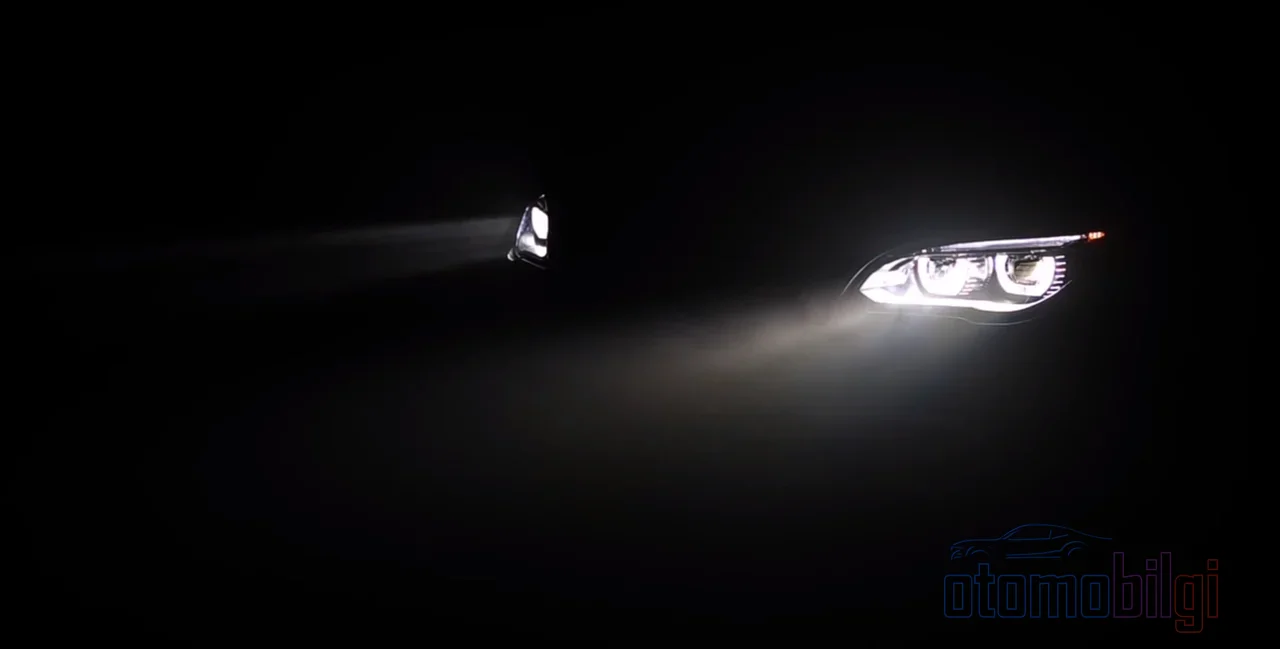
This is where the most crucial part of the matter lies. Lux alone is not the result of the bulb, but of the entire headlight system. The same LED bulb, fitted into two different headlight housings, can produce completely different lux values. The reasons come down to three headings: the total lumens the bulb produces, the distance to the point where the light is measured, and how narrowly or broadly focused the light beam is. A narrow, well-focused beam delivers high lux; a wide, scattered beam delivers low lux.
A concrete example would probably be more convincing. In a comparative test conducted within the same headlight lens and at the same test distance, of two bulbs both producing 45 W and 5,400 lumens, one read 902 lx at the near point while the other stayed at 397 lx; at the far point the difference was 79 lx versus 47 lx. In other words, the figures on the box were the same, but the bulb with the better optical design gathered visibly more light on the road. The lesson here is clear: when the numbers are equal, the optics make the difference.
The Role of Projector and Reflector Architecture
That optical difference also comes largely from the headlight's architecture. Projector headlights arrange the light on the road in a controlled and focused manner with a lens and a cutoff shield; the cutoff line is formed by that shield and lens together. In reflector headlights, the reflective bowl directs the light onto the road, and the cutoff line takes shape through the bowl's own form. Both can be good, but they do not deliver the same result with the same bulb. In the LED world there is one more critical detail: the LED chip must sit in exactly the same position as the original halogen filament. A 1:1 size match provides a sharp cutoff line; if the chip sits in the wrong place, the light scatters, visibility drops, and oncoming drivers are dazzled. There is also the matter of heat: LED chips that cannot be cooled adequately darken quickly and drag the lux value to the bottom. In other words, high wattage does not automatically mean high lux.
How Are Lumens and Lux Measured?
So how are these measurements done in the laboratory? For lumen measurement, a integrating sphere is used, a sphere with a reflective inner surface; the source is placed inside the sphere, and the light scattered in all directions is collected to calculate the total flux. Since these devices are usually found only in factories, it is easy for marketers to talk about lumens: put the bulb in the test chamber, write down the number.
Lux measurement, however, is a far more meticulous job: it is done with a calibrated lux meter, using a filtered sensor that mimics the spectral sensitivity of the human eye. For a proper test, the bulb is mounted in a fixed position, allowed to reach thermal stability, aimed at a test screen at a predetermined distance (typically 5, 10, or 25 meters), and readings are taken separately from the central hot spot and the surrounding points. There must be no other light in the environment, the voltage must be kept constant, and the distance must be recorded. Common mistakes are an added bonus: holding the meter at the wrong angle, reflections from white walls making the reading appear higher than it is, measuring before warm-up is complete, or looking only at the central lux while ignoring the beam pattern and glare. That is why measuring lux is difficult, but it is the only measurement that truly tells how much light falls on the road.
The Marketing Game: Why Is "20,000 Lumens" Usually a Balloon?
Now let's take a look behind the counter. Manufacturers have three sensible (by their own logic) reasons for highlighting lumens. The first, I just explained: measuring lumens is easy, measuring lux is hard. Second, big numbers sell; 20,000 lumens is impressive, while 40 lux @ 25 m is technical and "boring." Third, since lux depends on the entire headlight system, the manufacturer cannot give a single universal lux number valid for every housing; giving lumens is much more convenient.
The problem is that most of the huge figures on the market are theoretical calculations: the maximum value from the chip's datasheet is multiplied by the number of LEDs, completely ignoring lens and reflector losses, temperature, voltage and thermal equilibrium. These are called raw lumens; the usable light that actually reaches the road, i.e. effective lumens, is always lower. An extreme example: a 10,000-lumen bulb may deliver only 900 lux on the road while its 5,000-lumen rival can deliver 2,000 lux. Which one do you think is safer for night driving? I know the answer is the second one. From this you can draw a simple rule: approach lumen claims given without a lux value and measurement method with suspicion.
Lux in the World of Homologation: ECE and DOT Tests
Since the light that lands on the road is the real issue, the regulatory world measures exactly that. In the ECE system, the low beam pattern is checked against test points: the points on the cutoff line (to protect oncoming drivers) cannot exceed maximum lux values; the road points below the line cannot fall below certain minimum values. The current framework for LED lighting is the UNECE R149 regulation, which replaces the old R112, and the low beam pattern is evaluated by dividing it into four lighting zones.
On the American side, NHTSA's FMVSS No. 108 standard requires headlight intensity to be measured in the laboratory at photometric test points defined in polar coordinates. A striking detail: DOT approves only complete headlight assemblies (housing, lens, reflector and bulb together); it does not approve individual LED bulbs. That's why "DOT-approved LED bulb" labels are problematic at first glance. A historical note: a 2025 DOT study converted the 108 low beam test points into longitudinal, lateral and vertical positions on a flat road surface; in other words, the effort to relate laboratory coordinates to real-world road performance is still ongoing. NHTSA has also announced new rules that will reduce glare and update the test procedures. On the independent side, IIHS has been running a test protocol since 2016 that measures and rates the illumination headlights provide on the road, also taking excessive glare into account.
Multi-Point Measurement on the Road Surface
A nice example of a method from the world of independent testing is this: one test approach measures 8 key points out of the 23 points in the official regulation and, by converting the two-dimensional wall data into a three-dimensional road surface, transforms lux values into candela. The idea is very clever: instead of the brightness map on the wall, simulating the road the driver actually sees. The best headlight is the one that can balance these measurements: a pencil-like beam that shows impressive peak lux in the center but has weak lateral coverage will leave you alone in corners and at the roadside. Peak lux alone does not mean performance.
Halogen, Xenon and LED: Is a Lumen Comparison Enough?
Now let's look at the classic trio. Halogen headlights produce around 1,000-1,500 lumens at roughly 55 W of power. Xenon (HID) systems are typically around 3,000 lumens and offer more than twice the brightness compared to halogen. LED headlights, on the other hand, range from 3,000 to 6,000 lumens depending on the source and can be 1.5 to 5 times more efficient per watt than HID; for example, light efficiency (lm/W) is expressed with a calculation such as 3,300 lumens ÷ 30 W = 110 lm/W. However, this picture only tells you "how much water comes out of the hose"; how much reaches the pot is again told by lux. Even a halogen-LED pair with the same lumen value produces a completely different distribution on the road due to different housings, different chip positions and different beam architectures.
Stay Tuned for More Details with FAQs
- Does higher lumen mean longer range? No; range depends on beam design.
- Is higher lux always better? No; uncontrolled, excessive lux blindsens the oncoming driver. Brighter is not always better.
- Does an LED's lux remain constant throughout its life? It depends on heat dissipation; a chip that heats up yellows, and lux drops.
- If wattage increases, does lux increase? Not automatically; watts feed lumens, optics determine lux.
- Is there a universal "good lux" value? No; the value is always meaningful together with the test distance and method. (For comparison: 1 footcandle is approximately 10.76 lux.)
Conclusion: Which Number Should You Look at When Deciding?
Let's sum up, because I owe you the clear answer I promised. Lumen is the total luminous flux produced by the source; lux, together with the measurement distance and beam pattern, is the actual light intensity falling on a surface. The real measure of headlight performance is not lumens, but the beam distribution evaluated together with lux and candela; because two headlights producing the same lumens can cast completely different amounts of light onto the road. When shopping, don't look at the huge number on the box, but at lux values with a stated measurement distance, the beam pattern and the quality of the cutoff line. If a lumen claim is presented without lux, that number exists not for you, but for the sales chart. Next time when two boxes stand before you, you now know which one to choose.
Sources
- Lux vs. Lumens in LED Headlights: What Really Counts?
- Lux vs Lumens: What Matters More for LED Headlights?
- Lux vs Lumen in Automotive Lighting: Key Differences
- What's the Difference Between Lumen, Lux, and Candela?
- Headlight Test and Rating Protocol (IIHS)
- New Regulations Will Examine Headlight Glare (NHTSA)
- Comparing Projector vs. Reflector LED Headlights
- Xenon vs. Halogen Headlights