Why Aren't Headlights Icy White Anymore? The Color Temperature Debate
Share This Page
Headlight color is no longer ice-cold white, because the Kelvin value that measures whiteness is not an aesthetic choice; it is an engineering parameter directly connected to visibility distance, eye fatigue, the glare it creates for oncoming drivers, and fog-rain performance. The difference between the yellowish light of halogen and the cold white of LED is no coincidence; it is the joint result of physics and legislation.
Key Takeaways
- Halogen headlights typically operate in the 3000K-3500K range, while LED and xenon headlights usually operate in the 5000K-6000K range.
- In fog and rain, warm tones between 3000K-4300K produce less reflection and less glare.
- ECE regulations limit road-legal headlights to the 4300K-6000K range; tones above 6500K with bluish hues are banned in most places.
- Behind 6000K becoming the standard lies not only eye perception but also production cost optimization.
- Kelvin is not brightness: brightness is measured in lumens and is independent of color temperature.
What Does Kelvin Actually Mean? The Physics of Light Temperature
Let's first clear up a classic misconception: color temperature is not the temperature of the light. Its name comes from the way a heated metal first glows red, then turns yellow and whitens, but in automotive, the Kelvin value only expresses the color appearance of the light source. The scale extends from roughly 1000K to 12000K. Between 2700K-3500K is perceived as warm and yellowish, between 4000K-5000K as white close to daylight, and 6000K and above as bluish white.
In lighting engineering, these ranges even share a common language: below 3300K is classified as warm, 3300K-5300K as neutral, and above 5300K as cold light. Old sealed beam headlights had a tone of about 2700K, almost as warm as candlelight. Halogen bulbs sit in the 3000K-3500K band, while modern LEDs and HIDs mostly sit in the 5000K-6000K band. So the color difference between the two technologies is not an arbitrary choice by the manufacturer; it stems from the physical nature of each technology.
Now, here is a question for you: why do those ice-cold white headlights coming from the opposite direction hurt your eyes so much when driving at night? The answer lies entirely in this Kelvin game.
Why Do White Headlights Perform Poorly in Fog and Rain?
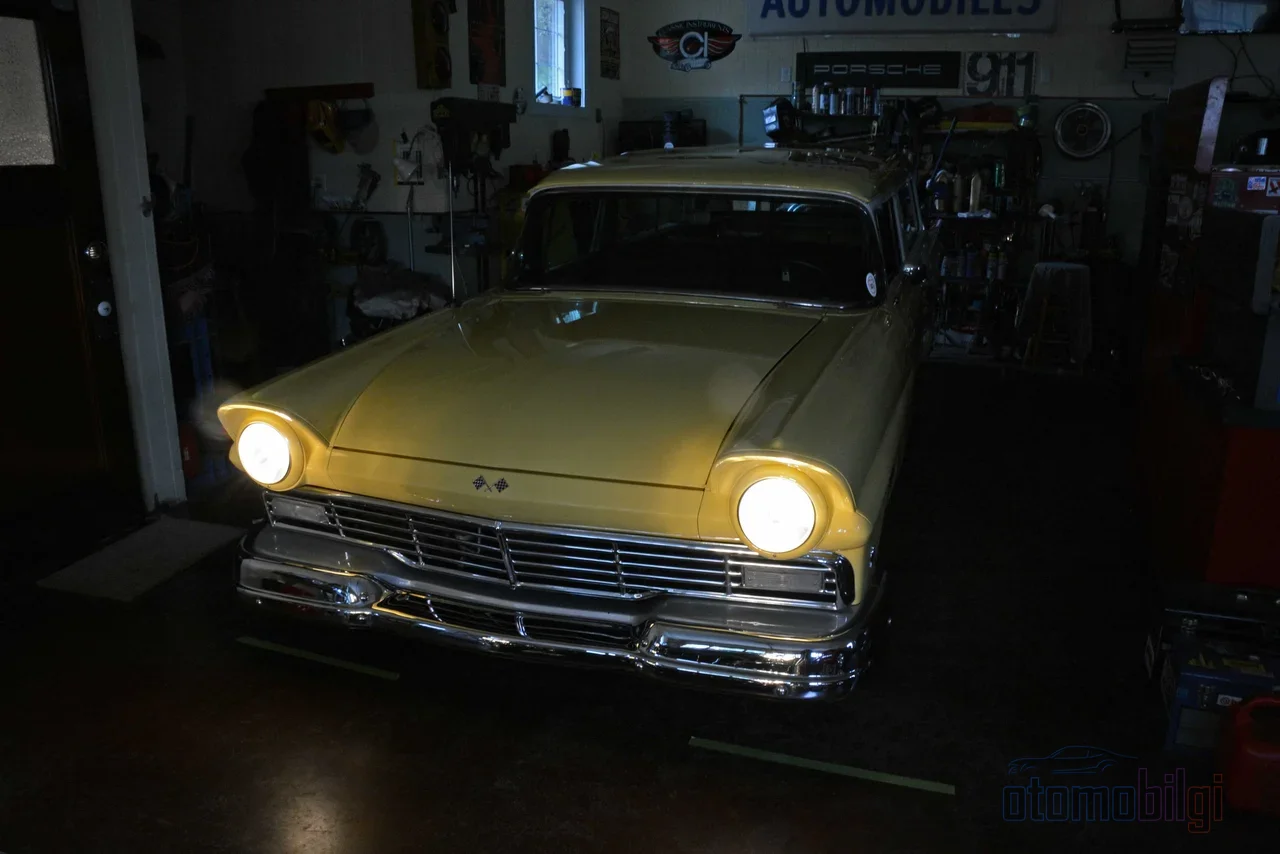
Behind the battle between white light and fog lies wavelength. Yellowish light has longer wavelengths and, when it encounters water droplets suspended in the air in conditions like rain, fog, and snow, it refracts and scatters less. At high Kelvin values, however, short wavelengths scatter more strongly; instead of going to the road, the light hits the droplets and spreads around. The result: the road is less illuminated, but a bright curtain appears in front of the headlight. That is why in fog lights, warm light between 3000K-4300K penetrates moisture better and reduces glare.
To be honest, squeezing the physics here into a single sentence would be cheating. Classic Rayleigh scattering scatters short wavelengths much more strongly in particles far smaller than the wavelength of light; but fog droplets are larger than the wavelength of light, and at that point things start to work differently. In other words, the scattering mechanism changes depending on which particle the light encounters. Yet field observation is common: warm tones cut through bad weather more cleanly.
Night Vision, Eye Fatigue, and the Glare Triangle
What about in the open air? That's when cool white light takes the stage. The range of 5000K–6000K provides daylight-like sharpness and long-distance vision; because it resembles daylight, it keeps the driver alert and reduces eye fatigue on long night drives. Warm tones, on the other hand, in the 3000K–4500K band, are more comfortable for night eyes. The preference varies with the conditions.
On the glare side, the picture is even more interesting. Color temperatures above 6000K can create disturbing glare for oncoming traffic, even causing momentary vision loss. The headlight beam aim is just as important as its color: aiming too low shortens detection distance, while aiming too high increases scattered light and the pain suffered by oncoming drivers. Also, light that shifts toward blue may appear brighter to the eye, but this perceived brightness is something different from the actual lumen output; since the Kelvin value is independent, a 3000K headlight can be just as bright as a 6000K one.
So What Does Science Say? The Visibility-Glare Dilemma
Here is the most critical point of the matter: a bluer color can, under some conditions, help see the road better and react faster, but it is more disturbing to look at. Visibility or glare? To solve this dilemma, aaafoundation is conducting joint studies with a light and health research center at Mount Sinai; two laboratory experiments and one field study have been planned. There is also a counter data point: a study published in 2024 found that the color temperature of LED lamps affected neither reaction time nor the degree of discomfort glare. In other words, the relationship between color temperature and glare is more complicated than it appears, and it is a research field that has not yet fully settled.
Halogen, Xenon, LED: Technologies and Light Outputs
To understand color temperature, we also need to look at how much light the technologies produce. Brightness is measured in lumens and is entirely independent of Kelvin. Here is a side-by-side comparison of the three main technologies:
| Technology | Typical Kelvin | Light Output | Efficiency |
|---|---|---|---|
| Halogen | 3000K–3500K | 1000–1500 lm | Lowest |
| Xenon (HID) | ~4300K white tones common | 3000–5000 lm | ~35% less energy than halogen |
| LED | Usually 5000K–6000K | 3000 lm+ | 1.5-5 times more efficient than HID |
Xenon and LED are 2-3 times brighter than halogen; LED headlights can run comparable HID systems with 25-30W, while a standard HID bulb draws 35W. One more interesting detail: In HID, the 3000K and 4300K white tones produce about 3000 lm, while the warmer 4300K tone can reach higher output in some applications, at ~3200 lm. But because the human eye perceives white light better, the numerical difference doesn't translate one-to-one into a perceptual difference.
Why Did 6000K Become the Standard? Eye Perception, or Cost?
The answer here is the kind that genuinely surprised me. The light the human eye perceives best in vehicle lighting is around 5800K; cool light is perceived as brighter and illuminates the road with a longer beam. So why do we see 6000K everywhere? The answer is partly engineering, partly economics: LED chips that produce 6000K are easier and cheaper to manufacture than chips that produce values like 5800K. Moreover, the difference between 6000K and 5800K is indistinguishable to the human eye. So the perception that white headlights are purely an aesthetic choice is being reversed: the cheap production of a value close to the eye's sweet spot has set the industry standard.
What Does the Legislation Say? Legal Kelvin Limits
Color temperature is not a free fashion domain; it is surrounded by strict regulations. ECE regulations limit road-legal vehicles to the 4300K–6000K range. On the US side, DOT allows up to 6500K but bans excessive blueness. The bulb's color is also subject to tolerance via chromaticity coordinates: the limit against blue is x ≥ 0.310, and the limit against yellow is x ≤ 0.500. So the color of the light is regulated not only by the Kelvin figure but also by its exact position in the color space.
- Bluish lights above 6500K are banned in most US states; For legal use, 4300K–5500K is recommended.
- California bans blue, green, red, and other colored headlight bulbs on the grounds that they do not produce sufficient light.
- Since there is no certified LED equivalent, aftermarket LED conversions are considered non-compliant in the US; HID products may be legal, but HID conversions are not.
- FMVSS 108 sets strict limits on light intensity and color temperature; but there is also criticism that the standard lags behind modern LED glare.
The practical balance range for everyday driving is around 4300K–5500K; 5000K–6000K is also a common recommendation. So both the eye and the law meet in the middle.
Will Headlight Color Change Dynamically in the Future?
The era of fixed Kelvin may be closing. AI-supported adaptive lighting and laser-based systems are emerging with dynamic temperature modulation that switches between warm and cool tones based on real-time environmental feedback. The logic is very sound: sharp cool white in open air, safer warm tones in fog and rain. The headlight is becoming a tool that changes its color according to conditions.
At the same time, complaints reaching eye health specialists about worsening night vision are increasing; LED glare and high-mounted headlights are among the leading causes of these complaints. So the question facing the industry is clear: whiter, or safer? Dynamic modulation seems to be the most promising answer to this dilemma. Which one do you think should come: always warm, or a smart transition?
Conclusion: The Right Kelvin Is Chosen According to Conditions
Headlight color is not a style detail, it is a safety component. If you want long-range vision in the open air, 5000K–6000K; if you want a clean cut-off in fog and rain, 3000K–4300K; and if eye comfort on a long night journey is your priority, warm tones are your card. The legal framework, meanwhile, draws a clear boundary for both sides within the 4300K–6000K band. And don't forget: when talking about what color your headlights are, you are talking kelvin; when talking about how much light they produce, you are talking lumens.
Sources
- The Ultimate Headlight Temperature Guide
- Effects of Vehicle Headlight Color on Glare and Safety
- Nighttime Glare and Driving Performance: Research Findings
- Why do most LED headlights have a colour temperature of 6000 K?
- Automotive Bul Regulations & Standards
- Chapter 21 – Vehicle Lights
- Color temperature
- Rayleigh scattering
- Effect of Correlated Color Temperature of LED Lamps
- DOT vs. ECE vs. SAE: Headlight Standards Explained
- Which is better: LED or xenon headlights?
- Best LED Headlights for Rain & Fog