Automatic Headlight Leveling Comes into Play When the Rear of the Car Is Loaded

Share This Page
Automatic headlight leveling is a system that automatically pulls the headlight beam down when the rear of the vehicle sags under load: a sensor on the rear axle measures the body's tilt, the control unit compares it with the target angle, and a stepper motor inside the headlight corrects the beam in far less than a second. In other words, when you load up the trunk and set off, the fact that your headlights point at the road instead of into oncoming drivers' eyes is not a coincidence - it's engineering.
Highlights
- Headlight leveling systems have been legally mandatory on new vehicles since 1993
- The target beam angle is usually 2-3 degrees below the horizon
- Nearly all vehicles with xenon headlights use dynamic leveling
- In dynamic systems, the correction is so fast that on a test screen it appears only as a brief flash
- For matrix and adaptive headlights, automatic leveling is required under regulations
How Does Automatic Headlight Leveling Work?
Its logic is actually based on a very simple question: Where is the vehicle pointing? When you put a heavy load in the trunk, the rear of the vehicle sags, the nose rises, and this causes the headlights to point upward too. For a driver sitting on a flat road, this means a wall of light shining directly into their eyes. The leveling system kicks in exactly at this point and pulls the beam back down to the road - that is, to the correct angle.
The system's lineup has four main players: the headlight itself, an actuator that physically moves the beam, height sensors on the front and rear axles, and a control unit that coordinates all of these. Supporting components such as the light switch and the speed sensor also appear in the diagram. The sensors run a continuous loop: measure, send the signal, compare it with the target value, and issue a command if necessary. This loop is repeated many times per second; so the system works not occasionally like a thermostat in an air conditioner, but almost without ever stopping.
The control module compares the pitch angle it measures with the target angle stored in its memory. This target is usually 2-3 degrees below the horizon line; because the headlights need to fall onto the road at a certain distance ahead, not into the oncoming lane. If there is a difference, the module sends a voltage command to the leveling motors in the headlights, and the motors rotate the reflector or the projection module.
How Does the Rear Axle Sensor Sense Body Sag?
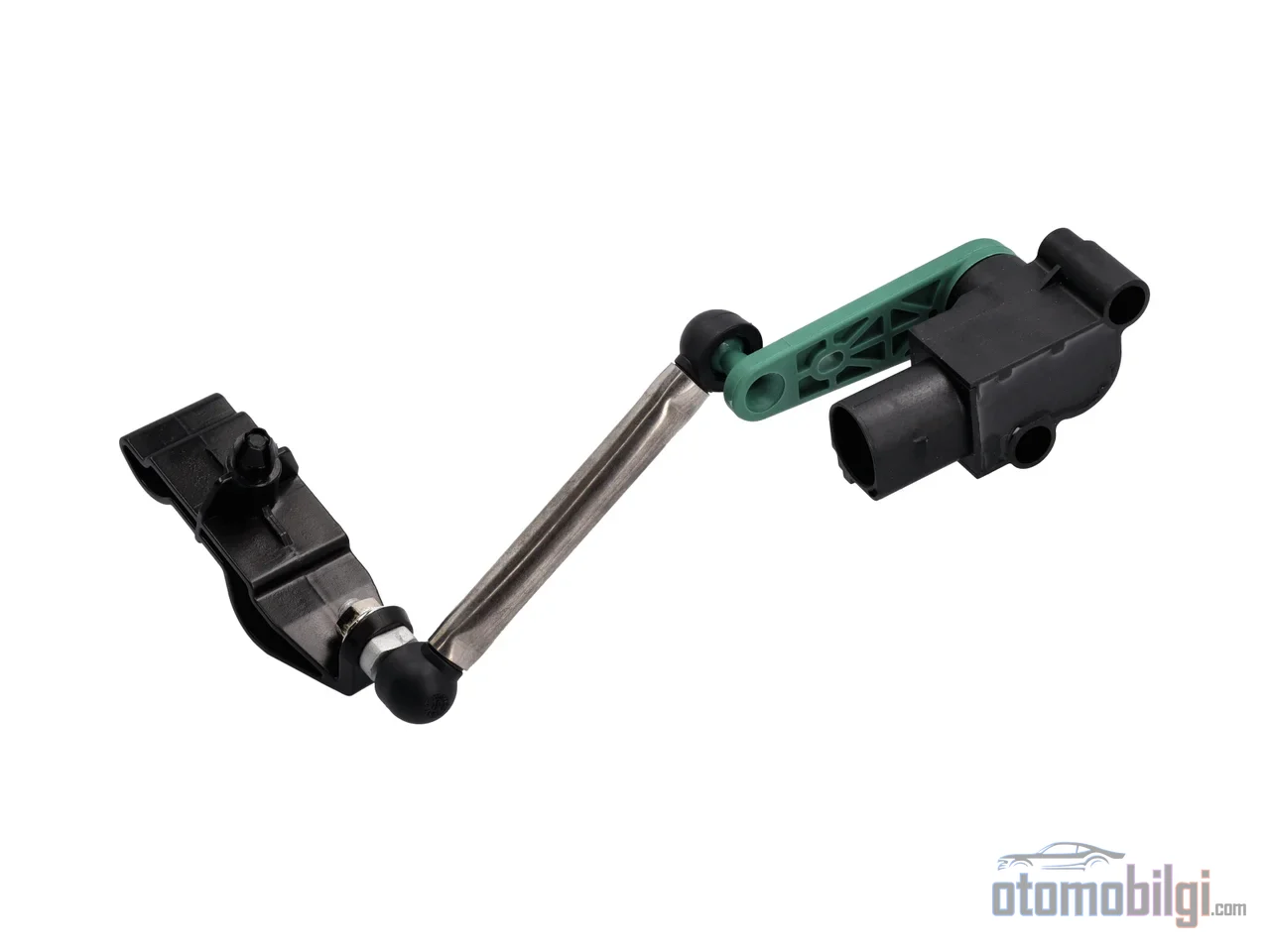
The most elegant part of the job, in my opinion, is the sensor side. The common solution is an inductive level sensor: a metallic rotor attached to the sensor arm affects the electromagnetic field generated by multiple coils on the circuit board. As the rotor's position changes, the field changes, and with a special chip (ASIC) interpreting this change, the sensor reads how much the suspension is compressed. The beauty of this sensor, which can output analog and PWM signals, is that it delivers high precision almost independently of temperature. In newer generations, the signal has been reduced to a compressed repetitive PWM format compressed by up to 75%; this way, a single sensor design can be used across different platforms.
There is an interesting shortcut in compact vehicles: on models with a short rear overhang, load changes are largely felt on the rear axle, so the front sensor can be dispensed with. In these vehicles, the sensor and control electronics are combined into a single unit, that is, a control unit integrated into the rear axle sensor (SIECU). This combined unit can replace the manual adjustment wheel not only in xenon-headlight vehicles but also in halogen-headlight models; both comfort and safety increase.
The inductive approach is not the only option. Some cornering kit applications use an ultrasonic sensor, and this sensor determines the body's tilt by measuring the distance to the road directly, not indirectly. A different sensor, the same goal: to tell the electronics the current state of the suspension.
Semi-Static or Dynamic? The Difference Between the Two Systems
Not every automatic leveling system works at the same speed, and this difference lies at the heart of the system. A semi-static system only corrects changes in load condition: you fill the trunk, the vehicle sags, and the system brings the headlights to the new position with heavy damping, meaning a delay of a few seconds. It does not follow nose-dipping behavior while driving.
A dynamic system, on the other hand, reacts instantly to tilt changes that occur while accelerating and braking. The actuator motors are triggered within fractions of a second; for this speed, a stepper motor is essential. For this reason, almost all vehicles that come with xenon headlights today feature dynamic leveling. Seeing the two systems side by side on a test screen is very impressive: when a load is applied, the adjustment in the semi-static system visibly shifts within a few seconds, while in the dynamic system the correction happens so fast that only a brief flash is perceived on the screen. In fact, in some vehicles the adjustment is made only while the vehicle is moving.
| Feature | Semi-static system | Dynamic system |
|---|---|---|
| What does it correct? | Only load-induced tilt | Load, acceleration, and braking |
| Response speed | A few seconds, heavy damping | Triggering within fractions of a second |
| Motor type | Standard leveling motor | Stepper motor |
| Typical use | Compact and halogen-headlight vehicles | Almost all xenon-headlight vehicles |
The Stepper Motor Inside the Headlight: The Engineering of Milliseconds
Now let's get to the real fireworks part: the actuators that physically move the beam. Inside each headlight there are actually two stepper motors; one adjusts the horizontal plane, the other the vertical plane. Stepper motors are preferred for this task because of their high resolution and fast dynamic response; that is, they can move the beam both in very fine steps and very quickly. The same approach is seen in adaptive headlight reference designs: by driving two stepper motors together, dynamic leveling and cornering function are provided with the same hardware.
The latest-generation actuators have turned into a complete mechatronic package. The intelligent stepper motor (ISM) concept combines a bipolar stepper motor with power electronics in a single unit. The integrated circuit handles all control of the motor, its own diagnostics, and communication. Thanks to microstep control, the motion is silent and low-resonance; in addition, electromagnetic compatibility improves, cable design is simplified, and part of the error management is moved to the motor. The same actuator family is also used in dynamic bending lighting and in modules offering variable light distribution. The production side is not small either: more than ten million actuators are produced annually in 12 V and 24 V versions.
On the communication side, the LIN bus stands out. Published reference designs for LIN-based headlamp leveling drivers translate commands from the control unit to the motor via PWM signals. So the chain works like this: sensor data reaches the control unit, the unit compares it with the nominal value, a command goes to the actuator, and the motor shifts the beam. All of this is finished even while you are braking.
The Legal Side: Why Is It Mandatory on Some Headlamps?
Since the subject is directly related to safety, regulators have not stood idle either. In Europe, the headlamp leveling system has been mandatory since 1993 on new vehicles; the relevant directives are 76/756/EEC and ECE-R48. UN Regulation No. 48 goes even further: it requires an automatic leveling device that automatically compensates for beam dipping on headlamps with certain light sources (for example, technologies producing an intense, bright beam). This is why high-brightness headlamps such as Matrix and laser are considered together with automatic leveling.
Regulatory work also supports the importance of the dynamic side. An evaluation examining how vehicle pitching is affected by numerous parameters revealed that the only approach that reliably reduces glare is the mandatory use of dynamic leveling devices. The interesting part, however, is North America: no leveling system is mandatory there. Nevertheless, a 2007 study recommended automatic levelers on all headlamps. Regulation for adaptive driving beam (ADB) headlamps in the US was only completed in February 2022; until that date, some matrix LED headlamps sold in Europe were not permitted in America.
The Glare Hazard: Why Does a Loaded Vehicle Blind Oncoming Drivers?
The reason for the system's existence is actually a single word: glare. If the headlamps of a loaded vehicle point upward, the beam scatters into the oncoming driver's field of vision and reduces their vision; it makes it harder for the oncoming vehicle to notice potential hazards on the road. This is precisely the biggest weakness of manually operated wheel-based leveling systems: since drivers have the option to adjust the headlamps when loaded, most are unaware of it, and as a result, many loaded vehicles unnecessarily glare at oncoming traffic.
On the other hand, the picture is not entirely one-sided. There are academic studies and safety board reports showing that glare reduces vision; but there are also assessments arguing that complaints about headlamp brightness are not directly associated with an increase in accidents. While this emphasis difference is debatable, the two-way risk of sensor failure is not: if the headlights point too high, the oncoming driver's vision is impaired and the risk of an accident increases; if they point too low, you as the driver cannot see far enough ahead to drive safely at night. The correct angle protects the safety of both sides.
What Happens If the Sensor Fails?
The system has its own unique weak points. Connector corrosion, calibration drift, mechanical wear, module communication faults, worn suspension components disrupting the reference height, and physical damage to the sensor body are the most well-known failure modes. Sensor life is typically around 80,000 to 150,000 miles; in salty or coastal climates this period can be shorter. In the event of a failure, the system may leave the headlights in their current position or pull them back to a safe starting position, the home position; the driver is alerted by a warning light or text on the cockpit display. In other words, rather than dying silently, the system prefers to talk to you - a nice engineering choice, in my opinion.
If you want to check it: the unloaded vehicle is placed on a level surface with a headlight tester, and the adjustment process is observed by adding loads to the trunk in stages. Diagnosing automatic leveling usually requires a diagnostic device; in some models, the level sensor also feeds data to other systems such as automatic suspension and steering-sensitive lighting, so the impact of a failure may not be limited to a single function.
Conclusion: Small Sensor, Big Difference
Automatic headlight leveling is one of the vehicle's most invisible yet most considerate systems. A small sensor body on the rear axle senses the body's dip, the control unit compares it against the target angle, and the stepper motor inside the headlight lowers the beam back onto the road in fractions of a second. Its mandatory status since 1993 and the automatic device requirement for high-intensity headlights are the clearest proof of how critical the system is. Next time you head out at night with a fully loaded trunk and notice that your headlights are still showing you the way, you'll know who to thank.
Sources
- What are self-levelling headlights?: Function & check
- Headlight Leveling System: How It Works
- Headlamp Actuators
- Stepper Motors Assist Adaptive Headlights
- Requirements for dynamic levelling devices to prevent headlamp glare - UNECE GRE-83-03
- NHTSA to Allow Adaptive Driving Beam Headlights on New Vehicles
- Ride height sensor
- Study on the Influence of Opposing Glare from Vehicle High Beams
- Nighttime Glare and Driving Performance - NHTSA
- Headlamp
- LIN-bus HID Lamp Levelling Stepper Motor Control