What's Inside a Xenon Headlight? The Engineering of the Arc Bulb and Ballast
Share This Page
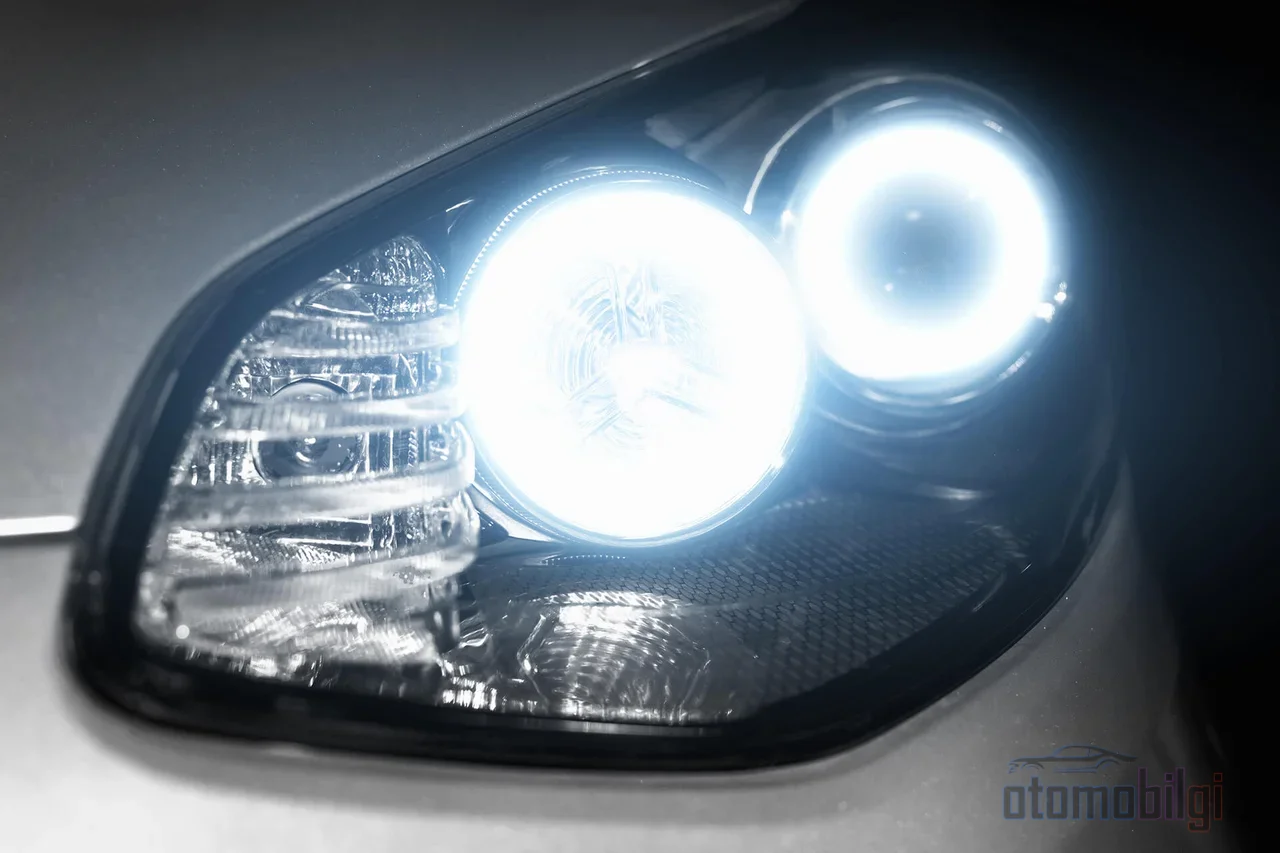
A xenon (HID) headlight has no tungsten filament inside; the light comes from an electric arc between two electrodes. To ignite this arc, the igniter sends an instant voltage of up to about 23,000 volts, then the ballast feeds the arc with a continuous, stable current. The metal salts vaporize to form the plasma, while the xenon gas provides fast partial light during a cold start. This is exactly the engineering that makes a xenon headlight a xenon headlight.
Highlights
- An igniter with a peak voltage of 20-30 kV is used for arc ignition
- After the arc is sustained, the operating voltage is around 70 V AC level
- HID bulb lifespan is 2,000-3,000 hours; in halogen this figure is 400-1,000 hours
- Light output is more than double that of halogen: approximately 3,000 lumens
- OEM xenon headlights operate at 35W of power
Arc Instead of a Filament: What's Inside a Xenon Headlight?
At the heart of a halogen bulb is a thin tungsten wire; current heats the wire, the wire glows, and light comes out. In a xenon lamp, that wire is completely gone. In its place are two tungsten electrodes with a gap of only about 2 mm between them. When electricity jumps across this gap, a light arc, a tiny lightning bolt, is born. The light comes not from a wire, but from the plasma inside this arc. Think of it like trapping a storm in a bottle - except the bottle isn't glass, it's an arc tube made of quartzite.
Inside the bulb there are three main sections: the arc tube, the electrodes at both ends, and the gas mixture. This mixture contains two star players: xenon gas and metal salts (along with mercury vapor). So why all this effort? Because an arc lamp produces a much smaller and much brighter light source than a filament. This is a huge difference for the headlight's reflector or projector: the smaller the light source, the more precisely the beam can be shaped.
Moreover, the color distribution is impressive: short-arc xenon lamps can achieve a spectrum close to daylight and a color rendering index (CRI) value of nearly 100. So xenon is not just bright - it's a source that renders colors faithfully too.
A Story That Begins with 20,000 Volts: Ignition and Warm-Up
The first spark: the igniter kicks in
So how do you get across that 2 mm gap between the electrodes? Normally you can't - air (in this case xenon gas) is an insulator. For electrons to overcome this wall, an extremely high voltage pulse is required. In automotive HID systems, the igniter sends a pulse with a peak voltage reaching 20,000-30,000 volts, ionizing the xenon gas. Once the gas ionizes, a conductive tunnel opens between the electrodes, resistance suddenly drops, and current begins to flow. It's like lighting a match with a flashlight: the light was already there, but you needed a spark.
The blue startup and the salts taking the stage
After the arc ignites, the lamp does not immediately reach full power - the famous "warm-up" process begins, one that nobody mentions but every xenon headlight user has seen. First the xenon gas itself ignites and the headlight emits light with a slightly blue tint. As the temperature rises, the metal salts inside the capsule evaporate, ionize into plasma, and the true light output begins. As the salts come into play, the voltage also drops; the lamp reaches its balanced, bright, near-white color.
The engineering elegance here lies in this: what determines the color is the salt mixture in the capsule. The mixture consists mainly of scandium iodide and sodium iodide; for "cooler" (bluer) color temperatures, indium iodide is added. So the difference between a 3000K yellow fog lamp and a 6000K ice-white headlight comes from the salt recipe inside the bulb. Power also affects color: a 55W 6000K bulb is designed with a cooler salt composition so that it appears the same as a 35W 6000K one.
The Ballast: Not the Arc Igniter, but the Brain That Tames It
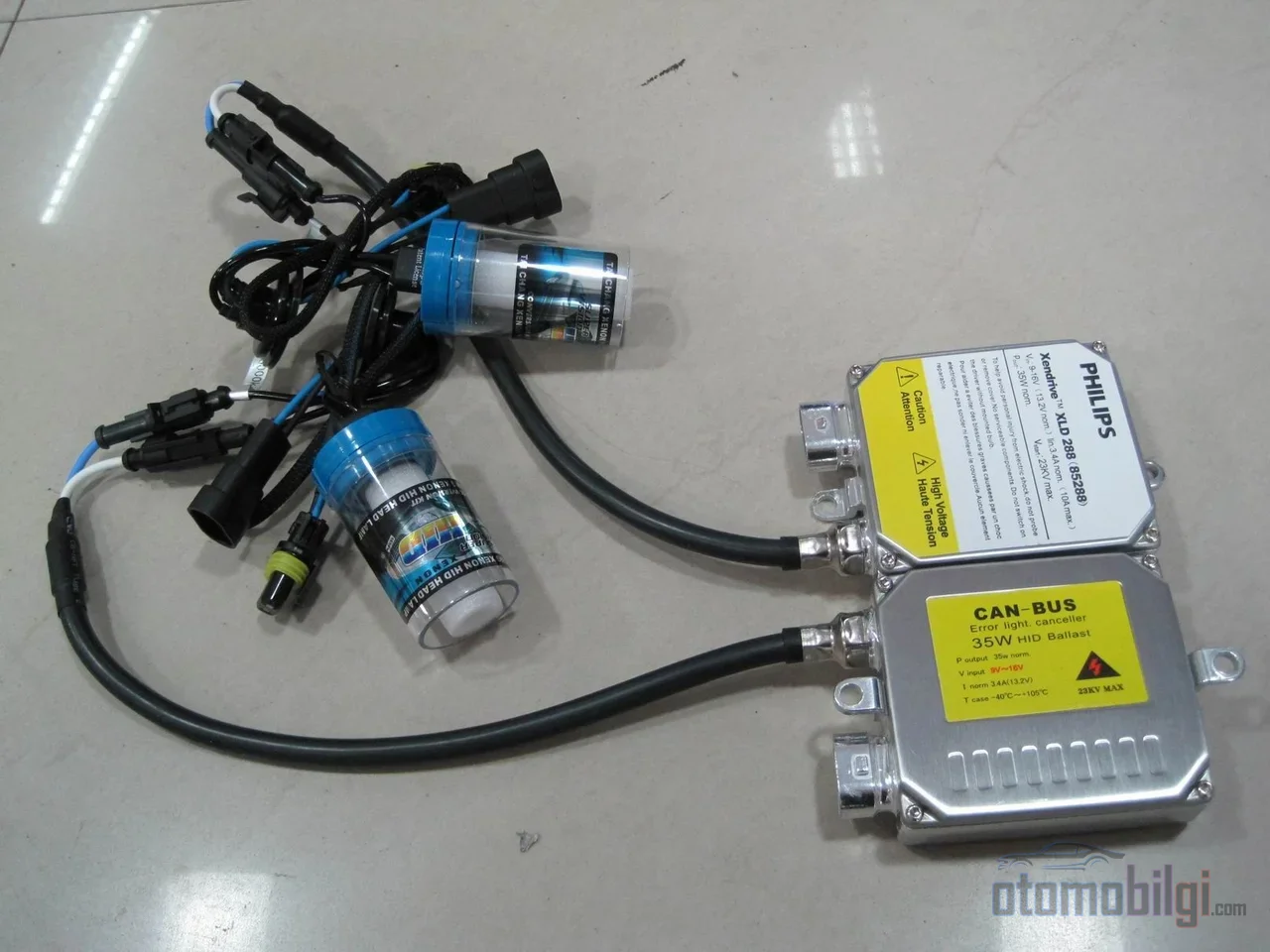
The ballast can be thought of as the heart of the xenon system, like the regulator in a battery-powered bike light - but far more sophisticated. Its job has two layers. The first is to provide that enormous voltage needed for ignition, together with the igniter. The second, and the harder one: managing the power carefully after the arc ignites while the lamp's resistance drops. Send too much power and you burn out the electrodes prematurely; send too little and the lamp struggles to warm up as if trying to wake up for minutes.
In digital ballasts, a control chip continuously analyzes the bulb's resistance and adjusts the output power accordingly. The highest-quality ballasts use ASIC chips specially designed for the HID version - that is, a chip whose only job is to drive an HID lamp. The ballast body is usually aluminum, and the internal circuit is made completely waterproof through a process called "potting." After all, the ballast is a part that must work for years on muddy roads.
Why is the igniter a separate part?
The ballast controls the main power output, but producing the ignition pulse requires a separate job; most igniters are rated at 23,000 volts. In older architectures, the igniter was integrated into the ballast body; in newer slim ballasts made to save space, the igniter has been separated from the main body and moved close to the bulb. What happens if it fails? An audible electrical arc crackling near the headlight, clicking sounds, and no lamp that lights at all - the classic trio.
Why AC? Where DC Eats the Electrodes
Here is the detail most people don't know but that determines the bulb's lifespan: the first HID bulbs ran on DC. With DC, the ions always travel in the same direction, meaning a single electrode is bombarded continuously and wears out rapidly. That's why all OEM (factory-installed) HID systems use AC: as the current direction changes, the heat is shared fairly between the two electrodes and the lifespan is significantly extended.
The result? A halogen bulb lasts on average 400-1,000 hours, while automotive HID bulbs go 2,000-3,000 hours. The difference in light output is even more dramatic: while halogen produces about 1,400 lumens, HID delivers 3,000 lumens. reaches around it. A significant portion of the halogen's energy is scattered as infrared, i.e. heat, instead of visible light; HID converts much more of this energy into light. So xenon is both brighter and more efficient - but not as much as LED; LED still leads the efficiency race.
| Feature | Halogen | Xenon (HID) |
|---|---|---|
| Light source | Incandescent tungsten filament | Electric arc (plasma) |
| Light output | Approximately 1,400 lumens | Approximately 3,000 lumens |
| Lifespan | 400-1,000 hours | 2,000-3,000 hours |
| Ignition voltage | Not required (12 V filament) | 20,000-30,000 V pulse |
| Operating voltage | 12 V DC | Approximately 70 V AC |
| Warm-up time | Instant | Gradual until the salts vaporize |
Why Is the Color Temperature Different? The Chemistry Inside the Trap
What gives your headlights their color is not a dye filter in the bulb glass, but the chemistry of the plasma. As the halide salts vaporize and ionize, the wavelengths of the light they emit vary depending on the type of salt. Factory HID headlights usually come with 4300K which is the "pure white" region that gives the best contrast even when it snows. 3000K yellowish tones are favorites in fog lamps, while 6000K ice white and 8000K ice blue are mostly favorites of the aftermarket world.
There is also an interesting fact about aging: as HID bulbs age, their color temperature rises - this is called "color-shifting". The electrodes deform over time, and the blue plasma glow on the deformed surface shifts the light toward cooler tones. So a five-year-old 4300K bulb can start to look like 6000K. If you come across a bluish "worn-out xenon", you now know why.
Let's add a safety note: the HID arc emits harmful UV rays. That's why every bulb has a second glass shell surrounding the arc capsule - this shell is the silent guardian that keeps UV away from the headlight lens and the plastic headlight housing.
Why Is the Light Pattern Everything? Replacing the Bulb Isn't Enough
One of the most misunderstood aspects of xenon is this: "Buy a good bulb, get a perfect headlight" is not a logic that can be freely applied. The HID arc is a much smaller light source than a halogen filament, and the headlight's reflector/projector must be designed exactly for this. The position of the bulb's arc capsule relative to the housing is critical; if the bulb doesn't sit perfectly at the back of the projector, the reflection is distorted and the beam scatters. The bracket holding the capsule must be made with a ceramic or metal frame - a plastic part that can deform with heat ruins the tightness of the beam.
That's why the golden rule is this: HID cannot be installed on a vehicle with halogen headlights by simply changing the bulb; only vehicles with factory HID headlights can use HID. Also be careful with marketing language - most products labeled "xenon bulb" in stores are just cheap bluish halogen bulbs. "Bi-xenon", on the other hand, is a real technical term meaning both the low and high beam are HID.
Another interesting point in a study reviewed by a peer-reviewed medical publication: HID headlights carry the light farther down the road, extending the driver's reaction time and improving safety; however, this brightness can be a source of discomfort, especially for older drivers. In other words, the technology's gain comes at a cost to the oncoming driver's eyes - pure good is rare in the engineering world.
Headlight Not Working: Bul or Ballast?
Since everything in a xenon system comes down to the ballast or the bulb, finding the faulty part can be confusing. Here are some practical tips:
- If the headlight does not come on at all and a clicking sound is heard: likely an output imbalance in the ballast.
- If the lamp flickers or glows dim while hot: the ballast is again the suspect.
- If there is an audible electric arc crackling near the headlight: a sign of igniter failure.
- If ignition fails even though there is 12-14 V at the ballast input: the ballast is faulty.
The logic is simple: the ballast both generates the ignition voltage and regulates the operating current; if either of the two fails, the headlight goes silent. The bulb ages too, of course - especially that color shift is the clearest sign that electrode wear has happened in your headlight as well.
In Short: The Engineering Identity of Xenon
A xenon headlight is less a bulb and more a mini plasma system: the arc born with a 20-30 kV pulse, the rapid first light of xenon gas and the gradual engagement of metal salts bring it to maturity; the ballast manages this entire cycle, the AC current protects the electrodes, and the salt mixture determines the color. Twice the light of halogen, three to five times the lifespan - in return, a more complex system, a warm-up time, and an absolute need for correct headlight geometry. This is why xenon represents that threshold where headlight technology transitioned from filament to physics; LED and laser headlights advanced along the very path opened by that threshold.
Sources
- High-Intensity Discharge (HID) Lighting: Complete Guide
- How HID lighting works
- All you wanted to know about HID Lighting
- Automotive HID Lamp Ballast
- HID Ballasts
- What Are HID/Xenon Headlights? A Comprehensive Guide
- How do xenon lamps and flash lamps work
- The Xenon Lamp: How It Works
- Why HID headlights bother older drivers
- Xenon vs. halogen headlights
- HID Headlight Igniter Failure: Signs and Symptoms