How Many Seconds Do Electric Vehicles Need to Finish the Quarter Mile?
Two cars stand side by side on the strip. The moment the lights go out, one launches as if it were nailed to the spot, while the other hesitates for an instant trying to catch the right revs. The difference between them is not fuel - it's electricity. So how many seconds does it take an electric vehicle to complete the quarter mile exactly, and is that time still in the shadow of the piston monsters, or is it now ahead of them? The answer is not as simple as you think - and lately it's far more striking than you'd expect.
The heart of drag racing is the quarter mile: A 402-meter straight strip, times that usually dip below 10 seconds, and a scoreboard that separates thousandths of a second. In this world, the scent of nitro ruled for years. But electric motors first quietly, and then with a roar, took the stage. Now let's look in order: why are they so fast off the line, how do the rules work, and who holds the crown right now?
One Hundred Percent Torque at Zero RPM: The Physics of the Launch
A gasoline engine needs to rev up to produce power. Clutch, gears, the torque curve... This entire chain gives the engine time to reach its full power. With an electric motor, the picture is completely different: the moment you press the accelerator - even when the motor is still at 0 rpm - you have all of the maximum torque. You settle into peak torque within milliseconds; there is no rev band waiting in between.
Let's make an analogy from daily life: a piston engine is someone climbing a staircase step by step, while an electric motor is someone who takes the elevator and goes straight to the top. Both reach the same floor, but one is at full power from the very start. That's why an EV's launch at a traffic light feels more explosive compared to a gasoline car with the same power.
But let's take an honesty break here: instant torque doesn't mean the vehicle is automatically more powerful. That instant response you feel is the power itself. Academic studies have also quantitatively compared the torque buildup of the two motor types; there are differences, but not the chasm you might think. The real divergence happens in how quickly and seamlessly the power is transferred to the ground - and on the strip, that's exactly what decides everything.
The Price of the Battery: Weight and Rules
Every advantage comes at a cost. The biggest enemy of an electric drag car isn't on the strip - it's underneath it: the weight of the battery pack. Battery technology has improved incredibly since the 1980s, and the performance gap with piston-powered cars has kept shrinking; but even today, the kilograms you carry directly translate into your quarter mile time. The classic equation of race engineers applies here too: less weight, faster ET.
The rules side is also different from classic drag racing. In addition to common safety rules, there are restrictions specific to electric vehicles: voltage, battery type, number of motors, and the motor's configuration all affect your class. The majority of electric drag organizations in North America are overseen by NEDRA, the National Electric Drag Racing Association. The IHRA has also adopted its own rules; electric cars, dragsters and motorcycles can race at IHRA events. Moreover, an NHRA racing license is mandatory for vehicles running 9.99 seconds or faster (6.39 in the 1/8 mile) or reaching speeds above 135 mph - if you're fast, this means you're serious.
Highlights
- Electric motors produce 100% torque at 0 RPM; that's a huge advantage at launch.
- NEDRA classes are determined by vehicle type and measured voltage; they range from below 24 volts up to the 600-volt A5 division.
- White Zombie ran a 11.466-second pass @ 114.08 mph for street-legal EVs in 2007.
- Steve Huff piloted the first electric dragster to break the 200 mph barrier, with a 201.07 mph trap speed in 2020.
- The name at the top: the Ford Mustang Cobra Jet 2200, holder of the record with a 6.76-second pass @ 222 mph.
How Do NEDRA Classes and Voltage Divisions Work?
In piston-engine drag racing, classes are determined by engine displacement, build level and fuel. At NEDRA, the equation is built on two axes: the vehicle's class and its battery's measured voltage. The voltage divisions climb from the J division, below 26.4 volts, up to the A5 division, above 600 volts. So a 600-volt monster and a 24-volt enthusiast project can race in the same organization but in different divisions.
The method for measuring voltage is also clear: nominal calculations and lead-acid battery counts are no longer valid; direct measurement is the only method. It can be measured at the pit exit, in the staging lane or at the starting line. The system has evolved over time: in 2006 the "A" division was split into three to boost competition, in 2013 the A4 and A5 levels were added, and in 2014 vehicle class definitions were replaced with the "Watt's Allowed" table.
Which Vehicle Is in Which Class?
On the four-wheel side, there is a spectrum ranging from street cars to full race cars: Street Production (SP), Pro-Street Production (PP), Pro-Modified Street Production (MP), Street Conversion (SC), Pro-Street Conversion (PS), Pro-Modified Street Conversion (MC), Extreme Street (XS), Funny Car/Altered (FC) and Dragster (DR). For motorcycles, the SPM, MPM, SCM, MCM and DMC classes are a world of their own. There are even CV classes for concept vehicles, HS for high school students and ED for higher education - young people are right in the middle of this sport.
The record rules are also meticulous: the driver and vehicle owner must be members before a record attempt, the time slip must be reported within 45 days, a vehicle can break only one record per event, and a valid slip must show no red light, i.e. no driver error. Since October 2019, a single time slip is enough - a clearer system than before. On the Jr Dragster side, the JR/xy format is used: the first letter shows the age class, the second the voltage division.
From White Zombie to 200 mph: Milestones
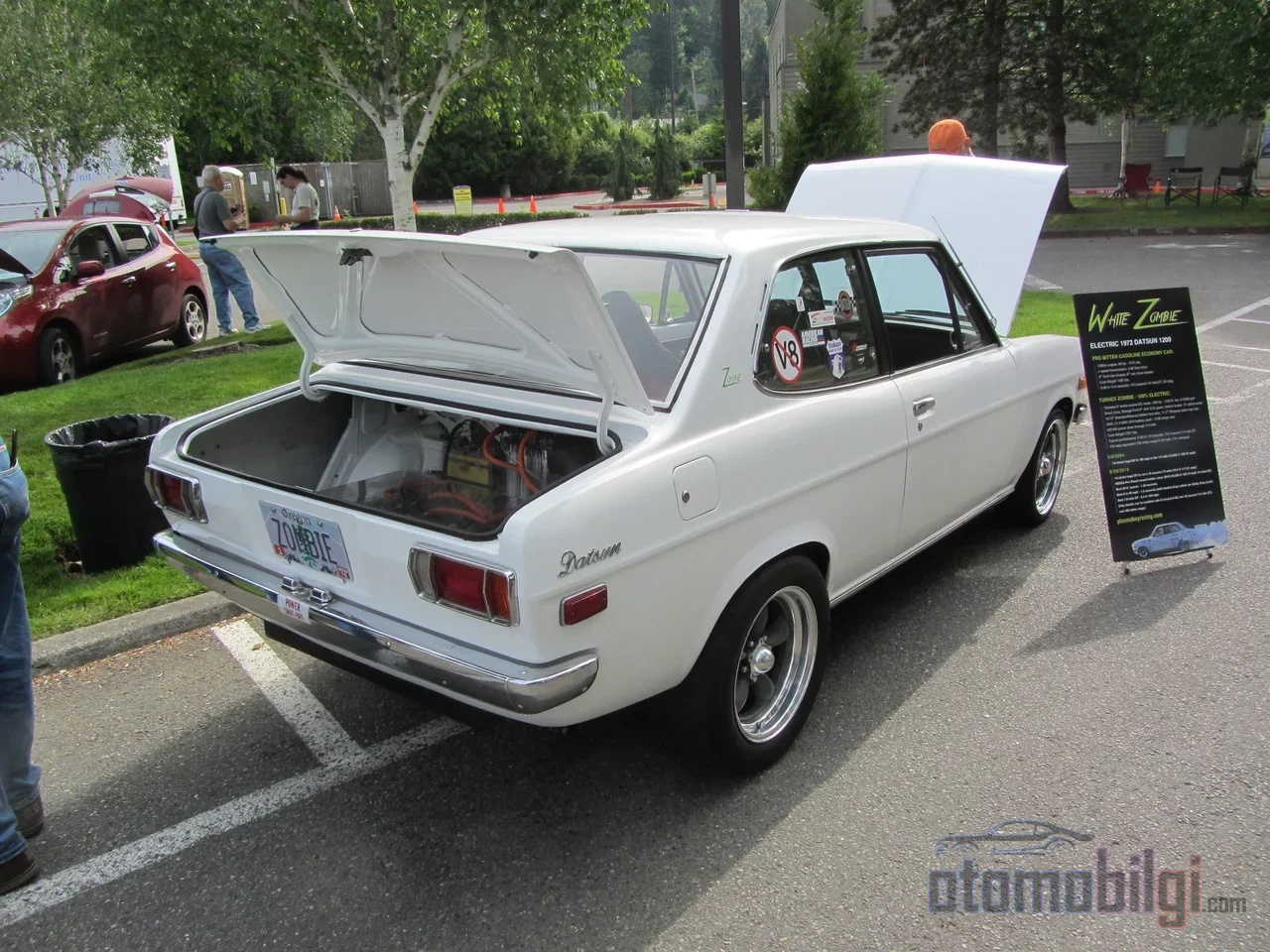
One of the legendary names of this story is the White Zombie, whose very name is a complete irony. Built by John Wayland on a 1972 Datsun 1200, this vehicle is a rear-wheel-drive classic; re-engineered with an electric motor powered by seven NiCad batteries. The car finished 0-60 mph in approximately 1.8 seconds, going down in history as one of the world's fastest street-legal electric vehicles. It set the quarter mile record for street-legal EVs on July 14, 2007: 11.466 seconds @ 114.08 mph. The best part of the story is this: it was even reported to have been banned for being too fast on the track - a legendary reputation for an EV.
The next big leap revolved around the 200 mph barrier. Steve Huff Motorsports claimed the title of the first electric dragster to break this barrier in a run it made at midnight at Tucson Dragway. According to official records, the journey was gradual: in 2017, 180.03 mph in the Unlimited Voltage Electric class, followed by a 201.07 mph trap speed in the same class in 2020. The record was later pushed to 201.37 mph at Pacific Raceways, matching the overall best EV rating held by an electric motorcycle. After crossing the 200 mph threshold, Huff stated that the goal was to get the dragster into the 6-second zone - and guess how important 6 seconds would be in the next chapter.
True Cousins: The Record Holders from Denmark
The star of the European side is Denmark's Team True Cousins. The team held the record of 8.677 seconds in the 24 volt division; their vehicle called Silver Giant II set a record in 2010 at Mosten in the 48V NEDRA motorcycle class with a 7.800-second 1/8 mile run - four 24V motors, a lithium-ion polymer battery supplying 48V/600A, approximately 100 kW of power, and CO2-pneumatic automatic gear shifts at 65 km/h. The motors were cooled to 5 degrees Celsius with dry ice between runs; the very essence of engineering creativity.
The real explosion came in 2018: the electric doorslammer called TC-X set the electric doorslammer world record with 7.98 seconds in the 1/4 mile (previous run: 7.99). The same vehicle also captured the electric vehicle world record in the 1/8 mile with 4.89 seconds / 233 km/h. And in 2021, the team's electric drag bike pulled the 1/4 mile record down to 6.74 seconds @ 195.4 mph (314.4 km/h). Note that: that 6.74 figure belongs to an electric motorcycle - the last word on cars had not yet been spoken.
Owner of the Summit: Ford Mustang Cobra Jet 2200
| The Electric Milestone | Date | Quarter Mile | Speed |
|---|---|---|---|
| White Zombie (street-legal EV) | 2007 | 11.466 s | 114.08 mph |
| True Cousins TC-X (doorslammer) | 2018 | 7.98 s | - |
| True Cousins drag bike | 2021 | 6.74 s | 195.4 mph |
| Steve Huff dragster (trap speed) | 2020 | - | 201.07 mph |
| Mustang Cobra Jet 2200 | 2026 | 6.76 s | 222 mph |
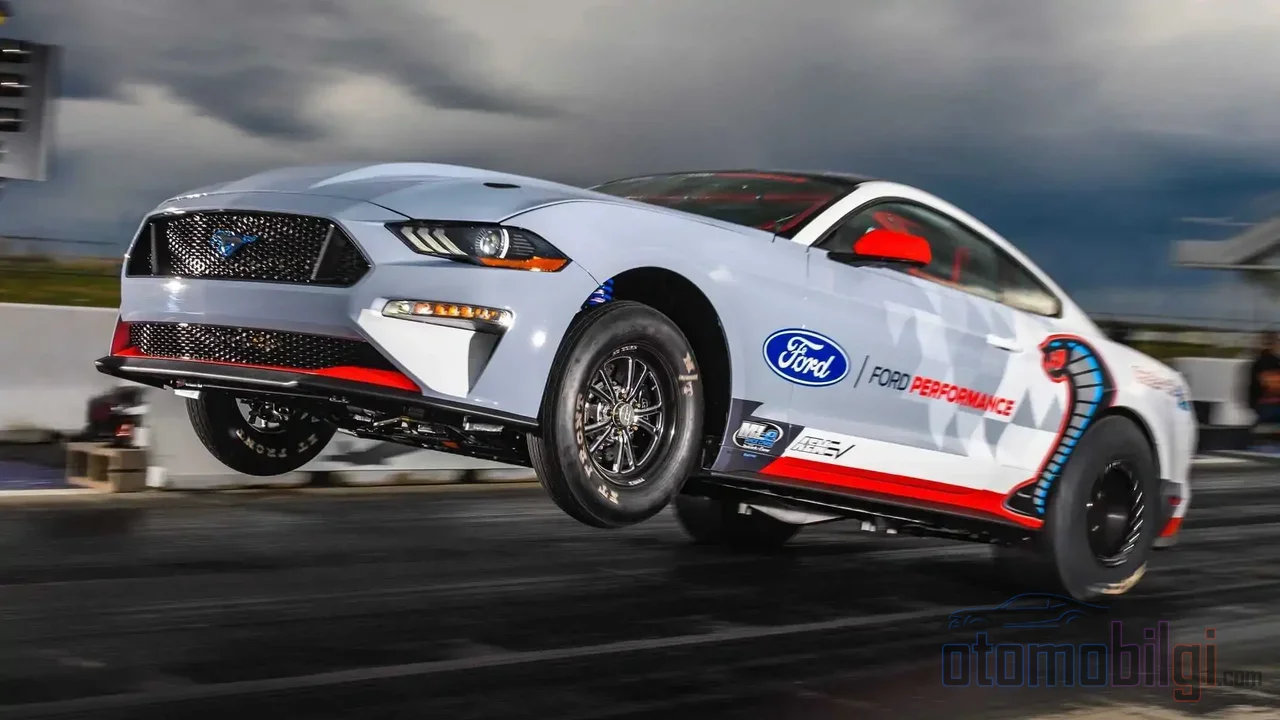
Here is the summit of the timeline: Ford Racing's Mustang Cobra Jet 2200, introduced in April 2020, hit the track with 2,200 horsepower during the 4-Wide Nationals weekend at NHRA Charlotte and finished the quarter mile with a low ET of 6.76 seconds at a top speed of 222 mph. With this run, the car became both the quickest and fastest electric drag vehicle in the world. The official nature of the figure is clear: Ford announced the low ET of 6.76 seconds at 222 mph as the official results of the weekend.
Because different runs were made at the event, there are other figures circulating from hand to hand: some runs show 6.87 seconds / 221 mph, while one announcer's call mentions 6.801 seconds / 220.22 mph. These are not contradictions; one is the best of all runs (low ET), the others are the result of a specific single run. Once you get used to track terminology, you make this distinction with your eyes closed. For comparison, here's the background: the manual stick-shift world record is 6.458 seconds @ 233.44 mph, while the doorslammer's overall peak is 5.114 seconds @ 262.79 mph. So the electric peak is approaching the piston-powered overall record but isn't quite there yet - and that's exactly what makes the race of the coming years so exciting.
So, How Many Seconds Do Electric Vehicles Need to Finish the Quarter Mile?
There is no single answer to the question, but there is a clear picture. While the best street-legal electric car in its class runs in the 11-second range (like White Zombie's 11.466 seconds in 2007), modified doorslammers drop to 8 seconds, and electric drag bikes go down to 6.74 seconds. And at today's absolute peak, the Mustang Cobra Jet 2200, with its 2,200 horsepower, finishes the quarter mile in 6.76 seconds at 222 mph - the fastest and quickest electric quarter mile ever covered by a car. So the answer is a scale stretching from 11 seconds to 6.7 seconds, depending on the vehicle's class, its voltage, and how serious a race project it is.
What's really striking isn't the numbers, but the curve: in 2007, 11 seconds was a world record, while today the same distance is covered in 6.7 seconds. Batteries are getting lighter, motors are getting more powerful, and that 100% torque available from launch is turning into an ever-growing margin every year. The nitro era's throne is shaking - and what's shaking it is an engine that launches in complete silence. Which record do you think will fall first?
Sources
- Inside the Breakthrough of Cobra Jet 2200
- Ford Mustang Cobra Jet 2200 Becomes World's Quickest Electric Drag Racer - Road & Track
- NEDRA Classes, Voltage Divisions and Record Rules
- Electric drag racing - Wikipedia
- Steve Huff Motorsports Records
- White Zombie 2007 Record - Plasma Boy Racing
- Electric Doorslammer 1/4 Mile World Record - CleanTechnica
- Electric Drag Bike Sets New Quarter-Mile World Record - autoevolution
- IHRA Adopts Rules For Electric Drag Racing - Motor Authority
- Instant Torque: The EV Performance Advantage - Alpha Motor