Michael Schumacher: The Story of Seven Championships
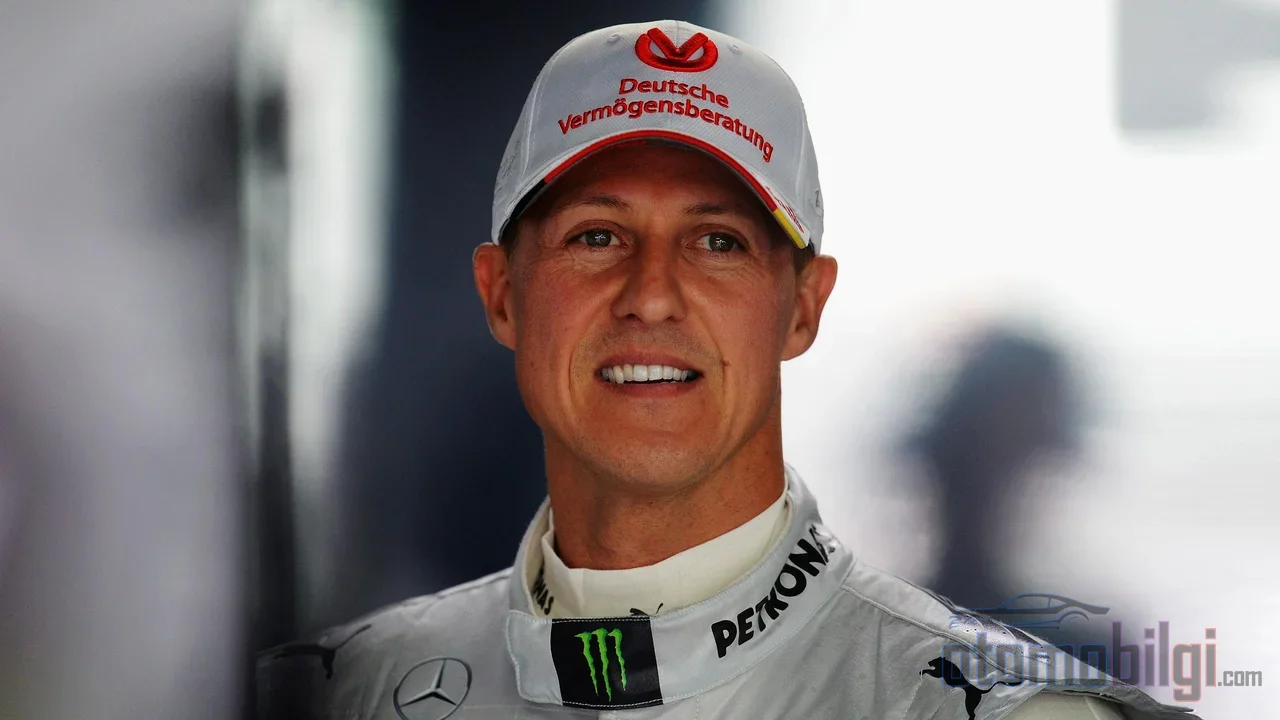
Seven world championships, 91 wins, and the most controversial, most brilliant career in Formula 1 history: Why is Michael Schumacher still talked about? How did a kid who grew up in a kart track's canteen become the most feared driver on the grid? Here is the complete Schumacher story, from his beginnings to today.
From the Kart Track Canteen to the Grid
Consider this: You were born on January 3, 1969, in Hurth, West Germany, into a working-class family. Your father was a bricklayer, and your mother ran the canteen of a kart track. So you are right next to the track, but Formula 1 is a world away. Michael Schumacher grew up in exactly this picture; at the age of four he took the wheel of a pedal kart, won the European Kart Championship in 1987, then claimed Formula Konig in 1988, the German Formula 3 championship in 1990, and the Macau GP.
Those who watched the 1990 Macau finals never forgot one detail: After ramming Mika Häkkinen from behind, his rear wing was torn off, but he had still won the race. Even more striking was that he gave the prize money to his indebted family. This man is not just fast; his story is like a movie scene. So how did a kid slip into F1 this fast? The answer is one of the craziest debuts in motorsport history.
The 1991 Spa Debut: A Folding Bicycle, Jordan, and What Happened in One Week
He entered the 1991 Belgian GP in place of Bertrand Gachot, who had gone to prison; Mercedes paid Jordan 150,000 dollars to secure this seat. The crazy part is this: Schumacher had never raced at Spa before. To memorize the track, he did laps on a folding bicycle - yes, on a bicycle. The result? He qualified 7th. Even though he retired in the first lap with a clutch failure, everyone knew something was there.
Right after his debut he moved to Benetton and Jordan took the case to court; but since no final contract had been signed, Jordan lost the case. Thus the next chapter began: the years in the blue-and-white suit, not red.
Highlights
- 7 world championships: 1994, 1995, 2000, 2001, 2002, 2003, 2004
- 91 wins, 155 podiums, 68 poles, 77 fastest laps
- First win: 1992 Belgian GP, last win: 2006 Chinese GP
- The fastest lap record still belongs to him today
- The championship record was matched by Lewis Hamilton in 2020
The Benetton Years: Was It the Worst Car a Champion Ever Won With?
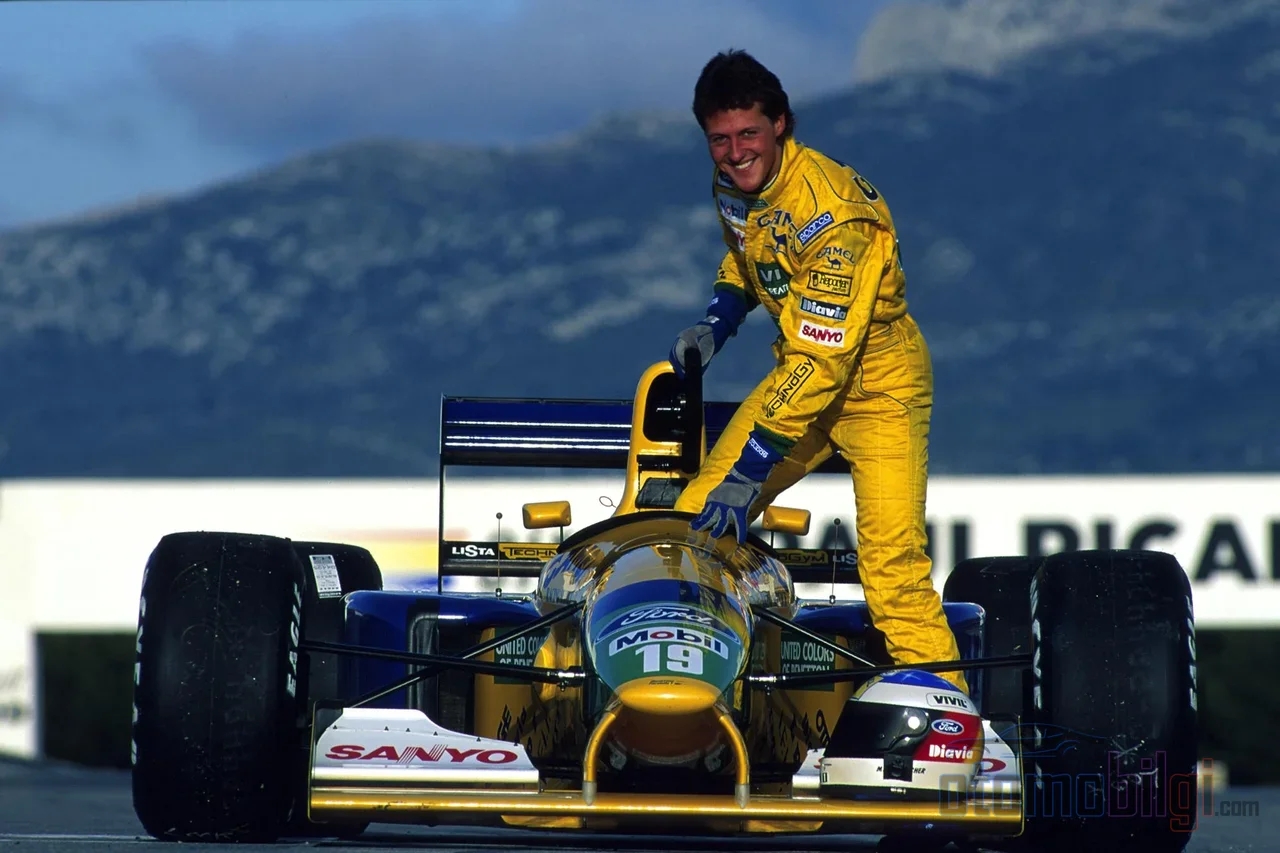
In 1992 he took his first victory in a wet race at Spa, and that win also went down in history as the last victory for an F1 car with an H-pattern manual gearbox. But the real explosion came in 1994: eight wins, a championship, and an undisputed star turn. Benetton's B194 car was described by some observers as the worst car a champion ever won with; that season Schumacher went through three different teammates (Lehto, Verstappen, Herbert), lapped the entire field in Brazil, and in Spain finished second with a car stuck in 5th finished second with the gearbox stuck in gear. In other words, while the car was struggling to stay alive, the driver was collecting the championship.
That year he witnessed the deaths of Ayrton Senna and Roland Ratzenberger at Imola; he dedicated his championship to Senna. In the season finale at the Australian GP, he collided with Damon Hill and both were out of the race. The stewards declared it a racing incident and Schumacher faced no action; but the British press was angry enough to try to drive him out, and public opinion split in two. That controversy still hasn't ended today, don't you think?
Cheat Allegations and the Shadow Over a Season
Another burden of 1994 was the cheat allegations hanging over Benetton. The FIA investigated the team on suspicion of violating the electronic aids ban; a hidden launch control function was found in the software, but there was no evidence it had been used in races. Schumacher was disqualified and banned for two races for ignoring the penalty and the black flag at the British GP; his Belgian GP victory, meanwhile, was annulled on the grounds of skid block wear, and the appeal was rejected. Many observers considered that two-race ban a small and meaningless punishment in which Schumacher fell into the role of victim amid the tension between Benetton and the FIA.
In 1995, he took 9 wins from 17 races, finished 33 points ahead of Hill, and, together with Herbert, delivered Benetton its first Constructors' championship. He had become the youngest two-time champion in history - still hard to believe, isn't it?
The Ferrari Era: How Was the 2000-2004 Dominance Built?
In 1996, Schumacher transferred to a struggling Ferrari, and this move changed the destiny of the red team. At first we kept saying he was doing it alone; in reality it was a conductor's job: Ross Brawn and Rory Byrne came from Benetton, Jean Todt took over management, and it took exactly six years for this team's efforts to bear fruit at Ferrari. The early years were bitter: in 1997 the championship ended in disqualification due to the collision with Villeneuve, in 1998 he finished second to Häkkinen, and in 1999 he broke his leg in a brake failure. Then the doors opened.
2000 brought Ferrari its first drivers' championship in 21 years, and Schumacher's victory marked the beginning of the road toward back-to-back championship sweeps together with Rubens Barrichello. In 2002, he took his fifth championship with a then-record 11 wins and a perfect podium rate. In 2004, while he took 13 wins from 18 races, the F2004 was producing 865+ horsepower with its roughly 3.0-liter naturally aspirated V10 engine; and he won the first five races of the season. So, in answer to those asking the question: was it the man or the machine? Both at once, and with Brawn, Byrne and Todt among them.
| Season | Car | Result |
|---|---|---|
| 2000 | F2000 | Champion, Ferrari's first drivers' title in 21 years |
| 2001 | F2001 | Champion |
| 2002 | F2002 | Champion, then-record 11 wins |
| 2003 | F2003GA | Champion |
| 2004 | F2004 | Champion, 13 wins, won the first five races of the season |
Driving Style and Training Discipline: What Set Him Apart?
Schumacher wasn't just fast; was known for pushing machines to their limits for long stretches, a pioneering fitness regime, a winning-at-all-costs mentality, and the ability to motivate teams. He is credited as one of the first at Monza to introduce rigorous physical training and psychological performance monitoring among drivers. He described discipline as the key to his success, and aerodynamicist Willem Toet described him as a driver with an extremely precise and consistent driving style who could adapt when necessary. He broke the mold of what the modern F1 driver means; he brought unprecedented levels of fitness.
With a simple analogy: Schumacher was not merely someone who drove cars, he was an engineer who tuned his own body as a component. That is why rain was not an enemy but a friend to him - at the 1996 Spanish GP in Barcelona, he signed one of the greatest wet-race performances in history with the F310, and at the 2000 Belgian GP he showcased wet-weather mastery at Spa. Spa was by far his favorite track; after all, he had raced his first F1 race there too. A twist of fate.
The Mercedes Era and Retirement: Why Didn't Things Go as Expected?
After finishing third in 2005 and second to Alonso in 2006, he announced his first retirement and took his final Ferrari victory that year at the Italian GP, as his 90th win in F1. In 2010, Mercedes took the stage with his comeback, pairing him with Nico Rosberg. Apart from a few podiums, success remained limited; yet he is credited with a share in the Mercedes project later reaching championship-winning form. So the 2012 Brazilian GP, the final race of his career, was not where the original fairy tale ended, but where the foundation of a new legend was laid. His final podium came that same year at the European GP.
His Legacy: What Remains When Hamilton Passes the Records?
So far, a complete story, but the real question is this: What does Schumacher mean to F1 today? At the moment of his retirement, he held the records for the most wins (91), poles (68), and podiums (155), and the record for the most fastest laps (77) is still his. Lewis Hamilton equaled the championship count in 2020 and broke the race wins record. Ross Brawn said Schumacher's legacy in F1 remains so strong even years later - not in a recorded statement, but the numbers whisper the same thing.
He himself knew records could be broken; he is reported to have predicted Hamilton would break his wins record. His true legacy lies not in the record tables, but at the trainer's desk, in the fitness gym, and in team strategy meetings: today's drivers learned from him how to manage their bodies and careers like a business. Modern F1 as it is today is built on the mold Schumacher created. That is why at the end of every season, no matter who becomes champion, the same name always appears in the greatest-of-all-time lists: Michael Schumacher.
Beyond the Tracks: Health Condition and Charity Work
Life after his career is the most painful chapter of the story. He suffered traumatic brain injury in a skiing accident in December 2013; he remained in a medically induced coma for about six months, was moved home in September 2014, and has not been seen in public since. Detailed information about his condition is kept private. Off the track, however, his heart was always generous: he was named a UNESCO Champion for Sport in 2002 and donated more than 65 million dollars to charities. So he broke a record not only on the track, but off it as well.
If we wanted to sum up Schumacher in a single sentence: he was someone who came from the karting track's canteen and rewrote the rules of F1, a real human being with both flaws and triumphs, someone who trained to make the next step better at every start. Understanding him means understanding F1; and for anyone who wants to truly understand F1, this story is definitely worth reading. What about you - which memory of Schumacher do you remember most, the folding bike lap at Spa, or the hard-to-break winning streak of 2004?
Sources
- Michael Schumacher
- Michael Schumacher's timeline
- Allegations of cheating during the 1994 Formula One World Championship
- 1994 - Michael Schumacher
- Ferrari F1: Schumacher Championship Years
- Discipline is Key to Success, Says Schumacher
- Michael Schumacher: the legend of Formula 1
- Lewis Hamilton v Michael Schumacher: The stats
- Ross Brawn: Michael Schumacher's F1 legacy as strong as ever
- Michael Schumacher - Turkish Wikipedia