Speed Racer Mach 5: The Car That Became a Cult Icon
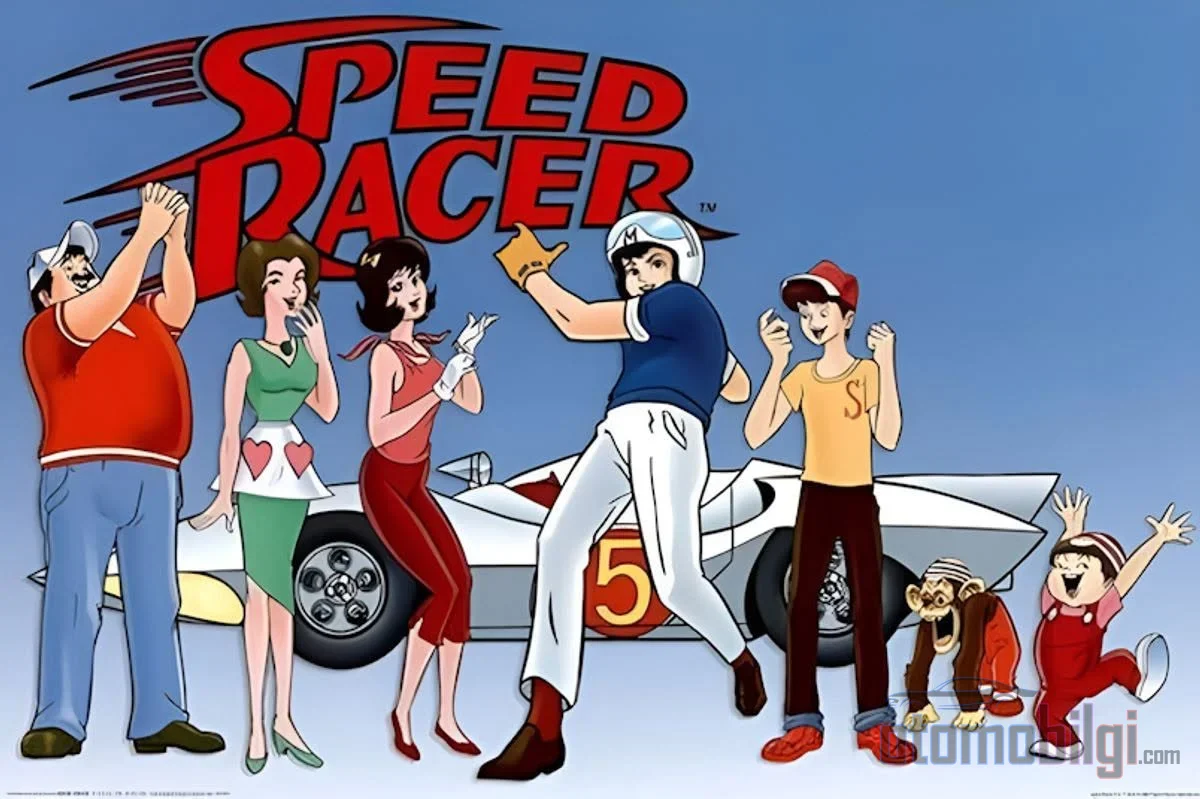
The first car I saw on TV when I was four years old was a racing machine with a red M, and on its steering wheel there was something no real car had: seven buttons. Even today, while watching a Cars or Fast and Furious movie, I find myself thinking: who planted the seeds of all this? The answer is older than most people think, and it comes from the world of anime. Why is Speed Racer's Mach 5 still a cult icon? If you're ready, let's dive into this story.
How the Mach 5 Was Born: From Manga Pages to Screens
First, let's clarify the dates, because this is exactly where confusion arises. Tatsuo Yoshida's Mach GoGoGo manga was published in Japan in 1966. The anime adaptation, bearing the Tatsunoko Production signature, started on Japanese television on April 2, 1967 and ran for 52 episodes. So the Mach 5 actually lived on paper first, then moved to the screen.
Do you know the interesting part? That same year, the series was localized in the US as Speed Racer, and the hero's name was changed from Gō Mifune to Speed Racer. Think about it: For most American viewers, this was their first encounter with anime; decades before anime became mainstream in the US. The "Go" in the name Mach GoGoGo refers both to the hero's name and to the excitement of racing; "Mach" expresses extreme speed. For Tatsunoko, this series was also one of the company's pioneering productions.
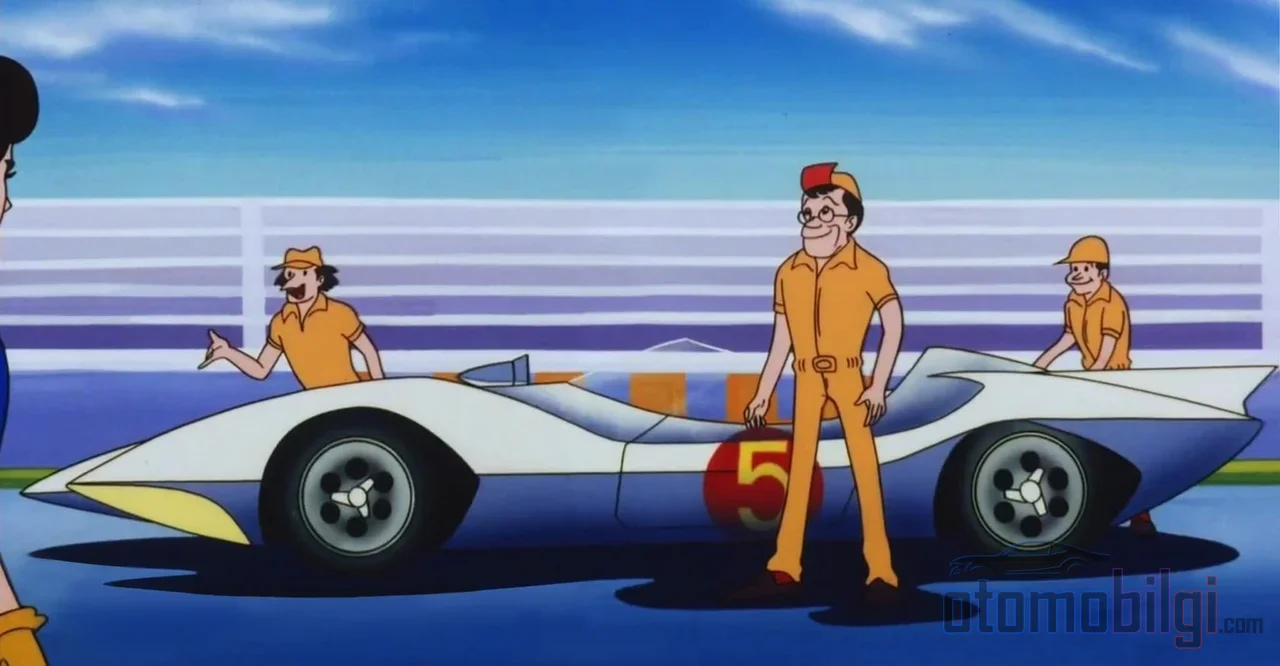
So who built the car? Within the fiction, the answer is quite sweet: The Mach 5 was designed and built by Pops Racer, an automotive engineer and the father of the racer Speed. A family project, you might say, and in an era of black-and-white screens at that.
Highlights
- The Mach 5 first appeared in the 1966 manga and the April 2, 1967 anime adaptation.
- The seven buttons A through G on the steering wheel resemble a spy gadget cabinet more than a car.
- The "M" on the hood stands not for "Mach 5" but for the family company Mifune Motors.
- The 2008 Wachowski film was a box office disappointment but gradually gained a loyal fan base.
- The Mach 5 has no real technical specifications; all performance figures are fictional estimates.
What Does the M on the Hood Stand For? The Secret Behind the Design
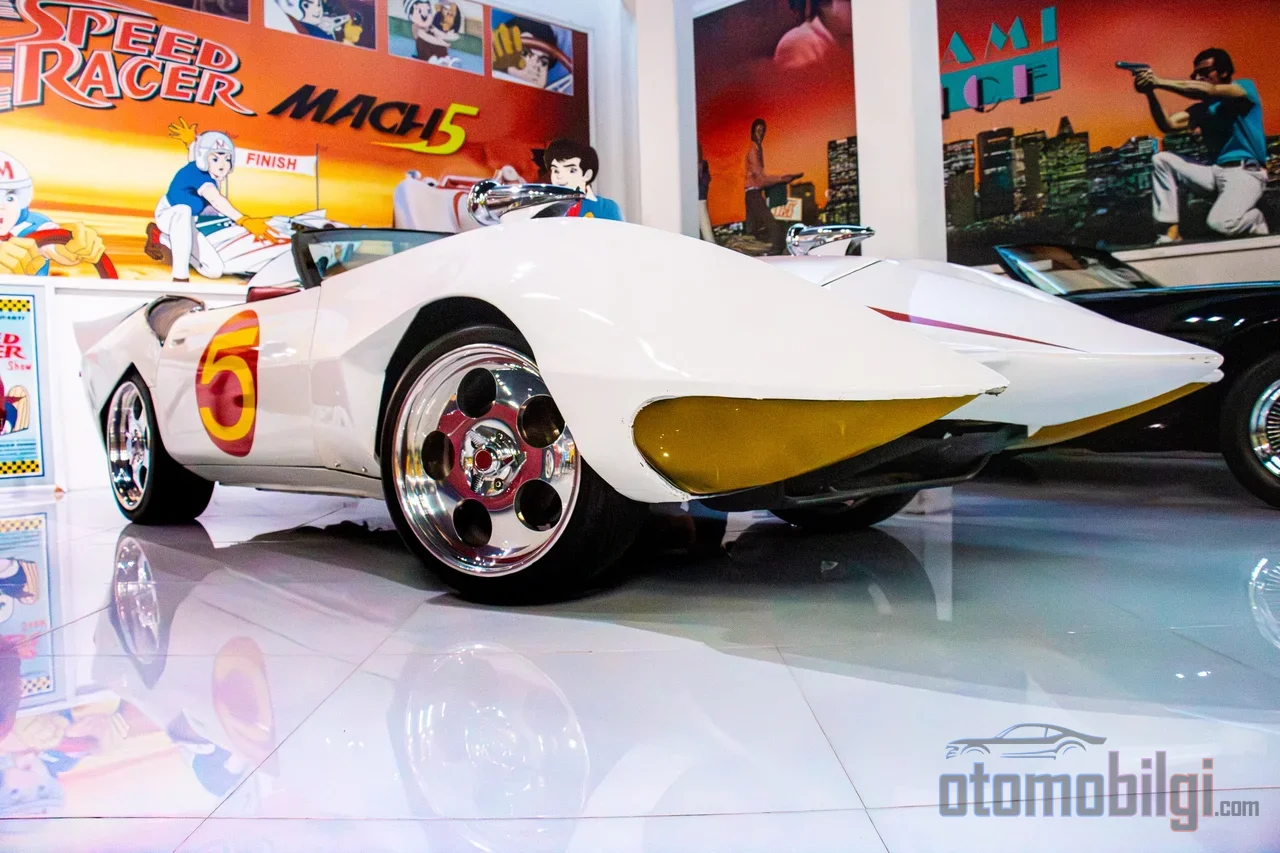
Here's a question for you: Do you think that big red M is an abbreviation of "Mach 5"? The answer is no, and this detail surprises even most of its fans. The letter M represents the hero's surname, that is, the family company Mifune Motors. So the emblem tells a family story just as much as the car itself.
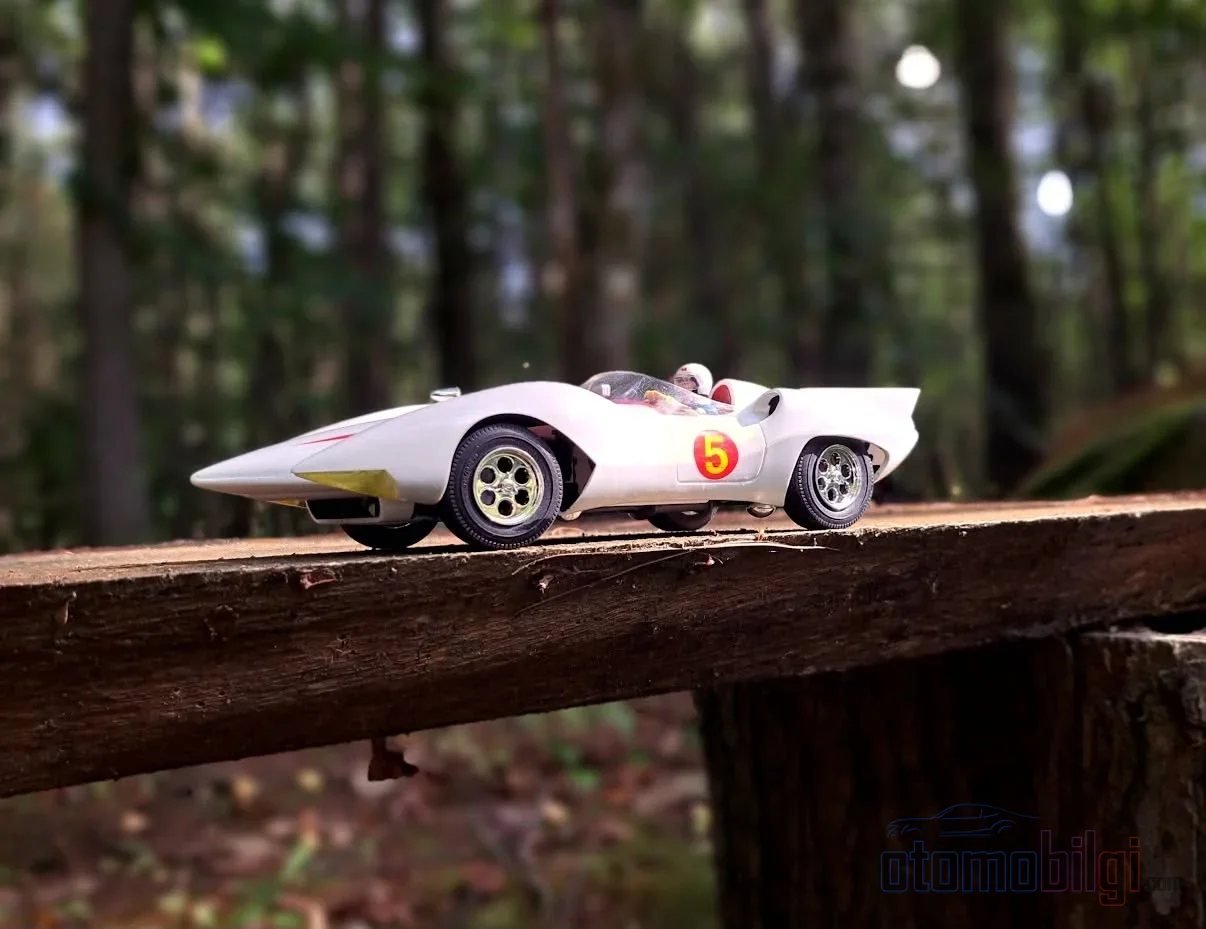
Now let's look at the design. A long hood, pointed front fenders, an open two-seater cockpit, a tiny bandage-type windshield, side scoops carved behind the wheels, and a raised rear body with pointed fins. This silhouette, resembling a Coca-Cola bottle, is so distinctive that it is recognized at a glance even sixty years later.
So what was the inspiration? There is no definitive answer here. Some accounts point to the Ferrari 250 Testa Rossa, the Ford GT40, and James Bond's armed Aston Martin. But there is also a more plausible candidate: the 1965 Prince R380, which won the 1966 Japanese GP. The Nissan R380-II and Aston Martin DBR1 are also mentioned. Since there is not a single official statement, the real source of inspiration retains some of its mystery; I think that mystery is part of the symbol.
The Seven Buttons on the Steering Wheel: An A-to-Z Guide to the Gadgets
Okay, now let's get to the most fun part. What made the Mach 5 legendary was not just its shape; it was the seven buttons on its steering wheel, lettered A through G. Each one activates a separate system. Go ahead, sit at the wheel and imagine:
- A - Auto Jacks: A hydraulic system jumps the car over obstacles. So while driving, suddenly the car has hopped over something.
- B - Belt Tires: A special tire coating that kicks in when ground conditions are bad; think of it as a traction-rescue button.
- C - Cutter Blades: Rotating cutting blades that open from the front, mowing through dense vegetation to clear a path.
- D - Deflector: A protective transparent canopy that wraps around the cockpit; it acts as a shield against collisions.
- E - Evening Eye: A night vision and special headlight system that lets you see in the dark.
- F - Frogger Mode: Underwater mode! The cockpit fills with oxygen, you can breathe for about 30 minutes, and the periscope rises up.
- G - Gizmo: A small bird-shaped reconnaissance robot that can carry messages and convey information. Something like the cartoon version of today's drone concept.
If you noticed, all seven of these were presented together for the first time in 1967. So it can be said that the Mach 5 anticipated the gadget-laden cars of later years right from the start. If KITT's or the Batmobile's buttons feel familiar to you, the first link in the chain was often this red race car.
A quick honesty break: since this vehicle is fictional, there is no real performance data. The figures circulating, such as claims of a 1,700 hp V12 or 5,000 hp, are pure fiction-based guesses; since there is no counterpart such as a manufacturer, there is no declared engine, torque or 0-100 figure either. Read the numbers for fun, not as a technical spec sheet.
The 2008 Hollywood Adaptation: The Mach 5's Cinema Adventure
In the late 2000s, the legacy moved to the big screen. The film Speed Racer, which Warner Bros released in May 2008, was written and directed by Lana and Lilly Wachowski. The cast was also quite solid: Emile Hirsch as Speed, Christina Ricci as Trixie, John Goodman as Pops, Susan Sarandon as Mom, and Matthew Fox as Racer X.
The film itself failed at the box office and reviews were mixed; but over time it gained a loyal fan base. The reason for its reevaluation is understandable: the film was faithful to the original, while its visual language was entirely original.
Resisting the Team: From Iconic to Untouchable
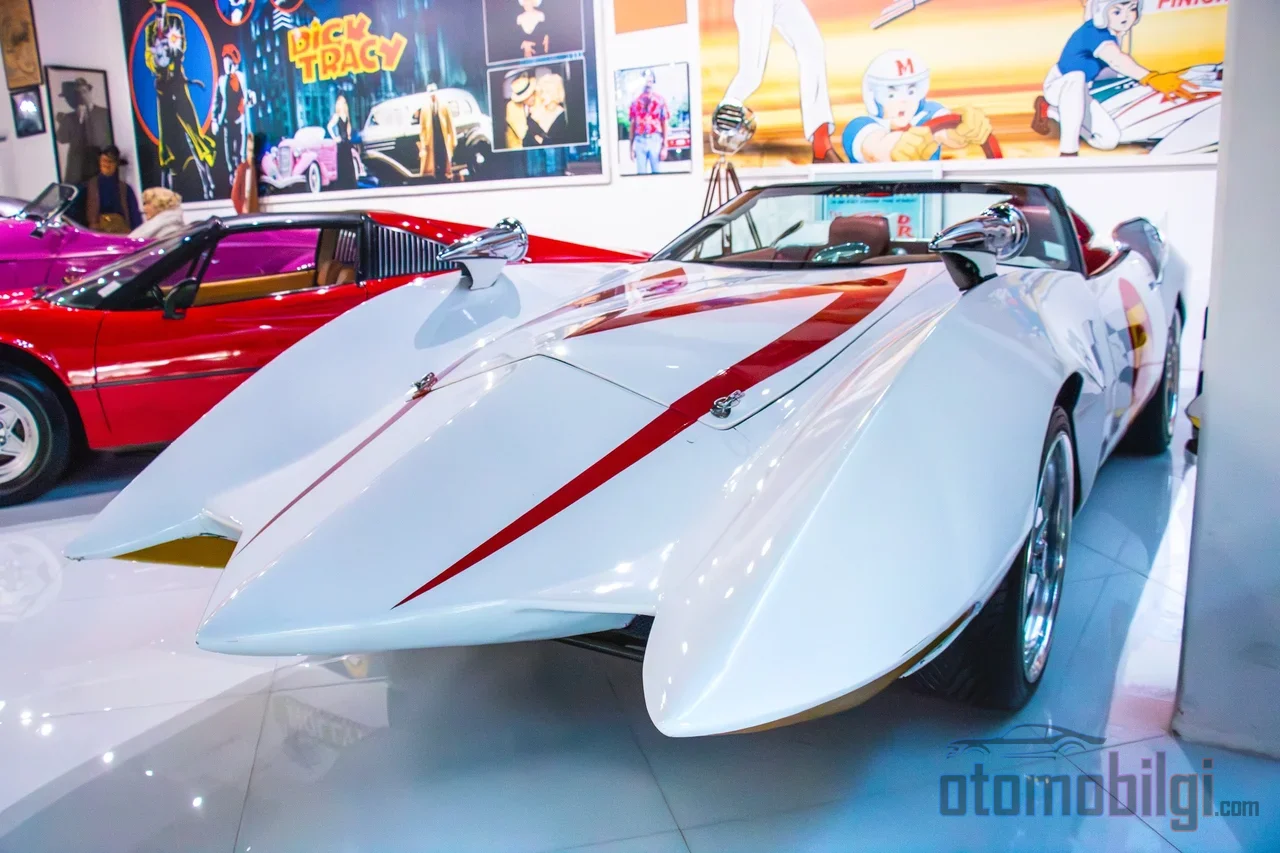
My favorite detail is this: the film team deliberately held back from changing the Mach 5; the vehicle was considered so iconic that its design was left untouched, and a purpose-built Mach 6 was developed separately for the new requirements. The 2008 version had slightly different rear fin shapes; the super-drift concept replaced them on screen with spinning saw blades, jacks, tire hooks and a bulletproof cockpit. The Mach 5 built for the film was exhibited at the North American International Auto Show in January; there is even a full-scale recreation built on a 1984 Chevrolet Corvette chassis, on display since 2008 at the Volo Museum. In 1999, a prototype powered by a Corvette roadster chassis and a 5.7-liter engine had also been built for charity.
Why the Mach 5 and Not the Batmobile or KITT?
Here we come to the main question of this page, and the answer actually has three layers.
First, the difference in origin. The Batmobile was born from a comic book, KITT from a live-action series; the Mach 5 emerged from the world of anime and became a global symbol. A Japanese production being adopted worldwide, especially in the US, through localization was an unusual cultural crossover for 1967.
Second, precedence. As I said before, it was that which prepared the idea of a gadget-loaded car with buttons for the vehicles of later films, series and games. When KITT came out, the audience already knew the concept; because the Mach 5 had introduced it.
Third, continuity. The franchise kept living on: Speed Racer Enterprises acquired the rights in the 1990s, in 1997 Tatsunoko made a modernized 34-episode remake, and in December 2013 a lawsuit settlement transferred the entire franchise rights retroactively to Tatsunoko as of May 2011. This is not a passing fad, but a sixty-year life cycle.
Where Does the Mach 5 Rank in the Speed and Power Ranking of Fictional Cars?
Another fun debate is this: which is the fastest fictional vehicle? In rankings prepared by insurance companies, KITT's 540 hp V8 takes first place, surpassing the Mach 5's 1,700 hp V12 and its 300 mph top speed. In another ranking, KITT is again first, the Mach 5 second with a top speed of 258 mph, and the Batmobile from Batman Begins third with 220 mph. So the Mach 5 is constantly second, but even that shows how deeply rooted a symbol it is; after all, all the figures mentioned are fictional estimates, nothing has been confirmed.
For those curious, let me sum up the clear answer: The Mach 5 is a racing car that was born in a manga in Japan in 1966, spread to the world with the 1967 anime, and, with the seven-button gadget system on its steering wheel, is the pioneer of the idea of a tool-loaded fictional car, emerging from the world of anime and settling into global popular culture. The secret of its cult-symbol status is these three things coming together in one vehicle.
The Mach 5 for Collectors: From Model Cars to Digital Collections
Since we are talking about a symbol, we cannot skip its market. The diecast world has never let go of the Mach 5. Johnny Lightning's 1:64 scale model in a tin box, Auto World's 1:18 scale version with opening hood and doors, opening cutter blades and a working auto-jack feature, and Jada's model from the Hollywood Rides series in 1:32 scale all occupy the shelves. The most impressive one is the Tamashii Nations (Bandai) Chogokin replica at roughly 1:18 scale: It reproduces all seven special functions.
The latest development is on the digital side: As of November 2026, a digital collectible and augmented reality series is being offered for the Mach 5 and Racer X's Shooting Star. This must be how a sixty-year-old icon reaches a new generation.
Mach 5's Legacy in Frequently Asked Questions
Is Speed Racer really a Japanese anime?
Yes. Tatsunoko Production produced it in Japan; the version we saw in the US was an English adaptation. That adaptation is why many of us first encountered anime.
Could the Mach 5 actually be that fast?
No, because it is not a real vehicle. No technical figures such as engine, torque, or 0-100 were ever disclosed by the manufacturer; all circulating numbers are fiction-based estimates. Grab it like a bagel, enjoy it like a coffee.
So what is the summary of this legacy?
The idea of a race car a father built for his son has fueled the imagination of car design for sixty years. What made the Mach 5 a cult icon is not a single feature; its anime origins, pioneering gadget concept, iconic design, and uninterrupted cultural presence all come together. That red car with seven buttons on its steering wheel came from a world of buttonless cars and changed everything.
Sources
- Speed Racer Mach 5 Car at Volo Museum
- The Story Behind Speed Racer and Its Lasting Pop Culture Legacy
- Mach Five (Speed Racer) - Wikipedia
- Speed Racer - Wikipedia
- The Iconic Mach 5 From Speed Racer Has Entertained Gearheads for Decades
- A Guide To Those Buttons On Speed Racer's Mach 5 Steering Wheel
- Insurance Company Ranks the Fastest and Most Expensive Fictional Cars
- Speed Racer Mach 5 Chogokin - Tamashii Nations