The Unforgettable Vehicles of Cartoon and Anime History
Speaking of Initial D, we all know the AE86 drifting on mountain roads, delivering tofu, and eurobeat quickening our hearts. But wait a minute: did the world of anime and cartoons give us only the Trueno? Absolutely not. Speed Racer's Mach 5, Wangan Midnight's Devil Z, Scooby-Doo's colorful van, even that red futuristic motorcycle in Akira... All of them are treasures locked in popular culture's garage, and most of them are based on real-life models. On this page, we take them out one by one and pop their hoods. If you're ready, we're entering the gallery!
What Are the Cult Vehicles of Anime and Cartoons?
Let's begin: Besides Initial D, which vehicles have been hung on the wall of animation history? The answer is far richer than you'd think. On one side, there's a button-laden race car from 1967 that puts James Bond to shame. On the other, a Z that roams Tokyo's highways at night, nicknamed the "Devil." And there's also a mystery-solving cartoon van and young drivers cling to gasoline in defiance of the age of artificial intelligence... Each of these vehicles has a different design story, real-world connection, and cultural footprint. So it's not just about "pretty-looking cars"; these are the channels through which car culture reached millions of people through animation.
Highlights
- Mach 5 first appeared on screens in 1967 and reached an estimated fan base of 50 million.
- Devil Z is a heavily modified Nissan Fairlady Z (S30); its engine enlarged to 3.1 liters, with twin turbos.
- The Mystery Machine's real-life basis is still debated: there are multiple claims, from the Dodge A100 to the VW LT40.
- eX-Driver depicted a future of electric and AI-controlled vehicles in 2000.
- Rideable recreations were produced of Kaneda's motorcycle; one of them is powered by a 250cc Yamaha engine.
Mach 5: Speed Racer's Button-Powered Legend
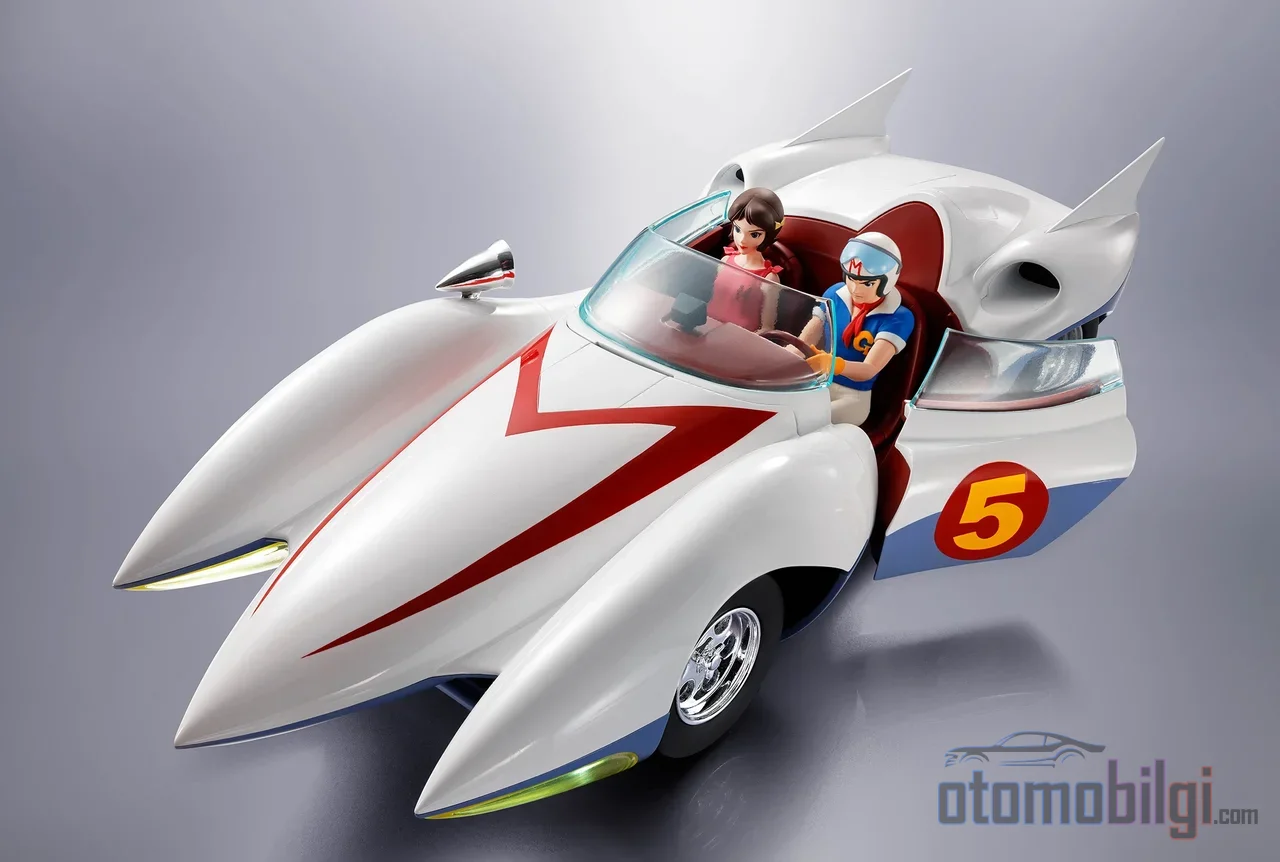
It all started in 1967. Born into the world alongside Tatsunoko Production's TV series and its creator Tatsuo Yoshida, the Mach 5 (Mahha-gō in Japan) has since been one of the most recognizable fictional race cars, bar none. A two-seater, left-hand drive, with a white-and-blue body and a red letter "M" on the hood, it is said to have a V12 engine - there aren't many detailed technical specs beyond that, but no matter, the real show is at the steering wheel.
Because the Mach 5's steering wheel has seven buttons from A to G, and each one is as crazy as a James Bond gadget:
- A - Auto-Jacks: Lifting jacks that allow jumping while in motion. Yes, the car jumps while driving.
- B - Belt Tires: The tires turn into tracks for traction on any terrain. So no winter tire worries.
- C - Cutter Blade: Rotating cutting blades emerging from the front. Perfect for clearing a path through a forest.
- D - Defensor: A transparent dome protecting the cockpit.
- E - Evening Eye: Infrared night vision; it works together with the visor in the helmet.
- F - Frogger Mode: 30 minutes of oxygen support and underwater driving with a periscope.
- G - Gizmo: A bird-like unmanned reconnaissance drone. We said drone back in 1967, if you noticed.
So is this vehicle based on a real model? The official story goes like this: The Mach 5 was redesigned by Mitsuki Nakamura, Tatsunoko's art director and a true car enthusiast, who drew inspiration from the Porsche, Ferrari, and Jaguar race cars of the era. In fan circles, it's also said that Bill Mitchell's 1959 StingRay design may have been another source of inspiration - it's not confirmed information, but an interesting parallel for those who know the design language. Fortunately, there are clearer details about the chassis structure: it is stated to be equipped with an all-wheel-drive system. Peter Fernandez, the English voice of the series, was so impressed that years later he would say this car still looked very modern and that it would take a long time for real cars to reach the Mach 5 level.
How Was the Mach 5 Brought into Real Life?
Once a car becomes this beloved, real-life versions were not long in coming. In 1997, a promotional replica based on the Nissan Saurus with an FRP body was produced, and in 2010 it was run at the Toyota Automobile Museum. In 2002, a serious plan came into play: 100 road-legal, registered Mach 5s were to be produced on the 2001 Chevrolet Corvette platform; the versions called the Signature Series would even bear Peter Fernandez's signature. While the engine was mid-mounted in the prototype, in the Corvette-based "production" version a 5.7-liter V8 producing 385 hp was to sit at the front. A mid-engine prototype is also on display at the Petersen Automotive Museum; the museum refers to the Mach 5 as "the world's most famous race car," alongside the estimated 50 million fans of the 1967 animated series. The Wachowskis' 2008 live-action film used the design almost unchanged - the car was rarely actually driven on set, mostly suspended from a crane and completed with computer graphics. And a sweet recent detail: In January 2026, a Mach 5 tribute car built on a 1979 Chevrolet Corvette chassis with a 350ci L48 V8 engine sold at a Hagerty auction for $21,000.
Devil Z: The Devil Z of Wangan Midnight
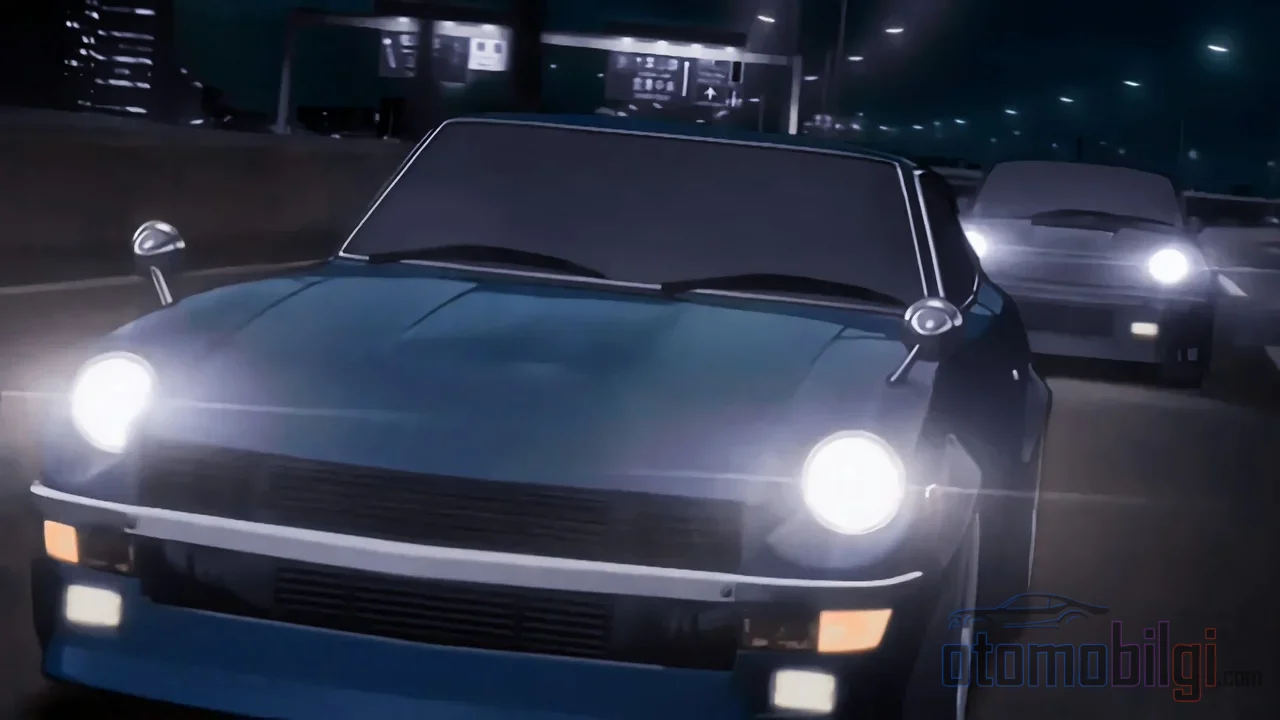
While Initial D drifted in the mountains, the heroes of Wangan Midnight played for top speed on Tokyo's highways - on what we call the wangan, the coastal expressway route. At the heart of the series is a heavily modified, Midnight Blue Nissan Fairlady Z (S30): the Devil Z. In Japan, Akuma no Zetto, meaning "The Devil's Z". This car has such a fast, such a dangerous reputation that in the story it is said to possess supernatural powers. In a series revolving around the story of high school senior Akio Asakura rescuing this car, the rivalry between the Devil Z and the Porsche-based Blackbird was told time and again as manga, anime, and live-action film.
On the technical side, things are serious: The L28 engine was enlarged to 3.1 liters and given a triple-carburetor, twin-turbo setup with intercoolers. So this is not a cosmetic modification, but a full-fledged representation of engineering culture. The story's echo in the real world is also interesting: It has long been said that the Devil Z was inspired by the cars of the Mid Night Club team that actually raced on Tokyo highways; it is claimed that a 280ZX belonging to the team in particular formed the basis. Unfortunately, there is no definitively documented source, but it is clear that the spirit of the series came from real street racing culture.
The comparison between Initial D and Wangan Midnight is also one of the fans' endless conversations: one drifts on mountain roads with lightness and technique, the other plays for top speed on the straight highway with power and courage. As the main character cars, the Toyota AE86 in one and the blue S30Z in the other stand out. Some see Wangan Midnight as a "love letter to car culture" even above Initial D - and the beauty of it is, you don't have to love both, but both are cornerstones of JDM culture.
Mystery Machine: Which Car Inspired Scooby-Doo's Van?
Now let's step away from the anime scene and return to Saturday morning cartoons: Scooby-Doo's Mystery Machine, that is, the orange-and-green flowered van. It has been one of the most recognizable vehicles on screen since the original animated series from 1969 to 1976. But here's the interesting part: there is no consensus on the van's real-life basis. The most common claims revolve around the 1964-66 Dodge A100 Panel Van, the 1970 Volkswagen LT40, the 60s Ford Taunus Transit, and the Chevrolet Greenbrier van - the designers seem to have blended the features of all four models, which makes the Mystery Machine one of the rare cult vehicles "without a single true ancestor."
This uncertainty doesn't stop the fans' desire either: In 2019, a philanthropist converted a 1991 Daihatsu Hijet into a Mystery Machine from top to bottom, and it went viral. In van culture, this vehicle, just like the Ecto-1 or the A-Team Van in the film world, is one of the most beloved examples of cartoon vehicles based on (or at least inspired by) a real production vehicle.
eX-Driver: The Anime That Predicted the Future in 2000
Ah, eX-Driver... A series rarely talked about but that predicted the future of the automotive world with surprising accuracy. Oh My Goddess! In this OVA series, planned and designed by its creator Kōsuke Fujishima and released in 2000, all future cars are electric and controlled by artificial intelligence. Kōsuke Fujishima, all cars in the future are electric and controlled by artificial intelligence. Does that sound familiar? when the AI breaks down, the elite young drivers who can still drive gasoline-powered cars manually - the eX-Drivers - step in. In other words, the series had brought to the screen exactly the chaos of the autonomous vehicle era we are discussing today, 25 years earlier.
In other words, 25 years ago, the series brought to the screen exactly the chaos of the autonomous vehicle era we are discussing today. Lorna's Lotus Europa, Lisa's Subaru Impreza WRC (later replaced by a Lancia Stratos HF), and Soichi's Caterham Super Seven. A selection dedicated to the spirit of classic cars - and looking back today, the series' prediction of automotive's future is referred to by fans as "the anime that foresaw the future."
Akira's Red Motorcycle: Kaneda's Icon
A two-wheeled legend is a must on the list too: The red, low-slung, futuristic motorcycle of Kaneda, the protagonist of the 1988 film Akira. Considered one of the most iconic vehicles in anime history, this machine is practically a symbol of freedom in the film's dystopian Neo-Tokyo. And the most fun part: this motorcycle wasn't limited to the screen. Multiple teams produced rideable replicas - Spanish designers made a drivable recreation, and Matus1976's Akira Bike Project takes its form from Kaneda's bike as a functional vehicle. The Bel&Bel design studio, meanwhile, developed a prototype with a 250cc Yamaha engine and prepared for limited production sales.
The craziest detail is the sound: the recreation's engine sound was created from a combination of MiG-21 fighter jet recordings and the sound of a 1927 Harley. So when you start that motorcycle, you hear both a jet and a classic Harley. For Kaneda's bike, the answer to the question "could it really be built?" is clear: yes, and it has been built more than once.
Traces of Anime Vehicle Culture: Why Are These Vehicles So Important?
So now that everything has come together, let's ask: why are these vehicles so important? Because anime became one of the strongest channels carrying the visual identity of JDM car culture to global audiences. Without Initial D, who knows how many people around the world would be chasing an AE86? Lists of "the best anime vehicles," ranging from the Mach 5 to My Neighbor Totoro's Catbus and Hercules in My Hero Academia, are also proof of this: vehicle design was never taken lightly in animation history.
Real-world connections aren't limited to the above, either. Real models such as the Ferrari Koenig Special Testarossa (Golden Boy), Nissan Skyline R32 (Initial D), Mercedes-Benz SL R107 (Dragon Ball), BMW E30 and Renault Alpine appeared on screen many times in anime. There is also a counterargument: some argue that anime isn't as obsessively interested in vehicles as American cartoon cars like the Batmobile. But the fact that in 2026 a Corvette-based Mach 5 could sell at auction for 21,000 dollars, that Kaneda's bike could be produced in limited series, and that the Devil Z legend is still alive settles the debate for me.
In short: Initial D is a great starting point, but the animation world's garage is much bigger. With its gadgets, the Mach 5 has continued to be a design target since 1967; the Devil Z is real street racing culture carried into fiction; the Mystery Machine is perhaps a design that consciously "belongs fully to no model"; eX-Driver is an automobile manifesto that foresaw the future; and Kaneda's bike is one of those rare moments when imagination touches real asphalt. The next time you open an anime, take a closer look at the vehicle the hero uses - there is probably a much more real story behind it than you might guess.
Sources
- Mach Five (Speed Racer)
- The Engineering Superhero Who Inspired Generations
- Mach 5 Dreams Made Real: A Speed Racer Fantasy
- Petersen Museum: Real Mach 5 Speed Racer Origins
- Devil Z | Wangan Midnight Wiki
- What is the story behind the real Devil Z?
- éX-Driver - Wikipedia
- Sue's ODD Travels - The Scooby-Doo Mystery Machine
- Design Studio Recreates Motorcycle from Akira
- The 10 Best Anime Vehicles Ever, Ranked