The Legendary '32 Deuce Coupe of American Graffiti
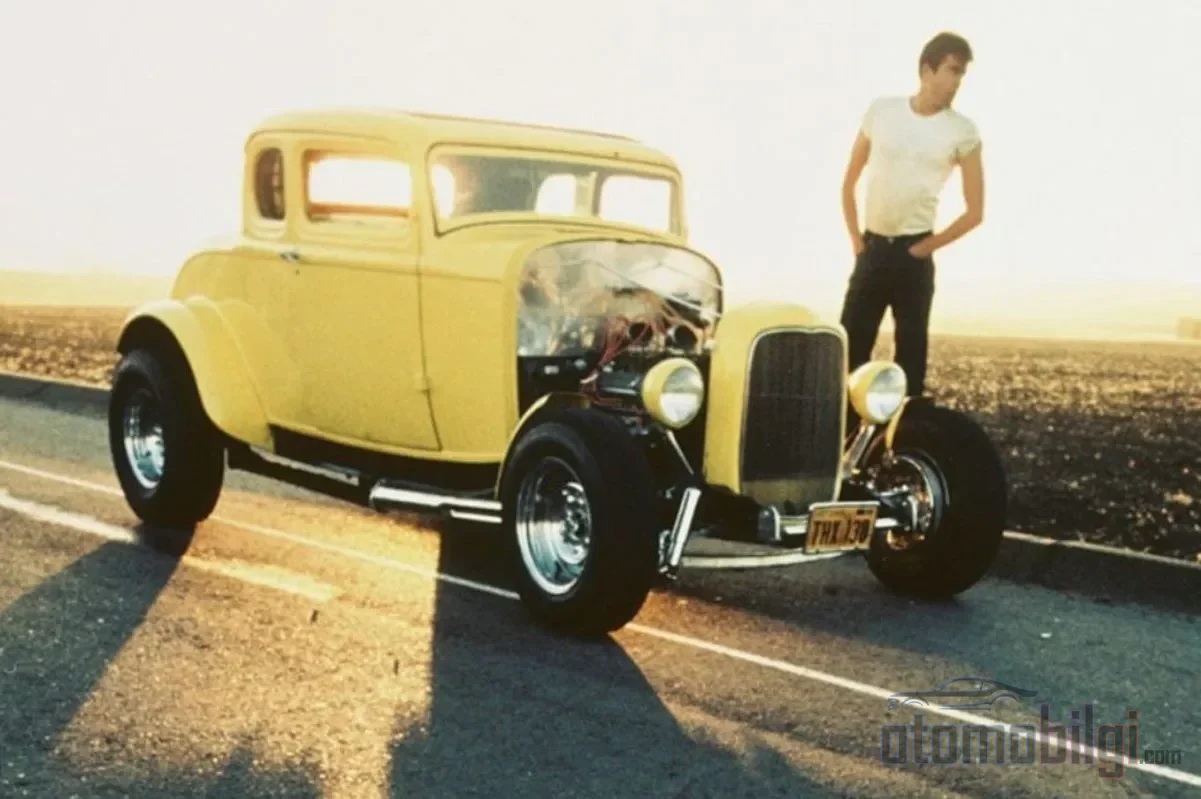
Take a moment to think: The yellow, bright-colored 1932 Ford from a 1973 film has remained one of the most recognizable cars in cinema history for over 50 years. Moreover, this car is neither a super sports car nor an expensive European classic. It is a simple hot rod endlessly cruising through a youth, a town, and a night. So who really owned that famous yellow Deuce Coupe from American Graffiti, what was under its hood, and where is it today?
Let's clear something up first, because there is a lot of confusion about this on the internet: That yellow coupe was not Steve Bolander's car; it belonged to John Milner, the leather-jacketed hot rodder played by Paul Le Mat in the film. This calm-looking but confident character, who owned the fastest car in town, was at the center of the street races in the heart of the film. Here is the story of that car, along with the chain stretching from George Lucas's youth to today.
George Lucas's Modesto Nights and the Birth of the Film
American Graffiti is a coming-of-age story set in the summer of 1962 in Modesto, California. The film was released in 1973, but its spirit comes directly from director George Lucas's own teenage years. Lucas was also from Modesto, and in the early 1960s the center of life for young people was the cruising culture around 10th and 11th Street: driving around for hours in cars, meeting up in parking lots, chatting under the headlights.
The film's cast of vehicles reflects this world exactly: Ron Howard's white-and-red scallop-patterned 1958 Chevy Impala, the 1951 Mercury custom, the 1955 Chevy driven by a young Harrison Ford as Bob Falfa, and the 1956 Ford Thunderbird of the film's mysterious blonde. But among them all, there is one that became the symbol of hot rod culture: Milner's yellow 1932 Ford five-window coupe.
How Did the Milner Coupe Become a Legend of Cinema?
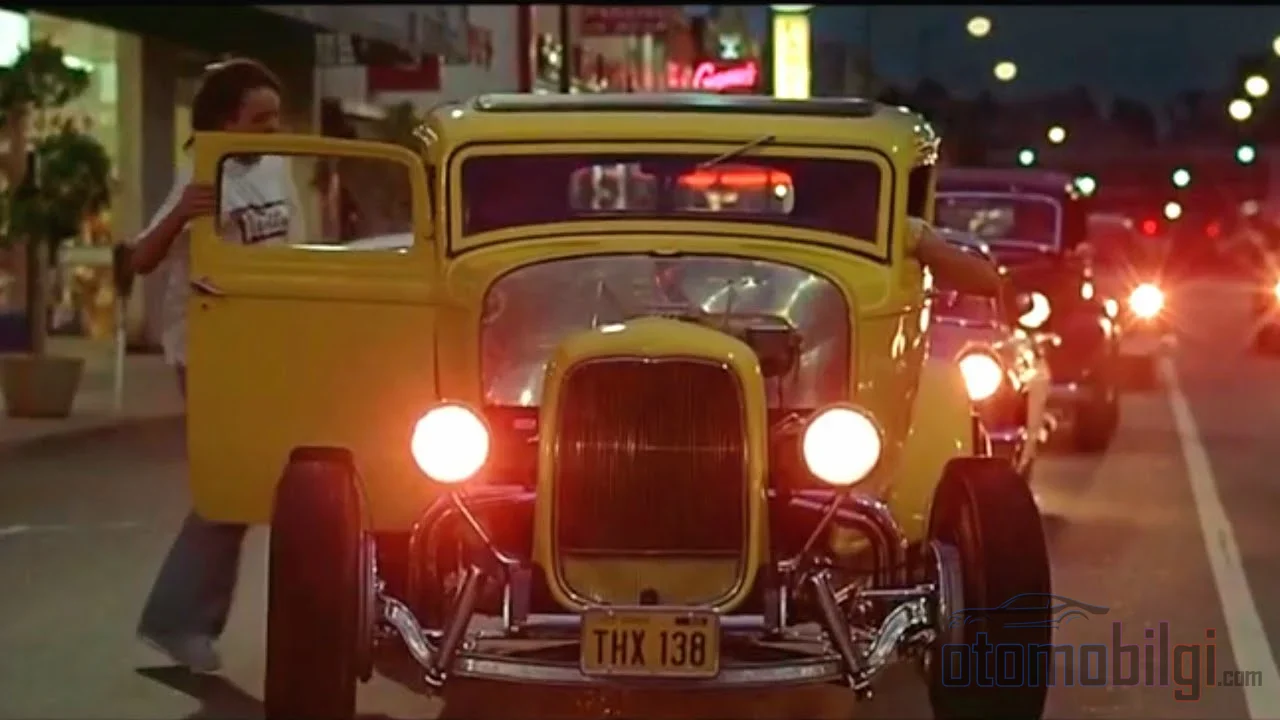
The 1932 Ford is known simply as the Deuce in the hot rod world, and it is perhaps the most sacred platform of this hobby. The first hot rods were built from old Fords: Model T, 1928-31 Model A, and 1932-34 Model B bodies were lightened, strengthened, and flown across the streets or dry lake beds. Among the venerable names of the hot rod community, there is no other model as beloved as the 1932 Ford; in particular, the roadster and five-window coupe bodies are considered legendary.
By carrying this tradition to the screen, the film raised hot rodders for generations. It is often said that modern hot rod culture truly began with this film; there are plenty of stories of a spark igniting in American Graffiti's viewers and leading them to spend the rest of their lives in the garage.
Highlights
- The yellow coupe in the film was John Milner's (Paul Le Mat) vehicle: 1932 Ford five-window Deuce Coupe
- Engine: Chevrolet 327 V8, four Rochester carburetors on a Man-A-Fre manifold
- Factory engine for its production year: 65 hp, 130 lb-ft of torque, 0-60 mph in 16.8 seconds
- The car was purchased for about 300 dollars for the production; its original color was red
- Its license plate was THX 138: A salute to Lucas' first film THX 1138
What the Studio Did to the $300 Car
Here is where the secret lies: that famous yellow coupe did not enter the scenes as a prestigious collector's item, but as an ordinary project bought for about $300. When the car was purchased, its bumpers and fenders were complete; the studio dismantled them all and deliberately gave the coupe a more aggressive stance. The grille was cut and sectioned, the rear fenders were shortened, and cycle-type fenders were fitted at the front. Moreover, the car was originally red; that gleaming yellow that went down in cinema history came from the studio's brush.
Even its license plate is a separate joke for those who know: The car's yellow plate read THX 138, a hidden reference to Lucas' first feature film THX 1138. This attention to detail is another reason why the car has remained so memorable.
Its Engine and Technical Equipment: Not a Flathead, But a Chevy 327
Contrary to what most people assume, the Milner Coupe's engine was not a Ford flathead. The studio placed a Chevrolet 327 cubic inch V8 in the car; on top was a manifold carrying four two-barrel carburetors of the Man-A-Fre brand, along with Rochester carburetors. The valve covers were Cal Custom style, and the exhaust manifolds were custom-made. The camshaft is known to be a Duntov 30/30-like profile used in high-performance engines with solid lifters. Let's make a simple comparison: it is like fitting a muscular heart from the mid-1960s into a featherweight 1932 body. The transmission was a BorgWarner T-10 four-speed manual, with a Hurst shifter and a piston-shaped shift knob; at the rear there was a 1957 Chevy differential with a 4.11 gear ratio. At the front, a chromed I-beam axle and tube shocks did the job.
Unfortunately, no verified horsepower or torque figure for the film car's Chevy 327 appears in any reliable source; figures such as the 350 HP seen in replica listings for sale belong to the exact-copy cars, not to the original coupe. Therefore, we put the factory figures of the 1932 Ford into the technical picture; after all, the hot rod exists to surpass its factory form, doesn't it?
| Specification | 1932 Ford Deuce Coupe (Factory) |
|---|---|
| Engine | 221 cubic inch (3.6 L) Ford Flathead V8 |
| Power | 65 hp @ 3,400 rpm |
| Torque | 130 lb-ft |
| Compression ratio | 5.5:1 |
| 0-60 mph | 16.8 seconds |
| Top speed | 76 mph |
| Weight | 1,090 kg (Roadster body) |
| Factory consumption / trunk capacity / price | Not disclosed by the manufacturer |
The 16.8-second 0-60 mph figure may make you laugh by today's standards; but in 1932, 65 hp was a power level that even an average car could not reach, and Ford was the first to bring the V8 to the public. That is exactly why hot rodders fell in love with the Deuce: a lightweight body, V8 potential, and plenty of room for modification.
The Car's Chain of Ownership: Who Has Owned It From the Studio to Today?
After the film was finished, the coupe's adventure continued. Producer Gary Kurtz had purchased the car for about $300; Around 1980, Steve Fitch took it over for $1,500. By the mid-1980s, it passed to Rick Figari, the car's owner today. Sources give the year of sale in two different versions, 1985 and 1986; what matters is that the car has been in Figari's hands since that day, in Northern California.
Figari did serious work to preserve and keep the coupe alive: the wiring was rewired, the T-10 transmission was rebuilt, the chrome exhaust manifolds were ceramic-coated with aluminum, the front fender brackets were reinforced, and the 327 engine was rebuilt. So that yellow coupe is not a showpiece toy, but a real, breathing, working hot rod.
The collector market also reflects the interest in Deuce Coupes in prices: as of 2026, a 1932 Ford coupe starts at around $35,000 for modest, patina'd examples, while quality restorations can exceed $250,000. The original movie car, meanwhile, is considered a cultural treasure entirely beyond this scale.
The Deuce's Legacy: Museums and the Celebration in Modesto
the 90th of the 1932 Ford. anniversary of the 1932 Ford, in June 2022, the Petersen Automotive Museum in Los Angeles opened an exhibition dedicated to the Deuce; the model's place in hot rod culture was moved onto museum walls. In Modesto, the Graffiti Summer celebration is held every year, and with Lucas Plaza dedicated to Lucas and its statue, the city keeps its cruising heritage alive. The city's Graffiti USA Museum emphasizes that American Graffiti was the film that opened the way for Lucas to his later giant projects like Star Wars and Indiana Jones.
Conclusion: Why Is This Car Still Talked About?
In summary: The yellow Deuce Coupe of American Graffiti, as John Milner's car, became a legend born from George Lucas's youth in Modesto that carried hot rod culture into the mainstream of cinema. A red coupe that the studio bought for $300 and painted yellow took on the role of the fastest car in town with a Chevy 327 V8 and four carburetors; with the THX 138 reference on its license plate, it carried the trace of a director's passion for cinema; today it still lives in Rick Figari's garage in Northern California. In our opinion, a car that can still light a fire in young hearts more than 50 years later is more impressive than any acceleration figure. Don't you think so too?