How Did Cars Turn Into Characters in Animated Films?
Share This Page
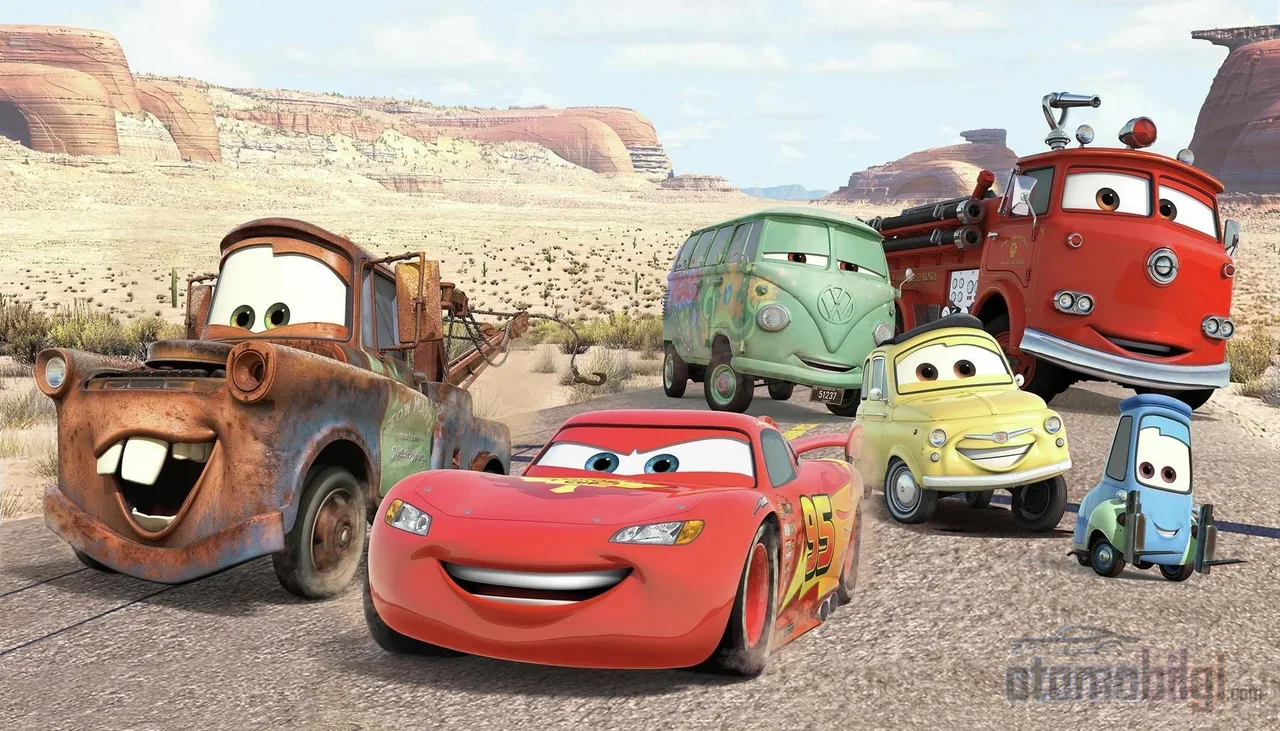
In animation, cars stop being road-gripping metal parts and become lead actors with eyes, voices, quirks, and heartbreaks. Designers give cars personality by making the headlights the eyes, the windshield the gaze, and the grille the mouth; thus, in a long tradition stretching from Pixar's Cars series to Wacky Races, cars become the true heroes of the story.
Highlights
- First notable animated example of anthropomorphic vehicles the 1937 production Streamlined Greta Green.
- Disney's Susie the Little Blue Coupe (1952) short film is one of the direct inspirations for Cars.
- Cars branded merchandise sales reached approximately 10 billion dollars between 2006 and 2011.
- Lightning McQueen's eyes were on the headlights in early designs; they were later moved to the windshield.
- The series was followed by numerous video games and short films from 2006 onward.
Why Do Cars Become Characters in Animation?
In live-action films, the car is the star of the script but still an object: no one can give Bond's Aston Martin a heartbreak. In animation, there is no taboo. In the cartoon world, a car can talk, feel sad, fall in love, and carry the story entirely on its shoulders. Creators noticed this and a tradition almost as old as animation itself was born: attributing human characteristics to vehicles, that is, anthropomorphism.
But is it really that old? Yes, and older than you might think. The 1937 Streamlined Greta Green is cited as the first notable animated example of anthropomorphized cars; in that short film, all the characters were humanized cars. So the 2006 Cars was not the pioneer of this field, but rather the most magnificent peak of an enormous tradition.
Before Pixar: The Long History of Talking Cars
Disney had long tried it. The 1952 short film Susie the Little Blue Coupe, adapted from Bill Peet's story, was a small blue car portrayed with a heroine as its protagonist. Interestingly, this short film is one of the direct inspirations for Cars. Animation director John Lasseter openly said this in a 2006 interview; he even noted that the technique of positioning the eyes on the windshield in Susie was also carried over into the film.
Susie was not alone. Pedro, the young Chilean mail plane in Disney's 1942 Saludos Amigos, and 1948's Little Toot, were also vehicles carrying human emotions. Tex Avery was not idle either: his One Cab's Family (1952) for MGM told the story of two married taxis whose son wants to become a hot rod; Little Johnny Jet (1953) took the same idea to airplanes.
When the television era arrived, things got serious. Hanna-Barbera released the talking car Speed Buggy, voiced by Mel Blanc, in 1973; a year later came Wheelie and the Chopper Bunch . The latter was discussed so much that some fans consider Wheelie's Cars claims that Mater, the legendary character, could have been inspired by it. But let's be honest: there's no verified source for this claim, and it lives on as a charming fan theory. Japan had its own examples too: Nippon Animation's 1985 production Bumpety-Boo (originally titled Hey Bumboo) stands out as a talking car example in Japanese animation.
On the British side, let's hit the rails: Thomas the Tank Engine was born from Rev. Wilbert Awdry's books beginning in 1945, and after the TV rights were purchased in 1983, it has been on screens since 1984. The same team's Tugs (1990) and the Canadian production Theodore Tugboat (1993-2001) series also featured anthropomorphic watercraft. Even the advertising world was in on it: the Chevron Cars ads between 1996 and 2011 were stop-motion clay animations produced by Aardman Animations, filled with named cars like Sam Sedan, Wendy Wagon, and Tony Turbo.
Headlights or Windshield? Why Eye Placement Matters
Here is the most famous debate in animation design. When you look at a car, you instinctively think the eyes are the headlights, right? John Lasseter agreed and said it outright: "Everyone naturally thinks of the headlights as eyes when looking at cars." But the Pixar team did exactly the opposite and placed McQueen's eyes on the windshield.
Why? Because even in concept drawings from the early development stage, the team noticed that eyes on the windshield provided a more human-like perspective. What's more, the eyes are no longer just a part of the vehicle - the entire body gets involved in the performance: when a pair of eyes is on the windshield, the whole car feels like it's reacting. The same logic explains the delicate balance of how shifting the eyes just a few inches made the character look completely different.
Why Don't Cars Bounce When They Talk? Pixar's "Truth to Materials" Rule
Now let's get technical, but don't worry, I'll keep it simple. One of Pixar's core animation philosophies is "truth to materials": steel should feel like steel, glass like glass. As supervising animator Scott Clark emphasized, a car weighing 3,000-4,000 pounds shouldn't read like a rubber toy. That's why Cars' cars can't jump and stretch on cables while talking; the doors never open, the interior is never shown. To put it simply: it would be like putting a ballet costume on a rock star. You'd ruin the character's nature.
What Would a Car's Body Language Look Like?
Pixar developed an entire dictionary for this: front end is the head, rear end is the hips, front tires are the hands. What you call a "look" is actually a steering movement; the "double-take" is performed with a sharp turn from the rear wheels. Facial anatomy was also meticulously constructed: the eyes on the windshield kept a plastic-glass quality, the metal strip above the windshield worked as eyelids and eyebrows, and the mouth at the level of the grille became the only region allowed flexibility. Even the eyelids were designed as a sliding panel on the windshield (design team member Eben Ostby explained this).
The suspension - the spring-damper system that regulates the vehicle's contact with the ground - became the very personality itself. Sarge is a 1940s Willys Jeep, rolling heavily with its stiff military suspension. McQueen, on the other hand, sits low to the ground in a controlled, tight racing setup. Female cars were given softer curves, males more angular forms; Sally, as a Porsche, was designed with a small, tidy mouth. And here's the proof of perfection: the entire cast, down to the background characters, shared the same basic control skeleton (rig). This "shared rig economy" made it possible for a team of 35-40 animators to build a massive city.
Wacky Races: The Wild Era of Personality-Filled Cars
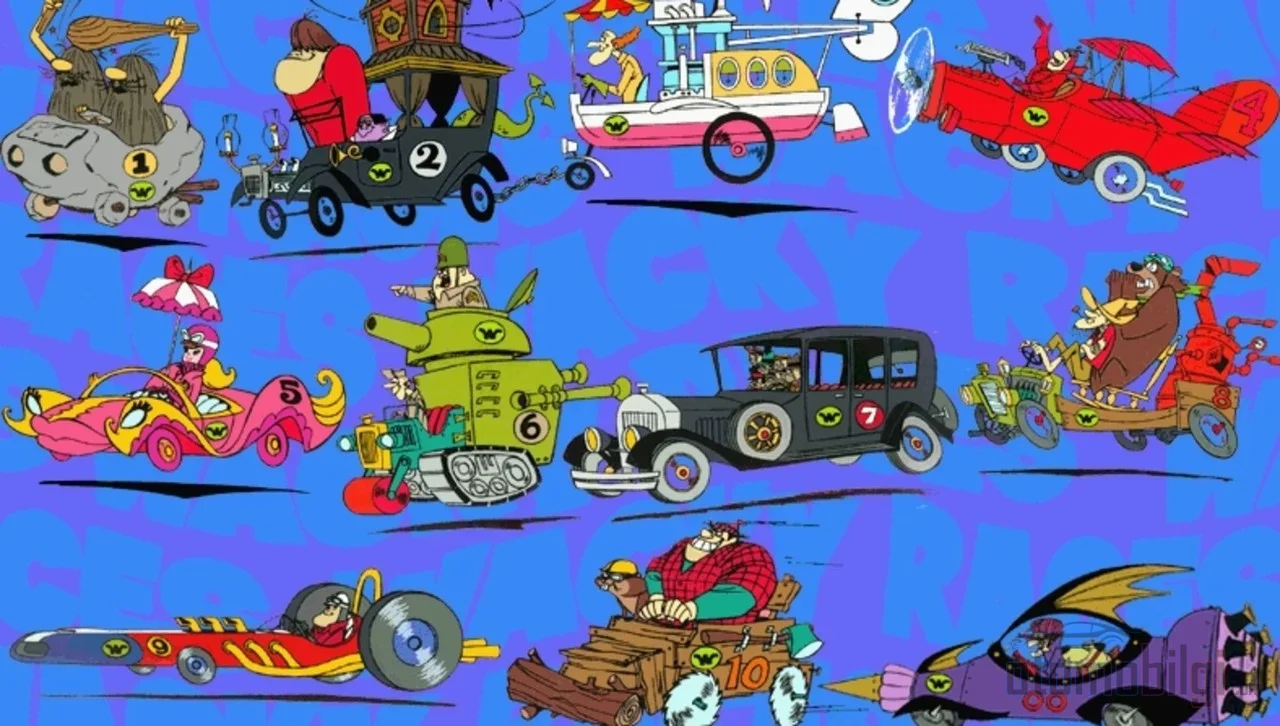
If Cars was the serious cinematic side, Wacky Races (1968) was pure chaos. In this Hanna-Barbera series, 11 different cars clashed in various rallies across North America; each driver had their own quirky vehicle and a personality to match. Deliberately crazy designs lined up, like Professor Pat Pending's convertible Convert-A-Car. And the undisputed star of the series: Dick Dastardly and Muttley's Mean Machine. Know what's ironic? The vehicle fans cite as the fastest car in the series belongs to that scheming pair who always tried to stay in the background.
From Screens to Toy Stores: $10 Billion Characters
Perhaps the biggest impact of animated cars happened not at the box office, but on the shelves. From 2006 to 2011, global retail sales of Cars branded products reached approximately $10 billion; Disney was the world's number one licensor at the time. The trilogy's box office was around $1.4 billion; meaning the series' real profit engine was toys and licensed products. Let's be realistic: don't ask a child why McQueen is so expensive, look at the toy store's cash register.
This commercial power was a direct result of the character design. A car with eyes on the windshield, personality through its suspension, and body language carries that personality when turned into a toy. The same logic carried over to video games as well: released on June 6, 2006, Cars: The Videogame was a multi-platform open-world racing game where the player controlled rookie race car Lightning McQueen, aiming to win the Piston Cup Championship. It was followed by Cars: Mater-National Championship, Cars: Race-O-Rama, Cars 2, Cars 3: Driven to Win and Radiator Springs Adventures . From 2008 onwards came the 7-minute Cars Toons short films, then Cars 2 in 2011, followed by Planes (2013) and Planes: Fire & Rescue (2014); even imitations like Wings , which premiered in Russia on August 9, 2012, were born.
Criticisms and Beyond-the-Boundary Questions: Is This World Realistic?
It's not all sunshine and roses, of course. Animation researcher Nichola Dobson questions the "problem of reality" in these worlds where human interaction is entirely absent; she also views the pedagogical impact of repetitive children's show narratives (such as The Adventures of Chuck and Friends ) with suspicion. In Japan specifically, there is an interesting gap: Cars-like feature-length anthropomorphic vehicle anime are almost nonexistent; only secondary examples exist, such as the AI-powered Tiger tank "Mi-kun" in Mao-chan.
There is also an ongoing aesthetic debate: the modern CGI "Thomas the Tank Engine" being found "creepy" compared to the original stop-motion series narrated by Ringo Starr keeps the tension in anthropomorphism's transition to CG alive. Meanwhile, a history note for the curious: the similarity between Disney's Susie and Isaac Asimov's "Sally" story about sentient cars is also debated; whether it was inspired or not is unknown.
What do you think - is it more natural for eyes to be on the headlights or on the windshield? In my opinion, next time you drive a car, look in the mirror and ask yourself: if my car were a character, what would it say?
Sources
- Planes, Trains, and... "Cars"?
- Anthropomorphized Vehicles in Children's Animation
- Pixar Chief John Lasseter on How Pixar's Cars Move
- Designing Cars: How Pixar Turns Automotive Icons into Animated Characters
- How 'Cars' Works
- Merchandise Sales Drive Pixar's 'Cars' Franchise
- Wacky Races (1968 TV series)
- Cars (video game)
- The Art of Movement: Animating Anthropomorphic Vehicles