Toyota Camry Hybrid: 900 km Range on 5 Liters of Fuel
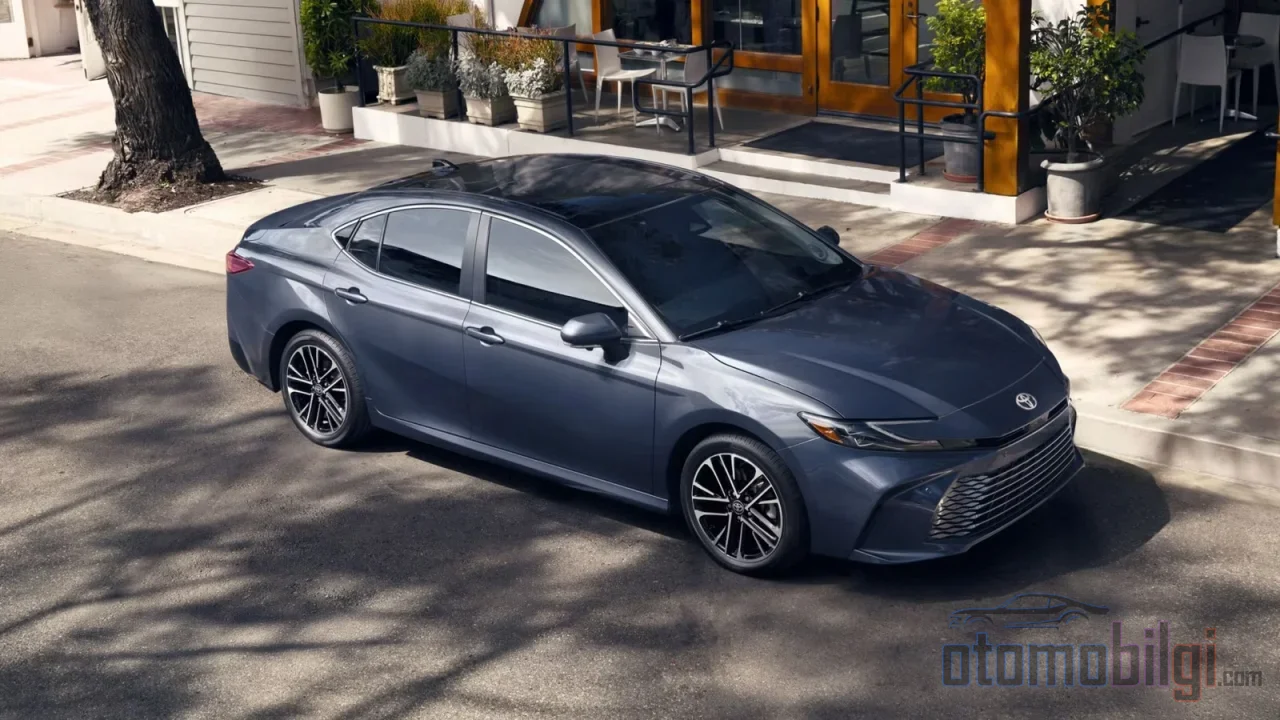
The Toyota Camry, one of the first names that comes to mind when thinking of the large family sedan, has tied its fate entirely to hybrid technology with its ninth generation. Starting from the 2025 model year, Toyota produces the Camry exclusively as a full hybrid; the V6 gasoline version has been discontinued. This means one of the most established names in the segment is now playing a different game: efficiency, not power; quietness, not showiness. But does the harmony between the 2.5-liter naturally aspirated engine and the electric motors really set this sedan apart from its rivals?
On this page, we examine the Toyota Camry Hybrid's city and long-distance consumption character, the operating logic of the eCVT transmission, interior and trunk practicality, equipment level, and its position against rivals, supported by technical data. We do not include the current price list; the focus of this page is the car's engineering identity.
The Toyota Camry Hybrid's Full Hybrid System: 2.5 Liters and the Harmony of Electric Motors
At the heart of the powertrain is a 2.5-liter, four-cylinder, DOHC 16-valve, naturally aspirated gasoline engine from the Dynamic Force family, operating on the Atkinson cycle. On its own, this engine produces 184 hp and 221 Nm of torque at 3,200 rpm. In the front-wheel-drive version, two electric motors accompany it: the main drive motor delivers 134 hp and approximately 207 Nm of torque. The result is a combined output of 225 hp distributed across the system.
In the all-wheel-drive version, a third electric motor drives the rear axle; this unit produces 40 hp and approximately 84 Nm of torque, raising the combined output to 232 hp. The energy store is a lithium-ion battery pack with a 0.6 kWh capacity. Listing the numbers one by one is not enough; the real question is how these two worlds are blended. This is where Toyota's Hybrid Synergy Drive architecture, developed since 1997, comes into play.
How Does the eCVT Work, and Why Is It Different?
The eCVT, which serves as the Camry Hybrid's transmission, is a mechanically completely different structure from conventional CVTs that use belts and pulleys. Instead of a gearbox, the system uses a planetary gear set and two electric machines (MG1 and MG2) integrated into this set. The computer can completely decouple the gasoline engine from the powertrain and drive the car using only the electric motor, or it can blend the torque of the two power sources seamlessly.
The practical result is this: the vehicle can move on electricity alone at low speeds, recovers energy to the battery through regenerative braking at the moment of braking, and keeps the gasoline engine's revs on the efficiency curve according to road conditions. Since it is not a plug-in, there is no charging setup that connects to the grid; the battery is entirely self-sustaining. This simplicity also means there is no obligation to change your usage habits.
Highlights
- 2.5-liter gasoline engine + electric motors: combined output of 225 hp (FWD) / 232 hp (AWD)
- Consumption: factory data of 5.0-5.5 L/100 km, with a range of 900 km on a single tank
- Quietness: 29 dBA at idle, 67 dBA at 70 mph cruising
- 0-100 km/h: approximately 6.8 seconds (AWD test)
- Trunk: 428 liters, capacity of 7 cabin suitcases
City and Highway Consumption Character: Is Around 5 Liters Real?
To summarize the Camry Hybrid's character: the city is its natural habitat. The electric motor's push at low speeds keeps the gasoline engine's engagement to a minimum in stop-and-go traffic. Factory figures show combined consumption of 5.0 L/100 km for the front-wheel-drive version and 5.1-5.5 L/100 km for the all-wheel-drive versions. Real-world measurements support this picture: real city tests measured 21.7 km per liter; for the Indian market, an official value of 25.49 km/l is announced.
The interesting part is the highway side. In many hybrids, highway consumption rises noticeably above city consumption; in the Camry, this gap is narrow. In mixed use of roughly 60 percent highway and 40 percent city, a realistic combined figure falls in the 5.0-5.2 L/100 km band. In real-world tests at a constant 120 km/s on the highway, the 19-inch wheel version measured 43 mpg (about 5.5 L/100 km), and the 18-inch wheel version 39 mpg (about 6.0 L/100 km). Wheel size and friction create a measurable consumption difference in this segment. A 900 km range on a single tank is a tangible convenience for long-distance families.
Quiet Efficiency: Measured Decibel Values
The quietness claim in the page title is not decoration; it is measurable data. Cabin noise level at idle is 29 dBA; that is a value close to library silence. At a steady 70 mph (about 113 km/h), 67 dBA is measured. The combination of acoustic laminated glass (on higher trims) and the electric motor's quiet push at low speeds is one of the core elements that carry the Camry toward its comfort-focused sedan identity. To be honest, at heavy throttle the gasoline engine's sound is roughly audible; the eCVT's rev-holding character sometimes makes this more pronounced.
Technical Specifications: Toyota Camry Hybrid Table
| Specification | Value |
|---|---|
| Gasoline engine | 2.5 L DOHC 16-valve Atkinson I4, 184 hp / 221 Nm |
| Electric motor (front) | 134 hp / ~207 Nm |
| Rear electric motor (AWD) | 40 hp / ~84 Nm |
| Combined power | 225 hp (FWD) / 232 hp (AWD) |
| System torque | 221 Nm |
| Transmission | eCVT |
| Battery | 0.6 kWh lithium-ion |
| 0-100 km/h | Approximately 6.8 s (AWD) / 7.0 s (FWD) |
| Top speed | ~185 km/h (electronically limited) |
| Combined consumption | 5.0-5.5 L/100 km |
A brief note on the acceleration figure: factory figures may not fully reflect real performance; in independent tests, the all-wheel-drive version completed 0-100 km/h in 6.8 seconds, and the quarter-mile trap speed was measured at 149.8 km/h. For a family sedan with 225-232 hp, this is the spirited part of driving.
Interior and Trunk Practicality: The Camry as a Family Sedan
Dimensions are solid by class standards: 4,915 mm length, 1,840 mm width, 1,445 mm height, and 2,825 mm wheelbase. Trunk volume is 428 liters; in a real-world test it fit 7 cabin suitcases, and this number rises to 19 when the rear seats are folded. In this generation, the hybrid battery does not noticeably eat into trunk space.
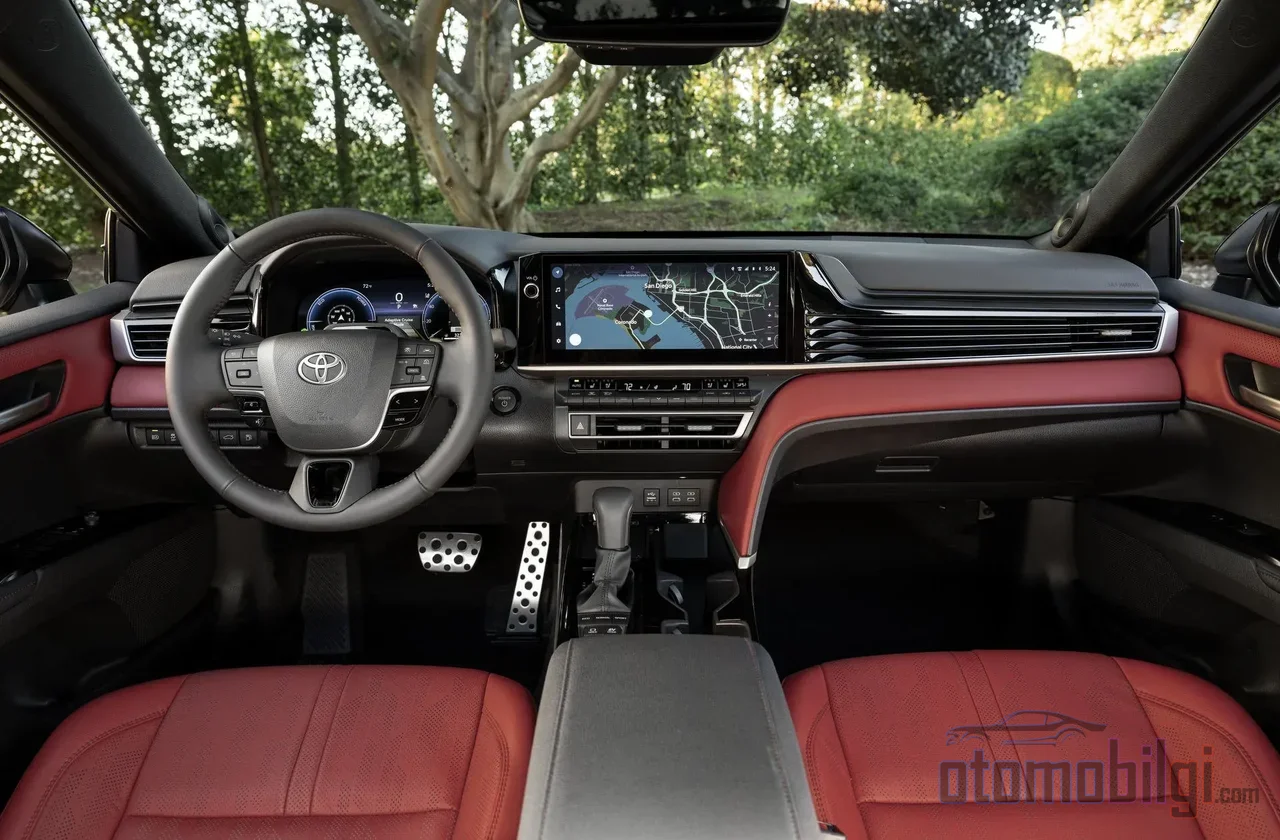
Inside, dual-zone automatic climate control and rear air vents are standard; top trims add leather upholstery, heated seats, a heated steering wheel, ambient lighting, and ventilated front seats. In the rear row, hip and shoulder width are sufficient, but headroom may feel tight for tall passengers. Compared with its rivals, the Honda Accord offers about 5 cm more rear knee room; in return, the two cars are nearly equal in trunk suitcase capacity.
Equipment and Technology: From the Screen to Safety
Standard equipment includes an 8-inch Toyota Audio Multimedia touchscreen, wireless Apple CarPlay and Android Auto, a 7-inch digital instrument cluster, and five USB ports. Top trims offer a 12.3-inch fully digital instrument cluster, an optional 12.3-inch central screen, a JBL sound system with 9 speakers, a head-up display, and a 360-degree camera system.
On the safety side, the standard package is packed: emergency braking with pedestrian and cyclist detection, Adaptive Cruise Control (ACC), lane tracing and lane keeping assist, and automatic high beam. Optionally, front cross-traffic alert and lane change assist can be added. Winning the IIHS Top Safety Pick+ award for the 2025 model year is the independent-test payoff of this package. Trim levels are offered in five grades: LE, SE, Nightshade Edition, XLE, and XSE, with the hybrid system standard on all of them.
Where It Stands Apart from Its Rivals: Facing the Accord and Sonata Hybrid
The segment's other two hybrid players are the Honda Accord Hybrid and the Hyundai Sonata Hybrid. Comparison tests paint a clear picture: At 225 hp, the Camry is more powerful than both rivals and clearly ahead in acceleration. The Camry is 2.6 seconds faster than the Sonata to 100 km/h; while the Accord Hybrid narrowly beats the Camry with 6.7 seconds in the 0-100 km/h sprint, it falls behind in acceleration up to 160 km/h. In a comparison conducted in winter road conditions, the Camry left both rivals clearly behind.
On the consumption front, the picture is more balanced: in some mixed-use tests, the Sonata can outdo the Camry; but in a high-speed highway test, while the Accord stayed at 36 mpg, the Camry stood out with 43 mpg. What sets the Camry apart is delivering power and efficiency at the same time. Its weak link, however, is the interior and the perceived equipment quality: those who buy its rivals seem to choose them for cabin richness, while those who choose the Camry prioritize quality, durability, and cost of ownership. Recurring user feedback about seat comfort also stands out; a point not emphasized this much in professional tests.
Reliability and Ownership Experience
Toyota's confidence in its hybrid system is concretized in the warranty terms: a 10-year / 150,000-mile warranty is offered for hybrid components. There is also a 3-year / 36,000-mile basic limited warranty, a 5-year / 60,000-mile powertrain warranty, and a 2-year free maintenance package. According to independent reliability surveys, the 2025 Camry Hybrid is found to be more reliable than most vehicles evaluated in the same model year.
On the longevity side, the Camry's track record is solid: well-maintained examples are known to cover 250,000-300,000 miles, roughly 400,000-480,000 km. As for the hybrid battery, the concern that was understandable 20 years ago has largely become history today; battery degradation can usually come into play after 100,000 miles. In owner reviews, satisfied feedback about long night drives and journeys exceeding 7 hours stands out. The view that its 2.5-liter A25A engine is reliable and easy to maintain is the prevailing opinion in owner discussions.
Conclusion: Who Is the Camry Hybrid the Right Choice For?
The short and clear answer: The Toyota Camry Hybrid is a full hybrid sedan that combines low city consumption with quiet and spirited highway cruising, appeals to large families with its 428-liter trunk and comprehensive safety equipment, and leaves its rivals behind with its power. For those who don't want to deal with electric charging infrastructure but want to enjoy efficiency, the plug-free hybrid architecture is a decisive advantage in terms of ease of use.
It is not for those seeking a sports sedan; the lack of steering feel and unexciting driving character are the result of a deliberate choice. But if what is expected from a family sedan is quietness, range, durability, and low operating costs, the Camry continues to be one of the segment's reference points in its ninth generation as well. By continuing to produce this car as a hybrid only, Toyota has in fact made its message clear: the future of the large sedan lies in quiet efficiency.
Sources
- 2027 Toyota Camry Review, Pricing, and Specs
- 2026 Toyota Camry Hybrid: Price and Technical Specifications
- The New Elegant Camry Hybrid
- Camry vs. Accord vs. Sonata: Mid-Size Hybrid Sedans
- 2027 Toyota Camry Prices, Reviews, and Pictures
- 2026 Toyota Camry Interior & Technology
- 2025 Toyota Camry Hybrid Reliability
- 2027 Toyota Camry - KBB