What Do Car Numbers Mean in NASCAR?
Imagine a place where 40 cars roar into the corners on the track: from the grandstands they all look alike, and the speed is so high that there's no time to read what's written on them. So how do fans know which car belongs to whom? The answer is hidden in a single character: the number. But when you ask who that number belongs to in NASCAR, things get interesting, because the answer is not "the driver," as most people assume.
Who Do the Car Numbers in NASCAR Belong To?
The biggest misconception in people's heads starts here. In Formula 1, the number follows the driver; wherever the driver transfers, they take their number with them (or whoever wins the championship takes the 1). In NASCAR, the system works completely the other way around: the numbers belong not to the driver, but to the team. Let's even go one step further - the real owner of the numbers is not even the teams, but NASCAR itself.
NASCAR grants the numbers to teams only with a usage license. When a team doesn't like its number or disbands, the number returns to NASCAR's pool; the team cannot sell or transfer it to another crew. So the number is just like a rented apartment: you can live in it for years, but the deed isn't yours.
One consequence of this system is this: drivers can build brand empires around their names and numbers, but in NASCAR, it's the teams that build the real empires. When a driver leaves, the number stays with the team - just like a footballer taking not their jersey, but the club's crest. This leads us to a natural question: how do teams get these numbers?
How Do Teams Get Their Numbers?
Teams submit requests to NASCAR for specific numbers, and NASCAR works with the team or sponsor to help find the desired number. So the system is not purely a lottery; there's an element of preference and negotiation. But the final word always belongs to NASCAR, because the pool is theirs.
The numbers do have a practical function, of course: fans, spotters, teams, and race officials distinguish the 40 cars on the track by these numbers. A spotter at the top of the grandstand can't say "that blue car" instead of "43, move inside" into their binoculars - everyone needs to speak the same language. The numbers are also historically consistent; they've been associated with the same teams for years, so in the grandstands you can tell at a glance whose car it is.
How does the charter system connect to the number?
In the Cup Series, 36 of the 40 cars in the field hold a right known as a charter. NASCAR allocated 36 charters to Cup Series teams; each charter gives the corresponding car a guaranteed starting spot in every points race and a share of the prize money. So a charter-holding team survives without the fear of failing to qualify for the week's race. The remaining 4 cars belong to teams without charters, fighting for a spot every week.
The charter has an interesting intersection with number ownership: once during the first five years of the agreement, a team can transfer its charter to another team for one full season. This is the gateway for new teams wanting to exist in the Cup Series. But be careful - charters can be transferred, numbers cannot. They are two separate things.
There is also the matter of scale. NASCAR's rules allow an organization to race with no more than four cars in each of its national series; organizations that had not reached four cars before 2025 are limited to three teams. There are 15 full-time organizations in the Cup Series, and Hendrick Motorsports and Joe Gibbs Racing stand above this cap with four cars each. Hendrick's 5, 9, 24 and 48; and Joe Gibbs Racing's 11, 19, 20 and 54 all live under this four-car umbrella.
Highlights
- The owner of NASCAR car numbers is not the teams, but NASCAR itself; teams only receive permission to use them.
- The number belongs to the team, not the driver; the driver leaves, the number stays.
- NASCAR never retires any number.
- Richard Petty's 43 saw 200 wins and 7 championships.
- Jimmie Johnson will make his 703rd and final Cup start at the 2027 Daytona 500 with the number 48.
Number 43: The King's Seal
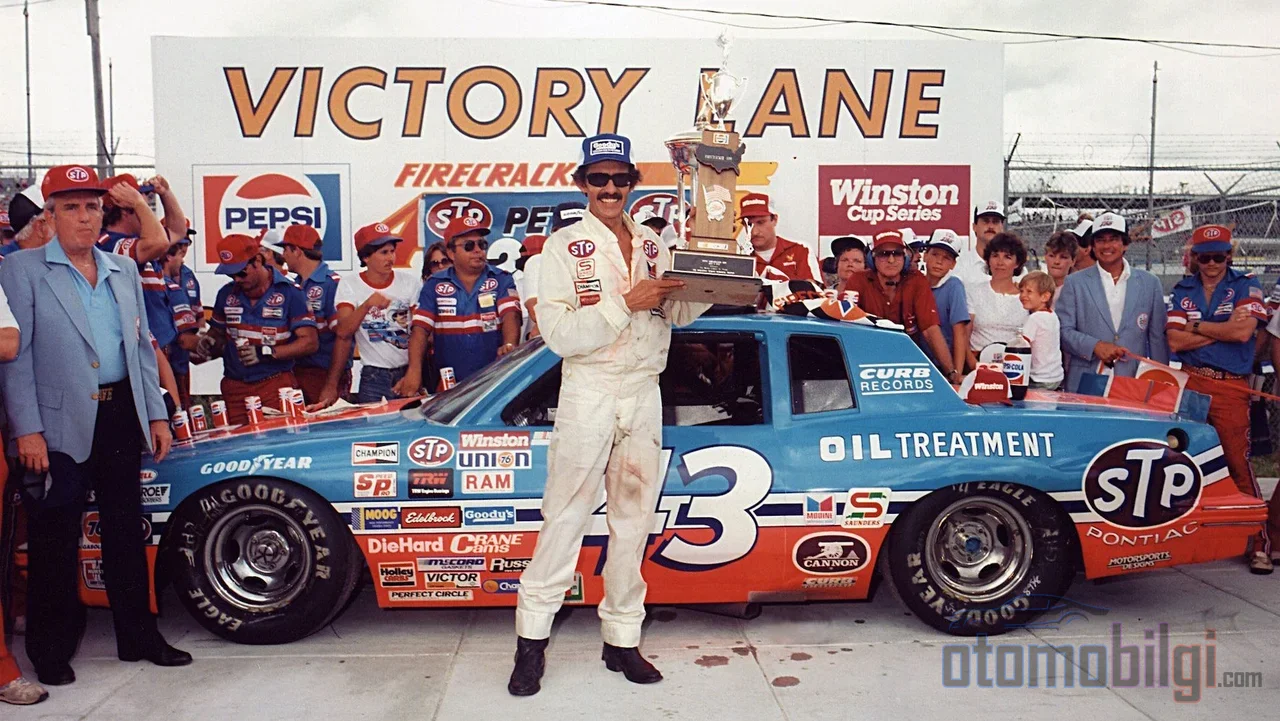
Now let's move to the cultural side, because in NASCAR numbers are not just ID cards; some are practically sacred. At the top of the list is, without a doubt, 43. Richard Petty raced with this number for 33 years, from 1959 to 1992, and set the record in NASCAR history: 200 wins and 7 championships. That is why they call him "The King." And as the first driver to reach seven championships, he etched his name into history.
The feats of the 43 are legendary not only in Petty's name, but also in the number's own record: that number started a total of 2,240 races and produced 200 wins, 122 poles, 580 top-5 and 854 top-10 finishes from those races. Even his first championship was recorded with a special detail: in 1964, following an event at Bristol, the championship was declared as he was stepping out of the 43. The STP-colored Plymouths and Pontiacs, and then that famous STP Dodge Charger... That car became identified with Petty's record-breaking 185th win and turned into a wall poster for a generation.
That is why 43 is not just a number; it became the symbol of the Petty family. The family legacy, of course, does not fit into a single number - with the return of the 44, another chapter of the Petty story opened. But when you see a flag in the grandstands with 43 written on it, you don't need to wonder who it means.
Number 3: The Dark Legacy of The Intimidator
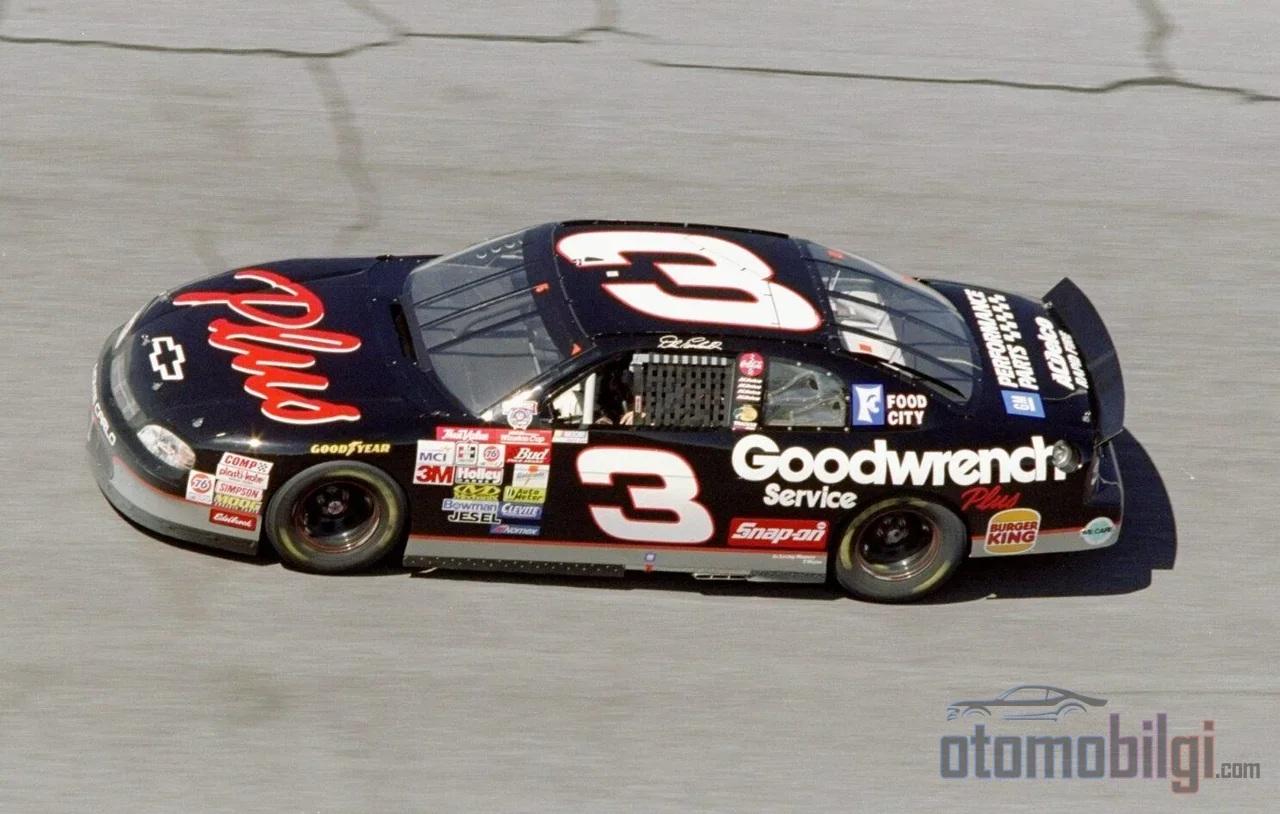
There is an old joke in the South: when children are taught to count, they count one, two, Earnhardt, four, five - no need to say three, because three is already Dale Earnhardt. Even when the joke was written down in 2005, it was not considered an exaggeration, because Earnhardt's black-carred, fearless identity had fused with the number 3 through the nicknames "The Intimidator" and "The Man in Black."
The issue here is actually the very heart of the number-identity debate: did that number define Dale Earnhardt, or did Dale Earnhardt define that number? The answer seems clear - it was the man who elevated the number. And because of that, for a while after Earnhardt's death in 2001, the number 3 seemed to vanish; He was the one who started the trend of driving his car onto the infield grass and spinning around to greet the crowd - the ancestor of the spin celebrations still done today. This is the purest form the respect for a number can reach in a sport's culture.
So who owns the 3 today?
This is exactly where things get complicated. Nowadays Austin Dillon races with the number 3 and is making it part of his own identity. While some fans think the number should never have been used again for a long time, others welcome its return; Dale Earnhardt Jr. is known to view this use positively as well. The 3 is still a number not everyone agrees on - and in my opinion, the fact that a number can spark debate even years later is proof of how special it is.
Meanwhile, a small detail: Earnhardt's post-race celebrations also became legendary. He was the one who started the trend of driving his car onto the infield grass and spinning it around to greet the fans - the ancestor of the spin celebration still performed today.
Number 48: The Story of Seven Championships and a Farewell
Let's look at more recent history: Jimmie Johnson and the number 48 together accumulated seven NASCAR Cup Series championships and 83 race wins. These seven championships match the peaks of Petty's and Earnhardt's numbers - meaning 48 became synonymous with a Hall of Fame career. Johnson actually chose 48 by combining his two previous numbers when entering the Cup Series; a small detail, but it shows that numbers can carry a personal story.
And here is this article's crucial current news: Johnson, the 703rd of his career, at the 2027 Daytona 500. and final Cup Series start at the 2027 Daytona 500 - and he will do it once again with the number 48. Rick Hendrick announced this at Indianapolis Motor Speedway, and Johnson unveiled the No. 48 Toyota for his final race; among the associate sponsors are Carvana and Lowe's. Johnson says this number reminds him of people, relationships and a period of his life, representing a chapter that shaped him. After the 2026 season, in which the 50-year-old seven-time champion legend and 19-year-old rookie Connor Zilisch are on the same team, this farewell tour is like a handshake between generations.
| Number | Legendary Name | Nickname | Notable Legacy |
|---|---|---|---|
| 43 | Richard Petty | The King | 200 wins, 7 championships |
| 3 | Dale Earnhardt | The Intimidator | 7 championships, cult icon |
| 48 | Jimmie Johnson | - | 7 championships, 83 wins |
Why Doesn't Anyone Retire the Number?
In basketball, Jordan's 23, and in hockey, Gretzky's 99 are retired; a number that is no longer used hangs there like a monument. NASCAR deliberately rejects this tradition: no number is retired, and full ownership of every number appearing in the three national series belongs to NASCAR. The logic behind this is hidden in the system itself - since a number already belongs to no one, no one can "close it off" either.
The result is a fun riddle for fans: 43 is always there, but it is not always Petty; Lives under the roof of Hendrick's 48, but tomorrow it could carry someone else. Even NASCAR's own "Driver by Number" feature on the site debates which driver each number is most identified with - is 99 Carl Edwards or Jeff Burton, is 88 Dale Jr. or Dale Jarrett, is 18 Kyle Busch or Bobby Labonte? The debate never ends, because the numbers belong to the team, the memories belong to the fans.
In short: Whose Number Is It, Whose Legend Is It?
Let's gather the clear answer to the question: In NASCAR, the owner of the car numbers is NASCAR itself; teams carry these numbers only with a license to use them, they cannot sell or transfer them, and the number belongs to the team, not the driver. The charter system regulates guaranteed starting rights but does not change number ownership. The driver leaves, the number stays with the team.
But the real story lies beyond the figures. 43 recalls Petty, 3 recalls Earnhardt, 48 recalls Johnson; the flags in the grandstands, the numbers on the hoods, and the chants at the edge of the track turn a rental license into an identity passed down from generation to generation. Legally, the number belongs to NASCAR; emotionally, it now belongs to all of us. Which number do you think is the most iconic? For me, the list is long but the summit is clear - still, I'm always open to debate.
Sources
- NASCAR Cup Series Teams
- How the NASCAR Charter System Works
- Jimmie Johnson to Return to No. 48 for Final Cup Start at 2027 Daytona 500
- How Do NASCAR Car Numbers Work?
- Pick a Number, Any Number: How Numbers Are Assigned in NASCAR
- Why Are Numbers Not Retired in NASCAR?
- NASCAR Teams Pick Car Numbers, Not Drivers
- In NASCAR Numerology, No. 3 Means Earnhardt
- The No. 3 Debate: The Most Famous Digit in NASCAR Returns
- 43 - The NASCAR Historian