Why Did AMC's Amitron Lithium Dream End Early?
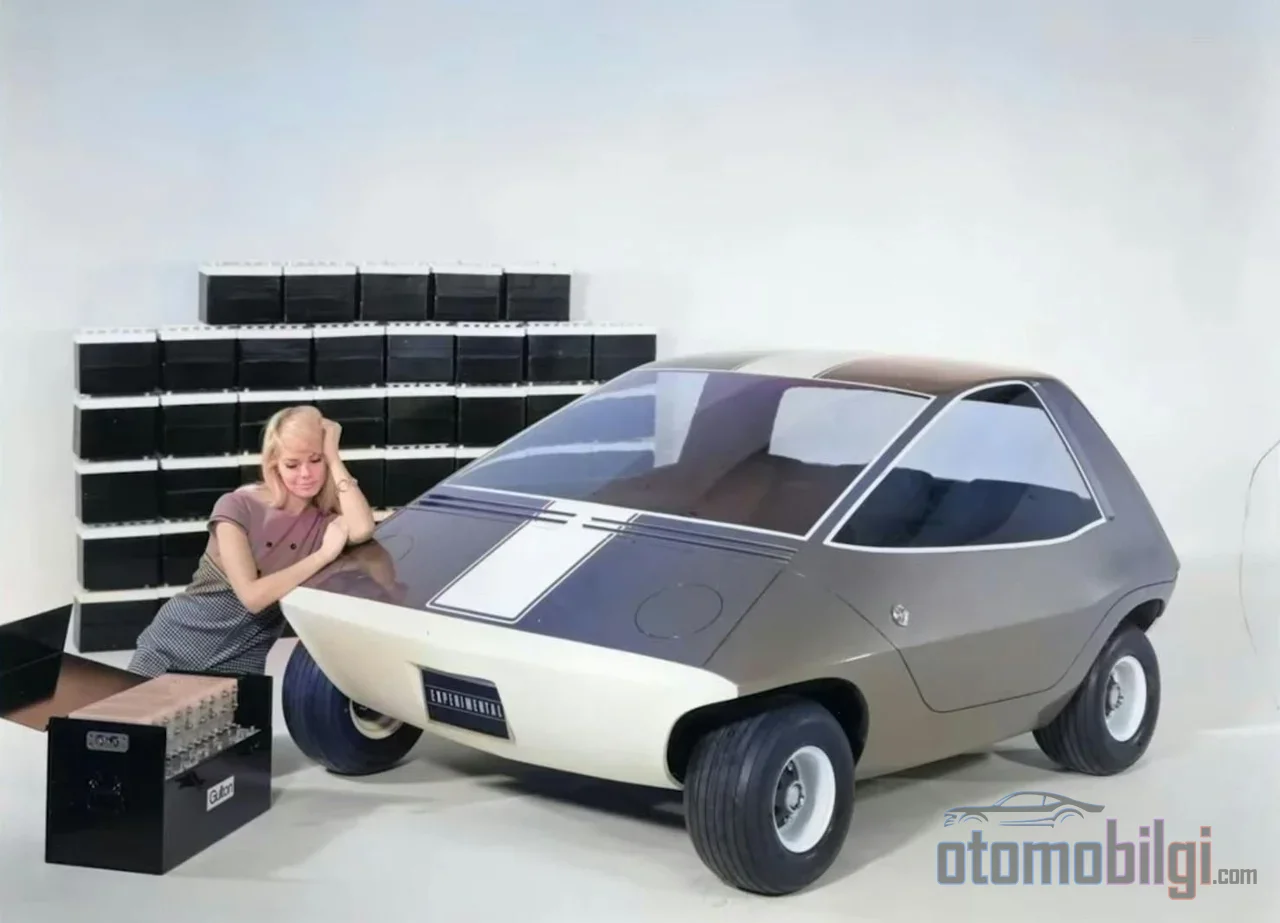
In December 1967, in a Detroit hotel, American Motors Corporation was unveiling a small but extraordinary concept vehicle: the AMC Amitron. In a market dominated by six-meter full-size sedans, this car-at just 85 inches (2,159 mm) long, a full 350 mm shorter than even today's Smart Fortwo-carried something far more radical than its striking design: a lithium-based battery. A full forty years before the Tesla Roadster entered series production with lithium-ion cells, lithium was already on the table. So why did this dream never make it into actual production?
How the Amitron Was Born: Congress, Air Pollution, and the Gulton Partnership
The story of the Amitron begins not within the automotive industry itself, but in Washington. 89. The U.S. Congress had passed three laws providing funding for electric vehicle development, and a fourth law amending the 1963 Clean Air Act completed this framework. The driving force behind the legislation was the degradation of urban air quality caused by automobile emissions. Additionally, electric vehicles were also seen as a way to reduce America's dependence on petroleum imports, which it considered expensive and insecure.
In this environment, American Motors Corporation made an agreement with Gulton Industries in Metuchen, New Jersey. The signed contract covered two technological developments: a new lithium-based battery and a speed controller designed by engineer Victor Wouk. The product of the partnership was the Amitron, an experimental electric subcompact that emerged in 1967 under the supervision of AMC's vice president of design, Dick Teague. The codename of the project Teague was working on within his team was, humorously, "Voltswagon."
Technical Specifications: The Division of Labor Between Two Battery Types
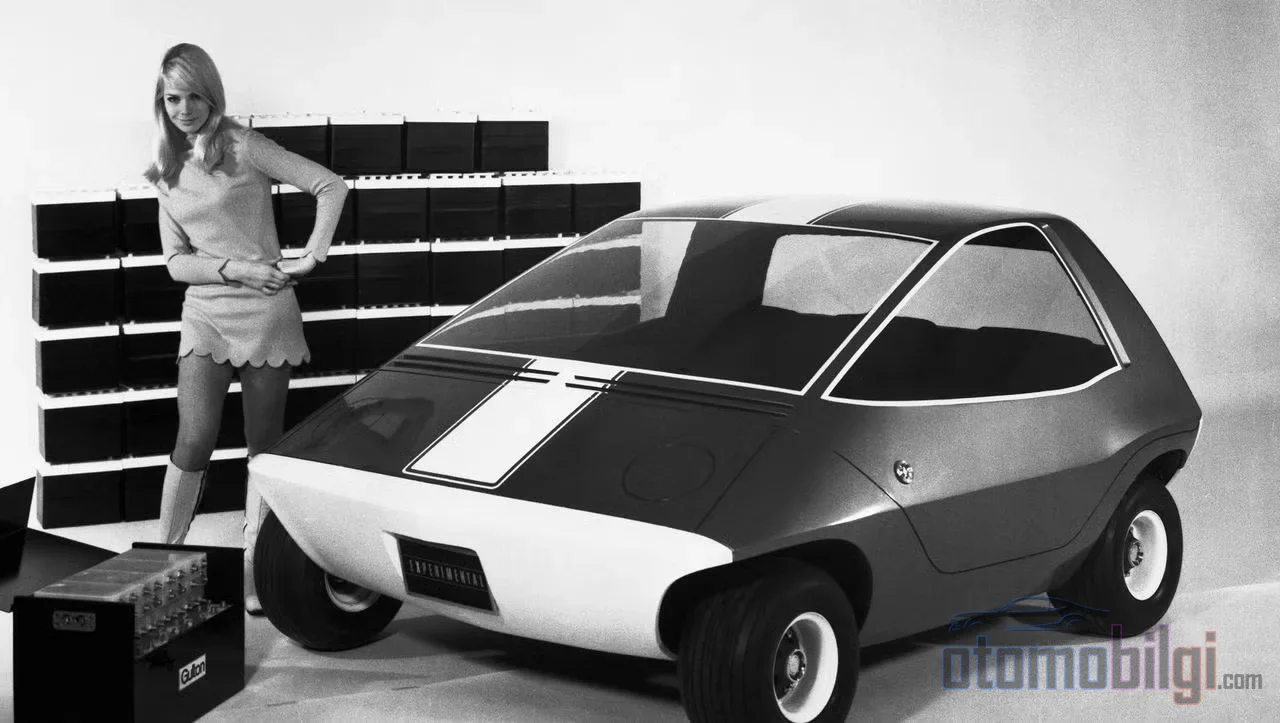
The Amitron's smartest engineering decision was not to rely on a single battery chemistry. The car used two different energy sources with a division of tasks designed to complement each other.
Lithium-Nickel-Fluoride Battery: The Energy Carrier
The primary power source was two 75 lb (34 kg) lithium-nickel-fluoride batteries. The energy density was 150 watt-hours per pound-that is, approximately 331 Wh per kilogram-and the total capacity was 22.5 kWh. The reason lithium was chosen is technically clear: its high reactivity (ease of oxidation) and high electromotive potential. However, the same chemistry had one weakness: low instantaneous power. Lithium cells alone could not meet the demands of reasonable acceleration and rapid recharging from regenerative braking.
Nickel-Cadmium Support: The Instantaneous Power Source
To close this gap, two 24 lb (11 kg) nickel-cadmium (NiCd) batteries were added to the system as a secondary source. The NiCd batteries could take the car from 0 to 50 mph (80 km/h) in 20 seconds; during driving, the lithium batteries recharged these NiCd batteries. In other words, the setup was a kind of hybrid architecture with an internal working mechanism, drawing energy from the lithium and power from the NiCd. The entire system was controlled by a solid-state power management system.
The weight accounting is striking compared to the lead-acid battery electric prototypes of the era: Amitron's entire battery pack weighed only 200 lb (91 kg); equivalent lead-acid cells would have come to about one ton (907 kg). With a curb weight of 1,100 lb (499 kg), the vehicle was targeting a range of 150 miles (241 km) on a single charge at a constant 50 mph.
Highlights
- 1967: AMC and Gulton unveiled the lithium-battery Amitron concept - 40 years before the Tesla Roadster
- 22.5 kWh lithium-nickel-fluoride battery, with a 150-mile (241 km) range target thanks to a NiCd-supported setup
- Entire battery pack weighed only 91 kg; an equivalent lead-acid solution would have been around 907 kg
- The first use of regenerative braking in the American automotive industry
- The project was shelved due to battery cost and technology issues; in 1977 it was turned into the Electron show car, which was not drivable
Regenerative Braking: An Industry First
Perhaps the most enduring technical legacy of the Amitron was its braking system. As the vehicle slowed, the drive motors automatically turned into generators, and the braking energy charged the NiCd batteries. The designers' goal was to preserve the feel of a brake pedal in a conventional car; the driver was not supposed to notice the system. This setup went down in history as the first use of regenerative braking in the American automotive industry. Yet it would take the industry about fifty years to widely adopt this technology, which is standard today in nearly every electric and hybrid vehicle.
The Rambler American Conversion and Road Testing
Although the concept vehicle was unveiled in 1967, the real-world road data came from converted ordinary cars. The first tests were conducted in 1968 with a Rambler American sedan. In 1969, AMC, working again with Gulton and Victor Wouk, converted a Rambler American station wagon with a 290 cu in (4.8 L) V8 engine into a fully electric vehicle using nickel-cadmium batteries. The NiCd cells were carried in the trunk; Wouk did not hold back his praise when describing this car. AMC's goal was clear: to sell the Amitron to suburban commuters and city shoppers within five years. The company's president, Roy D. Chapin Jr., argued in December 1967 that the Amitron could eliminate most of the problems that kept electric cars from being practical.
Electron (1977): The Second Act of the Same Vehicle
A decade later, the Amitron took the stage once again. In 1977, the prototype was updated, side mirrors were added, a fresh coat of paint was applied, and the vehicle was given the name Electron as part of AMC's "Concept 80" series of show cars - alongside the AM Van, Grand Touring, Concept I, Concept II and Jeep II. The presentation emphasized an 85-inch length, 69.5-inch width, 46-inch height, 60-inch wheelbase and a 150-mile (240 km) range target; the vision described was of creating one of the world's most compact four-passenger electric city vehicles with a lightweight lithium battery system.
But beneath the showmanship there was an important detail: The 1977 Electron, was not drivable; it had no powertrain. It was a podium car displayed at a dignified fair. The Amitron, initially a working prototype, had become a hollowed-out visual message a decade later. That regression itself is the most honest summary of where the project had gone.
Why Did It Never Reach Production?
The clear answer to the question can be summed up under three headings: technology, cost, and the economic context.
The Technology Was Not Mature
The lithium-nickel-fluoride chemistry was a laboratory success at 1967's scale; it was not a production-line reality. Even the fact that the cells needed NiCd support due to their instantaneous power limits showed how delicate a balance the system was. Competing manufacturers were openly skeptical, predicting that a practical battery could only arrive within a decade. On the AMC front, supporters argued they saw no major obstacle in the technology, that it was merely a matter of time. It would turn out that both sides were right: the obstacle was not conceptual, but the timeline was very long.
Battery Cost Weighed Heaviest
Development ended due to technological problems and the high cost of electric batteries. The expensive batteries forced AMC to halt its advanced electric vehicle experiments for several years. The company was a small manufacturer, and in the arithmetic of 1968 it was impossible to build a business model that could sell to suburban customers at a price that included the battery cost.
The Economic Superiority of Gasoline
The decisive context was market conditions. The period between 1968 and 1973 was shaped by cheap and abundant gasoline and the continuous improvement of the internal combustion engine. Viewed through a historian's eye, this picture is familiar: by 1912, a gasoline car cost 650 dollars while an electric roadster cost 1,750 dollars; gasoline had won the battle of technology and economics before World War II. In the 1960s, that equation had not changed at all. It would take the price shocks and gasoline shortages triggered by the 1973 Arab Oil Embargo to revive interest in electric vehicles - by which time the Amitron had long been shelved and clean transportation research programs had come to a standstill. Nor was the new technology expected to become popular until the late 1970s.
Where the Amitron Stands: An Idea Seen Forty Years Too Early
Assessments fall into two camps. On one side is the view that the Amitron was one of the most promising electrics of the sixties, possessing everything still required of a successful electric vehicle, such as reasonable range, low weight, and an attractive appearance; on the other side is the judgment that the car failed because it was far ahead of its time. The two do not contradict each other: it is precisely that the right idea appeared in the wrong decade. The first highway-legal series-production all-electric car with lithium-ion cells, the Tesla Roadster, only arrived in 2008; filling the gap in between required forty years of maturation in cell chemistry, power electronics, and cost curves.
The design legacy is also undeniable: The Amitron's short-wide layout influenced the AMC Pacer, and its chopped rear end influenced the AMC Gremlin. It has even been argued that its polygonal lines anticipated the look of the Tesla Cybertruck, introduced fifty years later in 2019. As for real-world application, AMC never entirely abandoned electric development: Starting in 1974, the electric Jeep DJ-5E Electruck delivery vehicle, produced in series in partnership with Gould, hit the road.
Prototype Found in a Barn Forty Years Later
The final act of the story reads almost like fiction. In January 2025, one of the original Amitron concept vehicles was found in a barn in Michigan. The owner's grandfather was an AMC executive, and he had taken the car and preserved it rather than letting it be scrapped; alongside it were the car's original pre-production model, photographs, and documents. The car's last public display had been in 1977 - that is, the show where it appeared as the Electron. Now being prepared to be seen again fifty years later, the vehicle stands waiting as the most tangible proof of an idea born forty years too early.
The lesson of the Amitron's short life is clear from an engineering standpoint: Battery chemistry determines a vehicle's fate, and the right chemistry meeting the right cost point takes far longer than a brilliant prototype. AMC and Gulton chose the right element in 1967; the market and technology would vindicate them only in the 2000s.
Sources
- AMC Amitron - Wikipedia
- Concept Car of the Week: AMC Amitron (1967) - Car Design News
- AMC Concept Electric Car From 1967 Discovered In A Barn - Yahoo Autos
- Remembering the AMC Amitron - autoevolution
- 1967 AMC Amitron Specs - Automobile Catalog
- Missing AMC electric concept car from 1967 - SuperCarBlondie